
Hollywood readers spend an average of 15 minutes on a script before making a coverage decision. That's not much runway. Most screenplays fail not because the writer lacks talent, but because the foundational elements are shaky: weak structure, unclear character arcs, or pacing that loses momentum before page 30. Mastering the craft means understanding both the mechanical framework that professional readers expect and the creative nuance that makes a script memorable. This guide walks you through every essential element, from act breakdowns to formatting benchmarks, so you can approach your next draft with clarity and confidence.
Table of Contents
- Understand screenplay structure: The backbone of a great script
- Essential elements of every successful screenplay
- Comparing screenplay methodologies: Save the Cat vs. Hero's Journey
- Page count, pacing, and formatting: Industry benchmarks for script success
- A professional perspective: Why human texture still matters
- Take your screenplay from good to great with professional feedback
- Frequently asked questions
Key Takeaways
| Point | Details |
|---|---|
| Master structure | A strong three-act framework and precise beats set professional screenplays apart. |
| Balance mechanics and voice | Great scripts blend impeccable formatting with unique character and thematic depth. |
| Choose the right model | Select Save the Cat or Hero’s Journey based on your story’s needs, not just trends. |
| Meet industry standards | Ideal page count, pacing, and clean presentation are crucial for Hollywood readers. |
| Get expert feedback | Affordable, professional notes help you refine structure and boost your odds of success. |
Understand screenplay structure: The backbone of a great script
Every successful screenplay rests on a clear structural foundation. Without it, even the most original concept falls apart under the weight of confused pacing and unearned emotional beats. Structure is not a creative constraint. It's the invisible architecture that keeps your story moving forward with purpose.
The three-act structure remains the universal backbone of Hollywood storytelling. Act One sets up your world, protagonist, and central conflict. Act Two escalates that conflict through obstacles and reversals. Act Three resolves it. Simple in theory, brutally difficult in execution.
Beyond the three-act framework, core structural elements include key turning points that anchor your story at specific page intervals. Here's a quick breakdown of the essential beats:
- Opening Image (page 1): A visual snapshot of your protagonist's world before change.
- Inciting Incident (pages 10-15): The event that disrupts the status quo and launches the story.
- Plot Point 1 (pages 25-30): The moment your protagonist commits to the central conflict.
- Midpoint (page 55-60): A major shift that raises the stakes and reorients the story.
- All Is Lost (pages 75-85): The lowest point. Everything seems hopeless.
- Climax (pages 90-100): The final confrontation where your protagonist faces the core conflict.
- Final Image (last page): A visual echo of the Opening Image, showing how far your character has traveled.
Practical page timing matters more than most writers realize. Median screenplay length is approximately 119 pages, running about 9% longer than actual runtime, which means one page equals roughly 55 seconds of screen time rather than the commonly cited 60. That distinction affects how you pace dialogue-heavy scenes versus action sequences.
For a story structure breakdown that maps these beats visually, it helps to see them plotted against page count. A structure flow guide can also clarify how each beat connects to the next.
"Professional readers flag structural problems within the first 20 pages. If your Inciting Incident hasn't landed by page 15, you're already losing them."
Consejo profesional: Trata tus primeras 10 páginas como un documento aparte. Púlelas sin piedad. Los lectores de Hollywood suelen pararse ahí si el setup está confuso o la voz suena plana.
Essential elements of every successful screenplay
With structure as your script's backbone, here's what every successful screenplay shares at its core.
A study of 12,000+ screenplays analyzed by researcher Stephen Follows identified specific traits that script readers consistently prioritize in coverage evaluations. The findings confirm what experienced writers already know: mechanics and craft are inseparable.
Here are the non-negotiable elements that define a professional-grade screenplay:
- Clear protagonist with a dynamic arc. Your lead character must want something specific, face meaningful obstacles, and change as a result. Static protagonists are the single most common reason scripts receive a "Pass."
- Distinct dialogue voice. Every character should sound different. Readers notice immediately when all characters speak with the same cadence or vocabulary. Subtext matters as much as what's said directly.
- Consistent, industry-standard formatting. Courier 12pt, standard margins, correct scene heading style. A formatting guide can save you from basic errors that signal an amateur submission.
- Cinematic pacing and vivid scene writing. Write what the camera sees. Action lines should be lean, visual, and immediate. Avoid directing from the page.
- Strong theme and subtext. What is your script actually about beneath the plot? Readers respond to scripts with a clear thematic spine, even if they can't articulate it immediately.
- Balanced mechanics and nuance. A technically clean script that feels lifeless will still get passed on. The script format impact on professional reception is real, but it works in combination with authentic storytelling.
For deeper analysis techniques that help you evaluate your own work before submitting, self-assessment tools can cut revision time significantly.
Consejo profesional: Usa Save the Cat o el Hero's Journey como herramienta diagnóstica sobre tu borrador ya terminado, no como plantilla mientras escribes. Forzar la estructura en un script todavía en progreso suele revelar exactamente dónde tu historia pierde impulso.
Comparing screenplay methodologies: Save the Cat vs. Hero's Journey
Knowing the core elements, it's crucial to choose a structuring method that fits your story.
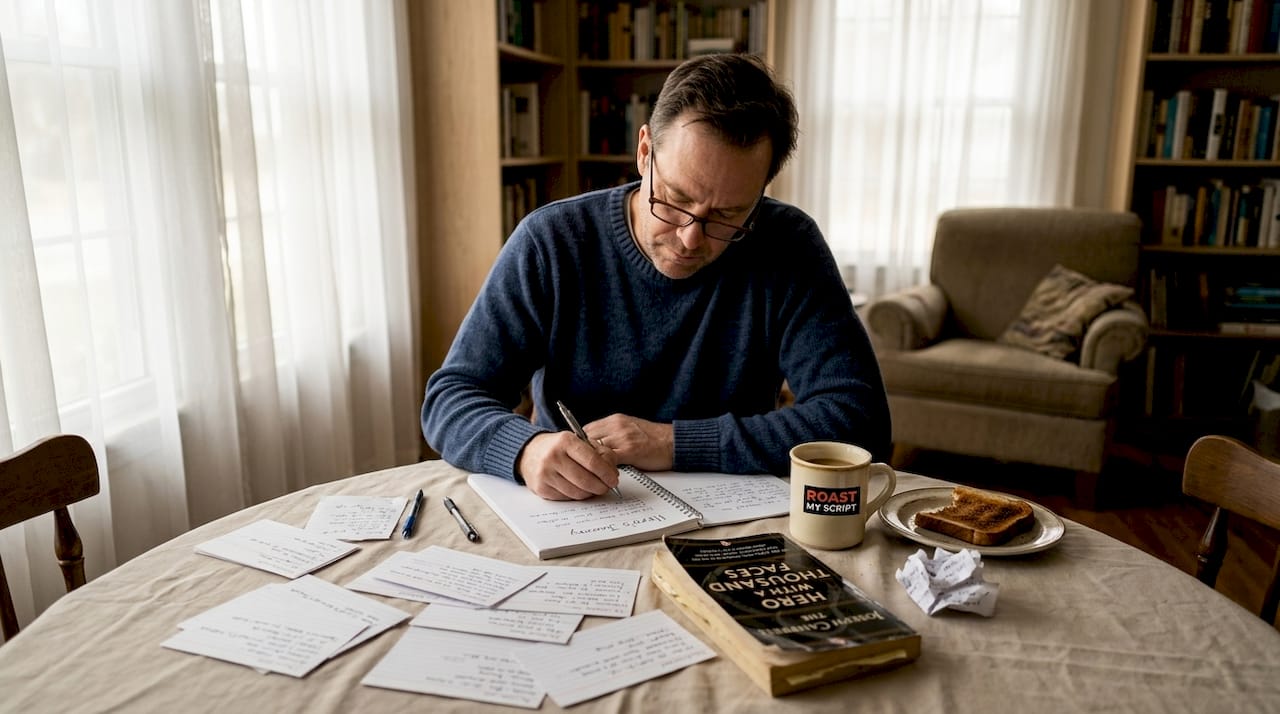
Blake Snyder's Save the Cat and Joseph Campbell's Hero's Journey represent the two most widely used structural frameworks in Hollywood today. They overlap in philosophy but differ significantly in application.
Save the Cat uses a precise 15-beat sheet with specific page targets. It's prescriptive by design, which makes it especially useful for commercial genres like action, thriller, and romantic comedy. The beats are concrete and measurable.
Hero's Journey draws from Joseph Campbell's mythic structure, emphasizing transformation through archetypal stages: the Call to Adventure, Crossing the Threshold, Ordeal, and Return. It's more flexible and suits epic, character-driven, or fantasy narratives.
| Element | Save the Cat | Hero's Journey |
|---|---|---|
| Origin | Blake Snyder (2005) | Joseph Campbell (1949) |
| Beat count | 15 specific beats | 12 archetypal stages |
| Page precision | Yes, with targets | No fixed page counts |
| Best for | Commercial genres | Mythic, epic, character-driven |
| Flexibility | Low to moderate | High |
| Industry adoption | Widely used in Hollywood | Common in development circles |
For a Save the Cat guide that breaks down each beat with examples, the page benchmarks alone can help you identify where your script is running long or thin.
Choosing between them depends on your story's genre and goals:
- Use Save the Cat when you need tight commercial pacing and clear market positioning.
- Use Hero's Journey when your story has a mythic or transformational core that resists rigid page targets.
- Use both as lenses when revising, since they often highlight different weaknesses in the same script.
Understanding screenplay genres also shapes which methodology serves you best, since genre conventions carry their own structural expectations.
Recuento de páginas, ritmo y formato: puntos de referencia de la industria para el éxito de un guion
Una vez que eliges una metodología, entender cómo presentar y dosificar tu guion para los lectores es crucial.
Los estándares de formato de la industria no son arbitrarios. Fuente Courier 12 pt, márgenes de 1 pulgada arriba, derecha e inferior, y un margen izquierdo de 1,5 pulgadas existen para que el recuento de páginas se correlacione aproximadamente con la duración. Alejarse de esos estándares señala inexperiencia antes de que un lector haya procesado una sola línea de tu historia.
Solo el 18% de los guiones cumplen exactamente la regla 1:1 página-por-minuto, y las comedias consistentemente son las más largas por género. Así se desglosan los puntos de referencia de páginas por género:
| Género | Rango típico de páginas | Notas |
|---|---|---|
| Drama | 100-120 páginas | Enfocado en diálogos; el ritmo varía |
| Acción/Thriller | 95-115 páginas | Líneas de acción escuetas mantienen el conteo bajo |
| Comedia | 90-110 páginas | A menudo dura más de lo esperado |
| Terror | 85-100 páginas | Se espera un ritmo ajustado |
| Ciencia ficción/Fantasía | 110-130 páginas | La construcción de mundo añade páginas |
Errores comunes de ritmo que delatan un guion amateur incluyen:
- Bloques de acción sobreescritos que frenan el impulso visual.
- Escenas de diálogo que duran tres o más páginas sin un giro de beat.
- Un midpoint que llega demasiado tarde, empujando la resolución del segundo acto más allá de la página 70.
- Un clímax que se resuelve demasiado rápido tras una construcción lenta.
Un formato consistente y un flujo amigable para el lector mejoran directamente la calidad del feedback profesional que recibes, porque los lectores pueden centrarse en la historia en lugar de descifrar el layout. El impacto del formato del guion en las coverage scores es medible, y una guía sólida de formato elimina las conjeturas de la ecuación.
"Las primeras 10 páginas son decisivas. Si tu formato es inconsistente o tu escena de apertura está sobreescrita, la confianza del lector en tu guion cae de inmediato."
Una perspectiva profesional: por qué la textura humana sigue importando
Después del dominio técnico, veamos el sutil arte de mezclar la estructura con tu huella creativa única.
Algo que la mayoría de los libros de oficio no te dirán directamente: un guion limpio y estructuralmente correcto pasará la coverage inicial. Pero no será elegido para opción ni producción. Los guiones que avanzan tienen algo más difícil de definir: una voz, un ritmo, un peso emocional que persiste después de la última página.
The difference between a clean script and a human film se reduce a la textura intencional. Piensa en la repetición en The Wolf of Wall Street, o en la acumulación de pequeños momentos en Moonlight. Ninguno de los dos guiones obtendría una puntuación perfecta en un diagnóstico de beat sheet. Ambos son inolvidables.
Formatea tu guion para coverage. Cumple los puntos de referencia. Pero no lijes cada arista en busca de la perfección mecánica. Los lectores responden a guiones que se sienten vividos y específicos. La meta es un guion que pase el filtro estructural y luego sorprenda al lector con algo genuino.
Unos buenos consejos de coverage para guiones te ayudan a encontrar ese equilibrio, identificando dónde la estructura necesita reparación genuina frente a dónde tus instintos realmente funcionan.
Lleva tu screenplay de bueno a excelente con feedback profesional
Habiendo aprendido lo esencial y la filosofía creativa, aquí tienes una forma práctica de elevar tu guion para Hollywood.
Conocer los elementos es una cosa. Ver exactamente dónde tu guion queda corto respecto a ellos es otra. Las notas profesionales revelan dónde los beats estructurales fallan, dónde los arcos de personaje se estancan y dónde el ritmo pierde al lector antes del midpoint.
En ROAST MY SCRIPT, la coverage asistida por IA basada en metodología de Hollywood te da ese filtro brutal inicial antes de que inviertas en caros script doctors o en inscripciones a festivales. Desde $9 obtienes un análisis estructural detallado en 1-2 días por email. Domina conceptos esenciales de escritura de guion con nuestros recursos educativos, o envía tu guion directamente para retroalimentación asequible para guiones que cumple los estándares de la industria sin el alto costo de la coverage tradicional.
Preguntas frecuentes
¿Cuáles son los momentos clave en un screenplay?
Los momentos clave incluyen la Imagen de Apertura, el Incidente Incitador, el Punto de Giro 1, el Midpoint, el momento "Todo está perdido", el Clímax y la Imagen Final. Estos puntos de giro anclan la estructura de tu historia y le dan a los lectores profesionales marcadores claros para evaluar el ritmo y el impulso de tu guion.
¿Cuánto debe durar un screenplay de largometraje?
Un screenplay típico corre entre 110 y 120 páginas, con la mediana situada en 119 páginas según datos empíricos. El género afecta este rango: el terror suele ser más corto y la ciencia ficción o fantasía suelen ser más largos.
¿Es mejor usar Save the Cat o el Viaje del héroe?
Depende del género y los objetivos de tu historia. Save the Cat y el Viaje del héroe responden a necesidades narrativas distintas: elige Save the Cat para un ritmo comercial compacto y el Viaje del héroe para un relato mítico o centrado en el personaje.
¿Realmente importa el formato para los lectores?
Absolutamente. Un formato consistente y un flujo claro permiten a los lectores enfocarse en tu historia en lugar de descifrar errores de layout, lo que mejora directamente las coverage scores y la recepción profesional.
Recomendados
- Master Story Structure Breakdown for Screenwriters | ROAST MY SCRIPT
- Script Development Process: Preparing for Hollywood Success | ROAST MY SCRIPT
- Script format impact: 90% boost production & pitch success | ROAST MY SCRIPT
- How to analyze a script for powerful screenplay improvement | ROAST MY SCRIPT