
Tu historia puede ser brillante. El concepto podría ser fresco, los personajes con capas, el diálogo afilado. Pero si tu script llega al escritorio de un lector pareciendo un ensayo de la universidad o una obra de teatro, lo tiran antes de la página cinco. El mal formato señala a un amateur y le da a los guardianes una razón fácil para pasar. El formato de guion de Hollywood no es una formalidad burocrática. Es un idioma profesional, y la fluidez en él es el precio de la entrada. Esta guía te lleva por cada estándar, explica por qué existe cada regla y te da pasos accionables para que tu maquetación trabaje a tu favor, no en tu contra.
Table of Contents
- What is Hollywood script format?
- Why format matters in Hollywood
- Core elements of a properly formatted script
- Feature film vs. TV scripts: key differences
- Common Hollywood script formatting mistakes
- Tips for mastering Hollywood script format
- Get your script professionally reviewed for format and story
- Frequently asked questions
Key Takeaways
| Point | Details |
|---|---|
| Format is non-negotiable | Proper Hollywood script format is essential for getting your script read and considered. |
| Elements drive clarity | Scene headings, action lines, and character cues make scripts readable and producible. |
| Film vs. TV differs | TV scripts have unique structures and page counts compared to feature films. |
| Mistakes hurt your odds | Common formatting errors can result in immediate rejection from readers and producers. |
| Use tools and coverage | Software and professional script analysis can ensure your format meets industry standards. |
What is Hollywood script format?
Antes de poder aplicar las mejores prácticas, necesitas una definición clara. Hollywood script format, también conocido como standard screenplay format, es el formato estándar de la industria para TV y cine. Usa fuente Courier 12pt, márgenes específicos e incluye elementos como encabezados de escena, líneas de acción, nombres de personajes, diálogo, acotaciones y transiciones. Cada estudio importante, compañía de producción y festival usa esto como la base para evaluar envíos.
El estándar existe por razones prácticas. Courier 12pt con los márgenes adecuados produce aproximadamente una página por minuto de tiempo en pantalla. Eso significa que un lector puede estimar la duración de una película de un vistazo. También facilita la planificación y el presupuesto para los equipos de producción. Entender los conceptos esenciales de la escritura de guiones empieza aquí, con el formato como la base.
Aquí tienes una tabla de referencia rápida de los elementos centrales del formato:
| Element | Rule |
|---|---|
| Font | Courier 12pt |
| Left margin | 1.5 pulgadas |
| Right margin | 1 pulgada |
| Top/bottom margins | 1 pulgada |
| Scene heading | ALL CAPS, flush left |
| Character name | ALL CAPS, centered |
| Dialog | Indented, centered block |
| Transitions | Right-aligned, used sparingly |
| Page count (feature) | 90 to 120 pages |
Errores comunes a evitar desde el principio:
- Usar Arial, Times New Roman o cualquier fuente que no sea Courier
- Ignorar las especificaciones de márgenes y dejar el texto pegado al borde
- Escribir encabezados de escena en mayúsculas y minúsculas en lugar de MAYÚSCULAS
- Abusar de transiciones como FADE TO: entre cada escena
- Apretar demasiado la descripción de acción en párrafos densos
Nuestra script formatting guide profundiza en cada uno de estos puntos si quieres un desglose completo.
Why format matters in Hollywood
Habiendo establecido la base del formato, descubre por qué es innegociable para la viabilidad de mercado de tu script.
Los lectores de guiones en agencias, estudios y festivales procesan docenas de envíos por semana. El formato es el primer filtro. Un script mal formateado no solo parece poco profesional. Interrumpe activamente la experiencia de lectura y señala que el escritor no entiende la industria. El formato correcto señala profesionalismo, mejora la legibilidad y el flujo de trabajo de producción; un formato pobre conduce al rechazo inmediato.
Más allá de la percepción, el formato tiene valor real en producción. La regla de una página por un minuto la usan los productores de línea para estimar días de rodaje y presupuestos. Un guion que rompe esta convención crea confusión luego. Entender el impacto del formato en el éxito del pitch significa reconocer que tu maquetación es parte de tu pitch.
"A script that looks wrong before the first line of dialog is read has already failed its first test."
Consejo profesional: Después de terminar tu borrador, imprime una página y compárala con un guion producido lado a lado. Si la densidad visual o el espaciado se ven diferentes, algo está mal. Las herramientas de IA para la escritura de guiones también pueden marcar automáticamente inconsistencias de formato.
Resultados tangibles de un formato correcto:
- Los lectores terminan tu script en lugar de abandonarlo temprano
- Los reportes de coverage se enfocan en la historia en lugar de quejarse del formato
- Los productores pueden estimar presupuesto y duración sin trabajo extra
- Las inscripciones a festivales pasan la ronda de cribado inicial
- Tu guion se lee al ritmo que pretendías
Core elements of a properly formatted script
Ahora, analicemos la anatomía de páginas de guion correctamente formateadas con ejemplos reales elemento por elemento.
Los elementos clave incluyen encabezados de escena escritos como INT./EXT. en MAYÚSCULAS, líneas de acción en tiempo presente, nombres de personajes en MAYÚSCULAS y centrados, diálogo sangrado en un bloque centrado, acotaciones usadas con moderación y transiciones como CUT TO: alineadas a la derecha y usadas solo cuando es necesario.
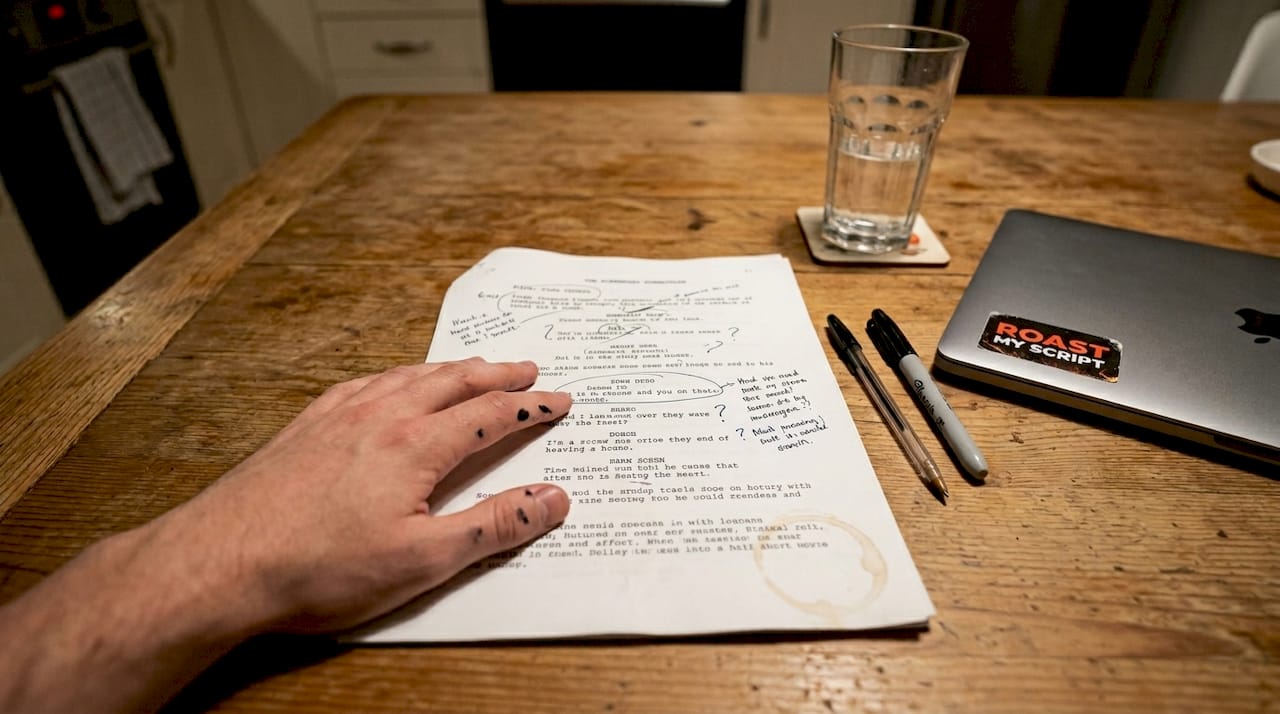
Aquí hay una comparación de uso correcto frente a errores comunes:
| Element | Correct | Common mistake |
|---|---|---|
| Scene heading | INT. COFFEE SHOP - DAY | Int. Coffee Shop - Day |
| Action line | She slams the door. | She had slammed the door. |
| Character name | MARIA | Maria |
| Dialog | Indented, 2.5 to 3.5 inches | Full-width text |
| Parenthetical | (whispering) | (She says this quietly and nervously) |
| Transition | CUT TO: | Cut to: or used every scene |
Pasos para formatear una escena básica correctamente:
- Escribe el encabezado de escena en MAYÚSCULAS: INT. o EXT., ubicación, momento del día
- Salta una línea y escribe la acción en tiempo presente, alineada a la izquierda
- Salta una línea, centra el nombre del personaje en MAYÚSCULAS
- Salta una línea y escribe el diálogo en el bloque sangrado
- Añade una acotación solo si la lectura es genuinamente ambigua
- Usa una transición solo en rupturas estructurales importantes, no entre cada escena
Consejo profesional: Las acotaciones son para dirección que no puede inferirse del propio diálogo. Si la línea se entiende por sí sola, corta la acotación. Abusar de ellas es una de las maneras más rápidas de marcarte como principiante. Revisa guiones producidos para ver con qué economía las usan los profesionales.
Para un vistazo más profundo de cómo la estructura y el formato trabajan juntos, vale la pena leer el story structure breakdown junto a esta guía. También puedes analizar el formato de tu screenplay usando una lista de verificación estructurada para atrapar errores antes de enviar.
Feature film vs. TV scripts: key differences
Once you know the core elements, it is crucial to distinguish how scripts differ by intended medium.
Feature film scripts run 90 to 120 pages, with each page representing roughly one minute of screen time. TV scripts are shorter and structured differently. A one-hour drama typically runs 45 to 60 pages, while a half-hour comedy lands between 22 and 32 pages. Both include act breaks, which are structural markers that correspond to commercial interruptions or streaming episode pacing.
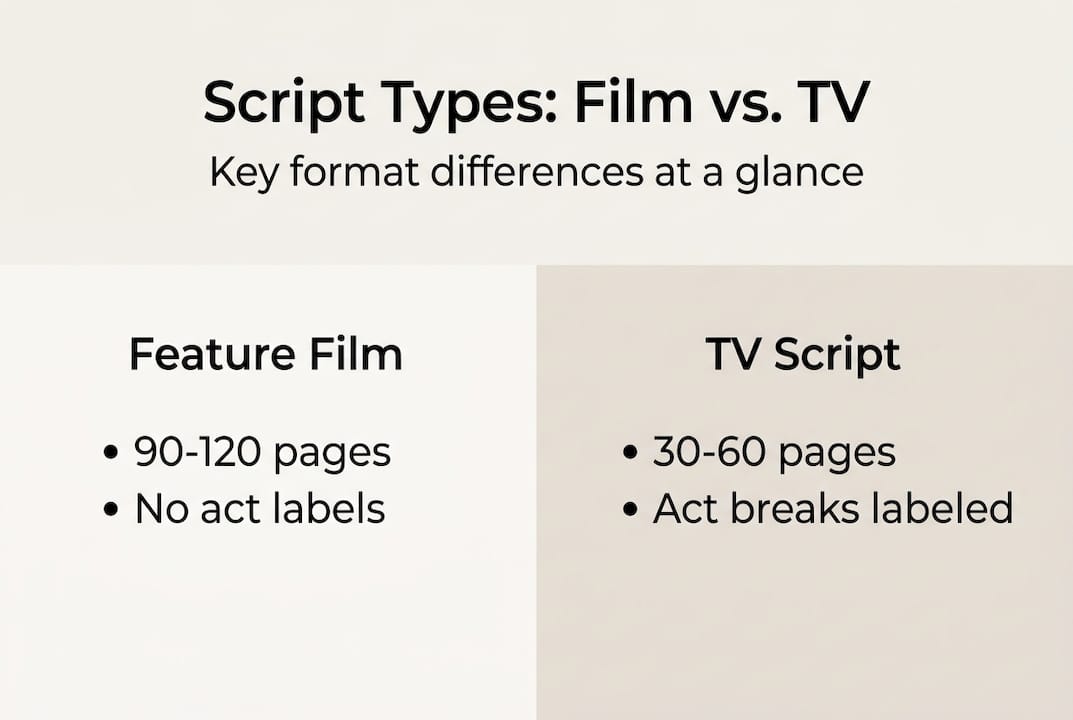
TV formatting differs in several specific ways: act breaks are labeled (ACT ONE, ACT TWO), teasers and tags appear at the start and end of episodes, and some shows use a cold open before the title card. Using software like Final Draft or Celtx lets you toggle between TV and film templates automatically, which removes most of the guesswork.
| Format type | Page count | Act breaks | Key conventions |
|---|---|---|---|
| Feature film | 90 to 120 pages | None (3-act implied) | Single continuous narrative |
| One-hour TV drama | 45 to 60 pages | 4 to 6 acts | Teaser, tag, act labels |
| Half-hour TV comedy | 22 to 32 pages | 2 to 3 acts | Cold open common |
| Short film | 1 to 15 pages | None | Compressed structure |
When to use which format:
- Writing a standalone story for theatrical release → feature film format
- Pitching to a streaming platform or network → TV pilot format with act breaks
- Submitting to short film festivals → short film format, under 15 pages
- Writing a limited series → treat each episode as a TV drama with consistent act structure
Understanding the script development process helps you choose the right format from the first draft. And if you are still deciding between mediums, the guide on screenplay genres for TV vs. film breaks down the creative and commercial differences clearly. For software-specific tips, industry formatting tools are covered in detail by Final Draft.
Common Hollywood script formatting mistakes
Even with format knowledge, avoid these classic missteps to keep your script in the running.
"Format errors are a first-read dealbreaker. A reader who sees wrong margins or the wrong font on page one is already looking for reasons to pass."
The market viability of your script depends on more than story. All industry sources agree that format is essential for a script to be taken seriously. Here are the mistakes that show up most often in submissions:
- Wrong font: Using anything other than Courier 12pt, including Courier New, which looks slightly different and is not the same
- Inconsistent margins: Left margin too narrow or right margin too wide, making the page look off-balance
- Misused scene headings: Writing INT/EXT without a period, or forgetting the time of day (DAY/NIGHT)
- Crowded action lines: Writing five or six line paragraphs of action when two to three lines is the professional standard
- Improper parentheticals: Using them to direct the actor's every emotion instead of reserving them for genuinely ambiguous readings
- Overused transitions: Writing CUT TO: after every single scene instead of only at major structural shifts
Quick fixes for each:
- Switch to a dedicated screenwriting app that locks in Courier 12pt automatically
- Use the software's built-in margin presets rather than adjusting manually
- Read your scene headings aloud and confirm each one has INT. or EXT., a location, and a time of day
- Break long action blocks into two shorter paragraphs with a line of white space between them
- Delete any parenthetical where the emotion is already clear from the dialog
Our formatting feedback guide covers each of these in more detail with before-and-after examples.
Tips for mastering Hollywood script format
You understand the mistakes. Now here is how to master industry-style formatting every time.
Steps to format a script page using software:
- Open Final Draft, Celtx, or WriterDuet and select the correct template (feature or TV)
- Use the tab and return keys to move between elements rather than manually spacing
- Let the software auto-format character names and scene headings as you type
- Review each scene heading manually to confirm INT./EXT. and time of day are correct
- Run a format check or use a script analysis service before submitting
Pro Tip: Read produced scripts from Script Slug or the WGA library before you write your next draft. Internalizing what a correctly formatted page looks like is faster than memorizing rules. Your eye will catch errors automatically once you have read enough professional scripts.
Resources for studying proper format:
- Script Slug: free library of produced screenplays across genres
- WGA script library: union-verified scripts from credited writers
- Simply Scripts: large archive of film and TV scripts, including shooting drafts
- Final Draft's blog: format tutorials with annotated examples
- Celtx's learning center: beginner-friendly formatting walkthroughs
Once your format is solid, the next step is developing the full script. The script development roadmap walks you through that process from concept to final draft. And if you want to make sure your title page formatting is also correct, that guide covers every detail including contact info placement and draft numbering.
Get your script professionally reviewed for format and story
When you are ready to submit, a professional review can ensure your script meets Hollywood standards before it reaches a producer or festival reader.
At Roast My Script, we built the service specifically for this moment. You have done the work. You have studied the format, revised the structure, and polished the dialog. Now you need a clear-eyed analysis that tells you what is working and what will get you passed on. For $9 to $25, you get a full PDF coverage report in 1-2 days by email, covering structure, character, dialog, and market viability using Hollywood methodology from Syd Field, McKee, and Save the Cat. It is the brutal first filter before you invest in expensive coverage or a script doctor. Think of it as the last check before the real stakes begin. Explore screenwriting mastery resources on our platform to sharpen your craft alongside your submission.
Frequently asked questions
What font and margins does Hollywood script format require?
Use Courier 12pt with a 1.5 inch left margin and 1 inch right, top, and bottom margins for all scripts. These are non-negotiable industry standards.
How long should a feature film script be?
Most feature scripts run 90 to 120 pages, with each page representing roughly one minute of screen time. Going significantly over or under that range raises flags.
Do TV scripts use the same format as movie scripts?
TV scripts follow similar conventions but include act breaks and shorter page counts, typically 30 to 60 pages depending on the format. The core font and margin rules remain the same.
Will a badly formatted script get rejected?
Improper format leads to immediate rejection in most professional contexts. Readers use format as a quick signal of whether a writer understands the industry.
What tools can help with script formatting?
Screenwriting software like Final Draft and Celtx handles standard formatting automatically, so you can focus on story rather than spacing rules.
Recommended
- Script format impact: 90% boost production & pitch success | ROAST MY SCRIPT
- Script Development Process: Preparing for Hollywood Success | ROAST MY SCRIPT
- Master Story Structure Breakdown for Screenwriters | ROAST MY SCRIPT
- Roast My Script | AI Script Coverage & Analysis from $9
- The essential parts of a screenplay pros use to get noticed