
Most screenwriters think character development means swapping personality traits or adding a redemption moment in Act Three. That's a surface-level misunderstanding that leads to flat protagonists and disengaged audiences. True character development involves the dynamic interplay of a character's conscious goal, deeper psychological need, and the wound that blocks fulfillment. This guide explains how to craft compelling arcs using the want-need-wound framework, advanced complexity techniques, and empirical insights that show strong character hooks achieve 70% viewer retention in episodic storytelling.
Table of Contents
- Key takeaways
- Understanding character development: the want-need-wound framework
- Adding complexity: contradictions, backstory, and ensemble dynamics
- Character arcs: change vs. flat models and their storytelling impact
- Empirical insights: how character development drives audience retention and critical success
- Explore expert screenwriting resources at Roast My Script
- FAQ
Key Takeaways
| Point | Details |
|---|---|
| Want Need Wound Framework | The want need wound triangle drives both external goals and internal growth to power transformation. |
| Contradictions for depth | Internal contradictions and selective backstory deepen characters beyond surface traits. |
| Micro narratives backstory | Micro narratives reveal backstory through action, not exposition, letting history unfold organically. |
| Character hooks boost retention | Strong character hooks drive higher audience retention across episodic formats. |
Understanding character development: the want-need-wound framework
Character development in screenwriting is the visible change in how a character perceives the world, values priorities, and behaves under pressure, primarily tracked through the conflict between their conscious want and deeper need, often rooted in a psychological wound. This triangle creates the engine of transformation that keeps audiences invested.
The want is your protagonist's concrete, playable goal. It's what they say they're chasing: the promotion, the love interest, the treasure, the victory. This goal must be specific enough to track visually on screen. In The Godfather, Michael Corleone wants to stay out of the family business and live a legitimate life.
The need represents the transformative internal fulfillment beyond the surface want. It's what the character actually requires to become whole, even if they don't recognize it initially. Michael needs to accept his identity and protect his family, which contradicts his stated want. This tension between want and need generates the emotional core of your story.
The wound is the psychological flaw or false belief triggering conflict. It's the trauma, shame, or misconception that prevents the character from pursuing their true need directly. Michael's wound stems from witnessing his father's violent world and believing he can escape that legacy through denial. The wound explains why characters make self-sabotaging choices that create drama.
Here's how each element functions in your narrative:
- Want drives external plot and creates immediate stakes
- Need drives internal arc and emotional resonance
- Wound creates obstacles and explains character behavior
- The conflict between all three generates tension and growth
Pro Tip: Integrate the want-need-wound triangle into every major scene. Ask yourself which element is being tested or revealed in each moment to heighten stakes and maintain narrative drive.
When you establish this framework early, you create a roadmap for character dimensionality that guides every choice your protagonist makes. The audience unconsciously tracks this triangle, sensing when a character is moving toward or away from their true need. That tracking creates emotional investment.
Adding complexity: contradictions, backstory, and ensemble dynamics
Advanced techniques include contradictions for complexity, backstory via micro-narratives, ensemble management with unique introductions, and showing behavior rather than telling emotions. These tools transform functional characters into memorable ones.
Internal contradictions make characters feel real. People contain multitudes: the proud detective who secretly doubts his abilities, the ruthless CEO who rescues stray animals, the pacifist forced into violence. These contradictions create surprise and prevent predictability. When you pair opposing traits, you force characters into impossible choices that reveal their priorities under pressure.

Micro-narratives are mini backstories revealed through action rather than exposition. Instead of a monologue about childhood trauma, show your character flinching at a specific sound or avoiding certain locations. These behavioral breadcrumbs let audiences piece together history organically. A character who counts exits in every room suggests military training or paranoia without stating it directly.
Ensemble management requires giving each character a distinct introduction and relationship arc. Avoid introducing everyone in a single scene with name tags. Stagger entrances so audiences can track personalities and dynamics. Give each character a unique way of speaking, moving, or reacting to conflict. In The Avengers, each hero gets a separate introduction that establishes their want, need, and wound before the team assembles.
Here are top techniques to deepen character complexity:
- Pair contradictory traits that force impossible choices
- Use physical behavior to imply psychological history
- Create unique speech patterns and body language for each character
- Establish relationships through conflict rather than harmony
- Layer backstory through objects, locations, and reactions
Follow these steps to layer backstory naturally in scenes:
- Identify the key wound or history moment that shapes current behavior
- Choose a sensory trigger that could evoke that memory (sound, smell, location)
- Show the character's physical reaction without explanation
- Let another character notice and question the reaction
- Reveal minimal information through evasive or emotional dialogue
- Return to the trigger later in the story to deepen understanding
The character spine concept emphasizes that every character needs a central motivation that runs through their entire arc. This spine connects their want, need, and wound into a coherent through-line. Without it, characters feel like they're reacting randomly to plot events rather than driving the story forward.
When managing ensembles, resist the urge to give everyone equal screen time. Prioritize characters whose arcs intersect most directly with the protagonist's journey. Secondary characters should illuminate different facets of your theme or provide contrasting approaches to the central conflict. This creates thematic depth without overcrowding your narrative.
Character arcs: change vs. flat models and their storytelling impact
A change arc involves internal transformation of protagonist beliefs or behavior, where the character moves from a false belief to a truth that resolves their wound. This is the classic hero's journey structure where growth equals success. Walter White in Breaking Bad undergoes a change arc, though his transformation is negative rather than redemptive.
A flat arc keeps the character steadfast in their beliefs while they impact others or the world around them. The protagonist already possesses the truth and must convince others or overcome external obstacles without changing internally. Indiana Jones maintains his core values across adventures; the world changes, not him. James Bond, Sherlock Holmes, and most action heroes follow flat arcs.
| Aspect | Change arc | Flat arc |
|---|---|---|
| Character journey | Internal transformation from false belief to truth | Steadfast beliefs that influence external world |
| Conflict source | Internal wound vs. external obstacles | External forces vs. character's unwavering truth |
| Genre fit | Drama, coming-of-age, tragedy | Action, thriller, mystery |
| Example | Michael Corleone (The Godfather) | Indiana Jones (Raiders of the Lost Ark) |
| Audience engagement | High emotional investment in growth | High plot-driven tension and spectacle |
| Risk factor | Can feel predictable if poorly executed | May lack emotional depth if plot isn't compelling |
Pro Tip: Test flat arcs carefully in plot-heavy genres by ensuring external stakes remain life-or-death and secondary characters undergo transformations. This prevents audience disengagement from a static protagonist.
Change arcs create emotional catharsis because audiences experience growth alongside the character. When done well, they provide satisfying closure as the character finally overcomes their wound and achieves their need. The risk is telegraphing the transformation too early or making it feel unearned through insufficient setup.
Flat arcs work brilliantly in genres where plot complexity and external stakes dominate. They allow audiences to focus on puzzle-solving, action choreography, or world-building without tracking internal psychology. The risk is creating a character who feels like a plot device rather than a person. Combat this by giving flat-arc protagonists strong values they refuse to compromise, which creates ethical dilemmas even without internal change.
Hybrid approaches exist where characters undergo partial transformations or oscillate between beliefs. Tony Stark in the MCU demonstrates a modified change arc where he grows in some areas while maintaining core personality traits. This flexibility lets you adapt arc types to your specific story structure breakdown and genre conventions.
The narrative impact of your arc choice affects pacing, theme, and audience expectations. Change arcs require more screen time devoted to introspection and relationship dynamics. Flat arcs demand tighter plotting and higher external stakes to maintain momentum. Choose based on what your story needs to communicate and what your genre audience expects.
Empirical insights: how character development drives audience retention and critical success
Scripts with strong character hooks achieve 70% viewer retention post-episode 3 in television, while shows with weak character introductions lose audiences rapidly. This data comes from analyzing thousands of episodic scripts against viewership patterns, revealing that early character development directly correlates with sustained engagement.
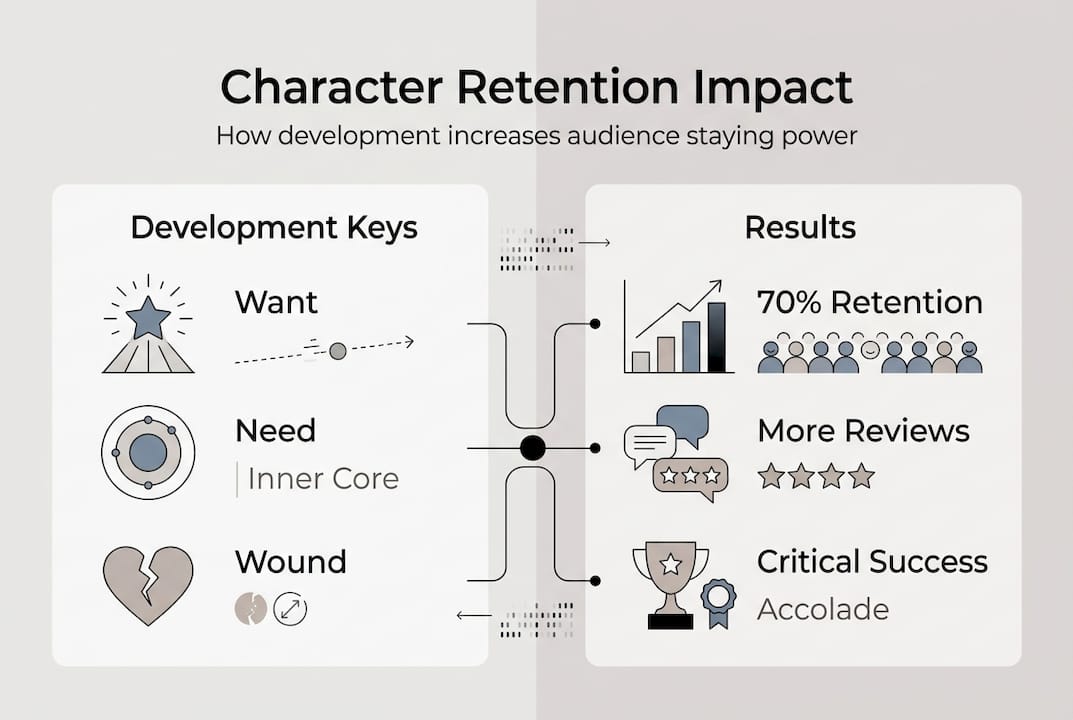
Natural language processing and machine learning research has explained up to 50% variance in viewership based on dialogue features like conflict density, surprise elements, and character voice distinctiveness. Scripts with higher dialogue conflict and unexpected character reactions generate larger audiences and better retention metrics. The algorithms can predict success by analyzing how characters speak and interact before a single frame is shot.
These storytelling factors drive measurable engagement:
- Early character hooks that establish want, need, and wound in the first 10 pages
- Dialogue conflict density showing characters with opposing goals in every scene
- Character complexity through contradictions and unpredictable choices
- Arc depth that delivers transformation or meaningful external change
- Relationship dynamics that evolve rather than remain static
| Study focus | Key finding | Impact metric |
|---|---|---|
| TV pilot character hooks | Strong hooks retain 70% of viewers post-episode 3 | Viewership retention |
| Dialogue conflict analysis | NLP models predict 50% of viewership variance | Audience size |
| Character-driven vs. plot-driven | Character focus increases critical review scores by 15-20% | Critical acclaim |
| Nonlinear character arcs | Deviation from rigid formulas correlates with higher completion rates | Binge-watching behavior |
"Scripts that establish character complexity early and maintain dialogue conflict throughout achieve significantly higher viewer retention and critical scores compared to formulaic plot-driven narratives."
The data reveals that storytelling music videos boost viewer retention through similar character-driven techniques, suggesting these principles transcend medium. When creators establish a protagonist with clear wants and obstacles in the first 30 seconds, completion rates jump dramatically.
Character-driven stories receive higher critical reviews because they offer thematic depth and emotional resonance that pure plot mechanics cannot provide. Critics and audiences alike respond to authentic human behavior under pressure. The role of dialogue in scripts becomes crucial here: characters must sound distinct and reveal psychology through word choice, not just convey plot information.
These findings have practical implications for your writing process. Invest heavily in your opening pages to establish character hooks. Ensure every scene contains dialogue conflict where characters pursue incompatible goals. Build complexity through contradictions and micro-narratives rather than exposition. Test whether your arc delivers meaningful transformation or external impact that justifies the runtime.
The correlation between character development and commercial success isn't coincidental. Audiences watch stories to experience human emotion and growth vicariously. When you deliver authentic character arcs backed by the want-need-wound framework, you tap into universal psychological patterns that create engagement regardless of genre or budget.
Explore expert screenwriting resources at Roast My Script
Mastering character development requires both theoretical understanding and practical application to your specific script. After absorbing these frameworks, the next step is implementing them in your work and getting professional feedback on execution.

Roast My Script offers targeted learning resources that deepen your craft beyond surface-level advice. Our character dimensionality masterclass with Linda Seger breaks down how to create multi-layered protagonists using the want-need-wound triangle and advanced complexity techniques. The character spine course teaches you to maintain narrative coherence while allowing characters to surprise audiences.
These courses provide actionable frameworks you can apply immediately to strengthen your current screenplay. Whether you're struggling with a flat protagonist or an ensemble that feels crowded, our screenwriting resources offer practical guidance rooted in industry-standard methodology.
Pro Tip: Investing in targeted learning accelerates your ability to craft memorable characters and build stronger scripts that stand out in competitive markets.
FAQ
What is character development in screenwriting?
Character development is the process where a character changes in perception, values, and behavior through conflict between what they consciously want and what they truly need, often rooted in a psychological wound or false belief. This transformation drives audience engagement by creating emotional investment in the character's journey. The change must be visible through action and choice rather than stated through dialogue.
How do I use the want-need-wound triangle in my script?
Establish your character's surface goal (want), underlying fulfillment (need), and psychological flaw (wound) in the first 10 pages. Use the conflict between these three elements to create tension and motivate growth throughout your story. Ensure this framework appears in every major scene by asking which element is being tested or revealed, maintaining narrative drive and emotional stakes.
What's the difference between change and flat arcs?
Change arcs involve internal transformation of the character's beliefs or behavior, moving from a false belief to truth that resolves their wound. Flat arcs keep characters consistent in their core values while they affect the world or other characters around them. Flat arcs fit action and thriller genres but risk lower emotional engagement if external plot stakes aren't compelling enough to compensate for static character psychology.
How does character development affect audience retention?
Strong character hooks boost viewer retention to 70% post-episode 3 in television by establishing want, need, and wound early. Dialogue conflict and character complexity directly influence viewer engagement, with natural language processing models predicting up to 50% of viewership variance based on these features. Well-developed characters correlate with higher critical acclaim and completion rates across all storytelling mediums.
Recommended
- Character Dimensionality in Narrative: A Strategic Masterclass on Linda Seger's Framework | ROAST MY SCRIPT
- Character Architecture: The Synergy between Archetypes and Temperaments according to Sánchez-Escalonilla | ROAST MY SCRIPT
- The Character's "Spine" According to Linda Seger | ROAST MY SCRIPT
- Master Story Structure Breakdown for Screenwriters | ROAST MY SCRIPT
- Storytelling in Music Videos: Boost Viewer Retention by 40% | Music Video Marketplace Blog