
TL;DR:
- Stakes are what characters stand to lose if they fail, creating emotional urgency and audience investment. Properly timing their reveal and escalation throughout a script enhances emotional depth and story tension, balancing personal and external risks. Mastering layered stakes leads to more compelling, universally resonant stories that resonate across genres and narrative levels.
Even polished, well-formatted scripts get passed on every day. The pages look clean, the dialog sounds natural, and the concept seems solid. But something feels flat. Readers disengage around page 30, and nobody can quite explain why. The answer is almost always the same: the audience has no clear sense of what the protagonist stands to lose. Stakes, not plot twists or clever dialog, are what make a story feel urgent. This article breaks down exactly what stakes are, when to reveal them, how different structure models handle them, and what you can do right now to sharpen them in your own script.
Table of Contents
- What are stakes and why do they matter in screenwriting?
- When and how should stakes be introduced?
- Different models: Save the Cat vs. Syd Field on stakes
- How to identify and raise stakes in your own script
- Common mistakes writers make about stakes and how to avoid them
- Why true script mastery means balancing stakes — what most guides miss
- Take your script further: Get expert eyes on your stakes
- Frequently asked questions
Key Takeaways
| Point | Details |
|---|---|
| Stakes create urgency | Clear stakes make the audience care about the outcome and keep them invested. |
| Timing is crucial | Introduce and escalate stakes at key structural beats for maximum impact. |
| Model your approach | Blend insights from Save the Cat and Syd Field to layer personal and global stakes. |
| Evaluate every scene | Every scene should highlight, test, or raise the stakes—or risk being cut. |
| Expert feedback helps | Pro analysis can pinpoint weak stakes and sharpen your script for the market. |
What are stakes and why do they matter in screenwriting?
Let's start with a clean definition. Stakes in screenwriting are what characters stand to lose if they fail, creating emotional cost, urgency, and investment in the story's outcome. That's it. Simple concept, but endlessly misapplied.
Most writers understand stakes in the abstract. They know their protagonist needs to "want something." But wanting something and risking something are two different things. Desire drives plot. Risk drives emotion. Without the second, you get a story where things happen but nobody cares.
Here's a useful way to think about it: a story without clear stakes is like watching someone play a video game on the easiest setting. The character moves through the world, overcomes obstacles, and eventually wins. But because nothing real was ever at risk, the journey feels hollow. The moment you raise the difficulty, every decision carries weight.
"Stakes are the engine of emotional engagement. When your audience knows what the protagonist stands to lose, every scene becomes charged with meaning."
Common misconception: stakes must be life-or-death. They don't. Some of the most gripping scripts in recent memory operate on deeply personal, intimate stakes. Consider Marriage Story, where the central risk is losing a family, a sense of self, and the version of life both characters had imagined. No explosions. No ticking bomb. Just two people who might permanently lose each other, and the emotional devastation that comes with it.
Stakes generally fall into three categories:
- Personal stakes: What the protagonist risks losing emotionally or relationally. A marriage, a friendship, their sense of identity, their belief in themselves.
- External stakes: What the protagonist risks losing in the physical or social world. Their job, their freedom, their home, their life.
- Global or thematic stakes: What the story suggests is at risk for the world, a community, or a way of life. These are most common in genre films like thrillers or sci-fi.
For a deeper look at how these stakes interact with your script's foundation, the story structure breakdown at Roast My Script is worth reading alongside this article. Understanding the importance of stakes in story genres also helps writers see how risk functions differently depending on the genre they're working in.
The key takeaway: stakes are not just plot mechanics. They are the emotional contract you make with your audience. Break that contract, and you lose them.
When and how should stakes be introduced?
Knowing what stakes are is only half the battle. The other half is timing. Even a script with genuinely compelling stakes can fail if they're revealed too late, too vaguely, or all at once.
According to story structure principles, the most effective approach follows a clear timeline: introduce personal stakes early in the First Act, threaten them at the Inciting Event, clarify them at the First Plot Point, and raise or redefine them at the Midpoint. Stakes evolve from personal to broader as the story deepens.
Here's how that plays out in practice:
- Pages 1 to 10 (Act One setup): Establish what the protagonist values most. Show us their world, their relationships, and what they stand to lose before anything goes wrong. This is where emotional investment begins.
- The Inciting Event (typically pages 10 to 15): Something disrupts the protagonist's world and directly threatens what they value. This is the first real test of stakes.
- First Plot Point (around page 25 to 30): The protagonist commits to a course of action. Stakes become explicit. The audience now understands exactly what failure would cost.
- Midpoint (page 50 to 60): Stakes shift or expand. A personal risk becomes a broader threat. Or a new layer of emotional cost is added. The protagonist can no longer go back.
- Act Three (pages 75 to 110): Stakes reach maximum pressure. Everything the protagonist values is simultaneously at risk. The climax forces a choice.
| Structural beat | Stake function | Example from The Shawshank Redemption |
|---|---|---|
| Act One setup | Establish personal values | Andy's dignity and innocence |
| Inciting Event | First threat to those values | Wrongful conviction |
| First Plot Point | Commitment under pressure | Andy decides to survive, not just endure |
| Midpoint | Stakes expand or shift | Andy begins to hope for freedom |
| Act Three climax | Maximum pressure, forced choice | Escape or permanent imprisonment |
Pro Tip: Stakes should become more layered and complex as the script progresses, not just louder or bigger. A protagonist who starts by risking their job might end up risking their moral identity. That's escalation through depth, not just volume.
For a structured look at how these beats connect, the screenplay structure guide maps this out in detail. And if you want to understand how crafting suspenseful stakes works in genre writing specifically, that's a useful companion resource.
Different models: Save the Cat vs. Syd Field on stakes
After understanding timing, it's critical to see how different story frameworks approach the weaving of stakes into structure. Two models dominate most screenwriting education: Blake Snyder's Save the Cat and Syd Field's paradigm. They're not in conflict, but they prioritize stakes differently.
Save the Cat emphasizes emotional accessibility from the very first pages. The "Save the Cat" moment, where your protagonist does something likable or relatable early on, is really a stakes-delivery mechanism. It tells the audience: here's a person worth caring about. Here's what they value. Here's what they could lose.
Snyder's model also uses the "All Is Lost" beat (around page 75) as a stakes crystallization point. Everything the protagonist has been fighting for appears to be gone. The emotional cost hits its peak before the resolution.
Syd Field's paradigm takes a more structural view. Stakes are built into the architecture of the three-act structure through plot points and the midpoint. Field focuses on how each structural turn raises the cost of failure. His approach is less about emotional warmth early on and more about progressive, logical escalation.
| Element | Save the Cat | Syd Field |
|---|---|---|
| Early stakes delivery | "Save the Cat" moment in first 10 pages | Established through character setup in Act One |
| Stakes escalation | Emotional beats (All Is Lost, Dark Night of Soul) | Structural plot points and pinches |
| Personal vs. external | Strong emphasis on personal, relatable stakes | Balances personal and external through structure |
| Best suited for | Character-driven and genre films with emotional core | Plot-driven and high-concept scripts |
| Weakness | Can feel formulaic if applied too rigidly | Can underemphasize emotional resonance |
Some story analysts argue that character-driven stories benefit most from emphasizing personal and intimate stakes over global ones, while structure models like Save the Cat and Syd Field focus stakes differently but are both essential tools for the working screenwriter.
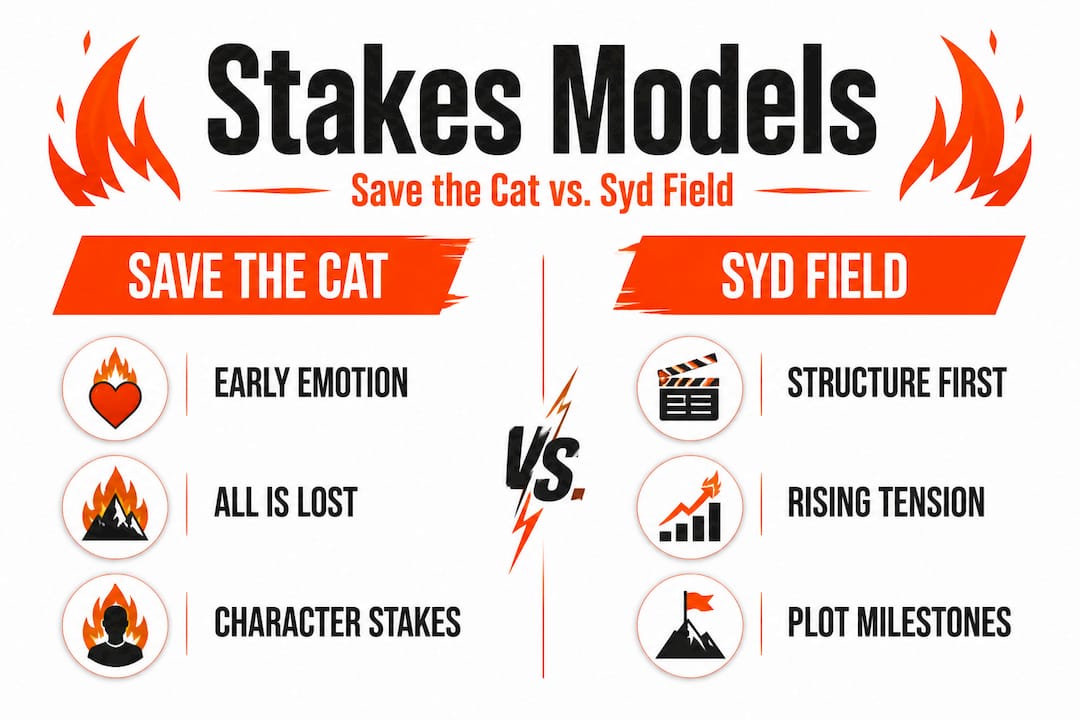
Pro Tip: Don't lock yourself into one model. Use Save the Cat to check your emotional accessibility and early audience connection. Use Syd Field to audit your structural escalation. A script that passes both tests is in strong shape.
For writers working across different genres, understanding screenplay genres helps clarify which model's stake-building approach fits your project. And if you're in active development, the script development best practices guide covers how to integrate these frameworks into a real workflow.
How to identify and raise stakes in your own script
In light of these model comparisons, here's how you can turn theory into action for your own script. The following questions work as a self-assessment toolkit. Be honest. Most writers discover that their stakes are either vague, static, or only external.
- What does your protagonist value most at the start of the script? If you can't answer this in one sentence, your setup needs work.
- What specific thing do they risk losing if they fail? Not "everything" or "their life." Something concrete and emotionally specific.
- Does the audience know what's at risk by page 15? If not, you're asking them to invest in a story they don't yet understand.
- Do the stakes change or escalate at each major structural beat? Static stakes create flat middles.
- Is there a moment where the protagonist must choose between two things they value? Conflicting stakes create the most powerful dramatic tension.
Here are concrete ways to raise stakes when they feel weak:
- Add a ticking clock. Deadlines create urgency. They force decisions and raise the cost of delay.
- Complicate a relationship. If someone the protagonist loves is now at risk because of their choices, the emotional stakes multiply.
- Introduce irreversibility. Once a character crosses a line they can't uncross, stakes become permanent.
- Raise the cost of failure. If losing means losing a job, what if it now means losing the family too?
As defined in screenwriting fundamentals, stakes are what characters stand to lose if they fail, creating emotional cost, urgency, and investment. Every scene in your script should either clarify, heighten, or test those stakes. If a scene does none of those things, it's a candidate for cutting.
Pro Tip: Every scene should either clarify, heighten, or test the stakes. If a scene does none of these three things, ask whether it belongs in the script at all.
For writers who want to go deeper on how to read their own scripts critically, the script analysis techniques guide offers a systematic approach. And since dialog is often where stakes get communicated most directly, understanding the role of dialog in scripts is a practical next step.
Common mistakes writers make about stakes and how to avoid them
Even when stakes seem present, writers often fall into avoidable traps. Here are the most damaging ones, with direct corrections.
- Vague or generic stakes. "He has to save the world" tells us nothing emotionally specific. Replace with: "He has to save his daughter, even if it means becoming the person he spent his life trying not to be." Specificity creates emotional resonance.
- External stakes without emotional underpinning. A bomb going off is a plot event. The bomb going off while the protagonist's estranged son is in the building is a stake. External threats need emotional anchors to land.
- Static stakes that never evolve. If the stakes in Act Three are identical to the stakes in Act One, the story hasn't grown. Each major beat should redefine or expand what's at risk.
- Protagonist doesn't actually care enough. If your protagonist can walk away from the goal without real cost, the audience will wonder why they're watching. The character must be unable to quit without losing something essential.
- Conflating plot goals with emotional stakes. "Get the briefcase" is a plot goal. "Prove to your dying father that you're not a failure" is a stake. Scripts that only track plot goals feel mechanical.
"When stakes are clearly defined as what characters stand to lose if they fail, every scene becomes an opportunity to deepen emotional cost and story investment."
Understanding why characters behave the way they do under pressure is directly tied to how their stakes are constructed. The concept of character spine helps explain why some characters feel real under pressure while others feel reactive. And character dimensionality is what allows stakes to feel personal rather than generic.
Why true script mastery means balancing stakes — what most guides miss
Armed with practical corrections, let's step back and consider what separates good from award-worthy scripts when it comes to stakes.
Here's what I've noticed reading hundreds of scripts: most screenwriting guides push writers toward one extreme or the other. Either they emphasize big, external, genre-driven stakes ("the fate of the world"), or they push intimate, character-driven stakes ("can she forgive herself?"). Both approaches produce scripts that feel incomplete.
The scripts that genuinely stand out, the ones that get optioned, win festivals, and stay with audiences, almost always layer both. Think about No Country for Old Men. On the surface, it's a thriller with external stakes: a man is being hunted. But the deeper stakes are existential. What does it mean to live in a world where evil operates without consequence? Those thematic, personal stakes are what make the film haunting rather than just tense.
The uncomfortable truth is that balancing these layers is harder than following any formula. It requires you to know your protagonist's deepest fear and then build a plot that forces that fear into direct conflict with the external world. That's not a beat sheet exercise. That's genuine story architecture.
The practical tool here is to write two sentences for your protagonist: one describing their external goal and one describing their internal fear. If those two sentences are in direct conflict by Act Three, your stakes are working. If they're parallel but never intersect, you have work to do.
For writers ready to push their characters to that level, exploring character dimensionality is the most direct path to building stakes that operate on every level at once.
Take your script further: Get expert eyes on your stakes
If you've worked through this article and identified real gaps in your script's stakes, the next step is getting specific, actionable feedback before you submit anywhere.

At Roast My Script, we built our AI-powered coverage service specifically to catch the structural and emotional problems that writers miss when they're too close to their own work. Stakes, escalation, and emotional cost are among the first things our analysis flags. For $9 to $25, you get a detailed PDF report in 1-2 days by email, grounded in the same Hollywood methodology covered in this article.
Before you spend $60 to $400 on traditional coverage or $500-plus on a script doctor, run your script through our filter first. Start by strengthening your screenwriting concepts, then refine your characters so their stakes feel real and specific. If you want to go deeper, master character dimensionality to ensure your protagonist's internal and external stakes are genuinely layered. Your script deserves honest, professional feedback before it lands on a reader's desk.
Frequently asked questions
How do I know if my script's stakes are strong enough?
Ask whether your protagonist truly risks losing something deeply important in every act and scene. If the answer is no, or if the risk feels vague, your stakes need sharpening before the script is submission-ready.
Can stakes be too high or unrealistic?
Yes. If stakes feel disconnected from character motivation or exceed what the story's world can support, audiences disengage. Layering personal and external stakes usually creates the most believable and compelling combination.
Where exactly should I reveal stakes in my script?
Introduce personal stakes in Act One, clarify them at the Inciting Event and First Plot Point, then raise or redefine them at the Midpoint. Stakes should evolve from personal to broader as the story develops.
What's a simple way to increase the stakes in a scene?
Add a ticking clock, raise the emotional risk, or introduce an obstacle that directly threatens what the protagonist values most. Emotional cost and urgency are the two levers that make any scene feel more charged.
Recommended
- Script Development Process: Preparing for Hollywood Success | ROAST MY SCRIPT
- Explain screenplay genres to elevate your scripts in 2026 | ROAST MY SCRIPT
- Master Story Structure Breakdown for Screenwriters | ROAST MY SCRIPT
- How to analyze a script for powerful screenplay improvement | ROAST MY SCRIPT
- Visual Storytelling Techniques in Film: Elevate Your Narrative