
Key takeaways
| Point | Details |
|---|---|
| Dialogue reveals character | Characters' words expose their motivations, fears, and emotional layers beneath the surface. |
| Effective dialogue drives plot | Well-crafted lines advance story beats, maintain pacing, and create narrative momentum. |
| Common myths hurt scripts | Misconceptions about naturalistic dialogue and exposition can sabotage your screenplay's quality. |
| Affordable feedback accelerates improvement | Budget-friendly AI tools provide professional insights faster than traditional coverage. |
| Structured feedback strengthens marketability | Applying targeted dialogue notes makes your script more competitive for producers and festivals. |
Introduction to dialogue's fundamental role in screenplays
Dialogue sits at the heart of every successful screenplay. While visuals tell part of your story, what characters say and how they say it reveals who they really are. Dialogue reveals character traits and emotions; drives narrative forward; and shapes audience engagement, creating a multi-layered experience for readers and viewers alike.
Think about your favorite movie scenes. The words characters speak expose their desires, mask their fears, or trigger unexpected revelations. This isn't accidental. Professional screenwriters craft dialogue to function on multiple storytelling levels simultaneously.
Here's what strong dialogue accomplishes:
- Shows character personality through word choice, rhythm, and speech patterns
- Propels plot forward by revealing conflict, secrets, or shifting power dynamics
- Engages audiences emotionally by creating tension between what's said and what's meant
- Reinforces theme through repeated motifs or contrasting perspectives
Linda Seger's character spine concept emphasizes that every line should connect to a character's core want or need. When dialogue drifts from this spine, scenes lose focus and pages drag. Your character's dialogue isn't just conversation. It's action.
How dialogue advances plot and pacing in Hollywood structures
Dialogue does more than reveal character. It pushes your story through key structural beats that keep audiences hooked. Whether you follow Syd Field's three-act paradigm, Robert McKee's beat-driven approach, or Blake Snyder's Save the Cat! method, dialogue serves as the engine moving your protagonist from setup to resolution.
In classical Hollywood structure, dialogue often triggers plot points at act transitions. Your hero receives a call to adventure through a conversation. An ally's warning signals the midpoint twist. A villain's monologue raises stakes before the climax. Save the Cat! dialogue beats increase act transition success by 40%, making these moments land with emotional impact.
Subtext separates amateur dialogue from professional work. What characters don't say matters as much as their actual words. When your protagonist says "I'm fine" while their world crumbles, audiences feel the tension between surface and truth. Syd Field emphasizes dialogue must push plot points forward; McKee highlights subtext in dialogue, creating depth that elevates storytelling.
Here's how dialogue pacing works across structures:
- Field's structure: Dialogue peaks at plot points (pages 25-30, 85-90) to maximize turning point impact
- McKee's approach: Rapid-fire exchanges during crisis beats increase tempo and urgency
- Save the Cat!: "Fun and Games" section uses lighter dialogue to provide breathing room
- All methods: Silence and pauses create dramatic weight between dialogue bursts
| Structure | Dialogue Focus | Pacing Strategy |
|---|---|---|
| Syd Field | Plot point transitions | Concentrated dialogue at act breaks |
| Robert McKee | Beat-by-beat conflict | Varied tempo matching emotional intensity |
| Save the Cat! | Genre-specific beats | Dialogue density shifts by story section |
Balancing dialogue with action and visual storytelling maintains audience engagement. Practical frameworks suggest alternating heavy dialogue scenes with visual sequences to prevent monotony.

Pro Tip: Read your dialogue aloud to catch pacing issues. If you run out of breath or lose interest, so will your audience.
Common misconceptions about script dialogue and their corrections
Many screenwriters fall into dialogue traps that undermine their scripts. Understanding these misconceptions helps you avoid pitfalls that lead to rejection.
The "authenticity above all" myth causes problems. Real conversations include filler words, tangents, and repetition. Screenplays can't afford that luxury. You have 90-120 pages to tell a complete story. Every line must earn its place by revealing character, advancing plot, or both.
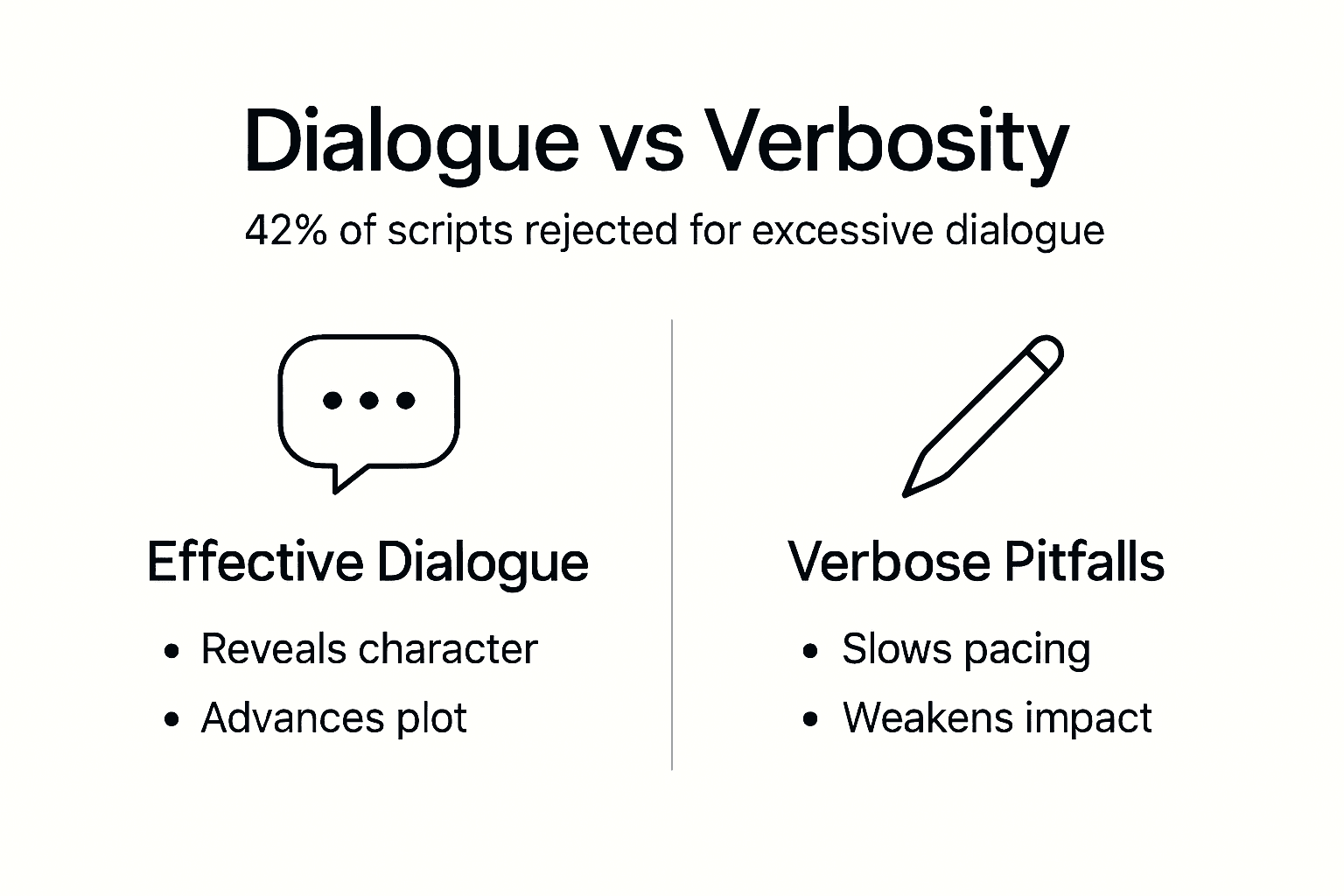
Another dangerous belief: more dialogue equals better character development. Wrong. Excessive talking slows pacing and frustrates readers who want your story to move. Silence, subtext, and action often communicate more powerfully than lengthy speeches.
The exposition dump remains a rookie mistake. Characters shouldn't explain backstory or world-building through unnatural conversations. "As you know, Bob" dialogue signals amateur writing. Integrating information naturally requires discipline and craft.
Here's what truly works:
- Stylized dialogue serves narrative economy better than pure naturalism
- Conflict-driven exchanges reveal more than friendly explanations
- Subtext creates layers that engage audiences intellectually
- Strategic silence amplifies emotional moments
Pro Tip: If a character speech exceeds half a page, question whether you need all those words. Trim ruthlessly.
As screenwriter William Goldman said:
"The easiest thing to do on earth is not write. But this is life on earth, you can't have everything."
Your dialogue should reflect that same efficiency. Make every word count.
Professional and affordable feedback models for improving dialogue
Getting quality feedback shouldn't drain your budget. Traditional script coverage costs $200-400 and takes weeks. That's a barrier for emerging writers developing their craft.
AI-assisted platforms changed the game. You can now receive affordable AI-assisted feedback starting at $9 with 1-2 day turnaround by email. These tools analyze your dialogue against Hollywood standards, identifying verbosity, exposition problems, and pacing issues.
Early feedback prevents costly mistakes. Discovering dialogue problems in draft one saves time and money compared to extensive rewrites after investing months in development. Professional readers catch issues you miss because you're too close to your work.
| Feedback Type | Cost | Turnaround | Coverage Depth |
|---|---|---|---|
| Traditional Coverage | $200-400 | 2-4 weeks | Comprehensive human analysis |
| AI-Assisted Analysis | $9-25 | 1-2 days by email | Structural and dialogue-focused |
| Script Doctor | $500-1500 | 1-3 months | Deep rewrite consultation |
| Peer Workshop | Free-$50 | Varies | Community perspectives |
Value comes from actionable insights. Generic praise doesn't improve your script. You need specific notes identifying exactly which scenes drag, where dialogue feels forced, and how to strengthen character voices.
Benefits of affordable feedback models:
- Multiple revision rounds become financially feasible
- Faster iteration cycles accelerate skill development
- Structured analysis aligns with industry expectations
- Lower risk investment lets you test different story approaches
The best feedback identifies patterns across your screenplay. If readers consistently flag your dialogue as too on-the-nose, you know where to focus your rewrites.
Practical strategies for incorporating dialogue feedback into rewrites
Receiving feedback is step one. Implementing it effectively separates writers who improve from those who stay stuck.
Start by prioritizing notes that address major issues: exposition dumps, pacing problems, or unclear character motivations. Don't get distracted by minor word choice suggestions until you fix structural dialogue problems.
Here's your revision process:
- Read all feedback without defending your choices
- Identify patterns where multiple readers flag similar issues
- Address exposition and pacing problems first
- Revise character voices for distinctiveness
- Test changes through table reads or workshops
- Measure improvements against specific feedback points
Table reads expose dialogue weaknesses instantly. When actors stumble over your lines or scenes feel flat, you've found problems to fix. Record these sessions so you can review specific moments later.
Workshops provide diverse perspectives. Other writers catch dialogue issues you normalized. Fresh ears hear awkward rhythms or confusing subtext that seemed clear to you.
Key implementation tactics:
- Create a feedback tracking document noting each issue and your solution
- Revise in passes focusing on one dialogue element at a time
- Compare revised scenes directly against original versions
- Set measurable goals like reducing dialogue density by 15%
Keep feedback focused on craft fundamentals tied to screenplay structure. Notes about personal taste matter less than observations about pacing, clarity, and character consistency.
Iterate based on results. If your second draft still gets flagged for verbose dialogue, you haven't cut enough. Be ruthless. Your story benefits from precision.
Summary: Elevating your screenplay through purposeful dialogue
Dialogue mastery separates scripts that get produced from those gathering dust. You've learned that effective dialogue operates on multiple levels: revealing character depth, advancing plot beats, and engaging audiences through subtext.
Balanced dialogue respects pacing. Mix rapid exchanges with strategic silence. Cut ruthless. Every line should serve character development or story progression. Preferably both.
Key principles to remember:
- Dialogue must connect to your character's core motivation
- Subtext creates depth that literal words can't match
- Hollywood structures use dialogue to trigger key story beats
- Professional feedback accelerates your improvement curve
- Early revision based on targeted notes strengthens market readiness
The 42% rejection rate tied to dialogue problems isn't inevitable. Writers who prioritize purposeful dialogue, seek structured feedback, and revise strategically create scripts that stand out in competitive markets. Your next draft can be that breakthrough screenplay.
Enhance your dialogue with expert AI feedback from Roast My Script
Ready to transform your dialogue from verbose to vivid? Roast My Script delivers professional AI script coverage and analysis starting at just $9. Our AI system evaluates your screenplay against Hollywood standards, identifying exactly where your dialogue drags, where exposition overwhelms, and how to strengthen character voices.

You'll receive detailed feedback within 1-2 days by email, letting you iterate quickly through multiple drafts. Our analysis covers structure, pacing, character development, and dialogue effectiveness using proven frameworks from Syd Field, Robert McKee, and Save the Cat! Thousands of screenwriters trust our platform to refine their scripts before pitching to producers or submitting to festivals. Get the brutal feedback you need before investing in expensive traditional coverage. Learn more about building stronger characters through our character spine learning resource and start improving your dialogue today.
FAQ
How does dialogue reveal a character's motivation?
Dialogue conveys desires, fears, and personality through both what characters say and how they say it. Word choice, speech patterns, and conversational tactics expose inner drives that visual storytelling alone can't capture. Subtext reveals hidden motivations beyond literal words, creating depth that engages audiences intellectually and emotionally.
What is subtext in screenplay dialogue?
Subtext is the underlying meaning behind spoken words, revealing conflict or emotion indirectly. It creates tension between surface conversation and true intention, letting audiences read between the lines. Strong subtext adds layers to scenes, making dialogue memorable and emotionally resonant beyond simple information exchange.
How can I get affordable, professional feedback on my script's dialogue?
Services like Roast My Script offer AI-driven feedback starting at $9 with turnaround in 1-2 days by email. These tools analyze your dialogue against industry standards, identifying verbosity, pacing issues, and character voice problems. You receive actionable insights without the weeks-long wait or $200-400 cost of traditional coverage.
Why is too much natural dialogue sometimes a problem?
Naturalistic dialogue can slow pacing and cloud narrative clarity because real conversations include filler that screenplays can't afford. Stylized dialogue serves storytelling economy better by cutting redundancy and sharpening focus. Every line must advance character or plot, making purposeful compression more effective than authentic reproduction of everyday speech patterns.