
TL;DR:
- Affordable script coverage is now widely accessible and crucial for independent writers’ success.
- Combining AI tools for structural first edits with human feedback for nuanced insights is most effective.
- Proper coverage helps identify weaknesses early, improving script quality and competitiveness in contests and pitching.
Most screenwriters assume professional script feedback is reserved for people who already know someone in Hollywood. That belief has kept thousands of talented writers from submitting polished scripts, because they never got an outside perspective before sending their work out. The truth? Affordable script coverage is now widely accessible, and it has become one of the most practical tools an independent writer can use. This guide breaks down what coverage actually is, how traditional and AI-powered options compare, what to look for in a service, and how to turn feedback into real script improvements that matter to producers, contests, and agents.
Table of Contents
- What is script coverage and why do you need it?
- Traditional vs. AI-powered coverage: Which is right for you?
- Key features of great coverage services for indie writers
- Getting the most from your coverage: Next steps and applications
- Real talk: When coverage helps—and when it doesn't
- Affordable coverage options for your next script
- Frequently asked questions
Key Takeaways
| Point | Details |
|---|---|
| Coverage demystified | Getting professional feedback is now affordable and vital for indie screenwriters. |
| AI vs. human feedback | AI excels at quick, structural analysis but human notes add creative nuance. |
| Choose the right service | Pick coverage based on your script's stage, your budget, and provider transparency. |
| Use feedback wisely | Leverage coverage notes for rewrites and position your script for contest or pitch success. |
What is script coverage and why do you need it?
Script coverage started as an internal industry tool. Development executives and agents at major studios needed a fast way to evaluate the hundreds of screenplays that landed on their desks every week. They hired readers, called coverage analysts, to summarize and assess each script, then recommend whether it was worth a closer look.
Script coverage is a professional summary and analysis of a screenplay used in the industry to help decision-makers prioritize their reading. Over time, independent writers started using the same tool to evaluate their own work before submitting it anywhere.
A standard coverage report typically includes:
- Logline and synopsis: A concise summary of your story premise and plot
- Structural analysis: How well your script follows a three-act or alternative structure
- Character assessment: Are your characters believable, motivated, and consistent?
- Dialogue review: Does your dialog feel natural and serve the scene?
- Strengths and weaknesses: Honest notes on what works and what doesn't
- Recommendation: Usually a rating such as Consider, Consider with Revisions, or Pass
"Coverage is not just a report card. It is a mirror that shows you what your script actually looks like to a stranger reading it for the first time."
For independent writers, that outside perspective is irreplaceable. You have been living inside your story for months. You cannot see the structural gaps, the character inconsistencies, or the scenes that drag because you already know what you meant to write. A coverage report catches those problems before a producer does.
Understanding screenplay structure essentials is the foundation for making sense of the feedback you receive. Coverage helps you close the gap between what you intended and what is actually on the page. That is its core value.
For contests like Nicholl, Austin Film Festival, or Sundance Labs, scripts that have been through at least one round of objective feedback consistently perform better. Coverage is not a guarantee, but it is a real competitive advantage.
Traditional vs. AI-powered coverage: Which is right for you?
With a grounding in what coverage entails, let's examine how traditional and AI-powered feedback stack up and when you should use each approach.
Traditional human coverage involves a working screenwriter or development professional reading your script and writing detailed notes. The process typically takes one to two weeks and costs anywhere from $60 to $400 depending on the reader's credentials and the depth of the report. The strength here is nuance. A human reader brings taste, industry instinct, and the ability to assess whether your voice feels distinctive.
AI-powered coverage uses large language models to analyze your script against proven structural frameworks like Syd Field's paradigm, McKee's story principles, and the Save the Cat beat sheet. Turnaround is 1-2 days by email, and pricing starts as low as $9. AI coverage is good for structure, speed, and affordability, but lacks taste and industry connections that a seasoned human reader brings.
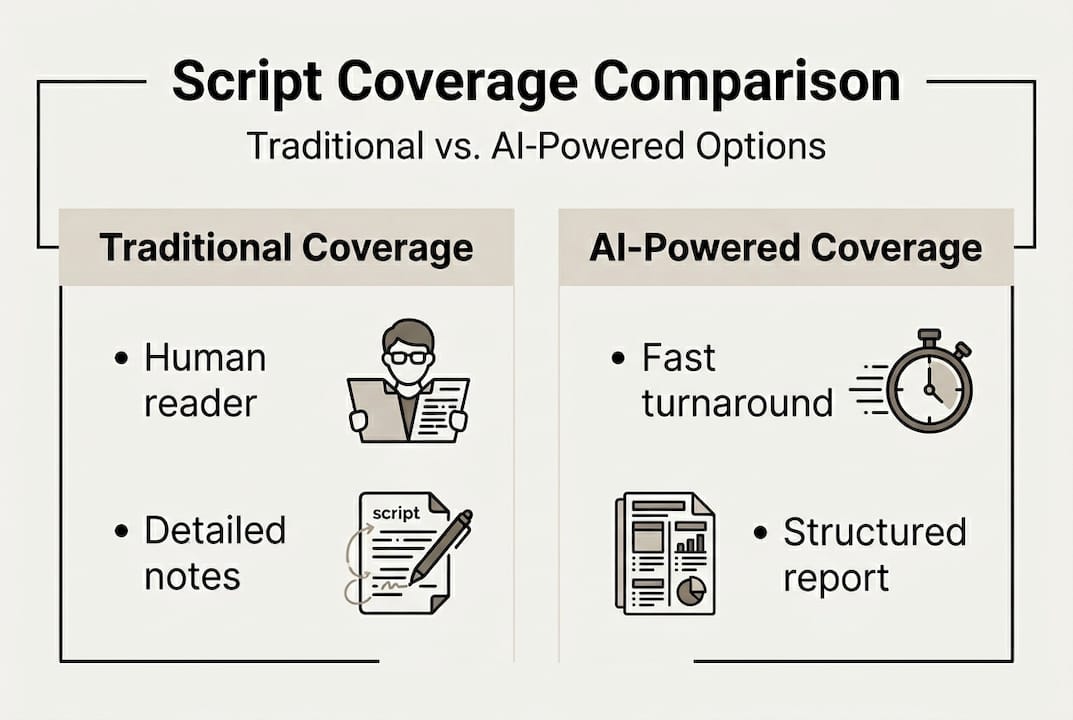
| Feature | Traditional coverage | AI-powered coverage |
|---|---|---|
| Cost | $60 to $400+ | $9 to $25 |
| Turnaround | 1 to 2 weeks | 1-2 days by email |
| Structural depth | High | High |
| Creative nuance | High | Limited |
| Industry insight | Yes | No |
| Best for | Final drafts, pitching | Early drafts, quick checks |
The smartest approach is to use both strategically. AI coverage works as a brutal first filter. It finds structural breaks, pacing issues, and weak loglines fast, before you spend money on human readers. Once you have addressed the structural fundamentals, human feedback adds the layer of creative judgment that only experience can provide.
Pro Tip: Run your script through AI coverage after every major rewrite. Reserve human coverage for when you are confident the structure is solid. This approach lets you cut costs with AI tools by up to 75% without sacrificing the quality of your final feedback.
If you want to understand how AI transforms scriptwriting beyond coverage, the broader applications for development and research are growing fast in 2026.
Key features of great coverage services for indie writers
Once you have considered which type of coverage fits your needs, it is crucial to know what to look for in a great coverage service.
Comprehensive coverage should address core screenwriting concepts to help scripts succeed in the market. Not all coverage services deliver that. Here is what separates reliable providers from the rest.
Must-have features:
- Objective structural analysis: The report should assess your three-act structure, midpoint, and act breaks with specific page references
- Actionable suggestions: Vague notes like "the second act drags" are not useful. Great coverage tells you exactly which scenes to cut, combine, or rewrite
- Clear scoring or rating system: A recommendation tier (Pass, Consider, Recommend) gives you a measurable benchmark
- Logline and concept assessment: Writing a great logline is the first test of your premise. Coverage should evaluate whether your logline is working
- Methodology transparency: Know whether the service uses Syd Field, McKee, or the Save the Cat methodology
Turnaround and pricing: Avoid services with vague timelines. A reputable provider commits to a specific window, typically two to seven days for human coverage and 1-2 days by email for AI reports. Pricing should be listed clearly without hidden fees.
Red flags to watch for:
- No sample reports available to review before purchase
- No information about the reader's background or the AI model used
- Generic feedback that could apply to any script
- No refund or revision policy
- Coverage that focuses only on story and ignores format
Proper script formatting is part of professionalism. Good coverage flags formatting issues alongside story problems.
Pro Tip: Always request a sample report before paying. If a service won't show you what their coverage looks like, that tells you everything you need to know.
Getting the most from your coverage: Next steps and applications
You have chosen your service and received actionable feedback. Here is how to turn those notes into a script that stands out.
The most common mistake writers make is emotional resistance. You spent months on this script. Critical notes feel personal. They are not. Rewriting based on objective feedback improves script readiness for the market, but only if you approach the notes with honesty.
Step-by-step approach to implementing coverage notes:
- Read the full report once without touching your script. Let it settle for 24 hours.
- Categorize the notes into structural issues, character issues, and dialog issues.
- Separate objective notes from subjective ones. If a reader says your structure breaks at page 60, that is objective. If they say your protagonist is unlikeable, that is a subjective signal worth considering.
- Prioritize structural fixes first. A broken structure undermines everything else.
- Rewrite one section at a time. Do not try to address every note simultaneously.
- Get a second round of coverage after major revisions to verify the changes worked.
Tracking your script's progress:
| Round | Key issue addressed | Recommendation received |
|---|---|---|
| Draft 1 | Structural breaks in Act 2 | Pass |
| Draft 2 | Midpoint and character arc | Consider with Revisions |
| Draft 3 | Dialog and pacing | Consider |
| Draft 4 | Polish and logline | Recommend |
This kind of tracking turns coverage into a measurable development process rather than a one-time opinion. Understanding Hollywood screenplay structure gives you the baseline to interpret what each round of notes is really pointing at.
When you submit to competitions or producers with documented coverage history and a script that has gone through objective revisions, your confidence in that material is grounded in evidence, not hope.
Real talk: When coverage helps—and when it doesn't
Let me be direct about something most coverage services won't say out loud. Coverage is only as useful as your willingness to do the work it reveals.
I have seen writers collect four or five rounds of coverage without ever finishing a rewrite. They treat feedback like validation shopping, looking for one reader to confirm what they already believe about their script. That is a waste of money and time.
Coverage works best as a mirror, not a magic bullet. It shows you where the problems are. It does not fix them for you. AI coverage is a fast and affordable first filter, genuinely excellent for identifying structural issues in early drafts. But as your script matures, the nuance that only a human reader can provide becomes more important.
Hybrid coverage, using AI for first drafts and human feedback for finals, often offers the best value across the development process. That is the workflow I recommend, and it is exactly what we built Roast My Script around.
The goal is a finished, polished script. Coverage is a tool to get you there faster. Use it to move forward, not to postpone the moment you have to commit to your final draft.
Affordable coverage options for your next script
If you are ready to stop guessing and start getting real feedback, Roast My Script was built for exactly this moment in your process.
We offer affordable script coverage starting at $9, with AI-powered reports delivered in 1-2 days by email based on proven Hollywood methodology. Every report covers structure, character, dialog, concept, and market viability. No vague notes. No hidden fees. Just the kind of direct, professional feedback that helps you identify what to fix before you send your script anywhere that matters. Roast My Script is the brutal first filter that saves you from expensive mistakes later.
Frequently asked questions
What does script coverage typically include?
Script coverage includes a summary and analysis of your screenplay covering structure, character, dialog, strengths, weaknesses, and a recommendation for next steps. Most reports also assess your logline and overall market viability.
How much does affordable script coverage cost?
AI-powered coverage starts as low as $9, while detailed human feedback can range from $50 to $200+. Using AI tools strategically for early drafts can reduce your total coverage spend significantly before investing in human readers.
Is AI feedback reliable for screenplays?
AI is highly reliable for structural analysis and consistent pattern recognition, but AI coverage lacks taste and the creative intuition that experienced human readers provide. Use AI for early drafts and human coverage for final polish.
How can coverage help my script for contests or pitching?
Objective feedback improves script readiness by identifying weaknesses before decision-makers see them, which directly strengthens your chances in competitions and pitch meetings.