
TL;DR:
- Market viability is crucial for screenplay success, assessing genre demand, comparable titles, audience fit, and professionalism.
- Industry gatekeepers evaluate scripts through professional coverage, platforms like The Black List, and direct submissions.
- Combining AI and human feedback helps refine scripts efficiently, emphasizing strong craft and market awareness.
Most screenwriters pour months or years into a script, only to send it into a void. The numbers are brutal: 50,000 scripts are registered with the WGA each year, yet fewer than 30 spec scripts sold in just the first half of 2023, and less than 1% of submitted scripts ever reach production. A great story is not enough. The writers who break through understand something most overlook: market viability is not a lucky accident. It is something you can learn, assess, and improve before your script lands on a single desk.
Table of Contents
- What does market viability mean for screenplays?
- Core factors that drive screenplay marketability
- How industry gatekeepers assess scripts
- Getting feedback: Should you use AI or human script readers?
- A reality check: Why market viability is a moving target
- Ready to test your screenplay's market fit?
- Frequently asked questions
Key Takeaways
| Point | Details |
|---|---|
| Industry odds are tough | Less than one percent of registered screenplays ever reach production each year. |
| Market fit is critical | Scripts with clear concepts, genre alignment, and professional formatting stand out to buyers. |
| Combine feedback sources | Use both AI tools and human readers to accurately assess your script’s market potential. |
| Gatekeepers value polish | Professional coverage scores often determine which screenplays reach producers or contests. |
| Chase timelessness, not trends | Scripts that focus on core story fundamentals and audience appeal have the best shot at success. |
What does market viability mean for screenplays?
Market viability is the measure of how likely your screenplay is to attract buyers, producers, or serious attention from festivals and competitions. It is not about selling out or writing formulaic content. It is about understanding the ecosystem your script enters the moment you send it out.
Think of it this way: every screenplay competes not just against others in its genre, but against the entire landscape of what studios, streamers, and independent producers are currently funding. And that landscape has tightened considerably. Film earnings declined 19.3% to $414.7 million in 2023, and overall scripted releases dropped 13.4% year over year to 857 in 2024. Gatekeepers are not being harsh for fun. They are making survival decisions.
Here is what decision makers actually evaluate when they talk about market viability:
- Genre demand: Is your genre currently attracting buyer interest? Elevated horror, contained thrillers, and prestige dramas have shown consistent demand even during industry contractions.
- Comparable titles (comps): Can you name two or three recent films your script resembles in tone and scope? Comps give buyers a shortcut to picture the audience and budget.
- Audience fit: Who watches this film, and where? A broad four-quadrant concept travels differently than a niche arthouse piece.
- Script professionalism: Does the screenplay look and read like it was written by someone who understands the craft? Format, length, and presentation signal competence before a reader even hits page ten.
"The market does not reward originality for its own sake. It rewards originality that arrives in a form it can recognize and sell."
Understanding Hollywood screenplay structure is a foundational step because structural clarity signals to readers that you control your story. Similarly, mastering script formatting essentials removes one of the most common early rejection triggers. These are not creative constraints. They are entry requirements.
Core factors that drive screenplay marketability
With a basic understanding of market viability, the next step is to break down exactly what elements make a script irresistible, or unsellable, to industry gatekeepers.
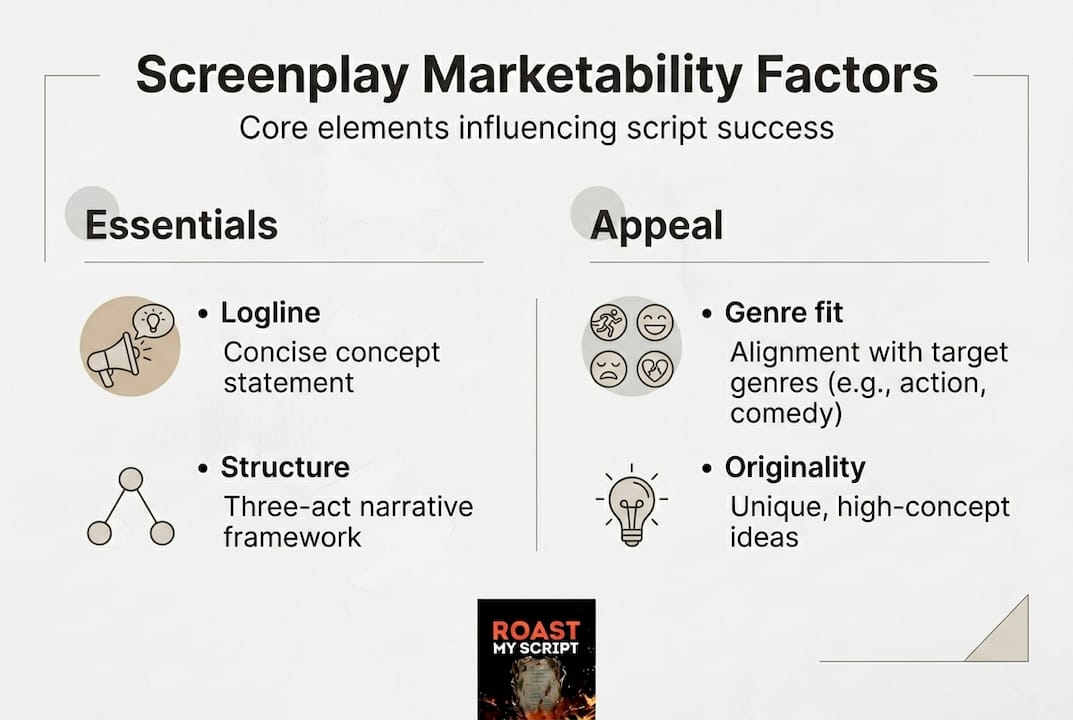
Marketable screenplays share identifiable traits. Below is a breakdown of the core factors that readers, executives, and competition judges consistently prioritize.
| Factor | Why it matters | Common failure point |
|---|---|---|
| High concept logline | Instantly communicates value and audience | Vague, plot-heavy, or genre-confused |
| Clear genre identity | Sets audience expectations | Tonal inconsistency across acts |
| Compelling protagonist | Drives emotional investment | Passive or contradictory character arcs |
| Structural integrity | Keeps story momentum and pacing tight | Sagging second act, unclear midpoint |
| Comps alignment | Helps buyers picture the product | Outdated or wildly mismatched titles |
| Professional formatting | Signals craft credibility | Non-standard fonts, wrong margins, bloated action lines |
| Commercial hook | Implies producibility and marketability | Unmarketable premise or unclear audience |
Each of these factors carries weight at different stages of evaluation. A reader doing coverage will flag structural problems in a pass. An executive skimming a logline decides whether to read at all. A festival programmer looks for originality that still fits a programmable category.
Your logline is your first pitch. It should communicate who the protagonist is, what they want, what stands in their way, and what makes this story unique. If you struggle to write a one-sentence version of your story, that is a signal the concept needs more work. Explore writing strong loglines before you submit anywhere.
The Save the Cat method offers a practical framework for checking whether your script hits the structural beats industry readers expect. These beats are not arbitrary rules. They reflect decades of audience behavior research. Ignoring them without intentional reason is a market risk.
One often underestimated issue is reader bias. Genre expectations must match the script's intent. A reader who hates horror will struggle to give fair notes on a psychological thriller. A reader unfamiliar with romantic comedies may flag emotional beats as implausible that audiences in that genre fully expect. This is why feedback from a single source is rarely enough.
Pro Tip: Cross-reference any coverage you receive against the genre expectations your script sets up in its first ten pages. If a reader's notes feel off, check whether they understood the genre conventions you were working within before revising based solely on their feedback.
Understanding entertainment market strategies beyond just screenwriting can also help you appreciate how buyers think. Producers evaluate scripts the same way investors evaluate pitches: with an eye on return, risk, and audience reach.
How industry gatekeepers assess scripts
Understanding the key factors, it is essential to know how scripts actually get evaluated and filtered in the industry. There are three primary pathways most scripts travel through: professional coverage, public platforms like The Black List, and direct submissions to agents, managers, or production companies.
Professional coverage is the most structured evaluation method. A script reader, paid by an agency, studio, or independent service, writes a synopsis and provides ratings on key elements including concept, structure, character, dialog, and marketability. Coverage scores are often the deciding factor in whether a script moves forward internally. A "Recommend" or "Consider" from a professional reader can unlock doors that a cold query cannot.

The Black List changed how unproduced scripts get discovered. Over 1,000 productions have come from scripts hosted on the platform, and top-rated unproduced scripts receive 30 to 48 executive mentions annually. But here is the thing: only scripts rated 8 and above on the platform's 1 to 10 scale consistently attract industry attention. Getting there requires targeted revisions based on quality professional notes, not just uploading and hoping.
Direct submissions through query letters, competitions, and industry events represent a third path. Contests like the Nicholl Fellowship or Austin Film Festival can put a script in front of hundreds of industry professionals. But these pathways reward scripts that have already been refined through multiple feedback cycles.
Here is how the typical evaluation flow works in practice:
- A script is submitted to a coverage service, contest, or directly to a production company.
- A reader evaluates the script, often in two to four hours, against genre benchmarks and structural criteria.
- Scores are assigned. Scripts rated highly are escalated. Scripts rated low receive a "Pass" with notes.
- Writers revise based on feedback and resubmit, or use the notes to target a better-fit submission.
- Scripts that consistently score well across multiple readers begin to attract requests.
"Professional readers are not your enemies. They are a filter. Pass the filter, and you earn access to the next one."
Professional coverage is your clearest window into how the industry sees your script before you commit to submitting widely. It is also where many writers find the gap between what they intended and what landed on the page.
Industry best practices recommend prioritizing professional coverage from experienced readers for market fit assessment before entering contests or festivals. The goal is simple: arrive at every major submission with a script that has already survived rigorous external scrutiny.
Getting feedback: Should you use AI or human script readers?
Once you understand what matters and how scripts are filtered, it is crucial to know how to get affordable, actionable feedback for improvement. The honest answer is that both AI coverage and human readers serve different purposes and different stages of your script's development.
What AI coverage does well:
- Delivers fast turnaround, often within 1-2 days by email
- Costs significantly less than human professional coverage, starting as low as $9
- Catches consistent structural problems: missing act breaks, weak setups, unresolved subplots
- Identifies formatting issues that signal amateur work to professional readers
- Provides objective scoring that removes personal taste from structural evaluation
- Works especially well on early drafts where broad feedback is more useful than nuanced creative notes
What human coverage does better:
- Provides genre-specific insight from readers who understand audience expectations
- Offers creative suggestions that go beyond structural diagnosis
- Captures the emotional experience of reading the script, which is often what sells it
- Understands cultural context and subtext that AI systems still process inconsistently
- Can flag marketability concerns based on recent industry deals and trends
The smart approach is to treat these as sequential steps, not competing options. AI analysis for scripts is your first filter. It finds the structural and formatting problems that would distract a human reader from your story's strengths. Fix those first. Then invest in human professional notes before any major submission.
This is also why how AI transforms scriptwriting matters beyond just coverage. AI tools are changing how writers draft, outline, and self-edit, making the gap between first draft and submission-ready much easier to close.
One critical warning: do not rely on a single feedback source for market viability assessment. Reader bias is real, and genre expectations vary significantly between readers. A horror script reviewed by someone who prefers character dramas will receive very different notes than the same script reviewed by a genre specialist. Multiple feedback sources reduce this risk and give you a clearer picture of your script's actual strengths and weaknesses.
Pro Tip: Start with cost-effective AI coverage to address structural issues. Then invest in one or two rounds of human professional coverage before major festival or contest submissions. This staged approach maximizes your budget while ensuring your script is genuinely competitive.
A reality check: Why market viability is a moving target
Here is the hard truth that most articles about market viability will not say directly: chasing trends is a losing strategy for emerging writers.
The screenwriting market moves faster than development cycles. By the time you finish a script designed to capitalize on a specific trend, the market has often moved on. Only 2% of screenwriters earn over $250,000 consistently, and many of them built their careers by mastering timeless craft rather than chasing whatever genre was hot in a given year.
Think about the scripts that break through unexpectedly. They rarely look like what was trending at the time of their sale. They work because they nail something more fundamental: a fresh angle on a universal human experience, delivered through a character audiences cannot look away from, in a story structure that holds together under pressure. These elements never go out of style. Genre windows open and close. Core storytelling does not.
This creates a useful reframe. Instead of asking "is my genre hot right now?" ask "have I solved the craft problems that make scripts fail regardless of genre?" Structure, character motivation, dialog that reveals rather than explains, stakes that feel genuinely threatening; these are the elements that make scripts read well at any moment in the market cycle.
That said, ignoring market context entirely is equally naive. Knowing that contained thrillers are easier to finance than $200 million action spectacles matters for an emerging writer deciding what to write next. Understanding that streaming platforms prioritize different structural rhythms than theatrical releases matters when you are formatting your script. Market awareness should inform your decisions without replacing your creative instincts.
The writers who build sustainable careers learn to hold both things at once: deep craft mastery and clear-eyed market awareness. They do not write for the trend. They write for the audience need that the trend is trying to meet, which is a more durable target.
Ready to test your screenplay's market fit?
After understanding the market landscape and feedback options available to you, the next logical step is to put your script through a real evaluation before it reaches a professional reader, producer, or festival judge.
At Roast My Script, we built our AI-powered coverage service specifically for this stage: the moment between "I think this draft is ready" and "I'm going to submit it everywhere." Our analysis is based on proven Hollywood methodology, including Syd Field, McKee, and Save the Cat frameworks, and it delivers a detailed PDF report in 1-2 days by email for as little as $9. Think of it as the brutal first filter that catches structural problems before they cost you a real opportunity. Before you invest in expensive professional coverage or a script doctor, start by reviewing essential screenwriting concepts and run your script through an evaluation designed to surface exactly what the market will notice.
Frequently asked questions
How many screenplays actually sell to studios each year?
Fewer than 30 spec scripts sold in the first half of 2023 alone, despite tens of thousands being registered with the WGA annually. The gap between written and sold is wide, which is why market preparation matters before submission.
Does getting high coverage scores improve my odds?
Yes. Professional coverage scores are frequently used by producers and festival programmers to determine which scripts advance. A strong coverage rating from a credible reader can be the deciding factor that gets your script in front of a decision maker.
Is AI script coverage accepted in Hollywood?
AI coverage is increasingly used as an affordable early feedback tool, but major studios and festivals still rely on human readers for final decisions. Use AI coverage to prepare your script for human evaluation, not to replace it.
What are comps, and why are they important for marketability?
Comps are comparable films used to position and pitch your script, showing buyers how it fits current audience demand. Genre expectations must align with your comps for the positioning to land credibly. Mismatched comps signal that a writer does not fully understand their own script's place in the market.