
TL;DR:
- Screenplay scoring is a structured evaluation process focused on measurable criteria like structure, characters, and marketability.
- Understanding scores helps writers target specific areas for improvement and increases their chances of success.
- Combining AI and human coverage offers a cost-effective, comprehensive approach to refining scripts before pitching.
Most screenwriters assume script evaluation is purely subjective, a matter of taste and personal opinion. That assumption is costing them pitches. Screenplay scoring is actually a structured, industry-standard process where readers evaluate your work against measurable criteria, including structure, characters, dialogue, and marketability, then assign a formal verdict. This guide breaks down exactly how scoring works, what each rating means, and how you can use the results to make your script genuinely pitch-ready. Whether you're submitting to a production company, a festival, or an agent, understanding this system gives you a real competitive edge.
Table of Contents
- What is screenplay scoring? Cutting through the confusion
- The scoring mechanics: Categories, ratings, and verdicts
- What readers look for: Industry standards and expert nuances
- Human vs. AI scoring: Pros, cons, and new trends
- A fresh take: Why scoring is your script's secret weapon
- Get professional screenplay scoring for actionable results
- Frequently asked questions
Key Takeaways
| Point | Details |
|---|---|
| Industry-standard scoring | Professional screenplay scoring uses set criteria to reduce subjectivity and enable actionable improvement. |
| Category-based feedback | Scripts are rated by category, with verdicts guiding targeted revisions for market readiness. |
| Human and AI approaches | Using both human and AI scoring provides more comprehensive coverage and speeds up script development. |
| Actionable coverage reports | Feedback from coverage reports helps writers identify blind spots and adapt their scripts for success. |
| Affordable expert evaluation | Affordable scoring makes professional script assessment accessible, helping you move confidently toward pitching. |
What is screenplay scoring? Cutting through the confusion
Screenplay scoring is not a reader's gut reaction. It's a structured evaluation framework used across Hollywood development offices, agencies, and coverage services. When a reader scores your script, they're working through a defined set of categories, each assessed independently before arriving at an overall verdict.
The standard components of coverage include a logline, synopsis, detailed comments on strengths and weaknesses, category scores for elements like concept, structure, and characters, and a final Pass, Consider, or Recommend rating. Every element serves a purpose. The logline tests whether your core idea is clear and compelling. The synopsis confirms the story holds together on paper. The category scores reveal exactly where your script succeeds and where it breaks down.
Here's what's typically evaluated in a scored coverage report:
- Concept: Is the premise original, marketable, and clearly defined?
- Structure: Does the story follow a logical, satisfying progression?
- Characters: Are the protagonist and supporting cast well-developed with clear motivations?
- Plot: Are the stakes high enough, and does the pacing hold throughout?
- Dialogue: Does it feel authentic? Does it carry subtext?
- Marketability: Who is the audience, and does the script fit a producible budget range?
"The goal of scoring isn't to crush your script. It's to give you the same lens a development executive uses when they decide whether to pass your work up the chain."
This structured approach matters because it removes the "I just didn't feel it" problem. When you understand analyzing screenplay improvement through a category-by-category lens, you stop guessing what's wrong and start fixing specific, identifiable issues. That's the real value of scoring. It transforms vague rejection into actionable direction. The script development process becomes far more efficient when you know which categories are dragging your overall rating down.
The scoring mechanics: Categories, ratings, and verdicts
Understanding the mechanics behind screenplay scoring helps you interpret your results without panic or false confidence. Let's be direct about how this works.
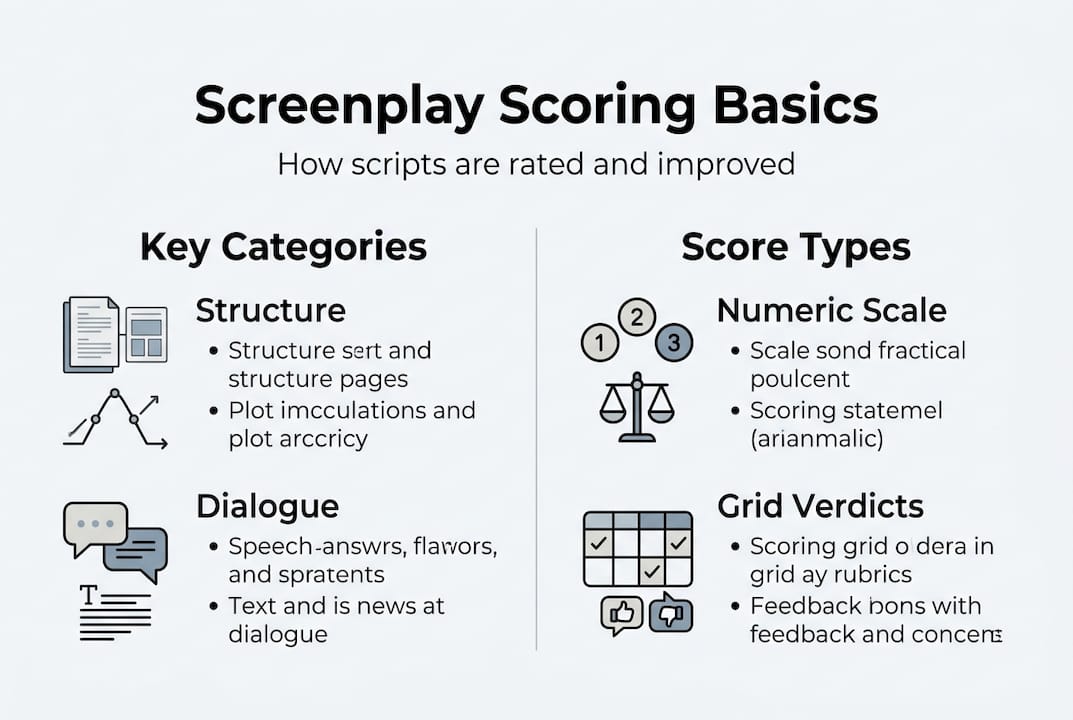
Scores are typically assigned using a numeric scale, often 1 to 10, or a grid system where each category receives a rating. The evaluation mechanics cover plot (structure, pacing, stakes), characters (arcs, motivations), dialogue (authenticity, subtext), theme, tone, and marketability. Each category is scored independently, and the overall verdict is a synthesis of all of them, not just an average.
Here's how the three main verdicts break down:
| Verdict | What it means | What to do next |
|---|---|---|
| Pass | Major structural or concept issues | Significant rewrite required |
| Consider | Real potential, but needs revision | Targeted rewrites, then resubmit |
| Recommend | Production-ready | Pitch immediately |
The numbers behind these verdicts are sobering. Fewer than 5% of scripts ever receive a Recommend rating. Most land in Pass or Consider territory, which is not a failure. It's information.
Here's a practical way to read your score report:
- Identify your lowest-scoring category. That's your priority rewrite target.
- Cross-reference with the written comments. Numbers alone don't tell the full story.
- Look for patterns across categories. A weak structure often pulls down character and plot scores simultaneously.
- Focus on Consider scripts first. If you're in Consider territory, you're closer than you think.
- Don't chase a perfect score. Chase a Recommend verdict. Those are different goals.
For writers exploring AI script scoring, the category-based system translates especially well to automated analysis. AI tools can apply consistent rubrics across every category without fatigue or bias. Understanding screenplay structure details becomes much easier when you can see exactly which structural beats are missing from your score report.
What readers look for: Industry standards and expert nuances
Knowing the categories is one thing. Understanding what actually impresses a reader within each category is where most writers gain the biggest advantage.
Industry readers are not looking for experimental genius on a first read. They're looking for competence against known standards, then originality within that framework. Readers prioritize industry standards like the three-act structure and an active protagonist, market fit over pure creativity, and actionable feedback over vague praise. That last point matters for you as the writer: a good coverage report should tell you what to fix, not just that something is broken.
Here's what experienced readers consistently flag as make-or-break elements:
- Protagonist agency: Your lead character must drive the story forward through active choices, not react passively to events around them.
- Clear stakes: By the end of Act One, readers need to know exactly what your protagonist stands to lose.
- Structural discipline: Midpoints, turning points, and act breaks should land where they're expected. Readers notice when they don't.
- Dialogue efficiency: Every line should either reveal character or advance plot. Preferably both.
- Concept clarity: If a reader can't summarize your premise in one sentence, that's a structural problem, not a marketing one.
Pro Tip: Before submitting for coverage, write your own one-sentence logline and a three-paragraph synopsis. If you struggle with either, your script likely has a structural issue that scoring will expose. Fix it before you pay for coverage.
Mastering screenplay structure is the single fastest way to improve your scores across multiple categories at once. Structure problems cascade. A weak midpoint creates pacing issues, which creates character arc problems, which tanks your dialogue score because characters say things that don't fit where they are in the story. Separately, dialogue essentials are often underrated by writers who focus on plot, but readers notice verbosity and on-the-nose exchanges immediately.

Human vs. AI scoring: Pros, cons, and new trends
The landscape of screenplay scoring has shifted significantly. In 2026, writers have access to both traditional human coverage and AI-driven scoring tools. Each has real strengths and real limitations.
Traditional human coverage versus AI scoring comes down to speed versus nuance. Human readers bring contextual judgment, cultural awareness, and the ability to recognize when a rule-break is intentional and brilliant. AI scoring is faster, more consistent, and removes the subjective mood a human reader might bring to your pages on a bad Tuesday afternoon.
| Factor | Human coverage | AI scoring |
|---|---|---|
| Speed | 3 to 7 days | 1-2 days by email |
| Cost | $60 to $400+ | $9 to $25 |
| Consistency | Varies by reader | Highly consistent |
| Nuance | High | Moderate |
| Bias | Present | Reduced |
| Best for | Final polish reads | Early development |
"AI scoring works best as the brutal first filter. It catches the structural problems you're too close to your own script to see. Human coverage catches the subtle ones."
One distinction worth making: actor scoring, where performers analyze a script for beats and character objectives, is a completely different process from industry coverage scoring. Actors score for performance; industry readers score for production viability. Don't confuse the two when interpreting feedback.
The smart approach in 2026 is to use both. Start with AI scoring to identify and fix foundational issues affordably. Then invest in human coverage once your script is structurally sound. You'll get more useful human feedback when the reader isn't spending the entire report explaining why your Act Two falls apart. For writers looking at expert script feedback, the combination of AI-first and human-second creates a more efficient, cost-effective development path.
A fresh take: Why scoring is your script's secret weapon
Here's what most writers get wrong about scoring: they treat it as a judgment rather than a tool. A Pass verdict feels like rejection. A Consider feels like a consolation prize. But that framing is backwards.
Scoring exposes the blind spots you cannot see yourself. You've lived inside your script for months. You know what you meant to write, so your brain fills in the gaps that aren't actually on the page. A scoring report reads only what's there, not what you intended. That gap between intention and execution is where most scripts die in development.
The uncomfortable truth is that most scripts are rejected not because they lack creativity, but because they miss key industry criteria that readers check in the first ten pages. Structure. Protagonist clarity. A hook that earns continued reading. These are learnable, fixable elements. Scoring tells you which ones you're missing.
Treat your scoring report as a roadmap, not a verdict. A low score in character development is not a statement about your talent. It's a specific instruction: go back and clarify your protagonist's motivation in Act One. That's actionable. That's useful. Understanding screenplay improvement through this lens turns every coverage report into a development session rather than a rejection letter. The writers who improve fastest are the ones who stop defending their scripts and start reading the scores.
Get professional screenplay scoring for actionable results
You now understand how screenplay scoring works, what the verdicts mean, and how to use the results to improve your script before it reaches a producer's desk. The next step is getting your own script scored.
At Roast My Script, we provide AI-driven script coverage starting at $9, with a 24 to 48-hour turnaround. You get a detailed PDF with category scores, structural analysis based on Syd Field, McKee, and Save the Cat methodology, and a clear verdict. It's designed to be the filter you use before investing in expensive human coverage or script doctors. If you want to go deeper, our resources on essential screenwriting concepts will help you understand exactly what high-scoring scripts do differently. Get your score, fix the issues, and pitch with confidence.
Frequently asked questions
What does Pass, Consider, and Recommend mean in screenplay scoring?
Pass signals major structural or concept issues that require significant rewriting. Consider means your script has real potential but needs targeted revisions, while Recommend is a production-ready rating awarded to fewer than 5% of scripts.
How are screenplay scores assigned?
Scores are numeric or grid-based, evaluating individual categories like concept, structure, characters, plot, dialogue, and marketability, with the overall verdict synthesized from all category results.
Is AI scoring as reliable as human coverage?
AI scoring is faster and more consistent across reads, which reduces subjective bias, but human coverage still provides richer contextual nuance, especially for tone and cultural fit.
Does screenplay scoring help with pitching to studios?
Yes. Scoring identifies specific structural and character weaknesses so you can revise before pitching, which means producers and development executives see a script that already meets baseline industry standards.
Does scoring cover format and logline quality?
Yes. Coverage includes logline and synopsis review alongside format assessment, giving you a complete picture of how your script presents before it reaches a reader's desk.