
Submitting a screenplay without professional feedback is like walking into a pitch meeting with your first draft. Most writers feel that knot in their stomach before hitting send, wondering if their structure holds up, if their protagonist is compelling enough, or if the whole thing falls apart in Act 2. Rejection stings worse when you never knew what was broken. Professional script evaluation follows a standardized process used by coverage services, readers, and industry professionals, and understanding that process gives you a real edge before you submit anywhere that matters.
Table of Contents
- Understanding script evaluation and coverage
- Preparing your script for professional evaluation
- Script evaluation steps: A step-by-step walkthrough
- Common mistakes and troubleshooting in script evaluation
- Verifying improvements and preparing for resubmission
- Boost your script's chances with affordable, expert evaluation
- Frequently asked questions
Key Takeaways
| Point | Details |
|---|---|
| Standard process matters | Following professional script evaluation steps increases your chances of positive feedback and industry recognition. |
| Preparation prevents rejection | Formatting, logline, and structural readiness are crucial for successful evaluations. |
| Use recurring feedback | Spotting patterns in multiple coverage notes helps target revisions for the most impact. |
| Rapid turnaround available | Affordable coverage services offer feedback within a week, letting you iterate faster. |
Understanding script evaluation and coverage
Script evaluation is the systematic review of your screenplay against industry standards. Script coverage, the written report that comes out of that review, is what professional readers produce for studios, agencies, and competitions. It tells decision-makers whether a script is worth their time. For writers, it tells you exactly where your script loses momentum, confuses readers, or misses the mark on concept.
Our script coverage guide breaks down what readers actually look for, but here is the short version: every evaluation touches the same core categories. Knowing these categories in advance helps you self-assess before you ever pay for feedback.
| Element | What gets evaluated |
|---|---|
| Concept | Originality, marketability, logline clarity |
| Structure | Three-act flow, turning points, pacing |
| Characters | Protagonist drive, arc, supporting roles |
| Dialogue | Authenticity, subtext, voice distinction |
| Formatting | Industry-standard layout, page count |
| Overall rating | Pass, consider, or recommend |
The Script Pipeline FAQ confirms that coverage services use this kind of standardized framework across the board. The rating at the end, Pass, Consider, or Recommend, is not arbitrary. It reflects how well your script performs across all these dimensions. A "Recommend" means your script gets forwarded to industry contacts. That is the goal.
Why does this matter for festival and producer submissions? Because readers at Sundance, Nicholl, and major production companies use the same evaluation lens. If your script cannot survive a coverage read, it will not survive the submission pile. Understanding analysis techniques used by professionals helps you internalize the standard before you submit.
Key elements every writer should know before submitting:
- Concept must be clear and marketable in one sentence
- Structure must hit recognizable turning points without feeling mechanical
- Protagonist must drive the story with clear motivation
- Dialogue must feel natural while advancing plot or character
- Formatting must meet industry standards or readers dismiss the script immediately
Preparing your script for professional evaluation
With a clear understanding of the evaluation process, let's make sure your script is ready for scrutiny. Submitting a messy draft wastes money and time. Readers notice sloppy formatting before they read a single line of dialog.
Here is a pre-submission checklist every writer should run through:
- Title page includes your name, contact info, WGA registration number if applicable
- Logline is one to two sentences, clear protagonist, conflict, and stakes
- Page count sits between 90 and 120 pages for features (drama can push 130)
- Formatting uses industry-standard software output (Final Draft, Highland, Fade In)
- Scene headings are consistent and correctly formatted
- Action lines are lean, present tense, and visual
- Character names are consistent throughout
Edge cases trip up a lot of writers. Script Pipeline's workshop FAQ flags that experimental scripts require a note explaining intentional convention breaks, scripts over 130 pages often incur additional fees, and genre mismatches or passive protagonists get flagged heavily in coverage. If your horror script reads like a slow drama, readers will note the mismatch and score it down.
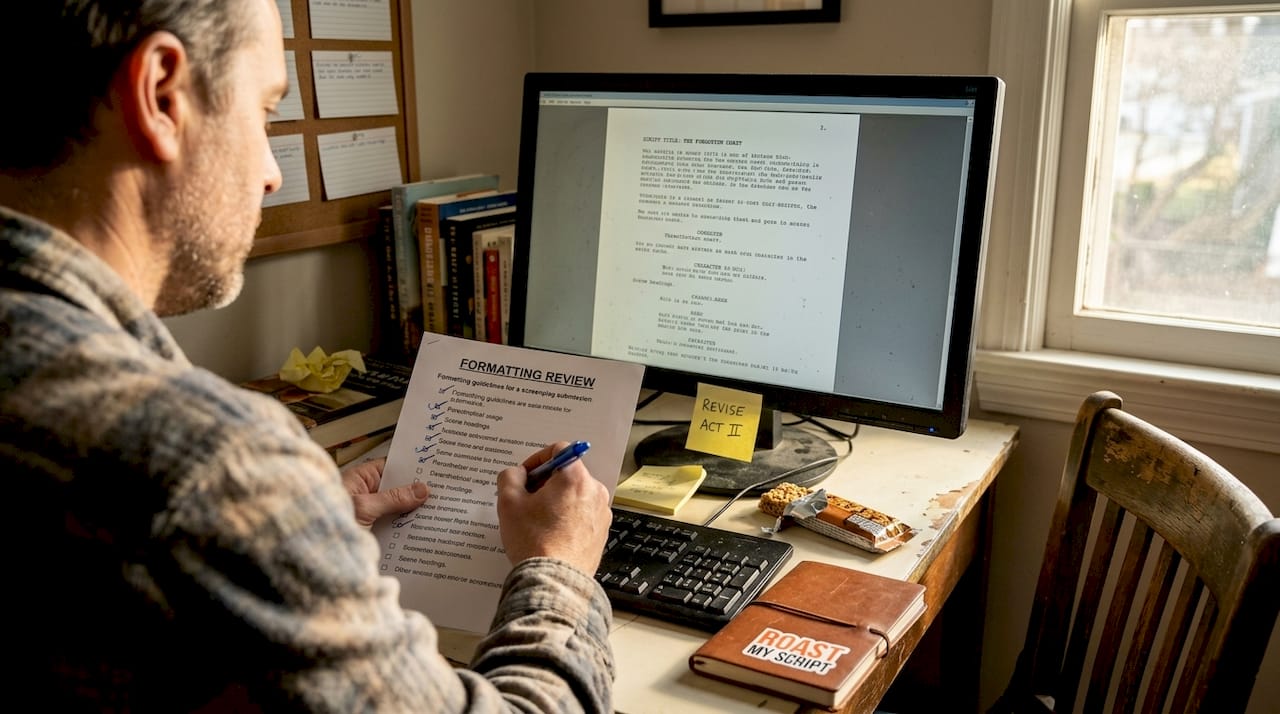
Our script formatting guide covers the technical side in detail. For the title page specifically, check our title page guidelines to avoid the small errors that signal amateur work. And if your logline is vague or missing, read our logline guidance before you submit anything.
Pro Tip: Write your logline before you prep your submission, not after. If you cannot summarize your script in two sentences with a clear protagonist, conflict, and stakes, your structure probably has a problem worth fixing first.
Script evaluation steps: A step-by-step walkthrough
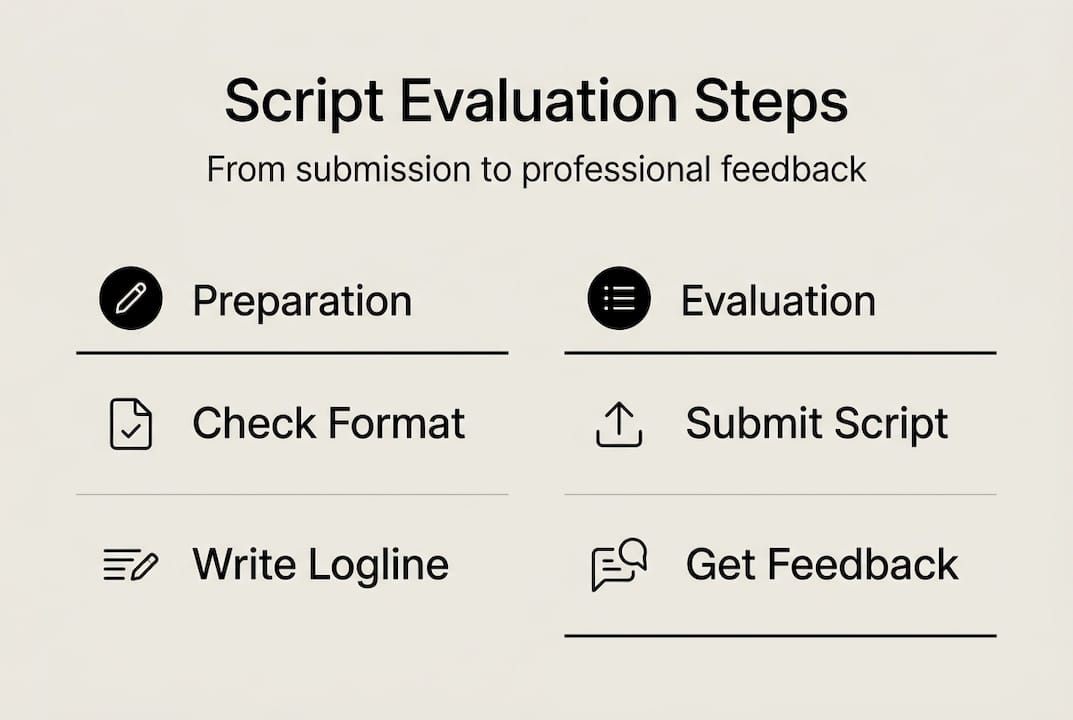
Once your script is properly prepped, it is time to follow the standardized evaluation steps. This is the actual workflow a professional reader uses, and mirroring it in your own self-review will sharpen your script before you pay for coverage.
- Intake and registration. The service logs your script, confirms page count, and assigns a reader. You receive a confirmation with an estimated turnaround.
- Initial cold read. The reader reads your script straight through without stopping. This simulates the producer experience. First impressions of pacing, tone, and engagement are noted here.
- Structure analysis. The reader maps your act breaks, midpoint, and key turning points against frameworks like Hollywood screenplay structure or the Save the Cat method. Sagging midpoints and weak Act 3 launches are flagged here.
- Character and depth review. Protagonist motivation, character arc, and supporting cast function are assessed. A passive protagonist who reacts instead of drives is one of the most common deal-breakers.
- Concept and marketability. The reader evaluates genre clarity, originality, and commercial viability. Understanding essential screenwriting concepts helps you anticipate this step.
- Formatting compliance. Technical issues are logged: incorrect slug lines, dense action blocks, overwritten dialog, or non-standard formatting.
- Summary notes and scoring. The reader writes a synopsis, strengths, weaknesses, and a final rating. This is your coverage document.
Here is how the three main evaluation approaches compare:
| Approach | Turnaround | Cost range | Best for |
|---|---|---|---|
| Traditional human coverage | 7-14 days | $60-$400 | Final polish before major submission |
| AI-assisted coverage | 1-2 days by email | $9-$25 | Early structural feedback, fast iteration |
| Hybrid (AI + human review) | 3-7 days | $30-$150 | Mid-draft validation with human context |
Affordable services like Script Pipeline ($75-$175) provide professional feedback pre-submission, prioritizing high-impact fixes like structure before polish. The script coverage overview confirms this approach is standard across the industry. Our guide to story structure explained is a useful companion when you are reviewing structural notes.
Pro Tip: Fix structural problems before cosmetic ones. A perfectly formatted script with a broken Act 2 still gets a Pass. A slightly rough script with a compelling protagonist and tight structure gets a Consider or better.
Common mistakes and troubleshooting in script evaluation
Evaluation often highlights recurring mistakes. Here is how to spot patterns and actively troubleshoot instead of just feeling defensive about notes.
The most common issues flagged in professional coverage:
- Passive protagonist. Your lead character reacts to events instead of driving them. Readers flag this immediately because it kills audience investment.
- Genre mismatch. Your tone does not match your genre label. A comedy that is not funny or a thriller with no tension confuses readers and signals a concept problem.
- Sagging middle (Act 2). The most common structural failure. Without a strong midpoint and escalating obstacles, Act 2 becomes a waiting room.
- Excessive length. Scripts over 120 pages for a standard feature signal pacing problems. Over 130 pages and you are paying more for coverage and losing reader goodwill.
- On-the-nose dialog. Characters say exactly what they mean with no subtext. It reads as amateur and kills authenticity.
"Writers should seek services with named, experienced readers with 5 to 20 or more years in the industry over anonymous services for reliability. Using multiple coverages helps spot recurring patterns in feedback rather than treating any single note as definitive." Script Pipeline Workshop FAQ
Troubleshooting actions that actually move the needle:
- Get two or three coverage reads from different services. If three readers flag the same Act 2 problem, it is real.
- Track every note in a spreadsheet. Categorize by element (structure, character, dialog). Patterns become obvious fast.
- Prioritize fixes by impact. Structure and protagonist issues affect every page. Dialog polish affects individual scenes.
- Use our AI scriptwriting guide to understand how AI tools can help you iterate faster between coverage rounds.
One thing writers underestimate: the difference between a named reader with industry experience and an anonymous service. Anonymous coverage can be inconsistent. Named readers with verifiable credits give you feedback you can trust and act on.
Verifying improvements and preparing for resubmission
After acting on feedback, validating your changes is the key to strengthening your script before resubmission. This step is where most writers skip ahead too fast. They fix the notes, do a quick read-through, and resubmit. That is not verification. That is hope.
Here is a structured approach to confirming your improvements actually work:
- Build a revision checklist. List every note from your coverage by category. Check each one off only when you have made a specific, traceable change to the script.
- Map your fixes against the original issues. If Act 2 was flagged for sagging, identify the exact pages where the problem lived and confirm the new version has escalating tension across those pages.
- Run a fresh cold read. Print your revised draft and read it in one sitting. Note where you slow down, get confused, or lose interest. Those spots still need work.
- Analyze feedback patterns across multiple rounds. Using coverage to improve your draft means prioritizing recurring issues like a sagging Act 2, tracking revisions with checklists, and resubmitting for validation.
- Submit for a second coverage round. Use a different service or reader to confirm your fixes land with a fresh set of eyes.
The numbers back up this process. Script Pipeline has facilitated over $8 million in script sales, with coverage turnaround running 7 to 12 days. Scripts rated Recommend get forwarded directly to industry contacts. That rating is earned through exactly this kind of iterative improvement process.
Our script analysis tools can help you run a faster self-assessment between paid coverage rounds. The goal is to enter each new coverage round with a meaningfully stronger draft, not the same script with minor tweaks.
One benchmark worth tracking: If your second coverage round produces the same core notes as your first, your revision process is not working. Different notes mean real progress. Repeated notes mean the root problem was not addressed.
Boost your script's chances with affordable, expert evaluation
You now have the full picture: what evaluation covers, how to prep your script, the step-by-step workflow professionals use, the mistakes to avoid, and how to verify your improvements before resubmission. The next move is getting real feedback on your actual pages.
Frequently asked questions
How long does professional script evaluation typically take?
Most coverage services deliver feedback in 7 to 12 days, though AI-assisted services like Roast My Script turn around analysis in 1-2 days by email.
What are the most common reasons scripts are rejected in evaluations?
Passive protagonists, genre mismatches, weak structure, and scripts over 130 pages are the top reasons professional readers give negative ratings.
Should I use multiple coverage services or stick with one?
Using multiple services with named, experienced readers helps you identify recurring patterns rather than treating any single note as the final word.
How do I verify my script improvements before resubmission?
Track every revision with a checklist, confirm recurring issues like a sagging Act 2 are genuinely resolved, and submit for a second coverage round to validate your fixes with fresh eyes.
Recommended
- How to analyze a script for powerful screenplay improvement | ROAST MY SCRIPT
- Roast My Script | AI Script Coverage & Analysis from $9
- Top 4 aiscriptreader.com Alternatives 2026 | ROAST MY SCRIPT
- Script format impact: 90% boost production & pitch success | ROAST MY SCRIPT
- Screenplay Coverage | Stonington Media LLC