
TL;DR:
- Script market readiness means a polished, industry-standard script with clear commercial potential.
- Achieving readiness involves multiple drafts, objective feedback, and adherence to professional formatting and structure.
- External script coverage and feedback help determine if a script is truly ready for submission and market success.
Finishing your screenplay feels like crossing a finish line. You type FADE OUT, exhale, and start imagining your name in the credits. But here's the uncomfortable truth: a completed draft and a market-ready script are two very different things. Most scripts that land in a reader's inbox fail not because the writer lacks talent, but because they were submitted before they were genuinely ready. This guide breaks down what market readiness actually means, the steps to achieve it, how objective feedback fits into the process, and the advanced pitfalls that trip up even experienced writers.
Table of Contents
- What does script market readiness really mean?
- Essential steps to achieve script market readiness
- Using script coverage and objective feedback
- Common pitfalls and advanced market readiness strategies
- What most writers miss about script market readiness
- Take your script to market readiness with expert feedback
- Frequently asked questions
Key Takeaways
| Point | Details |
|---|---|
| Market readiness defined | A truly market-ready script goes beyond completion, meeting both creative and business standards. |
| Essential preparation steps | Iterative drafts, objective checklists, and professional feedback are crucial before submitting your script. |
| Role of script coverage | Coverage and affordable AI assessments provide unbiased views and benchmark your script against industry expectations. |
| Avoid overlooked pitfalls | Period pieces or overly long scripts can sabotage your chances, no matter the craft. |
| Feedback from the right readers | Consistent, positive feedback from unrelated industry readers signals real market readiness. |
What does script market readiness really mean?
Let's be direct. A finished draft means you've told your story. A market-ready script means the industry can sell it. Those are not the same thing.
Script market readiness means a screenplay is polished, marketable, and ready for industry submission, featuring strong craft, clear commercial potential, and professional execution. That definition has two sides: creative and business. Both must be satisfied before you submit anywhere.
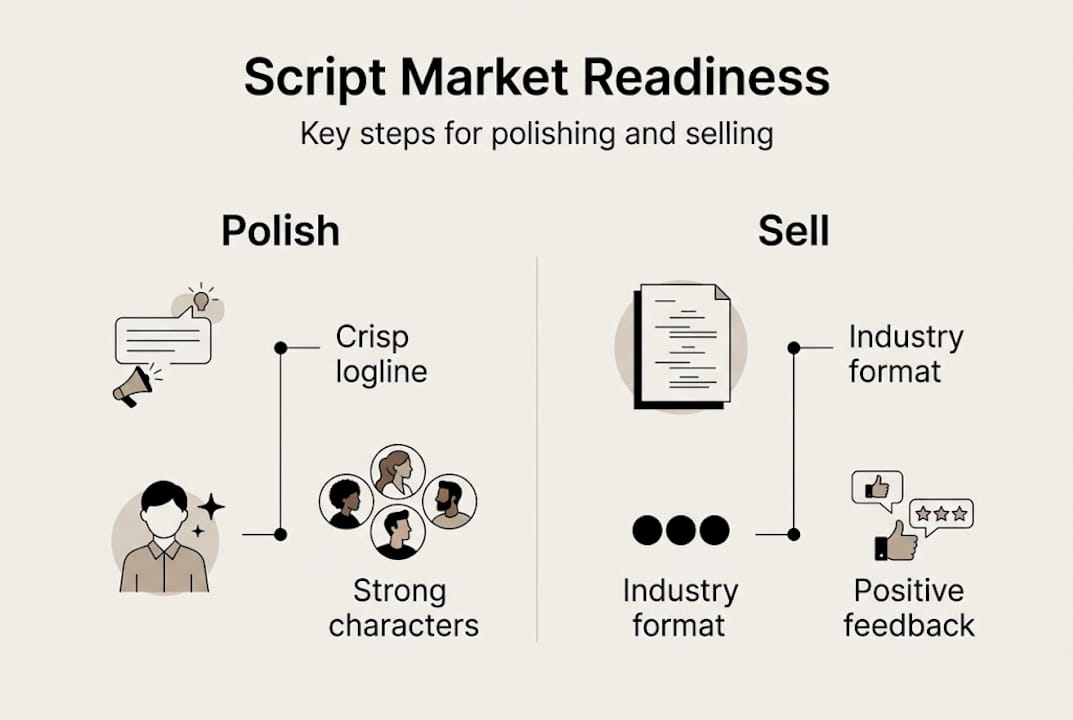
With the stakes clarified, let's break down what market readiness actually comprises.
Core features of a market-ready script:
- A strong concept with a logline that can be pitched in one sentence. If you can't craft a compelling logline, the script isn't ready.
- Clear genre identity. Buyers need to know exactly where it sits on the shelf.
- Budget awareness. A debut writer submitting a $200M period epic is ignoring market reality.
- Genuine emotional stakes. Readers must care what happens to your protagonist.
- Sharp, differentiated dialogue and complete character arcs.
Here's a direct comparison of where most writers are versus where they need to be:
| Criteria | Finished draft | Market-ready script |
|---|---|---|
| Story complete | Yes | Yes |
| Logline sharp | Often vague | Clear and compelling |
| Genre defined | Loosely | Precisely |
| Page count | Variable | 90 to 110 pages |
| Formatting | Approximate | Industry standard |
| Character arcs | Present | Fully resolved |
| Budget awareness | Ignored | Considered |
| Feedback received | Friends/family | Industry readers |
Industry buyers read dozens of scripts per week. They prioritize clarity and marketability above all else. A script that requires explanation or goodwill to appreciate will not advance. You need to master screenplay structure so thoroughly that the reader never has to work to follow your story.
"The gap between a completed draft and a submission-ready screenplay is where most careers stall. Market readiness is a professional standard, not a personal milestone."
Understanding this gap is the first step. Closing it requires a deliberate, repeatable process.
Essential steps to achieve script market readiness
Knowing the end-state helps, but how do you actually get there?
The script development process is not linear, but it does follow a clear progression. Most working writers go through far more iterations than beginners expect. Iterative drafting of 10 to 20 drafts, professional feedback loops, test reads from trusted industry contacts, and a final polish for formatting, typos, and length (with 90 to 110 pages as the ideal range) are all standard mechanics in the process.
Here is a practical roadmap:
- Complete your first draft without self-editing. Get the story out. Don't stop to fix problems mid-draft.
- Do a structural pass. Identify act breaks, midpoints, and character arc completions before fixing dialogue or scenes.
- Read it aloud. Dialogue problems reveal themselves immediately when spoken.
- Get early feedback from a trusted reader. One person, focused on story logic, not line edits.
- Revise based on structural notes. Fix the architecture before repainting the walls.
- Apply an industry checklist for readiness. Check for passive voice, orphaned subplots, unclear scene headings, and pacing issues.
- Verify formatting essentials. Industry-standard formatting is non-negotiable.
- Set the script aside for at least two weeks. Fresh eyes catch errors that familiarity hides.
- Final proofread. Typos and formatting inconsistencies signal unprofessionalism.
- Get professional coverage or objective feedback before submitting anywhere.
Pro Tip: Set your draft aside for a full month before your final review. The distance is not wasted time. It's the difference between reading what you meant to write and reading what's actually on the page.
Objective checklists matter here. You are too close to your own material to catch every flaw. Systematic review, not gut feeling, is what separates writers who improve from writers who repeat the same mistakes across multiple drafts.
Using script coverage and objective feedback
Polishing alone isn't enough. Let's see how external feedback can make or break your script's prospects.
Script coverage is the industry's standard tool for evaluating screenplay readiness. A coverage report provides a synopsis, scene-by-scene analysis, and ratings across key criteria. The final verdict falls into one of three categories: Pass, Consider, or Recommend.
Here is what a standard coverage rubric looks like:
| Element | What's evaluated | Score range |
|---|---|---|
| Concept | Originality, commercial appeal | 1 to 10 |
| Plot | Structure, pacing, logic | 1 to 10 |
| Characters | Arcs, motivation, differentiation | 1 to 10 |
| Dialogue | Voice, subtext, efficiency | 1 to 10 |
| Marketability | Genre fit, budget, audience | 1 to 10 |
| Overall | Pass / Consider / Recommend | Final verdict |
The coverage methodology is clear: fewer than 1% of scripts receive a Recommend rating. That number is not meant to discourage you. It's meant to calibrate your expectations. A Consider is a real achievement and signals genuine potential. A Pass with detailed notes is still valuable data.
Affordable feedback through coverage services typically runs $75 to $200 for standard human coverage. AI-powered tools bring that cost down significantly, making objective pre-submission assessment accessible to writers at every budget level.
What to look for in a coverage service:
- Specific, actionable notes (not just scores)
- Feedback on marketability, not just craft
- Turnaround time that fits your submission timeline
- Transparency about who is reading (human, AI, or both)
Pro Tip: If two or more independent coverage readers give your script a Consider or Recommend, that's a meaningful green light. One positive read can be an outlier. Multiple positive reads across different readers is a pattern worth trusting.
AI tools have made this process faster and cheaper. AI script analysis techniques can identify structural gaps, pacing issues, and dialogue inconsistencies at a fraction of the cost of traditional coverage. Understanding how AI transforms scriptwriting helps you use these tools strategically rather than treating them as a shortcut.
Common pitfalls and advanced market readiness strategies
But even with coverage and polish, some overlooked factors can keep a script from being truly ready.
Experienced writers make these mistakes too. Knowing the edge cases is what separates a script that gets passed on from one that gets optioned.
Common submission mistakes include period pieces with high budgets, scripts running over 110 pages, passive protagonists who react rather than drive the story, Act 2 that doesn't begin early enough, and writers who have no follow-up scripts ready when a rep asks.
Here are advanced strategies to address these issues:
- Lock your Act 2 entry early. Your protagonist should be fully committed to the central conflict by page 25 at the latest. Readers lose patience fast.
- Build a script portfolio. Managers and producers want to know you can write more than one story. Have at least one follow-up script ready before you start submitting.
- Prioritize voice over formula. Structure matters, but managers are looking for a writer with a distinct point of view. A script that hits every beat mechanically but sounds like everyone else won't stand out. Master story flow so well that your structure becomes invisible.
- Balance craft with market awareness. Know what's selling. Not to copy it, but to understand where your script fits and how to position it.
- Avoid budget traps. If your script requires 50 speaking roles, multiple international locations, and a third-act battle sequence, you're writing yourself out of the market as a debut writer.
"In the US market, a screenplay is a business document first. Clarity, efficiency, and commercial viability are not compromises to your art. They are the conditions under which your art gets made."
That mindset shift is hard for writers who came to screenwriting through a love of film. But it's the shift that separates writers who get meetings from writers who get form rejections.
What most writers miss about script market readiness
Here's what experience has shown me about what really determines a script's market fate, and it's not what most guides focus on.
The biggest trap is feedback loop bias. You share your script with people who care about you. They give you encouraging notes. You revise. You share again. The loop feels productive, but it's a closed system. Your trusted circle is not the market.
Readiness is confirmed by consistent positive feedback from multiple trusted readers who have no personal investment in your success. That means industry-savvy readers, coverage services, or peers who will tell you the truth. Avoid premature submission without that kind of pre-testing.
A script that impresses your writing group but confuses a stranger is not market-ready. The benchmark is clarity and impact for someone who owes you nothing.
Another trap is trend-chasing. Writers hear that a certain genre is hot and reshape their script to fit. The result is usually a script that feels derivative and lacks the authentic voice that makes a script memorable. Study the Save the Cat methodology for structure, but use it to serve your story, not to replace your instincts.
Finally, don't burn your shot by rushing. Waiting one more month to submit is almost always the right call.
Take your script to market readiness with expert feedback
You've done the work to understand what market readiness actually demands. Now the question is: does your script clear that bar?
At Roast My Script, we built an affordable, fast alternative to traditional coverage precisely for this moment. Upload your script, and within 1-2 days by email you receive a structured PDF analysis grounded in Hollywood methodology, covering structure, character, dialogue, and marketability. It's the brutal first filter before you invest in expensive coverage or pitch to producers. Start by exploring how to master essential screenwriting concepts, then get your script in front of affordable script coverage that gives you honest, actionable feedback when it matters most.
Frequently asked questions
How do I know if my script is market-ready?
A market-ready script is polished, has a compelling logline, fits industry standards, and receives consistent positive feedback from trusted readers who have no personal stake in your success.
What is script coverage and why does it matter?
Script coverage offers professional analysis and grades your script across story, structure, and market potential. Fewer than 1% of scripts earn a Recommend rating, making it the clearest benchmark for true market readiness.
How much does professional script feedback usually cost?
Standard coverage services typically run $75 to $200, while AI-powered tools like Roast My Script offer structured analysis starting at $9, making objective feedback accessible at any budget.
Should I avoid submitting period pieces or long scripts?
Period pieces with high budgets and scripts over 110 pages are considered high-risk by most buyers, especially for debut writers without an established track record.
Recommended
- Script Development Process: Preparing for Hollywood Success | ROAST MY SCRIPT
- Script format impact: 90% boost production & pitch success | ROAST MY SCRIPT
- How to analyze a script for powerful screenplay improvement | ROAST MY SCRIPT
- Roast My Script | AI Script Coverage & Analysis from $9
- Script formatting explained: The key to screenplay success