
TL;DR:
- A script reader report is a diagnostic tool that provides actionable feedback for screenplay revision.
- Effective use of the report involves understanding its sections, prioritizing structural issues, and viewing feedback as industry intelligence.
- Most successful writers treat reports as strategic guides, using repeated, focused revisions to improve marketability.
Most screenwriters treat a script reader report like a report card: scan for the grade, feel relieved or crushed, then move on. That reaction wastes one of the most actionable tools in the industry. A script reader report is not a judgment. It is a roadmap. The writers who consistently break through do not just receive these reports. They learn to read them strategically. This guide breaks down exactly what a script reader report contains, what each section means for your revision process, and how to use that feedback to make your screenplay genuinely competitive before it lands on anyone's desk that matters.
Table of Contents
- What is a script reader report?
- Inside a script reader report: Key sections explained
- How script reader feedback shapes your revision process
- Maximizing value: Common pitfalls and what most writers miss
- Our perspective: Why understanding script reader reports is your secret weapon
- Ready to take your script to the next level?
- Frequently asked questions
Key Takeaways
| Point | Details |
|---|---|
| Clarity in feedback | Understanding script reader reports gives you actionable, targeted notes for improvement. |
| Revision roadmap | Treat the report as a blueprint to address strengths and weaknesses before submitting your script. |
| Avoiding pitfalls | Don’t overlook formatting and recurring notes—these often mean the difference between rejection and a call back. |
| Market readiness | Scripts improved using reader feedback have a higher chance of success in the industry. |
What is a script reader report?
A script reader report is a structured written evaluation of a screenplay, produced by a trained reader who assesses your script against industry standards. Think of it as a diagnostic document. Its job is to tell you not just whether your script works, but specifically where and why it does or does not.
Script reader reports provide structured feedback, analyzing key screenplay elements for market readiness. That includes everything from your opening hook to your third-act resolution. The report is meant to simulate how a development executive, producer, or festival programmer would respond to your work.
A standard report typically includes:
- Logline: A one or two sentence distillation of your story's core premise
- Synopsis: A neutral summary of the plot, usually one to three pages
- Strengths: What the script does well, with specific references
- Weaknesses: Structural, character, or dialogue problems that undercut the story
- Notes: Targeted observations on plot, pacing, character arcs, and formatting
- Recommendation: A pass, consider, or recommend rating
Many writers confuse script reader reports with script coverage. They are related but not identical. Coverage is typically a shorter internal document written for executives to decide quickly whether a script is worth their time. A reader report, by contrast, is written for the writer. It prioritizes explanation over executive brevity. You can learn more about the distinctions in our script coverage vs reader reports breakdown.
You will typically encounter reader reports when submitting to competitions, production companies with open submission policies, or paid coverage services. Some writers commission them proactively before any submission at all, which is exactly the right instinct.
Pro Tip: When requesting a report, be specific about your goals. Are you trying to fix structure before a festival deadline? Strengthen dialogue before a pitch? Telling the reader your priority helps them focus their notes where you need them most.
Inside a script reader report: Key sections explained
With the basics in mind, let's break down exactly what you'll find when you open a script reader report.
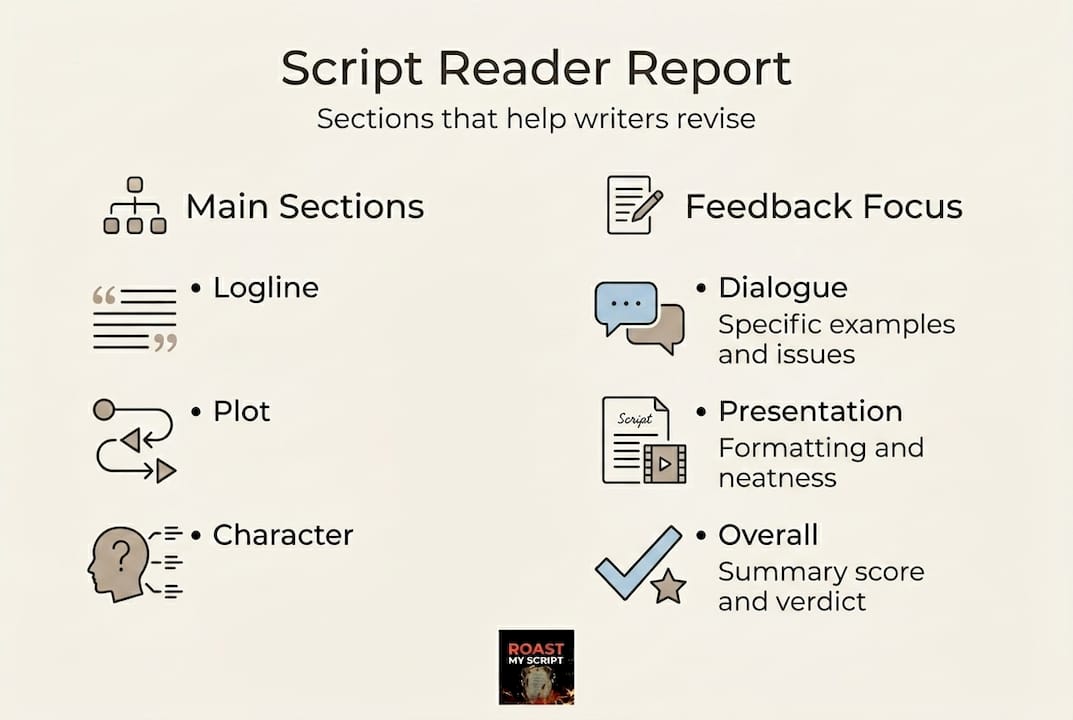
Coverage reports typically include a logline, comments on plot, character, dialogue, presentation, and an overall recommendation. Here is how each piece actually functions:

| Section | What it contains | What it means for you |
|---|---|---|
| Logline | One to two sentence premise summary | Tests whether your concept is clear and marketable |
| Synopsis | Neutral plot summary | Reveals if your story logic holds under scrutiny |
| Strengths | Specific positives | Shows what to protect and amplify in revision |
| Weaknesses | Structural or craft problems | Identifies priority areas for rewriting |
| Plot notes | Scene and act level observations | Pinpoints pacing gaps and structural issues |
| Character notes | Arc, motivation, and consistency feedback | Flags thin or contradictory characterization |
| Dialogue notes | Verbosity, authenticity, and subtext issues | Directly tied to reader engagement |
| Formatting notes | Industry standard compliance | Affects professional perception immediately |
| Recommendation | Pass, consider, or recommend | Simulates the executive decision you are trying to influence |
The recommendation tier deserves its own attention. A pass means the script is not ready for consideration in its current state. A consider means there is potential but significant work remains. A recommend means the script is competitive. Most working screenwriters are aiming to move from consider to recommend through revision.
Formatting gets its own section in most reports for a good reason. It signals professionalism before a single scene is read. Poor formatting tells a reader your script may not be ready. You can review specifics in our structure section for common structural missteps that also affect format perception.
"A pass is not a verdict on your talent. It is feedback on the current draft. The writers who treat it that way are the ones who eventually earn recommends."
Every section of the report connects to a concrete revision lever. The writers who understand this finish stronger drafts faster.
How script reader feedback shapes your revision process
Now that you know the parts of a report, it is time to see how those observations translate into concrete improvements.
Effective revisions based on reader feedback improve a script's marketability in ways that writers often cannot achieve by self-editing alone. The distance between writer and material is real. A reader gives you that distance without requiring you to wait six months and reread your own work.
Here is a practical five-step process for turning report feedback into a stronger draft:
- Read the full report once without reacting. Let it land. Do not open Final Draft or Fade In yet. Your first job is to absorb, not defend.
- Categorize every note as structural, character, or craft level. Structural notes touch your act breaks and major plot turns. Character notes address arcs and motivation. Craft notes cover dialogue, pacing, and formatting.
- Identify patterns across sections. If plot notes, character notes, and the overall comments all reference a weak second act, that is your real priority. One mention could be a preference. Three mentions is a problem.
- Prioritize structural fixes before line-level edits. Rewriting dialogue in a scene that may need to be cut entirely is wasted effort. Fix the architecture first.
- Apply the notes and do a targeted read-through. Once revisions are done, re-read only the scenes that were flagged to confirm the problems are resolved.
Translating general feedback into specific action is a skill. If a report says "too much exposition in act one," that means find every scene where a character explains something the audience could figure out from context, then cut or convert it to action and subtext.
Pro Tip: Avoid the trap of taking critical notes personally. A note on your dialogue is not a comment on your voice as a writer. It is information about how a specific exchange lands for an industry-trained reader. That is genuinely useful data. Feedback on dialogue is closely linked with industry acceptance and rejection rates, which means improving it based on reader notes has a measurable impact.
You can also use the formatting importance resources on our site to address any presentation flags quickly and cleanly before your next submission.
Maximizing value: Common pitfalls and what most writers miss
Equipped with revision strategies, it is just as important to avoid the traps that can undermine your script's potential.
Here are the most common mistakes writers make with script reader reports:
- Over-focusing on praise. Strengths matter, but spending your revision energy protecting what already works keeps you from fixing what does not.
- Dismissing formatting notes. This feels minor. It is not. Proper formatting can dramatically improve a script's chance for serious consideration by signaling that you understand industry standards.
- Resubmitting without meaningful revision. Sending the same script to a competition or company after receiving a consider or pass, with only cosmetic changes, wastes your submission fee and your opportunity.
- Treating the recommendation as the entire report. A pass with detailed, specific notes is more valuable than a consider with vague praise. The notes are the report. The recommendation is just the summary.
- Ignoring notes you disagree with. You do not have to act on every note. But dismissing notes simply because they are uncomfortable is a mistake. Sit with the discomfort before you decide.
| Effective use of reports | Ineffective use of reports |
|---|---|
| Prioritizing recurring feedback across sections | Fixing only surface-level grammar and typos |
| Using notes to restructure weak acts | Defending creative choices internally instead of testing them |
| Getting multiple reports before major submissions | Acting on the first report without checking for consistency |
| Treating formatting flags as quick wins | Skipping formatting notes entirely |
| Reading the synopsis section to test story clarity | Skimming only the recommendation and strengths |
Pro Tip: Before submitting to a major festival or production company, get at least two independent reports. If both flag the same problem, that problem is real. If they contradict each other, you have a judgment call. Either way, you are making a more informed decision. You can also use a formatting guide to clear up presentation issues before any report even reaches that section.
Our perspective: Why understanding script reader reports is your secret weapon
Here is what most articles on this topic will not say directly: the majority of screenwriters who receive reports read them wrong. They skim for validation or wince at criticism, then file the PDF and move on. That is not how competitive writers use this tool.
The writers we see make real progress treat each report like a business document. They study it. They map the feedback against their own intentions for the script. Then they make deliberate decisions, not reactive ones.
Knowing who script readers are and what they are actually trained to evaluate changes how you receive their notes. A reader is not your audience. They are a proxy for the industry professional who will decide your script's fate in the next step. Understanding that context turns feedback from criticism into intelligence.
The real marketplace advantage is not a better logline or cleaner formatting. It is the professional habit of using feedback to make intentional revisions. That habit, built over multiple drafts and multiple reports, is what separates writers who break through from writers who keep wondering why they do not.
Ready to take your script to the next level?
If you have made it this far, you already think about your craft more seriously than most. The next step is getting a reader report that gives you the specific, honest feedback your script needs before it goes anywhere important.
At Roast My Script, we deliver AI-driven script analysis starting at $9, with a turnaround of 1-2 days by email. The report covers structure, character, dialogue, formatting, and market readiness using methodology grounded in Syd Field, McKee, and Save the Cat. It is designed to be your brutal first filter before you invest in expensive coverage or pitch sessions. Explore our master screenwriting concepts library and our character dimensionality masterclass to keep building while your report is in progress.
Frequently asked questions
How detailed are typical script reader reports?
Most reports include a logline, synopsis, and targeted comments across plot, character, dialogue, and formatting, followed by an overall recommendation. Coverage reports include logline, comments on plot, character, dialogue, and a final recommendation as standard components.
Should I always act on every note in the report?
Not every note requires a rewrite, but effective report use involves focusing on substantial, recurring feedback that aligns with industry standards rather than treating every comment as equally urgent.
What's the difference between script coverage and script reader reports?
Coverage is a short internal document written for executive decision-making, while a reader report is written for the writer with detailed breakdowns of craft and structure. Script coverage is intended for buyers' quick decisions, while reader reports are built to support revision and improvement.
How much does a professional report cost?
Prices vary widely depending on the service and depth of analysis, but AI-driven options like Roast My Script start at $9 and deliver results within 48 hours, making professional-grade feedback accessible at any budget.
Why are notes on formatting so important?
Formatting is the first signal a reader receives about your professionalism, and correct formatting boosts production and pitch success rates significantly, making it one of the fastest wins available in any revision cycle.
Recommended
- What is a script reader? A 2026 guide for screenwriters | ROAST MY SCRIPT
- Script format impact: 90% boost production & pitch success | ROAST MY SCRIPT
- How to analyze a script for powerful screenplay improvement | ROAST MY SCRIPT
- Roast My Script | AI Script Coverage & Analysis from $9
- What is professional screenplay coverage, really? | Stonington Media LLC