
TL;DR:
- Screenplay competitions offer industry validation, feedback, and networking opportunities despite low odds of winning.
- Entries require proper formatting, thoughtful selection, and often include fees and multiple judging rounds focused on storytelling criteria.
- Using contests strategically for feedback and development is more effective than chasing wins, which are rare and not guaranteed.
Most screenwriters know the odds are brutal. The Nicholl Fellowship, one of the most prestigious contests in Hollywood, receives roughly 7,500 entries per year with less than 1% reaching the finals. Yet thousands of writers keep entering, and for good reason. Screenplay competitions are not just about winning. They are one of the few structured pathways where an unknown writer can get professional eyes on their work, earn credible validation, and sometimes land real industry introductions. This guide explains what these contests are, how they actually work, how scripts get judged, and how to approach them strategically rather than blindly.
Table of Contents
- Defining screenplay competitions: Purpose, players, and industry context
- How screenplay competitions work: Mechanics, formats, and rules
- How scripts are judged: Criteria, feedback, and advancement
- Benefits, drawbacks, and the reality for writers
- Industry perspective: What most writers get wrong about competitions
- Next steps: Maximize your script's potential with expert feedback
- Frequently asked questions
Key Takeaways
| Point | Details |
|---|---|
| Screenplay competitions explained | These are contests where writers submit scripts for feedback, prizes, and career opportunities. |
| Entry and judging mechanics | Expect fees, format rules, and multiple rounds with scripts evaluated on writing and originality. |
| Feedback-focused value | Top contests offer professional notes making them useful for development even if you don’t win. |
| Low odds, big returns | Finalist rates are under 1% but winners can gain connections and exposure impossible elsewhere. |
| Invest strategically | Prioritize contests with feedback and a proven track record rather than chasing every trophy. |
Defining screenplay competitions: Purpose, players, and industry context
At its core, a screenplay competition is a contest where aspiring and established screenwriters submit original scripts for judging by industry professionals. That is the clean definition. But the reality is more layered.
These events serve multiple functions at once. For writers, they offer a structured deadline, external feedback, and a shot at recognition. For the industry, they function as a talent pipeline, surfacing voices that agents and producers might not encounter through traditional channels.
The players in this space vary widely:
- Major prestige contests: The Academy Nicholl Fellowships, Script Pipeline, and Shore Scripts are considered top-tier. Winning or placing in these carries real weight on a query letter.
- Feedback-focused contests: BlueCat and Shore Scripts guarantee written notes to every entrant, making them valuable even if you do not advance.
- Genre-specific contests: Some competitions focus on horror, comedy, or TV pilots, letting writers target their niche directly.
- Festival-affiliated contests: Many film festivals run screenplay competitions as part of their programming, offering exposure to producers and directors in attendance.
Prizes across these events typically include some combination of cash awards, written coverage, mentorship sessions, and introductions to managers, agents, or production companies. The Nicholl, for example, awards up to $35,000 to fellows and circulates their scripts within the Academy community.
Why do competitions matter beyond the prize? Three reasons stand out:
- Feedback: Even a quarterfinalist placement tells you your script cleared an initial professional read.
- Industry access: Placing in a reputable contest opens doors that cold queries often cannot.
- Credibility: Contest placements signal to producers that your script has passed a filter beyond your own judgment.
If you are still working out the fundamentals of your story, it helps to start with explaining screenplay genres before deciding which competition fits your script best.
"The best competitions do not just reward the winner. They create a ladder for writers at every stage to measure where their work actually stands."
How screenplay competitions work: Mechanics, formats, and rules
Now that you know what these contests are, let's break down exactly how they work, step by step.
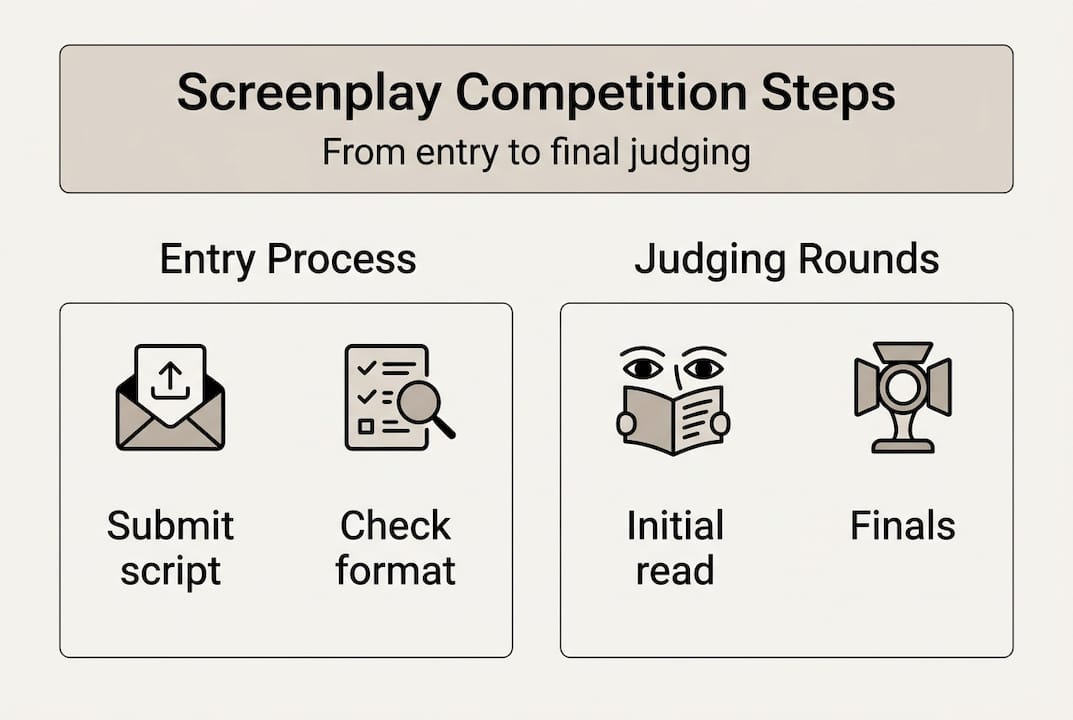
Entry typically involves a fee ranging from $40 to $95, a PDF submission between 80 and 125 pages, and multiple deadline tiers that reward early submission with lower fees. Most major contests open submissions in the fall or winter and close in the spring, with results announced in summer or fall.
Here is what a standard submission process looks like:
- Choose your contest based on genre fit, feedback offerings, and reputation.
- Prepare your script in standard industry format, typically using Final Draft or a compatible tool.
- Write a strong logline since many contests require one alongside the script. Learning writing a strong logline is worth your time before you submit.
- Submit before the early deadline to save on fees and give yourself time to revise if the contest allows resubmission.
- Track your results through the contest's notification system, usually via email or a submission portal.
Eligibility rules differ by contest, but common requirements include:
| Rule | Typical standard |
|---|---|
| Age | 18 or older |
| Script status | Unpublished, unproduced |
| AI-generated content | Prohibited at Nicholl and most major contests |
| Professional status | Some contests exclude established pros or past winners |
| Multiple entries | Usually allowed for additional fees |
Format matters more than most writers realize. Scripts that arrive improperly formatted, with wrong margins, inconsistent scene headings, or non-standard fonts, often get cut in early rounds before a reader even engages with the story. Reviewing script formatting rules before you submit is not optional. It is basic preparation.
Some contests, like BlueCat 2026 rules, also allow resubmission after receiving notes, which is a significant advantage for writers who want to iterate. Understanding essential screenwriting concepts and screenplay structure before you enter will help you address feedback quickly and effectively.
Pro Tip: Do not enter a script the same week you finish the first draft. Polish the format, tighten the structure, and get at least one outside read before paying any entry fee.
How scripts are judged: Criteria, feedback, and advancement
With the basics of entry covered, let's see how your script is actually assessed and moved through contest rounds.
Most major competitions use a multi-tiered structure: initial reads, quarterfinals, semifinals, and finals. Early rounds are typically handled by trained in-house readers or freelance script analysts using defined scoring rubrics. Later rounds often involve industry professionals, producers, or development executives.

Judging is based on storytelling, dialogue, plot, structure, originality, and marketability. Each criterion carries weight, and a script that excels in one area but fails in another rarely advances far.
Here is how the major contests compare on judging and feedback:
| Contest | Feedback included | Judging rounds | Notes quality |
|---|---|---|---|
| Nicholl Fellowship | No | Multi-round | N/A |
| Script Pipeline | No (winners only) | Multi-round | High for finalists |
| BlueCat | Yes, all entrants | Multi-round | Detailed written notes |
| Shore Scripts | Optional add-on | Multi-round | Professional coverage |
The criteria readers use typically break down like this:
- Concept and originality: Is the premise fresh? Does it have a clear hook?
- Structure: Does the story follow a coherent arc? Are act breaks clear and purposeful? Familiarity with the Save the Cat method helps here.
- Character: Are the protagonist's goals, flaws, and arc believable and compelling?
- Dialogue: Does each character have a distinct voice? Is the dialogue functional and revealing?
- Marketability: Could this script realistically be produced? Who is the audience?
The Nicholl Fellowship is widely considered the gold standard for judging rigor, with readers trained specifically on the Academy's rubric. Even placing as a quarterfinalist there carries more weight than winning some smaller contests.
One hard truth: the odds to finals are usually below 1% across major contests. That is not a reason to avoid them. It is a reason to enter only when your script is genuinely ready, and to pay close attention to title page formatting and presentation so you do not lose points on avoidable errors.
Benefits, drawbacks, and the reality for writers
Understanding the judging and rounds, what do contests actually do for your writing career, and what are their limitations?
Let's start with the genuine benefits:
- Professional feedback: Even a pass from a trained reader tells you something. Contests with written notes give you a roadmap for revision.
- Networking: Finalists and fellows often gain access to industry events, pitch sessions, and introductions that are otherwise hard to get.
- Career validation: A placement in a reputable contest gives you something concrete to mention in queries and on your writer's resume.
- Deadline pressure: The submission deadline forces you to finish and polish, which many writers need.
Now the drawbacks, because they are real:
- Fees accumulate fast. Entering five contests at $50 to $80 each adds up to $250 to $400 before you see a single note.
- Most contests offer no feedback. You pay, you wait, and you get a pass with no explanation.
- Not all contests are reputable. Some exist primarily to collect entry fees with little industry connection or transparent judging.
- Winning is rare and does not guarantee a career. Valuable for feedback and networking, but skepticism on ROI is justified given costs, slim odds, and market saturation in recent years.
"Treat contests as one tool in your development plan, not the entire plan."
Major contests like Script Pipeline have led to real sales and production deals for finalists, but those outcomes are the exception, not the rule. The writers who benefit most from competitions are those who use them strategically: entering scripts that are already polished, targeting contests that return notes, and treating placements as part of a broader script development process rather than a lottery ticket.
Pro Tip: Prioritize contests that offer written feedback over those that only announce winners. The notes are often worth more than the placement itself.
Industry perspective: What most writers get wrong about competitions
Here is the honest take most articles skip. Writers fixate on winning. They track results obsessively, feel crushed by a pass, and immediately enter the next contest without understanding why the script did not advance. That cycle is expensive and demoralizing.
The smarter approach flips the logic. Before you enter anything, get the script in front of a critical reader. Identify the structural problems. Fix the dialogue that does not land. Tighten the act breaks. Then enter a contest that returns written notes so you can compare what you fixed against what a fresh reader still flags.
Winning is rare. Using contests as a feedback loop and career-building tool is far more reliable than chasing a golden ticket. The writers I see get the most out of competitions are the ones who treat every entry as a data point, not a verdict. They invest first in polish, then in reputable contests that return notes or career introductions. That is a sustainable strategy. Entering blind and hoping for the best is not. Build a real strategic development process around your script before you spend a dollar on entry fees.
Next steps: Maximize your script's potential with expert feedback
Ready to apply what you have learned and give your script the best shot?
Before you pay a single entry fee, your script needs a brutal, honest read. That is exactly what we built Roast My Script for. For $9 to $25, you get a professional structural analysis based on Hollywood methodology, delivered in 1-2 days by email as a detailed PDF. It covers concept, structure, character, dialogue, and market viability. Think of it as the filter that catches the problems before a contest reader does. You can also explore screenwriting concepts for market success to sharpen your craft further. When your script is ready, professional, affordable script feedback is one click away.
Frequently asked questions
What does winning a screenplay competition actually get you?
Winners receive cash, feedback, mentorship, and industry circulation, which can translate into real career opportunities like manager introductions, option deals, or production interest.
Are screenplay competitions worth entering if you're new to screenwriting?
Yes, especially contests with guaranteed feedback. Feedback contests are best for polishing your script before producer submissions, and the notes alone can accelerate your development significantly.
How are scripts usually judged in these competitions?
Judging is based on storytelling, dialogue, structure, and originality, typically scored across multiple rounds by trained readers using defined rubrics.
Can AI-generated scripts be entered into major competitions?
No. AI-generated content is prohibited at the Nicholl and most other major competitions, and submitting such work can result in immediate disqualification.