
Most scripts submitted to Hollywood never get a full read. A development executive or agent may receive hundreds of submissions each month, and reading every page of every script is simply not possible. That's where script coverage steps in as the industry's primary evaluation tool. Coverage gives decision-makers a fast, structured summary and analysis of your screenplay so they can decide whether it's worth their time. Understanding how this process works is the difference between writing blindly and writing strategically.
Table of Contents
- Why script coverage is Hollywood's gatekeeper
- What's inside a typical script coverage report
- Human vs. AI script coverage: strengths and blind spots
- Practical takeaways: How script coverage shapes your screenplay's journey
- Hollywood script coverage: The wisdom most writers miss
- Affordable coverage for screenwriters: Next steps
- Frequently asked questions
Key Takeaways
| Point | Details |
|---|---|
| Coverage filters scripts fast | Hollywood uses script coverage to quickly assess which screenplays deserve a closer look. |
| Report contents matter | Coverage reports analyze plot, characters, structure, and marketability to inform producer decisions. |
| Human analysis tops AI | Human script readers offer nuanced feedback that AI tools still struggle to match. |
| Use feedback to revise | Writers can use coverage feedback to improve their scripts before pitching. |
| Affordable coverage is accessible | Professional script coverage is now affordable, helping screenwriters prepare for Hollywood or contests. |
Why script coverage is Hollywood's gatekeeper
Script coverage is the industry's shortcut for filtering through an overwhelming volume of submissions. Studios, agencies, and production companies rely on it to decide which scripts deserve a full read and which get a polite pass. Hollywood uses script coverage as a primary tool for efficiently evaluating and filtering screenplay submissions, and that reality shapes every submission you'll ever make.
Here's what coverage actually does for the people reading your script:
- Summarizes the premise, story, and key characters in a condensed format
- Analyzes structure, dialogue, character arcs, and marketability
- Rates the script using a standardized scoring rubric
- Recommends a course of action for the executive or producer
The three standard recommendations are Pass, Consider, and Recommend. Most scripts receive a Pass. A Consider means the reader sees potential but has reservations. A Recommend is rare and signals the script is ready for serious attention.
"A script that earns a Recommend from a reader doesn't just tell a good story. It tells a story that fits the market, respects the format, and makes the executive's job easy."
This is why your script coverage guide matters before you submit anywhere. Coverage is not just feedback. It's the mechanism that controls whether your work moves forward or disappears into a pile. Writers who understand this stop treating coverage as a formality and start treating it as a strategic tool.
If you want your script to stand out, you also need to understand screenwriting concepts for market success before you submit. The coverage process rewards writers who already think like producers.
What's inside a typical script coverage report
Understanding the gatekeeping role is just the start. Here's what the report actually includes.
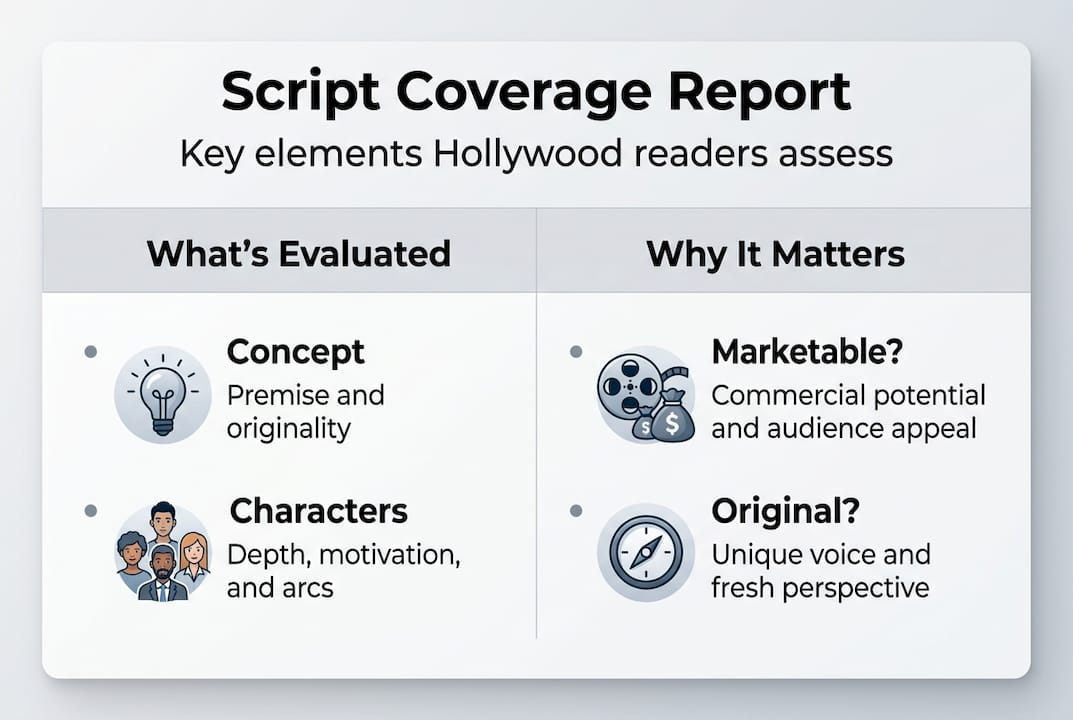
A standard script coverage report includes a cover page, logline, synopsis, analysis, and recommendation. Each section serves a specific purpose for the reader evaluating your work.
The five core components:
- Cover page — Title, writer, genre, page count, and submission date
- Logline — A one or two sentence summary of the core premise and conflict
- Synopsis — A condensed retelling of the story, usually one to three pages
- Analysis — Detailed breakdown of plot, characters, structure, dialogue, and marketability
- Recommendation — Pass, Consider, or Recommend, often with subscores per element
| Element | What's evaluated | Why it matters |
|---|---|---|
| Concept | Originality, marketability | Is it sellable? |
| Structure | Three-act flow, pacing | Does it hold together? |
| Characters | Arcs, motivation, consistency | Are they believable? |
| Dialogue | Voice, subtext, clarity | Does it feel real? |
| Marketability | Budget, audience, comp titles | Can it get made? |
Rubrics vary by company. A major studio may score each element on a scale of one to ten. An independent production company might use simpler ratings like Excellent, Good, Fair, or Poor. Contest coverage often adds a separate score for originality.
Pro Tip: Before submitting, write your own logline guide version and compare it against what a reader might write. If you can't summarize your own script in two compelling sentences, the reader will struggle too. Also review script formatting tips because poor formatting signals amateur work before the reader even reaches page ten.
Human vs. AI script coverage: strengths and blind spots
Now that you know what's in the report, let's compare who creates it: humans versus AI.

AI coverage offers speed and consistency but lacks nuance, humor, and market sense. Human coverage is preferred for depth. Both have a clear role depending on your goals.
| Factor | Human coverage | AI coverage |
|---|---|---|
| Speed | 3 to 7 days | 1-2 days by email (ROAST MY SCRIPT) |
| Cost | $60 to $400 | $9 to $25 |
| Consistency | Varies by reader | Highly consistent |
| Nuance and humor | Strong | Limited |
| Market instinct | Strong | Moderate |
| Structural analysis | Strong | Strong |
| Best use case | Final polish, pitching | Early drafts, bulk review |
Here's the honest breakdown:
- AI coverage excels at identifying structural problems, plot holes, pacing issues, and character inconsistencies. It applies methodology like Syd Field's three-act structure or Save the Cat beat sheets with precision and speed.
- Human readers catch things AI misses: a joke that lands wrong for a specific audience, a cultural reference that dates the script, or a market shift that makes the premise less viable right now.
- AI is ideal for writers who want a brutal first filter before investing in expensive human coverage or script doctors.
For a deeper look at how AI script coverage analysis can cut your revision costs, and how AI in scriptwriting is reshaping the craft, those resources break down the practical implications clearly.
The smart move is to use AI coverage early and often, then invest in human coverage when your script is genuinely ready.
Practical takeaways: How script coverage shapes your screenplay's journey
With strengths and weaknesses understood, here's how to turn script coverage into actionable advantage.
Coverage omits minor subplots for brevity and focuses on core premise. Studios emphasize market potential and budget. That tells you exactly what to prioritize when revising.
What contest and studio graders look for:
- A clear, marketable premise that fits an identifiable genre
- A protagonist with a specific, compelling goal and a real obstacle
- A three-act structure that moves without sagging in the middle
- Dialogue that reveals character without over-explaining
- A budget and scope that feels realistic for the intended market
How to use coverage feedback effectively:
- Read the synopsis the reader wrote. If it misrepresents your story, your script is unclear, not the reader.
- Focus on the lowest-rated element first. One weak link breaks the whole chain.
- Don't argue with a Pass. Use it as data and revise before resubmitting.
- Track patterns across multiple coverage reports. If three readers flag the same issue, it's real.
Pro Tip: Study Hollywood screenplay structure before you request coverage. Writers who understand structure going in get more actionable feedback because they can interpret the notes correctly. Also review screenplay story flow to make sure your pacing holds from page one to the final fade out.
Coverage is most valuable when you treat it as a revision roadmap, not a verdict.
Hollywood script coverage: The wisdom most writers miss
Here's what I tell screenwriters who are frustrated by a Pass: coverage is not a grade on your talent. It's a map of how a producer thinks about your script as a business decision.
Most writers read coverage looking for validation or specific line-level notes. That's the wrong frame. Studios emphasize market potential and actionable fixes in coverage because they're not just asking "is this good?" They're asking "can we make money on this, and how much work does it need?"
The writers who use coverage strategically treat every report as a window into producer logic. They ask: what does this reader's synopsis reveal about how my premise is landing? What does the marketability score tell me about my comp titles? A low structure score is not a personal attack. It's a signal that your Save the Cat methodology application needs work.
Coverage is also a forecasting tool. Patterns in coverage across multiple readers can reveal whether your concept is ahead of the market, behind it, or perfectly timed. That's intelligence most writers throw away.
Affordable coverage for screenwriters: Next steps
If you've made it this far, you understand that script coverage is not optional. It's the filter between your script and every opportunity that matters.
At Roast My Script, we built an affordable alternative to traditional coverage that gives you a professional structural analysis in 1-2 days by email, starting at $9. Our reports are grounded in Hollywood methodology including Syd Field, McKee, and Save the Cat, and delivered as a clean PDF you can act on immediately. Before you spend $60 to $400 on traditional coverage or $500 or more on a script doctor, use us as your brutal first filter. You can also explore screenwriting concepts for market success to sharpen your craft between drafts.
Frequently asked questions
What does a script coverage report include?
A coverage report includes a cover page, logline, synopsis, analysis of elements like plot and characters, and a recommendation rating. The analysis section is where most of the actionable feedback lives.
Why do most scripts get a 'Pass' rating?
Most scripts get a Pass because they don't meet Hollywood's standards for originality, structure, and marketability. Less than 1 to 5% of submitted scripts earn a Consider or Recommend.
Can AI script coverage replace human readers?
AI coverage is faster and more consistent, but human readers provide nuanced feedback, humor detection, and market instinct that AI currently can't replicate. Use both at different stages.
How can script coverage improve my screenplay?
Coverage highlights your script's structural weaknesses and strongest elements, giving you a clear revision priority list. Coverage focuses on core plot and premise, so feedback is always tied to what producers actually care about.
Is script coverage only for Hollywood studios?
No. Coverage is used by agencies, production companies, and screenwriting contests to evaluate scripts efficiently. Any serious submission process likely involves some form of coverage review.