
TL;DR:
- Self-assessment saves money and builds critical storytelling skills before professional coverage.
- Using structured checklists like the Ultimate Story Checklist and Save the Cat improves script evaluation accuracy.
- External feedback is necessary after self-assessment to achieve the final 10 percent of script refinement.
Most screenwriters have been there: you pay $150 for professional coverage, and the reader's first note is that your Act Two midpoint is missing. That's money spent on something you could have caught yourself. Professional coverage is valuable, but only when your script is ready for it. Before you spend $60 to $400 on a coverage reader or $500-plus on a script doctor, a disciplined self-assessment can eliminate the structural problems that would otherwise dominate every note you receive. This guide walks you through the exact checklists, frameworks, and step-by-step methods that working screenwriters use to evaluate their own scripts with real objectivity.
Table of Contents
- Why self-assessment matters for screenwriters
- Tools and checklists: the foundation of script self-assessment
- Step-by-step self-assessment: applying frameworks to your script
- Common mistakes and how to evaluate your results
- The hidden power (and limit) of self-assessment-of-self-assessment)
- Get expert feedback when you're ready
- Frequently asked questions
Key Takeaways
| Point | Details |
|---|---|
| Self-assessment saves money | Thorough self-evaluation lets you fix major script issues before paying for professional feedback. |
| Use reliable checklists | Frameworks like the Ultimate Story Checklist and Save the Cat provide objective, structured guidance. |
| Step-by-step review improves results | Following a clear process with industry tools increases your script's chances in professional coverage. |
| Learn to spot common traps | Recognizing typical self-assessment mistakes makes your next draft stronger and more market-ready. |
| Expert feedback still matters | Even the best self-assessment can benefit from outside eyes before submitting to the industry. |
Why self-assessment matters for screenwriters
Here's what most screenwriters skip: a structured review of their own work before anyone else reads it. It feels redundant. You wrote the thing. You know what it's supposed to do. But that familiarity is exactly the problem.
Self-assessment is not just a warm-up activity. It's a professional discipline. When you approach your script with the same rigor a coverage reader would, you start catching issues that would otherwise cost you money and opportunity. Understanding script coverage basics helps clarify what readers actually look for, and that knowledge sharpens your ability to evaluate your own work first.
Here's why this step matters more than most writers realize:
- It saves money. Coverage readers and script consultants charge for their time, not your education. If your protagonist has no clear want or need in Act One, a coverage reader will note it. You could have found that yourself for free.
- It builds craft. Analyzing your own script forces you to internalize story principles. Every time you identify a weak beat or a flat character arc, you get better at avoiding those problems in the next draft.
- It creates objectivity. Time away from a draft plus a structured checklist gives you a version of the critical distance that professional readers have by default.
- It meets industry expectations. Readers at studios and production companies evaluate dozens of scripts per week. A script that shows structural competence from page one signals a writer who understands the craft.
The numbers back this up. Using structure checklists like the Ultimate Story Checklist elevates the quality of critical analysis a writer can perform independently, often surfacing the same issues a paid reader would flag.
"The writers who get the most value from professional coverage are the ones who've already done the hard work themselves. Coverage should confirm your instincts, not educate you on basics."
Think of self-assessment as your first filter. It's not about perfecting the script in isolation. It's about making sure the structural skeleton is sound before you invite someone else to stress-test it.
Tools and checklists: the foundation of script self-assessment
A good self-assessment needs structure. Without a framework, you're just rereading your script and hoping something jumps out. The right tools give you specific, answerable questions that map your script against proven storytelling principles.
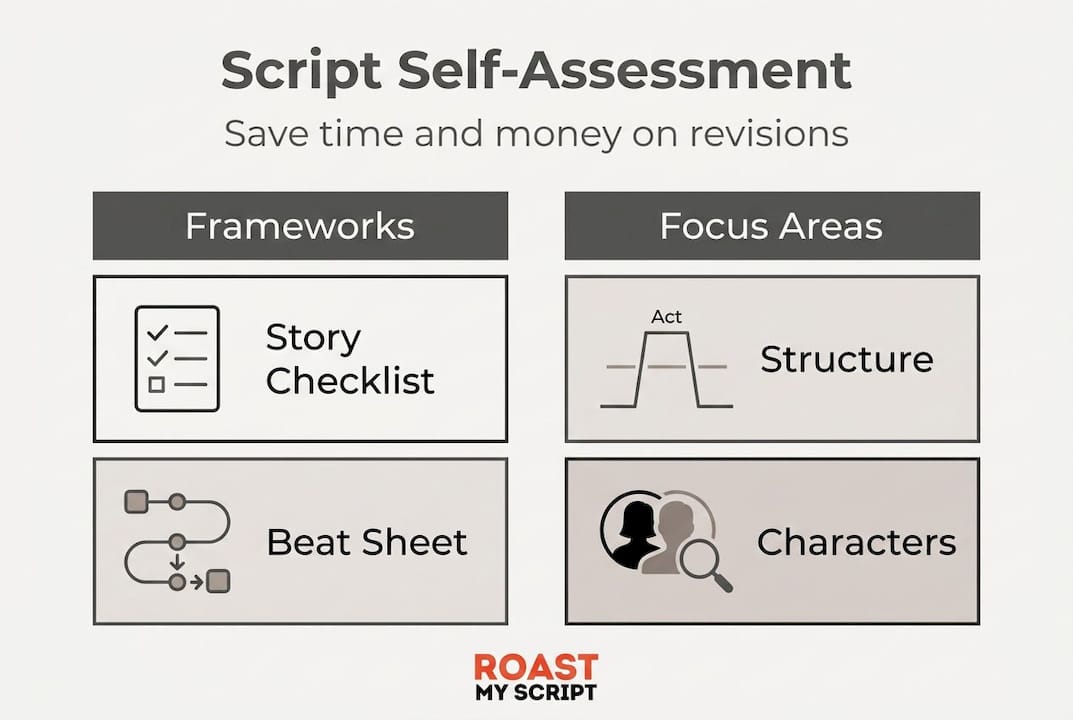
The two most widely used frameworks are the Ultimate Story Checklist and the Save the Cat Beat Sheet. Popular checklists include the Ultimate Story Checklist with 122 questions and the Save the Cat Beat Sheet, which together cover virtually every dimension of script quality.
Here's how the major tools break down:
| Tool | Focus areas | Best for |
|---|---|---|
| Ultimate Story Checklist | Concept, character, structure, scenework, dialogue | Deep analytical review |
| Save the Cat Beat Sheet | 15 beats mapped to page counts | Pacing and structure check |
| Hollywood Three-Act Paradigm | Act breaks, midpoint, turning points | Classic structure alignment |
| McKee's Story Grid | Scene-by-scene value shifts | Character arc and tension |
When you're analyzing script structure, the Ultimate Story Checklist is particularly effective because it forces you to answer questions you might otherwise skip. Questions like "Does your protagonist have a misbelief that drives their behavior?" or "Does your B-story challenge the theme of the A-story?" push you past surface-level edits.
The Save the Cat Beat Sheet works differently. It's prescriptive. You're matching your script's events to 15 specific beats: Opening Image, Theme Stated, Set-Up, Catalyst, and so on through the Final Image. This is especially useful if your story structure breakdown feels off but you can't pinpoint where.
Pro Tip: Checklists are not one-size-fits-all. A horror script and a romantic comedy have different structural expectations. Before you start, note which beats or questions are genre-specific and weight your analysis accordingly. A 90-minute contained thriller doesn't need the same midpoint mechanics as a two-hour ensemble drama.
The goal is not to check every box. The goal is to identify which boxes you can't check and understand why.
Step-by-step self-assessment: applying frameworks to your script
Now that you have the tools, here's exactly how to use them. Don't try to run every framework at once. Work sequentially.
- Wait before you assess. Put the draft away for at least one week after finishing it. You cannot evaluate what you're still emotionally attached to.
- Read it in one sitting. Print it out or read it on a tablet. Read it like a stranger would, without stopping to fix anything. Just note where you get bored, confused, or disengaged.
- Map your beats first. Before any checklist, write down your 15 Save the Cat beats and the pages where they occur. The Save the Cat Beat Sheet uses 15 distinct beats mapped to page counts, so if your Catalyst lands on page 25 instead of page 12, you already know something is structurally off.
- Run the Ultimate Story Checklist. Go question by question. Answer honestly, not hopefully. Mark every question you can't answer with a "yes" as a revision priority.
- Score by category. Tally your answers by section: concept, character, structure, dialogue. A script that scores well on concept but poorly on character arc has a clear, prioritized revision path.
- Prioritize structural issues first. Fix Act breaks and major beat problems before you touch dialogue or scene-level details. Polishing dialogue in a structurally broken script is wasted effort.
When you're deep in the script development process, it helps to compare which framework surfaces the right problems for your draft's stage.
| Framework | Strengths | Limitations |
|---|---|---|
| Save the Cat | Fast, page-specific, genre-tested | Can feel formulaic for literary scripts |
| Ultimate Story Checklist | Thorough, nuanced, character-focused | Time-intensive (budget 3-4 hours) |
For writers trying to align with Hollywood screenplay structure, combining both frameworks in sequence gives you the broadest coverage without redundancy.
Pro Tip: Set a time limit on your self-assessment session. Three to four hours maximum per pass. Over-editing in response to checklists without stepping back creates new problems as fast as it solves old ones.
Common mistakes and how to evaluate your results
Self-assessment has real limits, and most writers hit the same walls. Knowing the traps ahead of time is the difference between a useful review and a circular one.
The most frequent mistakes include:
- Assessing too soon. Reading your script two days after finishing it means you're still reading what you intended to write, not what's on the page.
- Answering checklist questions too charitably. "Does your protagonist have a clear goal?" is easy to answer yes to if you know what the goal is supposed to be. The question is whether a first-time reader would see it clearly on page 10.
- Fixing the wrong layer first. Writers often jump to dialogue and scene polish before resolving structural breaks. Understanding script format impact on readability is important, but format won't save a broken story.
- Over-correcting on one section. Fixing a weak midpoint sometimes creates a ripple effect that breaks Act Three. After any major revision, re-map your beats from scratch.
- Ignoring pacing. Pacing problems rarely feel like pacing problems when you're reading your own work. If your read-through notes say "slow here" more than twice in Act Two, that's a structural signal, not a scene problem.
When you interpret your checklist results, think in tiers. A structural problem in Act One is more urgent than a character inconsistency in Act Three. Structured self-assessment frameworks prepare scripts for successful professional coverage by surfacing the highest-impact issues first.
"Scripts that clear checklist hurdles consistently earn higher consideration ratings from coverage readers. The correlation between structural preparedness and a 'consider' recommendation is not coincidental."
Focus your revisions on the issues that would stop a reader cold, not the ones that bother you personally. Understanding mastering story flow at a structural level helps you distinguish between a story that's genuinely broken and one that just needs tightening.
The hidden power (and limit) of self-assessment
Here's what I tell screenwriters who ask how far self-assessment can take them: you can get to about 90 percent. That last 10 percent requires an outside eye, and no checklist replaces it.
But here's the part most writers miss. Self-assessment isn't just about fixing problems. It's where creative breakthroughs happen. When you're forced to articulate why a scene isn't working, you often discover what the scene is really supposed to do. That clarity rarely comes from a coverage note. It comes from sitting with the question yourself.
The contrarian truth is that writers who skip self-assessment don't just waste money on coverage. They also miss the most productive thinking they'll ever do on a script. External feedback is most valuable when you've exhausted your own critical capacity first.
That said, blind spots are real. No writer can fully see their own work's weaknesses in theme or emotional logic. That's where AI scriptwriting insights and professional coverage serve a function that no checklist can replicate. Use self-assessment to get as far as you can, then bring in outside perspective for what you genuinely cannot see.
Get expert feedback when you're ready
Self-assessment gets your script structurally ready. But at some point, you need a reader who has no idea what you were trying to do, only what's on the page.
That's exactly what Roast My Script is built for. Once you've run your checklists, mapped your beats, and addressed your structural priorities, our AI-powered coverage gives you a professional-grade analysis in 1-2 days by email, starting at $9. It's built on Hollywood methodology (Syd Field, McKee, Save the Cat) and delivers a PDF you can actually use. Explore AI script coverage options to see what level of analysis fits your draft, or go straight to get script feedback and upload your script today. Your self-assessment did the groundwork. Now let's pressure-test the result.
Frequently asked questions
What is the best checklist for script self-assessment?
The Ultimate Story Checklist with its 122 questions on concept, character, structure, and scenework and the Save the Cat Beat Sheet are the most widely recommended tools for thorough, structured script evaluation.
How many drafts should I self-assess before seeking paid coverage?
Most professionals suggest two to three self-assessed drafts to surface and resolve structural flaws before investing in paid coverage, so your money goes toward refinement rather than foundational fixes.
Can I use AI to help self-assess my script?
Yes, AI tools are increasingly effective for initial structural analysis and pattern detection, but human review remains essential for evaluating story nuance, emotional resonance, and market context.
What are common mistakes in self-assessment?
Overlooking pacing issues, answering checklist questions too generously, and fixing dialogue before addressing structural problems are the most frequent mistakes writers make when evaluating their own scripts.
Recommended
- How to analyze a script for powerful screenplay improvement | ROAST MY SCRIPT
- Script format impact: 90% boost production & pitch success | ROAST MY SCRIPT
- Roast My Script | AI Script Coverage & Analysis from $9
- Script Development Process: Preparing for Hollywood Success | ROAST MY SCRIPT
- Master film script analysis tips to improve storytelling