
Hollywood readers spend an average of 15 minutes on a script before making a coverage decision. That's not much runway. Most screenplays fail not because the writer lacks talent, but because the foundational elements are shaky: weak structure, unclear character arcs, or pacing that loses momentum before page 30. Mastering the craft means understanding both the mechanical framework that professional readers expect and the creative nuance that makes a script memorable. This guide walks you through every essential element, from act breakdowns to formatting benchmarks, so you can approach your next draft with clarity and confidence.
Table of Contents
- Understand screenplay structure: The backbone of a great script
- Essential elements of every successful screenplay
- Comparing screenplay methodologies: Save the Cat vs. Hero's Journey
- Page count, pacing, and formatting: Industry benchmarks for script success
- A professional perspective: Why human texture still matters
- Take your screenplay from good to great with professional feedback
- Frequently asked questions
Key Takeaways
| Point | Details |
|---|---|
| Master structure | A strong three-act framework and precise beats set professional screenplays apart. |
| Balance mechanics and voice | Great scripts blend impeccable formatting with unique character and thematic depth. |
| Choose the right model | Select Save the Cat or Hero’s Journey based on your story’s needs, not just trends. |
| Meet industry standards | Ideal page count, pacing, and clean presentation are crucial for Hollywood readers. |
| Get expert feedback | Affordable, professional notes help you refine structure and boost your odds of success. |
Understand screenplay structure: The backbone of a great script
Every successful screenplay rests on a clear structural foundation. Without it, even the most original concept falls apart under the weight of confused pacing and unearned emotional beats. Structure is not a creative constraint. It's the invisible architecture that keeps your story moving forward with purpose.
The three-act structure remains the universal backbone of Hollywood storytelling. Act One sets up your world, protagonist, and central conflict. Act Two escalates that conflict through obstacles and reversals. Act Three resolves it. Simple in theory, brutally difficult in execution.
Beyond the three-act framework, core structural elements include key turning points that anchor your story at specific page intervals. Here's a quick breakdown of the essential beats:
- Opening Image (page 1): A visual snapshot of your protagonist's world before change.
- Inciting Incident (pages 10-15): The event that disrupts the status quo and launches the story.
- Plot Point 1 (pages 25-30): The moment your protagonist commits to the central conflict.
- Midpoint (page 55-60): A major shift that raises the stakes and reorients the story.
- All Is Lost (pages 75-85): The lowest point. Everything seems hopeless.
- Climax (pages 90-100): The final confrontation where your protagonist faces the core conflict.
- Final Image (last page): A visual echo of the Opening Image, showing how far your character has traveled.
Practical page timing matters more than most writers realize. Median screenplay length is approximately 119 pages, running about 9% longer than actual runtime, which means one page equals roughly 55 seconds of screen time rather than the commonly cited 60. That distinction affects how you pace dialogue-heavy scenes versus action sequences.
For a story structure breakdown that maps these beats visually, it helps to see them plotted against page count. A structure flow guide can also clarify how each beat connects to the next.
"Professional readers flag structural problems within the first 20 pages. If your Inciting Incident hasn't landed by page 15, you're already losing them."
Pro Tip: Treat your first 10 pages as a separate document. Polish them relentlessly. Hollywood readers often stop there if the setup is muddy or the voice feels flat.
Essential elements of every successful screenplay
With structure as your script's backbone, here's what every successful screenplay shares at its core.
A study of 12,000+ screenplays analyzed by researcher Stephen Follows identified specific traits that script readers consistently prioritize in coverage evaluations. The findings confirm what experienced writers already know: mechanics and craft are inseparable.
Here are the non-negotiable elements that define a professional-grade screenplay:
- Clear protagonist with a dynamic arc. Your lead character must want something specific, face meaningful obstacles, and change as a result. Static protagonists are the single most common reason scripts receive a "Pass."
- Distinct dialogue voice. Every character should sound different. Readers notice immediately when all characters speak with the same cadence or vocabulary. Subtext matters as much as what's said directly.
- Consistent, industry-standard formatting. Courier 12pt, standard margins, correct scene heading style. A formatting guide can save you from basic errors that signal an amateur submission.
- Cinematic pacing and vivid scene writing. Write what the camera sees. Action lines should be lean, visual, and immediate. Avoid directing from the page.
- Strong theme and subtext. What is your script actually about beneath the plot? Readers respond to scripts with a clear thematic spine, even if they can't articulate it immediately.
- Balanced mechanics and nuance. A technically clean script that feels lifeless will still get passed on. The script format impact on professional reception is real, but it works in combination with authentic storytelling.
For deeper analysis techniques that help you evaluate your own work before submitting, self-assessment tools can cut revision time significantly.
Pro Tip: Use Save the Cat or the Hero's Journey as a diagnostic tool on your completed draft, not as a template while writing. Retrofitting structure onto a finished script often reveals exactly where your story loses momentum.
Comparing screenplay methodologies: Save the Cat vs. Hero's Journey
Knowing the core elements, it's crucial to choose a structuring method that fits your story.
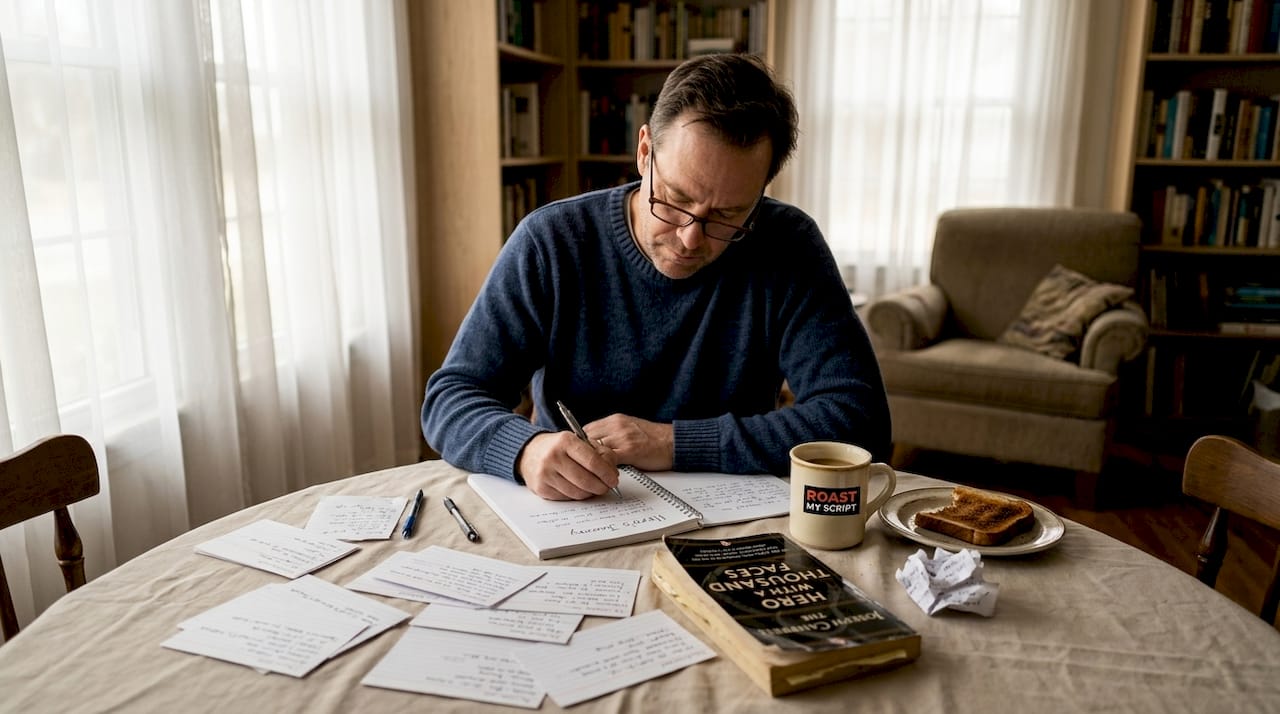
Blake Snyder's Save the Cat and Joseph Campbell's Hero's Journey represent the two most widely used structural frameworks in Hollywood today. They overlap in philosophy but differ significantly in application.
Save the Cat uses a precise 15-beat sheet with specific page targets. It's prescriptive by design, which makes it especially useful for commercial genres like action, thriller, and romantic comedy. The beats are concrete and measurable.
Hero's Journey draws from Joseph Campbell's mythic structure, emphasizing transformation through archetypal stages: the Call to Adventure, Crossing the Threshold, Ordeal, and Return. It's more flexible and suits epic, character-driven, or fantasy narratives.
| Element | Save the Cat | Hero's Journey |
|---|---|---|
| Origin | Blake Snyder (2005) | Joseph Campbell (1949) |
| Beat count | 15 specific beats | 12 archetypal stages |
| Page precision | Yes, with targets | No fixed page counts |
| Best for | Commercial genres | Mythic, epic, character-driven |
| Flexibility | Low to moderate | High |
| Industry adoption | Widely used in Hollywood | Common in development circles |
For a Save the Cat guide that breaks down each beat with examples, the page benchmarks alone can help you identify where your script is running long or thin.
Choosing between them depends on your story's genre and goals:
- Use Save the Cat when you need tight commercial pacing and clear market positioning.
- Use Hero's Journey when your story has a mythic or transformational core that resists rigid page targets.
- Use both as lenses when revising, since they often highlight different weaknesses in the same script.
Understanding screenplay genres also shapes which methodology serves you best, since genre conventions carry their own structural expectations.
Page count, pacing, and formatting: Industry benchmarks for script success
Once you select a methodology, understanding how to present and pace your script for readers is crucial.
Industry formatting standards are not arbitrary. Courier 12pt font, 1-inch margins on top, right, and bottom, and a 1.5-inch left margin exist so that page count roughly correlates to runtime. Deviating from these standards signals inexperience before a reader has processed a single line of your story.
Only 18% of scripts match the 1:1 page-per-minute rule exactly, and comedies consistently run the longest of any genre. Here's how page count benchmarks break down by genre:
| Genre | Typical page range | Notes |
|---|---|---|
| Drama | 100-120 pages | Dialogue-heavy; pacing varies |
| Action/Thriller | 95-115 pages | Lean action lines keep count down |
| Comedy | 90-110 pages | Often runs longer than expected |
| Horror | 85-100 pages | Tight pacing is a genre expectation |
| Sci-Fi/Fantasy | 110-130 pages | World-building adds pages |
Common pacing mistakes that flag an amateur script include:
- Overwritten action blocks that slow visual momentum.
- Dialogue scenes that run three or more pages without a beat shift.
- A midpoint that arrives too late, pushing the second-act resolution past page 70.
- A climax that resolves too quickly after a slow build.
Consistent formatting and reader-friendly flow directly improve the quality of professional feedback you receive, because readers can focus on story rather than decoding layout. The script format impact on coverage scores is measurable, and a solid formatting guide removes guesswork from the equation.
"The first 10 pages are make-or-break. If your formatting is inconsistent or your opening scene is overwritten, a reader's confidence in your script drops immediately."
A professional perspective: Why human texture still matters
After technical mastery, let's look at the subtle art of blending structure with your unique creative fingerprint.
Here's something most craft books won't tell you directly: a clean, structurally correct script will pass initial coverage. But it won't get optioned. The scripts that move forward have something harder to define, a voice, a rhythm, an emotional weight that lingers after the last page.
The difference between a clean script and a human film comes down to intentional texture. Think about the repetition in The Wolf of Wall Street, or the accumulation of small moments in Moonlight. Neither script would score perfectly on a beat-sheet diagnostic. Both are unforgettable.
Format your script for coverage. Meet the benchmarks. But don't sand away every rough edge in pursuit of mechanical perfection. Readers respond to scripts that feel lived-in and specific. The goal is a script that passes the structural filter and then surprises the reader with something genuine.
Good script coverage advice helps you find that balance, identifying where structure genuinely needs repair versus where your instincts are actually working.
Take your screenplay from good to great with professional feedback
Having learned the essentials and creative philosophy, here's a practical way to elevate your script for Hollywood.
Knowing the elements is one thing. Seeing exactly where your script falls short of them is another. Professional notes reveal where structural beats miss their marks, where character arcs stall, and where pacing loses the reader before the midpoint.
At Roast My Script, AI-assisted coverage built on Hollywood methodology gives you that brutal first filter before you invest in expensive script doctors or festival submissions. Starting at $9, you get a detailed structural analysis in 1-2 days by email. Master essential screenwriting concepts with our educational resources, or submit your script directly for affordable script feedback that meets industry standards without the high cost of traditional coverage.
Frequently asked questions
What are the most important beats in a screenplay?
The most important beats include the Opening Image, Inciting Incident, Plot Point 1, Midpoint, All Is Lost, Climax, and Final Image. These key turning points anchor your story's structure and give professional readers clear markers to evaluate your script's pacing and momentum.
How long should a feature-length screenplay be?
A typical feature screenplay runs between 110 and 120 pages, with the median landing at 119 pages based on empirical data. Genre affects this range, with horror running shorter and sci-fi or fantasy often running longer.
Is it better to use Save the Cat or Hero's Journey?
It depends on your story's genre and goals. Save the Cat and Hero's Journey serve different narrative needs: choose Save the Cat for tight commercial pacing and Hero's Journey for mythic or character-driven storytelling.
Does formatting really matter to readers?
Absolutely. Consistent formatting and flow let readers focus on your story rather than decoding layout errors, which directly improves coverage scores and professional reception.
Recommended
- Master Story Structure Breakdown for Screenwriters | ROAST MY SCRIPT
- Script Development Process: Preparing for Hollywood Success | ROAST MY SCRIPT
- Script format impact: 90% boost production & pitch success | ROAST MY SCRIPT
- How to analyze a script for powerful screenplay improvement | ROAST MY SCRIPT