
TL;DR:
- Films that subvert Story Circle beats tend to receive higher Metascores.
- Story structure guides emotional experience, pacing, and audience engagement effectively.
- Understanding and intentionally breaking conventions can lead to standout, impactful scripts.
Most screenwriters assume that nailing a rigid formula is the ticket to a great script. The data tells a different story. Empirical analysis of screenplays shows that films subverting more Story Circle beats actually receive higher Metascores than those following every beat perfectly. That single finding should reshape how you think about structure. It doesn't mean structure is irrelevant. It means the relationship between structure and success is more nuanced than any guru's rulebook suggests. This article breaks down what structure really is, how it shapes audience experience, and how you can use it as a creative tool rather than a creative cage.
Table of Contents
- What is structure in storytelling?
- How structure influences narrative and audience impact
- Formulas, conventions, and breaking the rules
- How screenwriters can master and apply structure
- Most writers overthink structure—and miss its real power
- Take your script structure from good to unforgettable
- Frequently asked questions
Key Takeaways
| Point | Details |
|---|---|
| Structure shapes impact | A strong story structure increases audience engagement, clarity, and overall script effectiveness. |
| Innovation can pay off | Subverting traditional frameworks sometimes leads to greater critical success and more memorable scripts. |
| Frameworks are tools | Classic structures like three-act or Story Circle provide a reliable foundation but should not restrict creativity. |
| Analysis unlocks growth | Professional script analysis empowers writers to refine structure and confidently submit their best work. |
What is structure in storytelling?
Now that we've challenged the myth of rigid structure, let's clarify what structure actually means for your screenplay.
At its core, story structure is the organizational framework that shapes how your plot unfolds, how your characters evolve, and how your audience feels at every stage of the journey. It's not a checklist. It's the underlying logic that makes a story coherent, emotionally satisfying, and worth watching.
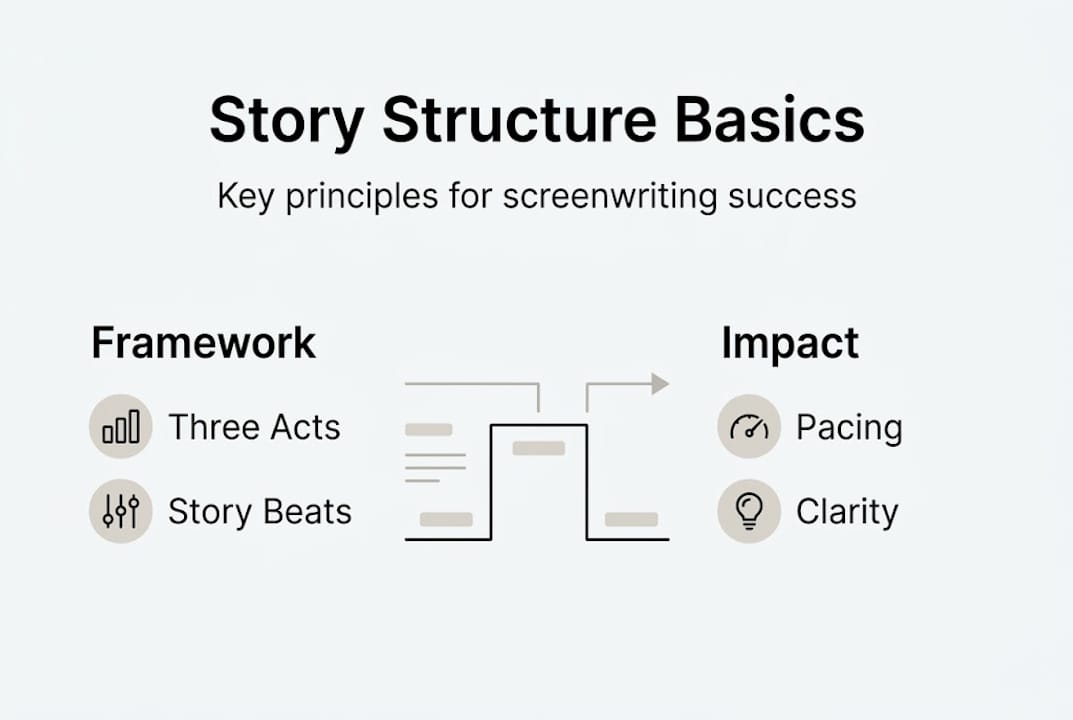
Story structure provides the framework for narrative progression, including exposition, rising action, climax, falling action, and resolution, ensuring audience engagement and emotional satisfaction in screenplays. Without this progression, even the most original premise can feel shapeless and frustrating to follow.
Here are the most widely used structural frameworks in professional screenwriting:
- Three-act structure: The industry baseline. Act One sets up your world and protagonist. Act Two escalates conflict and raises stakes. Act Three resolves the central tension. Simple, proven, and expected by most producers.
- Save the Cat beats: Blake Snyder's 15-beat framework that maps specific emotional moments to page numbers. Widely used in commercial Hollywood development.
- The Hero's Journey: Joseph Campbell's mythic structure, popularized in screenwriting by Christopher Vogler. Useful for character-driven stories with transformation at the center.
- Dan Harmon's Story Circle: An 8-step circular model derived from Campbell. Flexible enough for both episodic TV and feature films.
You can explore a detailed story structure breakdown guide to compare these frameworks side by side.
Here's what experienced writers understand that beginners often miss:
Structure is not about where you put your plot points. It's about engineering the emotional experience of your audience from the first page to the last.
Pacing, clarity, and marketability all flow from structural decisions. A script that meanders through Act Two without escalating pressure loses the audience before the climax lands. A script that rushes its setup leaves viewers emotionally disconnected from the stakes. Structure is the invisible hand that keeps readers turning pages and audiences leaning forward in their seats.
For new screenwriters, the three-act structure is the right place to start. It's not a limitation. It's the shared language of the industry, and fluency in it makes every other framework easier to learn and apply.
How structure influences narrative and audience impact
Having defined story structure, let's examine how structure directly shapes narrative effectiveness and audience reaction.
The connection between structure and audience engagement isn't just theoretical. Researchers have quantified it. Machine learning analysis of 25,000+ TV scripts found that dialogue structure, emotional features, and linguistic patterns predict viewership, explaining up to 50% of variance in audience numbers. That's a significant finding. It means the way you construct scenes and sequence emotional beats has a measurable effect on whether people keep watching.
| Structural element | Impact on audience |
|---|---|
| Dialogue pacing | Drives engagement and retention |
| Emotional arc | Creates investment in character outcomes |
| Scene escalation | Builds tension and forward momentum |
| Resolution clarity | Delivers satisfaction and closure |
The role of dialogue in scripts is often underestimated. Dialogue isn't just what characters say. It's how structural tension gets expressed moment to moment. Scenes where characters talk around conflict rather than through it tend to flatten the emotional arc, regardless of how well the broader structure is designed.

Emotional patterns in storytelling show that readers and viewers respond most strongly to contrast: calm followed by chaos, hope followed by loss, isolation followed by connection. Structure is the tool that lets you engineer those contrasts deliberately.
Commercial and critical success are both influenced by structure, but neither is solely determined by it. A structurally sound script with flat characters and generic dialogue will still fail. A structurally unconventional script with sharp emotional logic can break through. Learning to analyze a script for improvement means looking at both dimensions together.
The practical takeaway: structure creates the conditions for emotional impact. It doesn't guarantee it. Your job is to use the framework to set up moments that genuinely move people, not just to hit page 25 with an inciting incident because a book told you to.
Formulas, conventions, and breaking the rules
While structure forms the backbone of your script, industry history shows not all great works follow the same road map. Let's compare conventional approaches with celebrated rule-breakers.
Oscar-winning films often follow mature formulas: 67% are rated 15/18, average 131+ minutes in runtime, and feature themes of sex, violence, or strong language. Yet only 26% overlap with all-time best lists, and 73% are not in the box office top 10. The formula exists. It just doesn't guarantee greatness or commercial dominance.
| Approach | Critical reception | Commercial performance |
|---|---|---|
| Formula-driven | Moderate to high | More predictable |
| Structurally unconventional | Often higher Metascores | Variable, higher risk |
| Hybrid (structured but subversive) | Strong across both | Best overall balance |
Films like Rashomon, Memento, and Pulp Fiction all broke conventional structural expectations and became landmarks of cinema. Non-linear storytelling, fractured timelines, and unreliable narrators are not gimmicks. They're structural choices that serve specific emotional and thematic purposes. The key word is purpose.
Breaking structure without intention is just chaos. Breaking it with intention, and with a clear understanding of what you're trading away, is craft.
For TV, episode arcs add another layer. Serialized storytelling requires micro-structure within each episode and macro-structure across a season. Writers who understand both levels can create the kind of escalating tension that keeps audiences committed across 10 or 13 episodes.
Pro Tip: Before you decide to subvert a structural convention, ask yourself: "Do I know why this convention exists?" If you can't answer that clearly, you're not ready to break it effectively. Study the rule until you understand its function, then decide if breaking it serves your story.
You can explore story structure frameworks in depth, and if you're writing for a specific genre, reviewing screenplay genres in 2026 will help you understand the structural conventions that audiences bring to each category.
How screenwriters can master and apply structure
Understanding formulas and innovation is useful, but how do you apply these insights to your own script? Let's break down a practical approach.
Here's a straightforward method for assessing and strengthening your script's structure before submission:
- Map your beats first. Before rewriting, identify where your key structural moments actually land. Use whichever framework fits your story. The goal is to see your script's skeleton clearly, not to force it into a template.
- Layer in Save the Cat beats or the Hero's Journey for depth. Once you have the three-act baseline, Robert McKee's method recommends mastering the three-act structure first, then using Save the Cat for beat precision or the Hero's Journey for character transformation depth.
- Run the 10-minute pitch test. McKee's insight here is blunt and useful: if your story doesn't hold up in a 10-minute verbal pitch, it won't hold up across 110 pages. A pitch that loses the listener means your structure has gaps. Fix the pitch, and you'll often fix the script.
- Prioritize change under pressure over formula adherence. The most consistent marker of a working script isn't which framework it follows. It's whether your protagonist is genuinely forced to change by the events of the story. Pressure plus transformation equals drama.
- Get external analysis before you submit. Peer feedback is valuable but limited. Professional script analysis techniques reveal structural problems that writers are too close to their own work to spot.
Pro Tip: Don't wait until your script is "finished" to test its structure. Run the pitch test after your first draft. You'll catch structural problems early, before they're baked into 90 pages of scenes that need to be rebuilt.
The script development process is iterative by nature. Structure is something you refine across drafts, not something you get right on the first pass. Build that expectation into your workflow and you'll approach revision with more clarity and less frustration.
Most writers overthink structure—and miss its real power
Here's a candid perspective on what really sets great storytellers apart.
I've read hundreds of scripts through Roast My Script, and the pattern is consistent. Writers who struggle most are usually doing one of two things: either rigidly forcing their story into a template, or rejecting structure entirely because they think it limits creativity. Both approaches miss the point.
Structure is scaffolding. It's what holds the building up while you're constructing it. Once the building stands on its own, the scaffolding becomes invisible. The best scripts work exactly this way. Audiences feel the emotional journey without ever noticing the framework underneath.
The breakdown of story structure isn't a formula to copy. It's a map of how human beings process narrative. When you understand it at that level, you stop asking "does my script hit the right beats?" and start asking "does my script create the right emotional experience?" That shift in question changes everything.
Professional analysis is invaluable here because it gives you an outside perspective before the script reaches industry gatekeepers. Study the frameworks. Then focus entirely on what brings change, tension, and authentic emotion to your specific story.
Take your script structure from good to unforgettable
Ready to raise your script's impact? Here's how to get expert support on structure before you submit.
At Roast My Script, we built our analysis specifically around the structural frameworks covered in this article: three-act structure, Save the Cat, McKee's principles, and more. Our AI-powered coverage gives you a clear, honest read on where your structure holds and where it breaks, delivered in 1-2 days by email for as little as $9.

Before you pay for expensive coverage or pitch to a producer, use Roast My Script as your first filter. You can also strengthen your craft through our learning resources, including essential screenwriting concepts, the character spine framework, and a character dimensionality masterclass. Better structure starts with honest feedback.
Frequently asked questions
Can breaking traditional story structure improve my script's chances?
Yes. Films subverting Story Circle beats tend to receive higher Metascores, though audience expectations in commercial markets may still favor more familiar structural patterns.
What structural framework should a new screenwriter master first?
Start with the three-act structure. It's the foundation for most industry expectations, and narrative progression built on exposition, rising action, climax, and resolution keeps scripts clear and professionally readable.
How does script structure affect audience retention?
Machine learning on 25,000+ TV scripts shows that dialogue structure and emotional pacing predict viewership, accounting for up to 50% of variance in audience numbers.
Is following an 'Oscar formula' important for script success?
Not necessarily. Oscar-winning films follow recognizable formulas, but 73% aren't in the box office top 10 and only 26% appear on all-time best lists, so formula alone doesn't define lasting success.
Recommended
- Explain screenplay genres to elevate your scripts in 2026 | ROAST MY SCRIPT
- Master Story Structure Breakdown for Screenwriters | ROAST MY SCRIPT
- What is a script reader? A 2026 guide for screenwriters | ROAST MY SCRIPT
- Script Development Process: Preparing for Hollywood Success | ROAST MY SCRIPT
- Guide to writing chapter books for young readers in 2026
- The Art of Storytelling: What Makes a Book Impossible to Put Down | Mark Watson books: Crybaby, a gripping horror thriller of survival and vengeance about a rogue elephant in rural India. Buy now or learn more.