
You've probably heard Save the Cat dismissed as the formula that ruined Hollywood, turning every blockbuster into a predictable paint-by-numbers exercise. But here's the truth: Save the Cat isn't a creativity killer. It's a diagnostic tool that helps you identify structural weak points before you send your script anywhere. Understanding what Save the Cat actually is and how to use it flexibly can transform your screenwriting process, whether you're crafting your first feature or refining your tenth. This guide breaks down the real Save the Cat, explores expert nuances that most writers miss, and shows you how to apply it without sacrificing your unique voice.
Table of Contents
- Key takeaways
- What is Save the Cat and how does it work?
- Criticisms and expert nuances of Save the Cat
- How to apply Save the Cat effectively in your screenplay
- Enhance your script with expert feedback
- FAQ
Key Takeaways
| Point | Details |
|---|---|
| Save the Cat tool | It is a diagnostic framework of fifteen story beats that helps identify structural weaknesses before you submit a script. |
| Flexible use advised | The method works best when used flexibly, combined with other frameworks, and as a diagnostic tool rather than a rigid rulebook. |
| Concrete beat questions | It asks concrete questions about choices and stakes tied to core beats such as debate midpoint and all is lost to sharpen structure. |
| Criticisms to weigh | Critics warn that overreliance on formulas can lead to generic plots and shallow characters, especially in nonlinear or ensemble narratives that require adaptation. |
What is Save the Cat and how does it work?
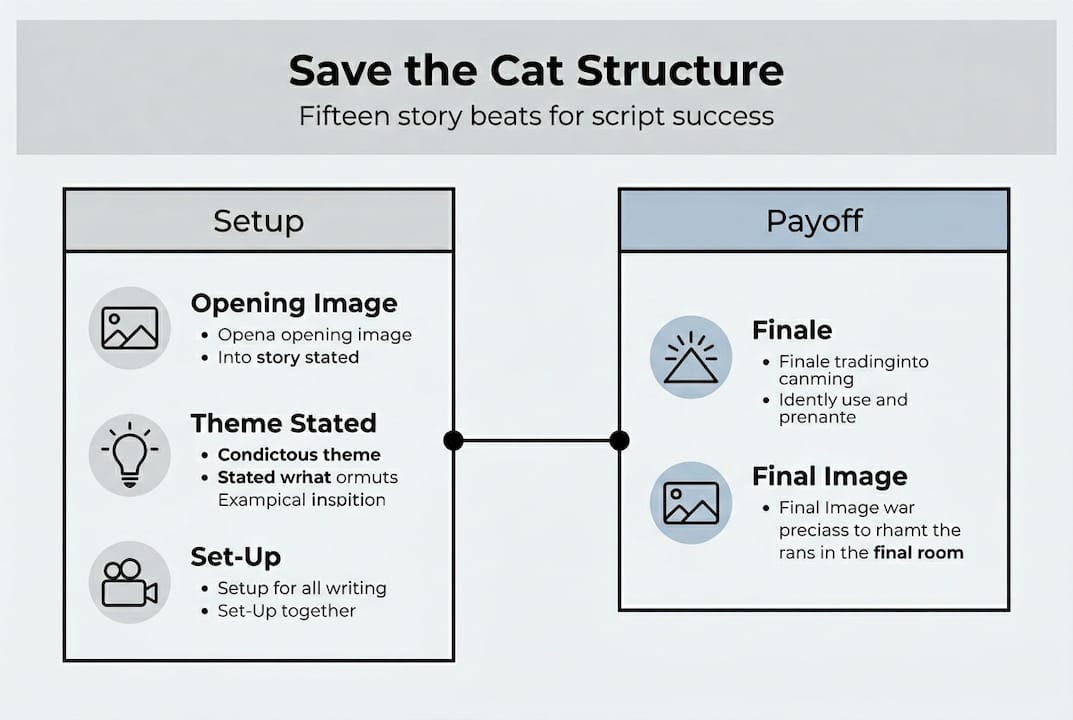
Save the Cat emerged from screenwriter Blake Snyder's analysis of commercially successful Hollywood films. He reverse-engineered what made audiences emotionally invest in stories that fit within the economic constraints of a two-hour runtime. The result was a framework of 15 story beats that map the emotional journey audiences expect, from the opening image that establishes your world to the final image that shows transformation.
These beats aren't arbitrary. They correspond to psychological moments where audiences naturally engage or disengage. The titular "Save the Cat" moment, for example, typically occurs in the first 10 pages. Your protagonist does something kind or relatable that makes us root for them, even if they're flawed. Think of Indiana Jones rescuing his students from a collapsing temple before we see his darker traits, or Elle Woods defending a store clerk in Legally Blonde before law school humbles her.
The framework organizes your screenplay into predictable page ranges. The catalyst that disrupts your protagonist's world should hit around page 12. The midpoint revelation that raises stakes lands near page 55. The all-is-lost moment crushes hope around page 75. These aren't rules carved in stone, but they reflect patterns that resonate with how humans process narrative tension and release.
Here's how the core beats function in practice:
- Opening Image: Establishes tone, genre, and protagonist's starting state
- Theme Stated: Someone voices the story's central question or lesson
- Catalyst: The inciting incident that disrupts normalcy
- Debate: Protagonist hesitates before committing to the journey
- Break Into Two: Enters the new world or situation
- B Story: Introduces relationship that explores theme
- Midpoint: False victory or defeat that raises stakes
- All Is Lost: Lowest point where everything seems hopeless
- Dark Night of the Soul: Internal reckoning before final push
- Break Into Three: Armed with new knowledge, protagonist acts
- Finale: Confronts antagonist and resolves central conflict
- Final Image: Shows transformation from opening
What makes Save the Cat powerful for script analysis techniques is its specificity. Instead of vague advice like "develop your characters," it asks concrete questions. Does your protagonist face a clear choice at the debate stage? Does your midpoint fundamentally change the stakes? When you can answer these with specific page numbers and scenes, you've built a structurally sound foundation.

Criticisms and expert nuances of Save the Cat
The backlash against Save the Cat centers on a legitimate concern: formulaic storytelling that prioritizes plot mechanics over authentic character development. Critics point to the sameness of modern blockbusters, where every superhero origin follows identical beats and every romantic comedy hits the same emotional notes at the same minute markers. When studios use Save the Cat as a checklist for greenlight decisions, it can homogenize storytelling.
The structure also struggles with certain story types. Anti-heroes who never earn audience sympathy, nonlinear narratives that deliberately withhold information, and ensemble pieces without a clear protagonist all require significant adaptation. A film like Pulp Fiction or Memento doesn't map cleanly onto Save the Cat beats because the structure assumes chronological storytelling with a single emotional throughline.
Pro Tip: If you're writing an anti-hero story, flip the Save the Cat moment. Show your protagonist doing something morally questionable but understandable, creating fascination instead of likability. Walter White's first meth cook works because we understand his desperation, even as we recognize the ethical line he's crossing.
The novel versus screenplay distinction matters significantly. Screenplays compress story into 90 to 120 pages because of economic realities. Theater seats, streaming attention spans, and production budgets all favor tight pacing. Novels have no such constraint. Adapting Save the Cat for novels requires expanding beat ratios and allowing for slower character development that would feel glacial on screen.
Expert screenwriters use Save the Cat differently than beginners. Alan Watt recommends treating it as a diagnostic tool rather than a construction blueprint. Write your first draft following your instincts, then map your existing scenes against the beats. Where do you have gaps? Where does pacing drag? This approach preserves your unique voice while benefiting from structural wisdom.
Combining frameworks adds depth that single structures lack. The Hero's Journey provides archetypal resonance and mythic weight. The three-act structure offers simplicity and clarity. Character dimensionality models like Linda Seger's framework ensure your protagonist has psychological complexity beyond plot function. Save the Cat handles pacing and emotional beats, but it needs partners to create truly memorable stories.
The key insight most writers miss: Save the Cat describes what successful commercial films do, not what they must do. It's observational, not prescriptive. Understanding the pattern gives you power to either follow it for maximum commercial appeal or deliberately subvert it for artistic effect. Both choices work when made consciously.
How to apply Save the Cat effectively in your screenplay
Using Save the Cat without becoming its prisoner requires strategic flexibility. The beats should serve your story's emotional logic, not override it. Genre matters enormously. Horror films often delay the catalyst to build dread. Romantic comedies might hit the midpoint earlier to maximize time in the "fun and games" section where the couple explores their chemistry. Thrillers compress the debate section because hesitation kills momentum.
Here's a practical process for integrating Save the Cat into your script development workflow:
- Write your first draft without consulting the beats. Let your story find its natural shape and voice.
- Map your existing scenes against the 15 beats. Note which beats you hit organically and where gaps appear.
- Identify pacing issues by checking page numbers. If your catalyst hits page 30, your setup is probably dragging.
- Evaluate each missing beat. Does its absence weaken your story, or does your narrative work better without it?
- Revise strategically by adding, moving, or combining scenes to address genuine structural weaknesses.
- Test your adjustments by reading the revised draft aloud to catch unnatural rhythms introduced by formula thinking.
Pro Tip: Use Save the Cat to diagnose why a scene feels off rather than to dictate what scenes you need. If your midpoint lacks impact, the problem might be unclear stakes, not missing beats. Fix the underlying issue, not just the surface structure.
The difference between rigid application and flexible adaptation shows clearly in practice:
| Rigid Formula Approach | Flexible Adaptation Approach |
|---|---|
| Catalyst must occur on page 12 exactly | Catalyst occurs when setup is complete, typically pages 10 to 15 |
| Every protagonist needs a likable Save the Cat moment | Protagonist needs a compelling reason for audience investment, whether sympathy, fascination, or identification |
| All 15 beats must appear in order | Beats can be combined, reordered, or omitted if story logic demands it |
| Page counts are absolute requirements | Page ranges provide pacing guidelines to test against your draft |
| Structure dictates character choices | Character psychology drives structure, with beats supporting emotional truth |
The most sophisticated use of Save the Cat involves layering it with other analytical frameworks. Check your story structure breakdown against multiple models. Does your protagonist complete a Hero's Journey transformation? Do your three acts build tension progressively? Does your character arc satisfy dimensionality requirements? When multiple frameworks align, you've built something structurally robust.
Timing your Save the Cat analysis matters as much as the analysis itself. Use it too early and you'll write by committee, second-guessing every creative instinct. Use it too late and you might face massive rewrites. The sweet spot is after your first complete draft exists. You've discovered your story's organic shape, and now you can refine it with structural wisdom.
Remember that Hollywood screenplay structure conventions exist because they work commercially, not because they're the only way to tell stories. Save the Cat gives you a competitive advantage in a market where readers evaluate hundreds of scripts. A structurally sound screenplay gets read all the way through. A structurally confused one gets rejected on page 30, no matter how brilliant your dialogue or concept.
Enhance your script with expert feedback
You've invested weeks or months crafting your screenplay, refining every scene and sharpening every line of dialogue. Now comes the critical question: does your structure actually work? Before you submit to competitions, pitch to producers, or hire expensive script consultants, get objective analysis that identifies exactly where your Save the Cat beats land and where your pacing falters.

Roast My Script delivers AI-powered script analysis starting at just $9, providing detailed feedback on your story structure, character development, and market readiness within 1-2 days by email. Our analysis maps your screenplay against proven frameworks including Save the Cat beats, identifies pacing issues, and highlights opportunities to strengthen emotional impact. Combine structural insights with character dimensionality techniques to ensure your protagonist resonates on multiple levels. Get the brutal, honest feedback you need before investing in traditional coverage that costs $60 to $400. Start your analysis now and discover what's working and what needs refinement in your script.
FAQ
What is the Save the Cat moment in screenwriting?
The Save the Cat moment is a scene early in your screenplay where the protagonist does something kind, heroic, or relatable that makes the audience emotionally invest in their journey. It doesn't need to be literally saving a cat. It can be defending someone weaker, showing vulnerability, or demonstrating values we admire. This moment typically occurs in the first 10 pages and creates the empathy foundation that carries us through the story, even when the protagonist makes mistakes or faces moral complexity later.
Can Save the Cat structure be used for novels?
Yes, but novels require significant adaptation because they aren't constrained by the two-hour runtime that shapes screenplay structure. Instead of page 12 for your catalyst, you might hit it at page 40 or 50 in a novel. The beats remain useful as emotional guideposts, but their timing expands proportionally to your word count. Novels also allow for deeper interiority and slower character development that would stall a screenplay. Use Save the Cat as a loose framework for pacing checks rather than a strict template, and prioritize your novel's natural rhythm over beat formulas.
What are alternative story structures to Save the Cat?
The Hero's Journey provides archetypal stages like the call to adventure, meeting the mentor, and return with the elixir. The three-act structure offers elegant simplicity with setup, confrontation, and resolution. The five-act structure adds nuance for complex narratives. Dan Harmon's Story Circle adapts the Hero's Journey for serialized storytelling. Combining Save the Cat with these structures creates richer narratives. For example, you might use Hero's Journey for character transformation while using Save the Cat for pacing and emotional beats. Each framework illuminates different aspects of storytelling craft.
How do I know if Save the Cat is right for my script?
Save the Cat works best for commercially oriented screenplays in mainstream genres like action, comedy, thriller, and drama that target traditional studio or streaming distribution. If you're writing experimental cinema, art house films, or deliberately subversive narratives, the structure might constrain rather than enhance your vision. Ask yourself: am I trying to reach the widest possible audience, or am I prioritizing artistic innovation? Both goals are valid, but they require different structural approaches. You can also use Save the Cat diagnostically even for experimental work, identifying which conventions you're subverting and why.
Does following Save the Cat guarantee my script will sell?
No structure guarantees commercial success because storytelling involves far more than beats and pacing. You need a compelling concept, dimensional characters, sharp dialogue, thematic resonance, and market timing. Save the Cat provides a structurally sound foundation that prevents common pacing mistakes and ensures emotional engagement. It gets your script past the first structural evaluation, but it doesn't replace originality, voice, or execution. Think of it as necessary but not sufficient. A structurally perfect but conceptually boring script still fails, while a structurally messy but brilliantly original script might succeed despite its flaws.
Recommended
- Master Story Structure Breakdown for Screenwriters | ROAST MY SCRIPT
- What is a script reader? A 2026 guide for screenwriters | ROAST MY SCRIPT
- Script Development Process: Preparing for Hollywood Success | ROAST MY SCRIPT
- Script format impact: 90% boost production & pitch success | ROAST MY SCRIPT
- How to Tell Great Stories That Captivate Audiences | Prodcast