
TL;DR:
- Most script rejections result from poor execution of structure and character, not ideas.
- Strong structure, clear page count, and well-developed characters are essential for market success.
- External feedback and proper formatting significantly increase a script's chances of getting noticed.
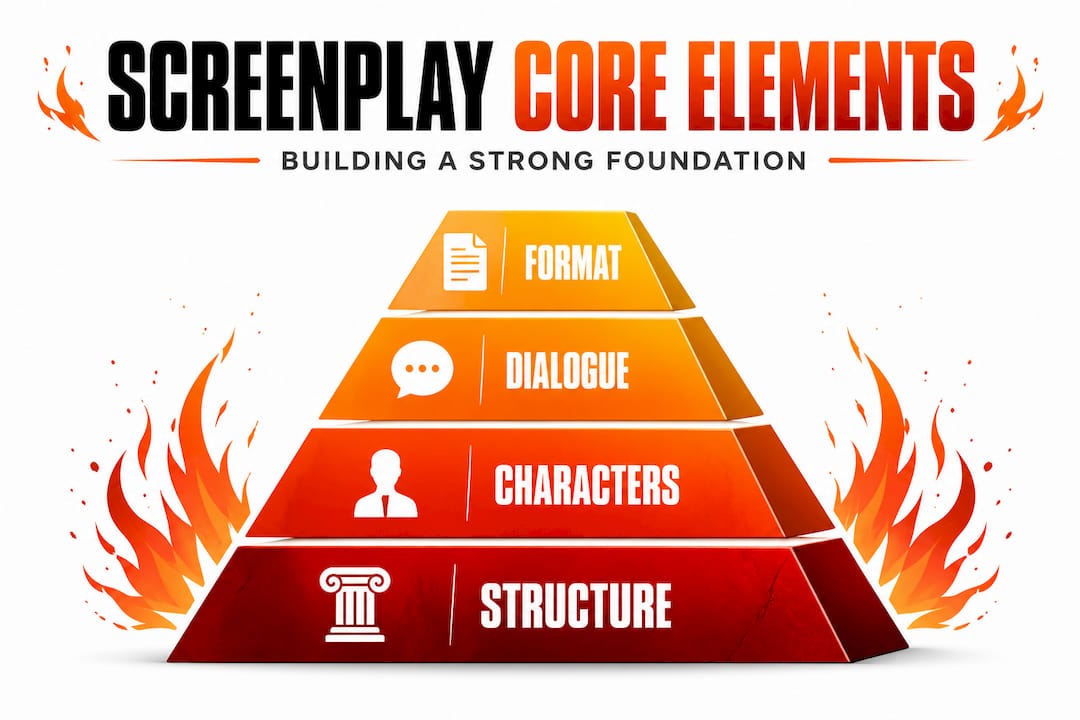
Most scripts get rejected not because the idea is bad, but because the execution breaks down at the foundational level. Industry data consistently shows that the majority of submitted screenplays fail before page 30, not because they lack originality, but because they ignore the structural, character, and dialogue fundamentals that readers and producers use to evaluate scripts every single day. Clever twists and sharp one-liners are memorable, but they cannot rescue a script with a broken spine. This guide cuts through the noise and gives you a clear, actionable framework for the core elements that separate a competitive screenplay from a forgettable one.
Table of Contents
- Script structure: The backbone of powerful storytelling
- Compelling characters: The heart of memorable scripts
- Dialogue and subtext: Breathing life into your story
- Formatting, timing, and market benchmarks
- Why most scripts fail (and how to break out of the crowd))
- Level up your script with expert feedback
- Frequently asked questions
Key Takeaways
| Point | Details |
|---|---|
| Structure sets the standard | Scripts built on solid structure instantly engage readers and boost their sales chances. |
| Characters drive success | Emotionally complex and motivated characters distinguish market-ready scripts from forgettable ones. |
| Dialogue reveals depth | Great dialogue conveys emotion and intent while advancing both plot and character. |
| Formatting matters | Industry-standard formatting and timing are essential for taking a script seriously. |
| Feedback accelerates growth | Expert coverage turns theoretical knowledge into actionable improvements for real scripts. |
Script structure: The backbone of powerful storytelling
With the importance of core elements established, it's essential to begin with the backbone: structure. Every strong script shares it, regardless of genre, tone, or budget.
Structure is not a creative cage. It is a set of proven narrative agreements between the writer and the audience. Readers, producers, and development executives assess structure within the first ten pages. If they do not feel a clear premise taking shape, a protagonist with a visible problem, and a story world establishing itself, the script loses them fast.
Why page count and timing matter more than you think
Standard screenplay length runs 90 to 120 pages, with 110 being the industry sweet spot. The one-page-per-minute rule approximates screen time, but it shifts by genre: comedies tend to run longer per page because of slower dialogue delivery, while action scripts move faster due to visual action lines.
Here is what that means practically:
- A 95-page thriller signals tight pacing, which is a genuine asset in that genre.
- A 145-page romantic comedy tells a reader you do not understand your own format.
- An 80-page drama raises questions about whether the story is fully developed.
Getting your page count right is not about following a rule for its own sake. It tells the reader you understand genre expectations in screenplays and that you have thought about how your story will actually play on screen.
Three-act structure and why it works
The three-act structure is not outdated. It maps directly onto how human brains process narrative tension and resolution. Here is the basic breakdown:
| Act | Page range (110-page script) | Core function |
|---|---|---|
| Act 1 | Pages 1 to 25 | Establish world, protagonist, and central conflict |
| Act 2A | Pages 25 to 55 | Escalate the problem; raise stakes |
| Act 2B | Pages 55 to 85 | All is lost; protagonist hits rock bottom |
| Act 3 | Pages 85 to 110 | Resolution; character transformation complete |
Frameworks like Save the Cat (Blake Snyder), the Story paradigm (Syd Field), and Story (Robert McKee) all describe variations of this same architecture. The labels differ. The underlying logic does not.
For a deeper breakdown of how these frameworks connect, the story structure breakdown at Roast My Script walks through each beat with concrete examples from produced films.
"Structure predicts market and reader success more reliably than originality. A unique idea inside a broken structure fails. A familiar idea inside a tight structure competes."
Understanding how readers assess structure is just as important as understanding structure itself. Readers are not reading to enjoy themselves. They are reading to evaluate. Know what they are looking for.
Compelling characters: The heart of memorable scripts
Just as a strong structure creates the blueprint, unforgettable characters give your story emotional depth and thematic power. You can have perfect structure and still produce a cold, mechanical script if your characters feel like placeholders.

The want versus need distinction
Every protagonist needs two things: what they want (their conscious goal) and what they need (what will actually make them whole). These two things should be in tension with each other throughout the story. Want drives action. Need drives transformation.
For example:
- A character who wants to win back their ex but needs to learn to trust themselves.
- A detective who wants to solve the case but needs to confront their own corruption.
- A soldier who wants to return home but needs to make peace with what they did.
When want and need align at the climax, you get a satisfying arc. When they never align, you get a tragedy. When they barely connect at all, you get a flat script.
Pro Tip: Write two sentences for your protagonist before you write page one. Sentence one: what do they want? Sentence two: what do they actually need? If those sentences feel disconnected from each other, your arc will feel disconnected from your plot.
Character quality and market performance
Research into what makes scripts commercially viable shows a clear pattern. Scripts with clear premise, logical character behavior, escalating conflict, and unambiguous resolution predict approximately 60% ROI classification accuracy based on combined textual and human analysis. That is not a small number when you consider how many variables affect box office performance.
| Script characteristic | Impact on reader evaluation |
|---|---|
| Clear character arc | High: drives emotional investment |
| Logical motivation | High: builds credibility and trust |
| Dimensional backstory | Medium: adds texture without bloat |
| Clichéd archetypes | Negative: signals generic thinking |
| Consistent psychology | High: makes character choices feel earned |
The character psychology framework developed by Linda Seger gives writers a practical method for building characters who feel psychologically real rather than narratively convenient. Her approach to building a character spine is especially useful for writers who feel their characters are behaving inconsistently across scenes.
Character-driven scripts do not necessarily outperform plot-driven scripts at the box office, but they consistently score higher in reader evaluations, which is the gateway to getting a script optioned, pitched, or produced in the first place. The readers are your first audience. Write for them.
Dialogue and subtext: Breathing life into your story
With your characters set and your structure locked, it is time to focus on the surface: how your story sounds, feels, and surprises through its dialogue.
Here is the mistake writers make most often. They treat dialogue as a way to deliver information. Characters explain things to each other. Characters explain things to themselves. Every conversation moves in a straight line from question to answer. The result is dialogue that reads like a screenplay instruction manual.
Real dialogue does the opposite. It creates friction. Characters want different things. They misunderstand each other. They say one thing and mean another. The drama lives in the gap between what is said and what is meant. That gap is called subtext.
What the research shows about dialogue quality
NLP analysis of screenplays shows that dialogue features including emotional engagement in Act 3, sentence complexity, and word count per line predict audience ratings with an R² of 0.5255. That means over half of the variation in audience ratings can be predicted by analyzing dialogue features alone. Character consistency and plot reasonableness are also key predictors of perceived script quality.
This is significant. It means dialogue is not decoration. It is a measurable driver of how audiences experience and evaluate a film.
Pro Tip: Read your dialogue out loud. If you can deliver a line with only one possible tone of voice, it is probably on the nose. Strong dialogue works with multiple readings, each revealing something slightly different about the character's emotional state.
Common dialogue problems to fix before sending your script anywhere:
- Overwriting: Characters speaking in complete, grammatically perfect sentences rarely sounds human.
- Parentheticals overload: If you are using more than one parenthetical per page to control delivery, your dialogue is not doing its job.
- Exposition dumps: Two characters explaining backstory to each other when they both already know it. Readers call this "as you know, Bob" dialogue, and it is a quick rejection trigger.
- On-the-nose delivery: Characters saying exactly what they feel instead of deflecting, deflecting, and then cracking.
For a practical breakdown of how to cut verbosity in dialogue, the Roast My Script blog goes deep on the specific patterns that trigger rejections in dialogue-heavy scripts.
Formatting, timing, and market benchmarks
Getting the creative elements right is only half the battle. Next, make sure your script looks and feels industry-ready.
Formatting is not bureaucratic busywork. It is a signal. A properly formatted script tells a reader that you know the rules, that you respect their time, and that your script is production-ready. A script with inconsistent margins, incorrect sluglines, or bizarre font choices tells them the opposite before they read a single line of dialogue.
Formatting fundamentals that readers notice immediately
- Font: Courier Prime or Courier New, 12-point, always. No exceptions.
- Margins: Standard screenplay margins are not suggestions. Left margin 1.5 inches, right margin 1 inch, top and bottom 1 inch.
- Sluglines: Every scene needs a proper INT./EXT., location, and time of day. Missing sluglines force the reader to do your work for them.
- Action lines: Keep them to four lines or fewer per block. White space is not wasted space. It is pacing on the page.
- Character cues: Character names above dialogue must be capitalized and centered. First appearance of a character name should also be capitalized in the action line.
Common formatting traps that quietly damage a script's evaluation:
- Widowing a single line of dialogue onto a new page.
- Using CONT'D inconsistently.
- Scene numbers on a spec script (this signals you do not know what stage you are at).
- Dual-column dialogue used incorrectly or unnecessarily.
- Narrative description written like a novel, with rich metaphor and internal character thought.
Page count and timing function as the script's hidden handshake with producers. When your script runs to the right length for its genre and format, it signals that you understand how production actually works.
Pro Tip: Matching your format tightly to genre creates a subconscious sense of trust in the reader. A lean, tight action script at 100 pages reads differently than the same story at 120 pages. The shorter version signals discipline. Discipline signals a writer who can take notes.
For writers ready to push beyond basics, the market-ready script essentials resource covers what buyers and festival programmers actually look for when they move past the coverage stage. Understanding how formatting boosts pitch success is especially relevant if you are preparing to submit to production companies or competitions.
Why most scripts fail (and how to break out of the crowd)
After exploring the foundational elements and their practical application, here is an unfiltered perspective on why so many scripts still miss the mark.
Let me be direct about something the writing community does not say enough: originality is not the problem. Most scripts that fail have interesting premises. The failure happens at execution. The writer had a compelling idea and did not build the structural and character architecture needed to pay it off.
The scripts that succeed commercially do something specific. They blend originality with proven form. Top commercial scripts, including something as celebrated as The Godfather, succeed because of economy of information, tight character psychology, and the avoidance of narrative tropes in favor of earned behavior. The idea matters far less than how that idea is dramatized, scene by scene.
Here is the uncomfortable truth: most writers need outside eyes before they can see their own script clearly. You are too close to it. You know what you meant, so you read what you meant instead of what is actually on the page. Structural problems, dialogue issues, and character inconsistencies become invisible to you after your third or fourth pass.
This is exactly why iterative feedback matters. Not because your instincts are wrong, but because they are limited by proximity. Tools like improving your screenplay give you a framework for self-assessment, but the most reliable signal still comes from an outside evaluation. The writers who break out are not always the most talented. They are the ones who actively seek feedback, absorb it without ego, and revise with purpose.
That cycle, write, get feedback, revise, submit, is not optional if you are serious about getting your work in front of the right people.
Level up your script with expert feedback
You now know what makes scripts work. The next step is putting that knowledge to use on your own pages before they reach any reader, producer, or festival.

At Roast My Script, we built the platform specifically for this moment in a writer's process. You have a draft. You believe in it. But before you spend $200 on traditional coverage or pay for a script consultant, you need a clear, structured evaluation of what is actually working and what is not. Our affordable script analysis starts at $9 and delivers a professional PDF report in 1-2 days by email, built on Hollywood methodology from Syd Field, McKee, and Save the Cat. For writers who want to go deeper on craft before submitting, screenwriting concepts for market success is a strong next read.
Frequently asked questions
How long should my screenplay be for industry standards?
Aim for 90 to 120 pages, with 110 being the ideal page count for most genres. Genre adjustments apply: action can run shorter, while some dramas or comedies may land closer to 115.
What common structural mistakes keep scripts from getting noticed?
Weak or unclear premise, flat character arcs, and lack of a satisfying resolution are the top rejection drivers. Research confirms that scripts with logical character behavior, clear conflict escalation, and unambiguous endings predict significantly better ROI outcomes.
How does dialogue quality affect script success?
Dialogue that conveys genuine emotion and serves the story increases audience ratings measurably. NLP analysis demonstrates that dialogue features including emotional engagement, sentence complexity, and character consistency account for over half the variation in how audiences rate a film.
Do I need to follow formatting guidelines exactly?
Yes. Proper formatting signals professionalism and makes your script faster and easier for producers to evaluate. Incorrect formatting, even on a script with great story bones, can trigger an early rejection because it signals a writer who has not done the work. Industry page count standards apply here too: format and length work together to communicate production readiness.
Recommended
- How to analyze a script for powerful screenplay improvement | ROAST MY SCRIPT
- Master Story Structure Breakdown for Screenwriters | ROAST MY SCRIPT
- Script Development Process: Preparing for Hollywood Success | ROAST MY SCRIPT
- Explain screenplay genres to elevate your scripts in 2026 | ROAST MY SCRIPT
- Master the video storytelling process for brand success
- Visual Storytelling Techniques in Film: Elevate Your Narrative