Your story might be brilliant. The concept could be fresh, the characters layered, the dialogue sharp. But if your script lands on a reader's desk looking like a college essay or a stage play, it gets tossed before page five. Poor format signals an amateur and gives gatekeepers an easy reason to pass. Hollywood script format is not a bureaucratic formality. It is a professional language, and fluency in it is the price of admission. This guide walks you through every standard, explains why each rule exists, and gives you actionable steps to make your layout work for you, not against you.
Table of Contents
- What is Hollywood script format?
- Why format matters in Hollywood
- Core elements of a properly formatted script
- Feature film vs. TV scripts: key differences
- Common Hollywood script formatting mistakes
- Tips for mastering Hollywood script format
- Get your script professionally reviewed for format and story
- Frequently asked questions
Key Takeaways
| Point | Details |
|---|---|
| Format is non-negotiable | Proper Hollywood script format is essential for getting your script read and considered. |
| Elements drive clarity | Scene headings, action lines, and character cues make scripts readable and producible. |
| Film vs. TV differs | TV scripts have unique structures and page counts compared to feature films. |
| Mistakes hurt your odds | Common formatting errors can result in immediate rejection from readers and producers. |
| Use tools and coverage | Software and professional script analysis can ensure your format meets industry standards. |
What is Hollywood script format?
Before you can apply best practices, you need a clear definition. Hollywood script format, also known as standard screenplay format, is the industry standard layout for TV and film. It uses Courier 12pt font, specific margins, and includes elements like scene headings, action lines, character names, dialog, parentheticals, and transitions. Every major studio, production company, and festival uses this as the baseline for evaluating submissions.
The standard exists for practical reasons. Courier 12pt at proper margins produces roughly one page per minute of screen time. That means a reader can estimate a film's runtime at a glance. It also makes scheduling and budgeting easier for production teams. Understanding essential screenwriting concepts starts here, with format as the foundation.
Here is a quick-reference table of the core format elements:
| Element | Rule |
|---|---|
| Font | Courier 12pt |
| Left margin | 1.5 inches |
| Right margin | 1 inch |
| Top/bottom margins | 1 inch |
| Scene heading | ALL CAPS, flush left |
| Character name | ALL CAPS, centered |
| Dialog | Indented, centered block |
| Transitions | Right-aligned, used sparingly |
| Page count (feature) | 90 to 120 pages |
Common mistakes to avoid right from the start:
- Using Arial, Times New Roman, or any non-Courier font
- Ignoring margin specifications and letting text run edge to edge
- Writing scene headings in mixed case instead of ALL CAPS
- Overusing transitions like FADE TO: between every scene
- Cramming too much action description into dense paragraphs
Our script formatting guide goes deeper on each of these if you want a full breakdown.
Why format matters in Hollywood
Having set the formatting foundation, discover why it is non-negotiable for your script's market viability.
Script readers at agencies, studios, and festivals process dozens of submissions per week. Format is the first filter. A misformatted script does not just look unprofessional. It actively disrupts the reading experience and signals that the writer does not understand the industry. Proper format signals professionalism, aids readability and production workflow, and poor format leads to immediate rejection.
Beyond perception, format has real production value. The one page equals one minute rule is used by line producers to estimate shoot days and budgets. A script that breaks this convention creates confusion downstream. Understanding format's impact on pitch success means recognizing that your layout is part of your pitch.
"A script that looks wrong before the first line of dialog is read has already failed its first test."
Pro Tip: After finishing your draft, print one page and check it against a produced script side by side. If the visual density or spacing looks different, something is off. AI tools for scriptwriting can also flag formatting inconsistencies automatically.
Tangible outcomes of correct formatting:
- Readers finish your script instead of abandoning it early
- Coverage reports focus on story rather than format complaints
- Producers can estimate budget and runtime without extra work
- Festival submissions pass the initial screening round
- Your script reads at the pace you intended
Core elements of a properly formatted script
Now, let's break down the anatomy of properly formatted script pages with real element-by-element examples.
Key elements include scene headings written as INT./EXT. in ALL CAPS, action lines in present tense, character names in ALL CAPS and centered, dialog indented in a centered block, parentheticals used sparingly, and transitions like CUT TO: right-aligned and used only when necessary.
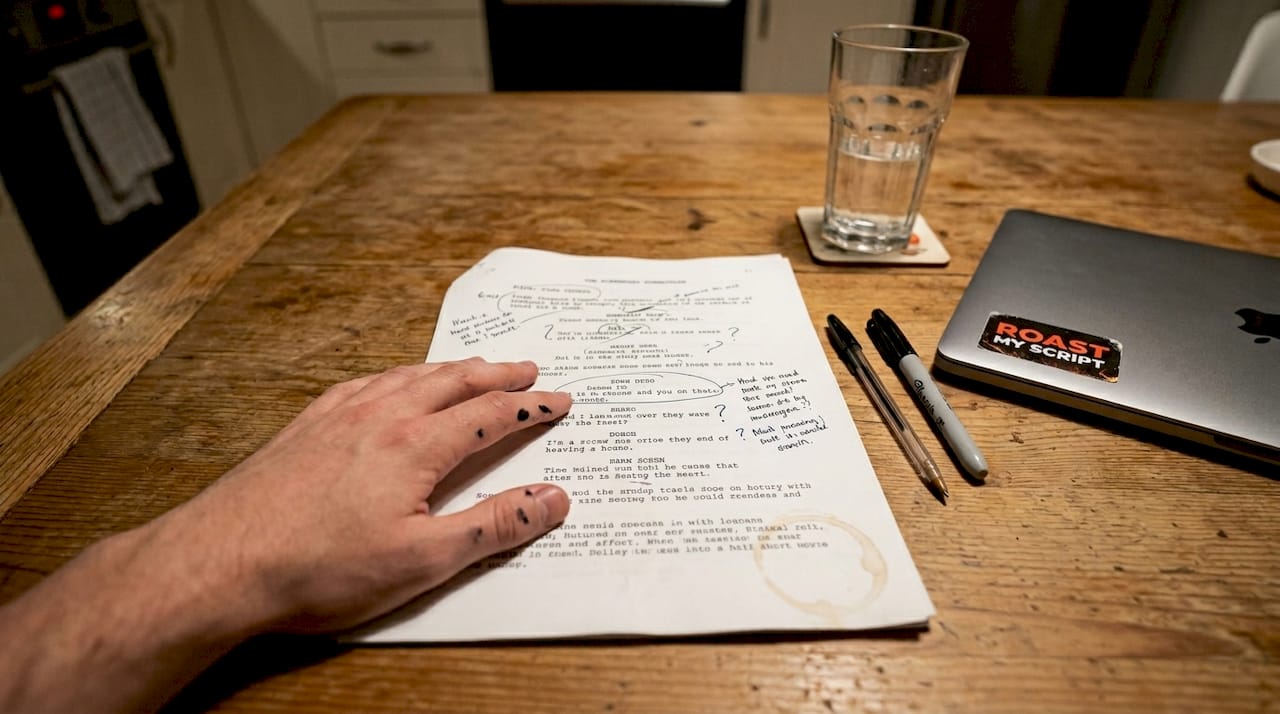
Here is a comparison of correct usage versus common mistakes:
| Element | Correct | Common mistake |
|---|---|---|
| Scene heading | INT. COFFEE SHOP - DAY | Int. Coffee Shop - Day |
| Action line | She slams the door. | She had slammed the door. |
| Character name | MARIA | Maria |
| Dialog | Indented, 2.5 to 3.5 inches | Full-width text |
| Parenthetical | (whispering) | (She says this quietly and nervously) |
| Transition | CUT TO: | Cut to: or used every scene |
Steps to format a basic scene correctly:
- Write the scene heading in ALL CAPS: INT. or EXT., location, time of day
- Drop one line and write action in present tense, flush left
- Drop one line, center the character name in ALL CAPS
- Drop one line and write dialog in the indented block
- Add a parenthetical only if the reading is genuinely ambiguous
- Use a transition only at major structural breaks, not between every scene
Pro Tip: Parentheticals are for direction that cannot be inferred from the dialog itself. If the line reads clearly on its own, cut the parenthetical. Overusing them is one of the fastest ways to mark yourself as a beginner. Check produced script samples to see how sparingly professionals use them.
For a deeper look at how structure and format work together, the story structure breakdown is worth reading alongside this guide. You can also analyze your screenplay format using a structured checklist to catch errors before submission.
Feature film vs. TV scripts: key differences
Once you know the core elements, it is crucial to distinguish how scripts differ by intended medium.
Feature film scripts run 90 to 120 pages, with each page representing roughly one minute of screen time. TV scripts are shorter and structured differently. A one-hour drama typically runs 45 to 60 pages, while a half-hour comedy lands between 22 and 32 pages. Both include act breaks, which are structural markers that correspond to commercial interruptions or streaming episode pacing.
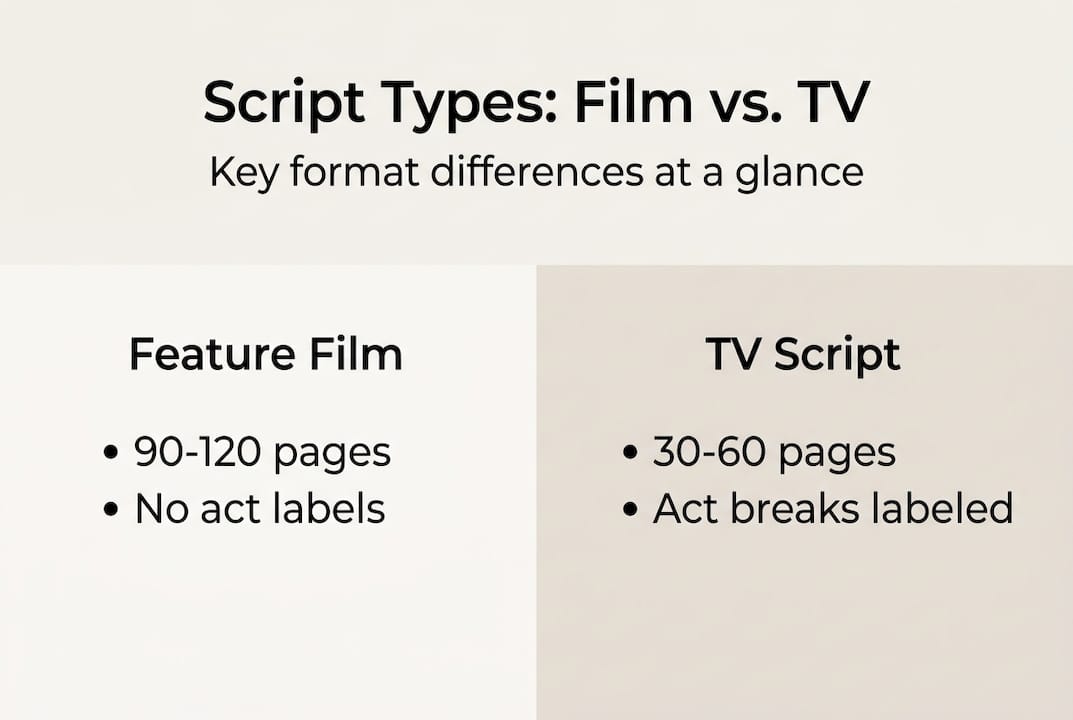
TV formatting differs in several specific ways: act breaks are labeled (ACT ONE, ACT TWO), teasers and tags appear at the start and end of episodes, and some shows use a cold open before the title card. Using software like Final Draft or Celtx lets you toggle between TV and film templates automatically, which removes most of the guesswork.
| Format type | Page count | Act breaks | Key conventions |
|---|---|---|---|
| Feature film | 90 to 120 pages | None (3-act implied) | Single continuous narrative |
| One-hour TV drama | 45 to 60 pages | 4 to 6 acts | Teaser, tag, act labels |
| Half-hour TV comedy | 22 to 32 pages | 2 to 3 acts | Cold open common |
| Short film | 1 to 15 pages | None | Compressed structure |
When to use which format:
- Writing a standalone story for theatrical release → feature film format
- Pitching to a streaming platform or network → TV pilot format with act breaks
- Submitting to short film festivals → short film format, under 15 pages
- Writing a limited series → treat each episode as a TV drama with consistent act structure
Understanding the script development process helps you choose the right format from the first draft. And if you are still deciding between mediums, the guide on screenplay genres for TV vs. film breaks down the creative and commercial differences clearly. For software-specific tips, industry formatting tools are covered in detail by Final Draft.
Common Hollywood script formatting mistakes
Even with format knowledge, avoid these classic missteps to keep your script in the running.
"Format errors are a first-read dealbreaker. A reader who sees wrong margins or the wrong font on page one is already looking for reasons to pass."
The market viability of your script depends on more than story. All industry sources agree that format is essential for a script to be taken seriously. Here are the mistakes that show up most often in submissions:
- Wrong font: Using anything other than Courier 12pt, including Courier New, which looks slightly different and is not the same
- Inconsistent margins: Left margin too narrow or right margin too wide, making the page look off-balance
- Misused scene headings: Writing INT/EXT without a period, or forgetting the time of day (DAY/NIGHT)
- Crowded action lines: Writing five or six line paragraphs of action when two to three lines is the professional standard
- Improper parentheticals: Using them to direct the actor's every emotion instead of reserving them for genuinely ambiguous readings
- Overused transitions: Writing CUT TO: after every single scene instead of only at major structural shifts
Quick fixes for each:
- Switch to a dedicated screenwriting app that locks in Courier 12pt automatically
- Use the software's built-in margin presets rather than adjusting manually
- Read your scene headings aloud and confirm each one has INT. or EXT., a location, and a time of day
- Break long action blocks into two shorter paragraphs with a line of white space between them
- Delete any parenthetical where the emotion is already clear from the dialog
Our formatting feedback guide covers each of these in more detail with before-and-after examples.
Tips for mastering Hollywood script format
You understand the mistakes. Now here is how to master industry-style formatting every time.
Steps to format a script page using software:
- Open Final Draft, Celtx, or WriterDuet and select the correct template (feature or TV)
- Use the tab and return keys to move between elements rather than manually spacing
- Let the software auto-format character names and scene headings as you type
- Review each scene heading manually to confirm INT./EXT. and time of day are correct
- Run a format check or use a script analysis service before submitting
Pro Tip: Read produced scripts from Script Slug or the WGA library before you write your next draft. Internalizing what a correctly formatted page looks like is faster than memorizing rules. Your eye will catch errors automatically once you have read enough professional scripts.
Resources for studying proper format:
- Script Slug: free library of produced screenplays across genres
- WGA script library: union-verified scripts from credited writers
- Simply Scripts: large archive of film and TV scripts, including shooting drafts
- Final Draft's blog: format tutorials with annotated examples
- Celtx's learning center: beginner-friendly formatting walkthroughs
Once your format is solid, the next step is developing the full script. The script development roadmap walks you through that process from concept to final draft. And if you want to make sure your title page formatting is also correct, that guide covers every detail including contact info placement and draft numbering.
Get your script professionally reviewed for format and story
When you are ready to submit, a professional review can ensure your script meets Hollywood standards before it reaches a producer or festival reader.
At Roast My Script, we built the service specifically for this moment. You have done the work. You have studied the format, revised the structure, and polished the dialog. Now you need a clear-eyed analysis that tells you what is working and what will get you passed on. For $9 to $25, you get a full PDF coverage report in 1-2 days by email, covering structure, character, dialog, and market viability using Hollywood methodology from Syd Field, McKee, and Save the Cat. It is the brutal first filter before you invest in expensive coverage or a script doctor. Think of it as the last check before the real stakes begin. Explore screenwriting mastery resources on our platform to sharpen your craft alongside your submission.
Frequently asked questions
What font and margins does Hollywood script format require?
Use Courier 12pt with a 1.5 inch left margin and 1 inch right, top, and bottom margins for all scripts. These are non-negotiable industry standards.
How long should a feature film script be?
Most feature scripts run 90 to 120 pages, with each page representing roughly one minute of screen time. Going significantly over or under that range raises flags.
Do TV scripts use the same format as movie scripts?
TV scripts follow similar conventions but include act breaks and shorter page counts, typically 30 to 60 pages depending on the format. The core font and margin rules remain the same.
Will a badly formatted script get rejected?
Improper format leads to immediate rejection in most professional contexts. Readers use format as a quick signal of whether a writer understands the industry.
What tools can help with script formatting?
Screenwriting software like Final Draft and Celtx handles standard formatting automatically, so you can focus on story rather than spacing rules.
Recommended
- Script format impact: 90% boost production & pitch success | ROAST MY SCRIPT
- Script Development Process: Preparing for Hollywood Success | ROAST MY SCRIPT
- Master Story Structure Breakdown for Screenwriters | ROAST MY SCRIPT
- Roast My Script | AI Script Coverage & Analysis from $9
- The essential parts of a screenplay pros use to get noticed