
You've poured months into your screenplay, but how do you know if it's ready for producers or festivals? Most screenwriters struggle to objectively identify their script's true strengths before submission. Professional feedback offers clarity but often costs hundreds of dollars. This guide walks you through a strategic, affordable process to evaluate your screenplay's core strengths using structured criteria, self-assessment techniques, and accessible professional tools. You'll learn exactly how to pinpoint what makes your script marketable and submission-ready without breaking the bank.
Table of Contents
- Key takeaways
- Preparing to evaluate your screenplay
- Step-by-step process to identify screenplay strengths
- Common mistakes and how to avoid misjudging your screenplay's strengths
- Verifying strengths: leveraging affordable professional feedback
- Explore affordable AI script coverage to refine your screenplay
- FAQ
Key Takeaways
| Point | Details |
|---|---|
| Structured evaluation criteria | Use a structured checklist that covers story, characters, dialogue, and formatting to guide focused, session by session evaluations. |
| Affordable feedback options | Seek affordable professional feedback and AI analysis to gain marketable insights without breaking the bank. |
| Three act structure focus | Assess for a clear three act structure with an inciting incident, midpoint reversal, and satisfying climax to signal strong marketability. |
| Formatting standards adherence | Prioritize correct formatting margins, font, and scene headings to boost perceived professionalism. |
Preparing to evaluate your screenplay
Before diving into evaluation, gather your resources and establish a clear framework. Start with your latest complete screenplay draft and a digital notepad or spreadsheet for tracking observations. You'll need to understand the four core screenplay elements: structure, characters, dialogue, and formatting. Each element contributes differently to your script's marketability and production viability.
Familiarize yourself with industry standards for screenplay formatting. Knowing proper script formatting boosts success chances by 90%, making it a critical strength to verify early. Producers and readers expect specific margins, font choices, and scene heading formats. Deviations signal amateur work, regardless of story quality.
Create an evaluation checklist covering both macro elements like three-act structure and micro elements like dialogue economy. This checklist keeps your assessment focused and prevents overlooking crucial components. Break down your analysis into manageable sessions rather than attempting a single marathon review.
Essential evaluation materials:
- Complete screenplay draft in PDF or Final Draft format
- Notepad or spreadsheet for tracking strengths and weaknesses
- Reference guides for script formatting standards
- Evaluation checklist organized by screenplay element
- Timer for structured review sessions
Core screenplay elements to assess:
| Element | What to evaluate | Why it matters |
|---|---|---|
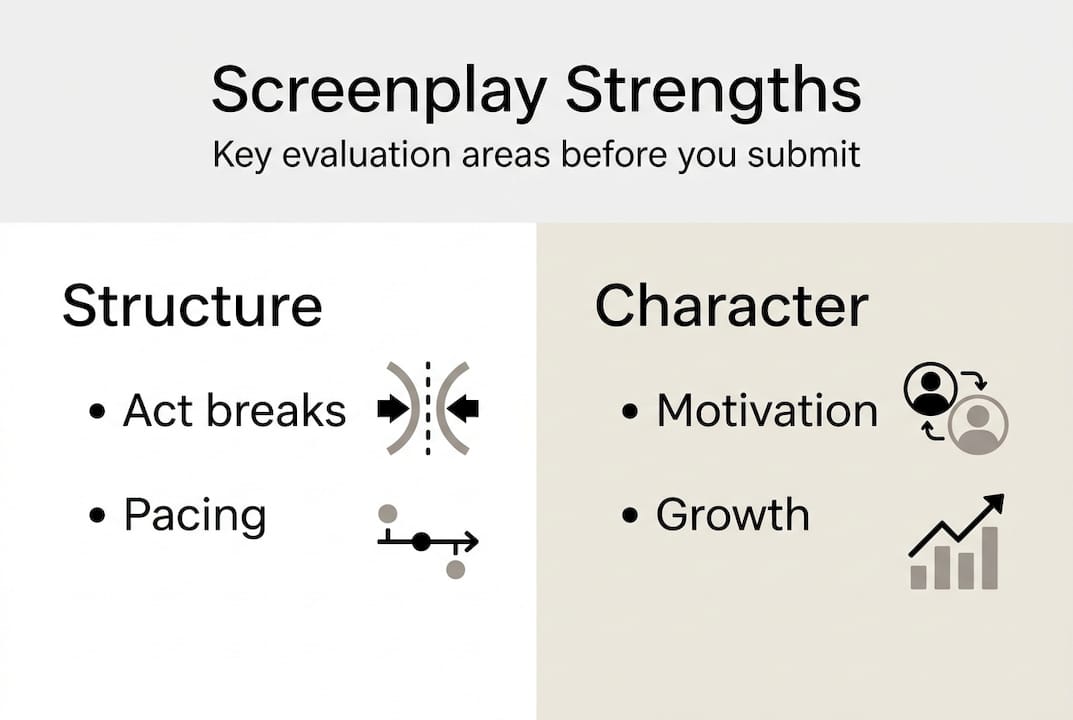
| Structure | Act breaks, plot points, pacing | Foundation of narrative engagement |
| Characters | Motivation, complexity, growth | Drives emotional connection |
| Dialogue | Naturalness, economy, voice | Reveals character and advances plot |
| Formatting | Industry standards, readability | Affects professional perception |
Understanding the script development process helps you recognize which evaluation stage you're in. Early drafts require different assessment criteria than polished final versions. Focus your evaluation on elements appropriate to your draft's maturity level.
Study story structure fundamentals to recognize strong structural choices in your work. Identifying where your script successfully implements proven frameworks gives you concrete strengths to highlight when pitching. This preparation transforms vague feelings about your script into specific, marketable selling points.
Step-by-step process to identify screenplay strengths
Start with story structure evaluation. Assess whether your plot follows a clear three-act framework with identifiable turning points. Strong structure means your inciting incident hooks readers early, your midpoint shifts momentum dramatically, and your climax delivers satisfying resolution. Create a structural breakdown noting where major plot points occur and whether pacing feels balanced.
Story structure evaluation checklist:
- Identify your inciting incident within the first 10-15 pages
- Locate your midpoint reversal around page 55-60
- Confirm your climax builds tension effectively
- Verify resolution addresses core story questions
- Check pacing for momentum and variety
Compare your structural choices against proven frameworks:
| Framework element | Your script | Strength indicator |
|---|---|---|
| Inciting incident timing | Page number | Within first 15 pages |
| Act 1 length | Page count | 25-30 pages |
| Midpoint placement | Page number | Around page 55-60 |
| Climax positioning | Page number | Pages 85-95 |
| Resolution length | Page count | 5-10 pages |
Next, analyze character dimensionality using professional frameworks. Strong character dimensionality is critical for narrative impact, separating memorable scripts from forgettable ones. Evaluate whether your protagonist displays clear external goals, internal conflicts, and meaningful transformation. Supporting characters should serve specific functions while maintaining distinct personalities.

Examine each major character for complexity. Do they make surprising choices that feel authentic? Can you articulate their core motivation in one sentence? Does their arc show visible growth from opening to closing scenes? These questions reveal character strengths worth emphasizing to producers.
Character strength indicators:
- Clear, specific external goals driving plot action
- Internal conflicts creating emotional complexity
- Distinct voice and behavioral patterns
- Meaningful transformation across the narrative
- Relationships that reveal different character facets
Evaluate dialogue by reading scenes aloud or using text-to-speech software. Strong dialogue sounds natural, reveals character, and advances plot simultaneously. Dialogue quality strongly influences script acceptances and rejections, with verbosity causing 42% of rejections. Listen for rhythms, subtext, and whether each character sounds distinct.
Check every exchange for economy. Can you cut words without losing meaning? Do characters say exactly what they mean, or does subtext create tension? Eliminate on-the-nose dialogue where characters explicitly state themes or emotions. Professional script readers immediately notice dialogue that trusts the audience.
Pro tip: Record yourself reading dialogue aloud, then listen back without looking at the script. If you can identify which character is speaking by voice alone, you've created strong, distinct dialogue. If everyone sounds the same, that's a weakness to address.
Finally, verify formatting against industry standards. Proper margins, courier font, correct scene heading format, and appropriate action line length all signal professionalism. These technical strengths might seem minor but dramatically affect how readers perceive your work. Review the comprehensive formatting guide to ensure your script meets production standards.
Strong formatting means readers focus on your story instead of being distracted by technical errors. It demonstrates you understand the industry and respect professional conventions. This foundational strength makes every other element of your screenplay more effective.
Common mistakes and how to avoid misjudging your screenplay's strengths
Emotional attachment creates the biggest evaluation blind spot. You've invested months or years into your screenplay, making objective assessment nearly impossible alone. Writers often overvalue favorite scenes or dialogue exchanges while missing structural problems that undermine the entire narrative. Balance your self-assessment with external perspectives from people who haven't lived inside your story.
Many screenwriters focus exclusively on individual elements while neglecting how components interact. A script might feature brilliant dialogue but lack the structural foundation to support it. Strong characters can't compensate for a weak premise. Evaluate your screenplay holistically, considering how each strength amplifies or undermines others.
Common evaluation traps to avoid:
- Overvaluing clever dialogue while ignoring weak plot structure
- Focusing on protagonist development while neglecting supporting characters
- Emphasizing originality without ensuring marketability
- Skipping formatting review because content feels strong
- Relying solely on friends and family for feedback
Don't limit feedback to a single draft stage. Your screenplay needs evaluation at multiple development points: early outline, first draft completion, mid-revision, and final polish. Each stage reveals different strengths and weaknesses. Early feedback identifies structural issues before you invest in detailed scene work. Later feedback catches dialogue problems and pacing issues.
Skipping professional validation creates false confidence. While self-assessment builds awareness, professional script coverage services offer unbiased, expert feedback to complement your evaluation. These services apply consistent industry standards rather than personal preferences, giving you reliable data about your screenplay's competitive position.
Avoid the trap of seeking only positive reinforcement. Honest critique identifying both strengths and weaknesses provides more value than praise alone. When reviewers highlight problems, they're helping you strengthen your script before it reaches decision makers who won't offer second chances.
Pro tip: Cross-reference feedback from multiple sources to identify consistent patterns. If three different readers mention the same strength or weakness, that's reliable data. Isolated comments might reflect personal taste rather than objective quality.
"The best screenplay evaluation combines self-assessment, peer feedback, and professional analysis. Each perspective reveals different aspects of your script's strengths, creating a complete picture of its market readiness and competitive advantages."
Understand that identifying strengths isn't about ego validation. It's strategic preparation for pitching and marketing your screenplay. Knowing your script's specific competitive advantages helps you target appropriate producers, festivals, and opportunities. Misidentifying strengths wastes time pursuing wrong markets or emphasizing weak elements in pitch meetings.
Review both successful and rejected scripts in your genre to calibrate your evaluation standards. What strengths do produced screenplays consistently demonstrate? Where do rejected scripts typically fall short? This market research helps you assess your own work against realistic industry benchmarks rather than abstract ideals.
Verifying strengths: leveraging affordable professional feedback
Professional feedback transforms subjective self-assessment into objective market analysis. AI-driven script coverage services provide detailed evaluation at a fraction of traditional coverage costs. Affordable AI script coverage starts from $9 and delivers comprehensive reports analyzing structure, characters, dialogue, and marketability within 1-2 days by email.
AI analysis detects patterns human readers might miss. It measures pacing consistency, dialogue distribution across characters, and structural proportion with mathematical precision. This data-driven approach complements creative intuition, revealing technical strengths you can quantify when pitching. Producers respond to concrete metrics demonstrating professional craft.
When selecting feedback services, match the evaluation type to your current needs. Early draft analysis should focus on structural foundations and character development. Final polish feedback should emphasize dialogue refinement and formatting precision. Different services specialize in different aspects, so choose based on where you need verification most.
Considerations when reviewing professional feedback reports:
- Identify strengths mentioned consistently across multiple reports
- Note specific page numbers where evaluators highlight strong execution
- Compare feedback against your self-assessment to find blind spots
- Prioritize actionable suggestions over vague praise or criticism
- Look for market-specific insights about genre expectations
- Track whether feedback aligns with your target submission venues
Professional reports often reveal unexpected strengths you hadn't recognized. Maybe your subplot structure exceeds your main plot in complexity and interest. Perhaps supporting characters display more dimensionality than your protagonist. These insights help you restructure emphasis or develop pitch angles highlighting your script's genuine competitive advantages.
Integrate professional feedback into systematic revision. Don't just read the report and file it away. Create an action plan addressing each identified weakness while amplifying confirmed strengths. Use the character's spine framework to deepen protagonist development. Apply character architecture principles to supporting cast refinement.
Understand the complete development process to know when additional feedback rounds add value versus when you're ready to submit. Over-revising based on conflicting feedback creates new problems. Trust verified strengths and focus improvement efforts on genuine weaknesses supported by multiple evaluations.
Professional validation boosts submission confidence. When you pitch knowing an objective expert confirmed your structural execution, character complexity, and dialogue quality, you communicate authority. Producers sense when writers truly understand their screenplay's value versus hoping for the best. That confidence translates directly into more successful pitch meetings and festival submissions.
Budget for feedback strategically. Invest in professional coverage at key milestones rather than after every minor revision. One thorough evaluation before major submissions provides more value than multiple rushed assessments. The insights from quality feedback compound across future projects, teaching you to self-evaluate more effectively over time.
Explore affordable AI script coverage to refine your screenplay
Now that you understand how to evaluate screenplay strengths systematically, take the next step with professional verification. Roast My Script offers AI-driven screenplay coverage starting at just $9, providing detailed analysis of your script's core strengths and improvement opportunities. Our service delivers professional-grade feedback within 1-2 days by email, helping you identify exactly what makes your screenplay marketable before investing in expensive traditional coverage.

The platform applies proven Hollywood frameworks to assess structure, character development, dialogue quality, and formatting precision. You'll receive specific insights about your screenplay's competitive advantages and concrete suggestions for amplification. Our character development resources, including the character's spine framework and dimensionality masterclass, complement the coverage reports with actionable craft guidance.
Use this affordable feedback as your final verification step before submitting to producers, contests, or festivals. Understanding your screenplay's verified strengths transforms how you pitch and position your work in a competitive market.
FAQ
How can I tell if my screenplay's characters are strong?
Strong characters demonstrate clear motivations driving their actions, internal conflicts creating complexity, and visible growth from opening to closing scenes. They make choices that feel both surprising and inevitable based on their established psychology. Use Linda Seger's dimensionality framework to analyze whether your characters display sufficient depth across multiple facets: professional life, relationships, internal struggles, and external goals. If you can articulate each major character's core want and need in one sentence each, and those elements conflict meaningfully, you've created strong character foundations.
What's the best way to evaluate my screenplay's dialogue?
Read your dialogue aloud or use text-to-speech software to hear how exchanges sound in real time. Strong dialogue flows naturally, reveals character through word choice and rhythm, and advances plot without feeling expository. Check that each character maintains a distinct voice. Dialogue quality strongly influences acceptance rates, with verbose or on-the-nose exchanges causing 42% of rejections. Cut any words that don't serve multiple purposes simultaneously. If dialogue only provides information without revealing character or creating subtext, it needs strengthening.
How does professional feedback improve my screenplay evaluation?
Professional feedback provides objective, industry-informed perspectives free from your emotional attachment to the material. Expert script readers apply consistent evaluation criteria across hundreds of screenplays, giving them calibrated judgment about competitive standards. They identify hidden strengths you might undervalue and weaknesses your proximity prevents you from seeing clearly. This outside validation increases submission success by helping you emphasize genuine competitive advantages rather than elements you personally prefer but don't serve the market.
When should I seek professional screenplay evaluation?
Seek professional evaluation at three key stages: after completing your first full draft to verify structural foundations, mid-revision to confirm character and dialogue improvements, and before final submission to catch remaining formatting or pacing issues. Avoid requesting feedback on incomplete drafts or immediately after finishing scenes when you lack perspective. Space evaluation requests to allow revision time between assessments. Budget permitting, obtain coverage before any major submission opportunity like festival deadlines or producer meetings where first impressions determine whether you advance.
What makes AI script coverage different from traditional coverage?
AI coverage analyzes structural patterns, pacing metrics, and dialogue distribution with mathematical precision that human readers can't match manually. It delivers consistent evaluation criteria without fatigue or subjective mood affecting judgment. However, AI complements rather than replaces human insight, excelling at technical assessment while human readers better evaluate emotional resonance and market positioning. The combination of AI's objective data analysis with human creative judgment provides the most comprehensive evaluation. At significantly lower cost than traditional coverage, AI services make professional feedback accessible for multiple revision rounds rather than just final drafts.