
TL;DR:
- Industry-standard formatting, structural revisions, and sharp dialogue are crucial for script success.
- Professional feedback helps identify blind spots and strengthens marketability before submission.
- Final formatting checks and understanding market needs are essential for polished, Hollywood-ready scripts.
You've finished your script. It feels solid, maybe even great. But there's a gap between a script you're proud of and one that survives a Hollywood reader's first ten pages. That gap isn't about grammar or spell-check. It's about structure, pacing, dialogue subtext, and professional presentation, the details that separate writers who get requests for more pages from those who collect polite passes. This guide walks you through exactly what it takes to close that gap, from the mindset and tools you need before you start revising, to the final formatting check before you submit to any producer, manager, or festival.
Table of Contents
- Preparing your script: Tools and mindset needed
- Step-by-step polish: Transforming your script like a pro
- Polishing dialogue: Making characters and voice stand out
- Format, presentation, and the final check
- The uncomfortable truth about script polish for Hollywood
- Next steps: Get expert script feedback
- Frequently asked questions
Key Takeaways
| Point | Details |
|---|---|
| Prepare with the right mindset | Success starts with professional tools, industry standards, and a willingness to cut favorite scenes. |
| Polish with purpose | Focusing on structure, pacing, and dialogue ensures your script stands out to Hollywood readers. |
| Perfect your presentation | A well-formatted script reduces reader friction and boosts your chances in the industry. |
| Get expert feedback | Independent coverage reveals blind spots and gives you a competitive edge in festivals and pitches. |
Preparing your script: Tools and mindset needed
Before you touch a single scene, you need to get honest with yourself. Hollywood doesn't grade on a curve. Industry readers evaluate hundreds of scripts per month, and they're trained to spot problems in the first few pages. The script development process is not a single pass. It's a series of deliberate, structured revisions, each targeting a specific layer of the work.
Here's what you need assembled before you start:
- Script formatting software: Final Draft, WriterDuet, or Highland 2. These enforce industry-standard margins, spacing, and element styles automatically.
- A printed or annotated copy: Reading on paper catches things screens hide. Print it. Use a red pen.
- A structural checklist: Know your act breaks, midpoint, and key turning points before revising any individual scene.
- Trusted feedback sources: Even one reader who will tell you the truth is worth more than ten who say it's great.
- A reference guide: Keep a script formatting guide bookmarked for formatting edge cases.
| Tool | Purpose | Cost range |
|---|---|---|
| Final Draft | Professional formatting software | $100-$250 |
| WriterDuet | Cloud-based collaboration and formatting | Free to $12/month |
| Script coverage service | Structural feedback from trained readers | $9-$400 |
| Printed script + pen | Physical annotation for scene-level notes | Minimal |
The mindset piece is often harder than the tools. Most writers revise emotionally, defending scenes they love instead of evaluating what the script needs. Cutting darlings, whether favorite characters or beautifully written scenes that slow the story, is one of the most vital disciplines in professional-level script revision. If a scene doesn't move the story forward or reveal character under pressure, it's likely holding you back.
Pro Tip: Before your first revision pass, write down your script's central dramatic question in one sentence. Every scene you keep should connect to that question in some direct way. If you can't make the case, cut it.
Step-by-step polish: Transforming your script like a pro
Once prepared, it's time to roll up your sleeves. Here's how to methodically polish your script to meet Hollywood expectations.
Most writers make the mistake of editing linearly, starting on page one and working forward. Professionals don't do that. They target problem areas first, because fixing a structural flaw on page 30 often resolves five smaller issues you'd otherwise spend hours on.
- Run a structural pass first. Confirm your act breaks land at the right page ranges. Act One should close around pages 25-30, the midpoint near page 55-60, and Act Three should kick off around page 85-90 in a standard feature. Use a story structure breakdown to benchmark yours.
- Identify and cut redundant scenes. If two scenes deliver the same emotional beat or the same information, keep the stronger one and cut the other.
- Tighten scene entries and exits. Entering scenes late and exiting early is one of the most effective pacing techniques in professional screenwriting. Cut the setup. Get to the conflict. Leave before the resolution is fully stated.
- Check your action lines. Keep them lean, three lines maximum per block. Passive voice and camera directions kill pace.
- Do a dialogue pass. Read every line aloud. If it doesn't sound like something a real person would say under pressure, rewrite it.
- Run a format check. Confirm scene headings, character names, and transitions follow standard conventions.
| Revision pass | Focus area | Common fix |
|---|---|---|
| Structural | Act breaks, midpoint, turning points | Reorder or cut scenes |
| Pacing | Scene length, redundancy | Trim or consolidate |
| Scene entry/exit | Where scenes start and end | Cut setup and resolution beats |
| Dialogue | Subtext, character voice, verbosity | Reduce, rewrite on-the-nose lines |
| Format | Headings, spacing, page count | Apply standard conventions |
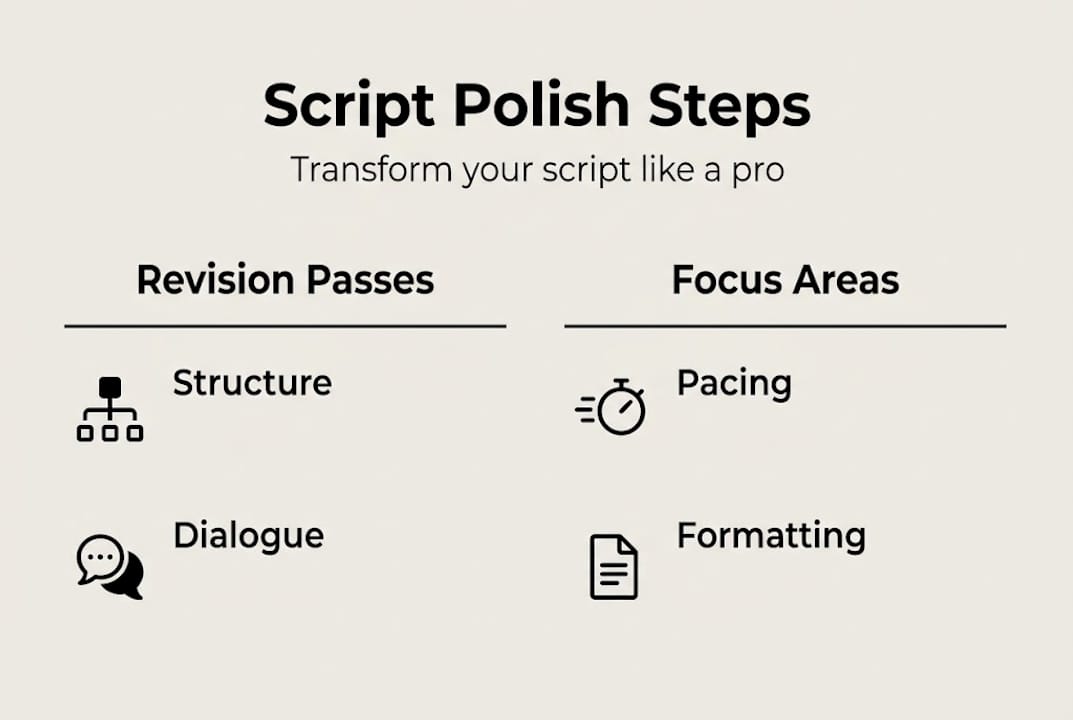
When you're analyzing your script this way, you're thinking like a producer, not a protective author. Understanding screenplay structure at a granular level makes each pass faster and more precise.
Pro Tip: Use a colored highlighter system. Yellow for structural issues, pink for dialogue problems, blue for pacing. A quick visual scan of your printed script tells you instantly where your revision energy needs to go.
Polishing dialogue: Making characters and voice stand out
With major structural revisions handled, polishing dialogue is the next crucial way to make your script stand out.
Hollywood readers can identify weak dialogue by page three. It's one of the fastest ways a script gets passed on. The most common failure is "on-the-nose" dialogue, where characters say exactly what they mean with zero subtext. Real people rarely do that, especially under emotional pressure.
Here are the red flags to cut immediately:
- Exposition dumps: Characters explaining backstory to each other when they'd already know it.
- Emotional announcements: "I'm angry because you betrayed me." Real characters show anger, they don't label it.
- Repeated information: If the audience already knows it, don't have a character say it again.
- Filler openers: Lines that begin with "Well," "Look," or "Listen" before the actual point.
- Matching tone: Every character sounding like the same person. Voice distinction is critical.
The role of dialogue in scripts goes beyond conversation. Dialogue should reveal character, create conflict, and advance plot simultaneously. If a line only does one of those three things, ask whether it's earning its space.
"Dialogue is not conversation. It's the illusion of conversation." This distinction matters more than most writers realize. Every word on the page was chosen. Nothing is accidental. That's the standard Hollywood readers hold you to.
Subtext is your most powerful tool. When a character says "Fine" in response to devastating news, the gap between the word and the emotion is where the scene lives. Writers who master subtext write characters readers remember.
Strong dialogue also makes your script significantly more marketable. Producers and managers who read strong character voice immediately visualize casting, which moves a script closer to production consideration faster than almost any other single element.
Avoiding on-the-nose dialogue and eliminating repetition requires reading your lines from the character's emotional perspective, not the writer's need to communicate information.
Format, presentation, and the final check
Once your script tells a compelling, well-paced story with standout dialogue, make sure it's presented in a way that commands professional respect.
Format signals professionalism before anyone reads a word of your story. A script with inconsistent scene headings, wrong margins, or an improperly structured title page tells industry readers you're an amateur, regardless of the quality of your writing. Proper formatting can boost production and pitch success by up to 90% compared to improperly formatted submissions.
| Formatting element | Standard requirement |
|---|---|
| Font | Courier Prime or Courier, 12pt |
| Page count | 90-120 pages for features |
| Margins | 1.5 inch left, 1 inch right, 1 inch top/bottom |
| Scene headings | INT./EXT. LOCATION - DAY/NIGHT |
| Title page | Title, writer name, contact info only |
Here's your final pre-submission checklist:
- Verify your title page. It should contain your title, your name, and contact information. No WGA registration numbers displayed, no copyright symbols cluttering the header. Review complete title page formatting rules before finalizing.
- Check page count. Features run 90-120 pages. A 145-page spec script is a submission red flag.
- Confirm all scene headings are consistent. Interior vs. exterior, location name, time of day. Inconsistency here reads as careless.
- Remove camera directions. Unless you're directing it, don't write CLOSE ON or SMASH CUT TO throughout your script.
- Export to PDF. Never submit a raw .fdx or .docx file. PDF locks your formatting.
- Read the first ten pages cold. Wait 48 hours after your final pass, then read the opening as if you've never seen it. If you're hooked, a reader probably will be too.
Review your formatting guide one final time before locking your script. Small inconsistencies at submission stage communicate a lack of professional discipline.
Pro Tip: After your final self-edit, send your script to a professional feedback service before submitting anywhere. A single outside read can catch formatting issues and structural blind spots you've become immune to after months of working on the same pages.
The uncomfortable truth about script polish for Hollywood
Here's what most polish guides won't tell you: a technically flawless script with a weak core concept still gets passed on. Every time. Formatting, structure, and dialogue are necessary, but they're not sufficient. The idea has to be marketable, distinctive, and clear from the logline forward.
I've seen writers spend six months polishing a script that had a fundamental concept problem no amount of revision could solve. The real question isn't "Is this well written?" It's "Would a producer want to make this in today's market?"
Fresh perspective matters more than flawless grammar. That's why professional notes, even ones that sting, are more valuable than another self-edit pass. Ignoring critical feedback because it's uncomfortable is one of the most costly mistakes you can make before pitching.
DIY polish has a ceiling. You can't see your own blind spots. AI script analysis techniques have changed the economics here, making it possible to get structural notes that catch real problems before you spend money on expensive coverage or pitch the wrong draft to the right person.
Next steps: Get expert script feedback
Now that you've learned proven ways to polish your script, the fastest way to validate your work is with a professional outsider's eye.
At Roast My Script, you can get affordable script feedback starting at $9, with a full structural analysis delivered in 1-2 days by email. The analysis is built on Hollywood methodology including Syd Field, McKee, and Save the Cat, and it gives you specific, actionable notes on structure, character, dialogue, and market viability. Before you pitch to a producer or enter a festival, this is the brutal first filter your script needs. You can also master essential screenwriting concepts through our free educational resources to sharpen your craft alongside professional feedback.
Frequently asked questions
How do I know if my script is ready for Hollywood submission?
Your script is ready if it meets industry formatting standards, has passed third-party feedback, and tells a compelling story free of redundant scenes and on-the-nose dialogue. Proper formatting alone can significantly boost your pitch success.
What are the most common mistakes when polishing a script?
The most common mistakes are leaving in unnecessary scenes or characters, failing to cut repetitive dialogue, and ignoring professional formatting conventions. Cutting darlings is vital for pacing and is often where writers resist the most.
Is dialogue really that important for script polish?
Absolutely. Hollywood readers identify weak or overly direct dialogue within the first few pages, and it undermines the script's credibility fast. Avoiding on-the-nose dialogue is one of the most impactful polish steps you can take.
Do I need professional feedback for a Hollywood-ready script?
Self-editing is essential, but it has limits. Professional feedback consistently catches subtle structural and dialogue issues that writers become blind to after months on the same project.
How can I cut costs when getting my script professionally reviewed?
AI script coverage tools can reduce review costs by up to 75% compared to traditional script coverage services, making professional-quality notes accessible for under $25.
Recommended
- Script Development Process: Preparing for Hollywood Success | ROAST MY SCRIPT
- How to analyze a script for powerful screenplay improvement | ROAST MY SCRIPT
- Script format impact: 90% boost production & pitch success | ROAST MY SCRIPT
- Master Story Structure Breakdown for Screenwriters | ROAST MY SCRIPT
- The essential parts of a screenplay pros use to get noticed