
TL;DR:
- Exposition is the continuous presentation of essential background information through visuals, action, and subtext.
- Avoid info dumps by embedding details in conflict, environment, and character behavior to maintain momentum.
- Trust the audience to infer and reveal key information strategically to create engaging, invisible exposition.
Most scripts don't get rejected because the dialogue is weak. They get rejected because the exposition is broken. Screenwriters pour energy into perfecting their characters' voices while burying the audience under walls of background information delivered at the worst possible moment. Many scripts falter at the exposition stage not because of clunky sentences but because of structural missteps. Exposition is not a writing problem. It's an architectural one. This article will show you exactly what screenplay exposition is, how it works mechanically, and how to make it invisible without sacrificing clarity or momentum.
Table of Contents
- What is screenplay exposition?
- The mechanics of exposition: How information is revealed
- Best practices: Making exposition engaging and invisible
- Common pitfalls and how to fix them
- An expert perspective: Why less is more and when to break the rules
- Get your exposition pitch-perfect with expert feedback
- Frequently asked questions
Key Takeaways
| Point | Details |
|---|---|
| Exposition orients audience | Screenplay exposition provides the essential background needed to understand story and stakes. |
| Show, don’t tell | Reveal information through visuals, actions, and natural dialogue instead of narration or info dumps. |
| Pace your reveals | Spread exposition throughout your script to maintain momentum and protect mystery. |
| Fix structural, not just surface issues | If exposition feels forced, consider revising story structure—not just editing lines. |
What is screenplay exposition?
Now that we've framed the challenge, let's clarify exactly what exposition means in screenwriting.
At its core, screenplay exposition is the introduction of essential background information including setting, characters, world rules, relationships, and stakes to orient the audience without halting narrative momentum. That last part matters. Exposition is not a pause in the story. Done right, it is the story moving forward while also informing the audience.
Think about the opening crawl in Star Wars. In roughly 200 words, audiences understand a galactic civil war, a stolen weapon, and a princess in danger. No character explains it. No dialogue is needed. The world is established through text and music, and the story launches immediately. That's exposition working at its best.
Inception takes a different approach. The world rules of dream-sharing are explained through scenes of active conflict and demonstration. Characters don't sit down and lecture. They argue, test, and reveal information through action.
Here's what exposition typically covers:
- Setting: Where and when the story takes place
- Characters: Who the protagonist is and what they want
- Relationships: How characters connect to each other
- World rules: What is normal or possible in this story's universe
- Stakes: What is at risk and why it matters
"Exposition is not a section of your script. It's a function your script performs continuously, and the best writers make it feel effortless."
In terms of story structure breakdown, exposition lives primarily in Act 1, often anchored around the inciting incident. But it doesn't stop there. New information is revealed throughout the script whenever the audience needs it to understand a decision or a consequence.
The biggest misconception? That exposition only happens through dialogue. Visual storytelling, set design, costume, and action can all carry expositional weight. A character's cluttered apartment tells you something. A worn wedding ring tells you something. Exposition is everywhere, not just in what people say.
The mechanics of exposition: How information is revealed
With a clear definition in hand, we can examine how exposition actually lands on the page and the screen.
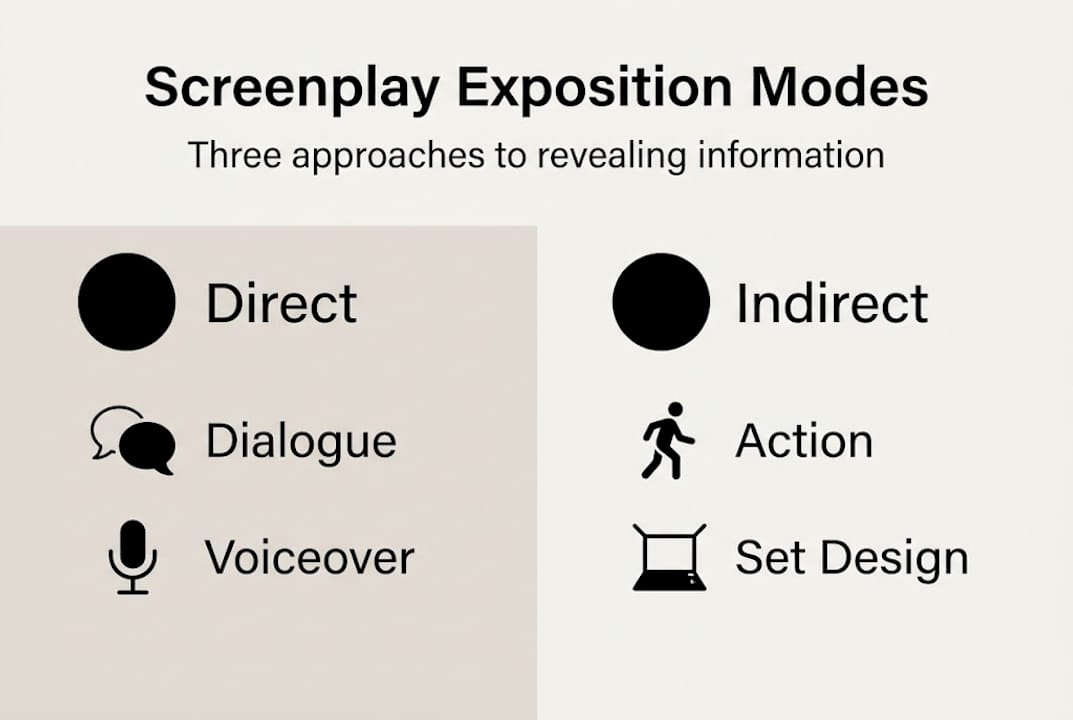
There are three primary modes of delivering exposition, and each has its place. Mechanics include direct, indirect, and implicit exposition; in screenplays, prioritize visual and action-based approaches over narration.
| Mode | How it works | Strengths | Weaknesses |
|---|---|---|---|
| Direct | Explicit statements, narration, on-the-nose dialogue | Clear, efficient | Can feel forced or unnatural |
| Indirect | Embedded in conflict, objects, or behavior | Feels organic | Requires more craft to execute |
| Implicit | Audience infers from context and visuals | Elegant, trusts the viewer | Can confuse if overdone |
Here's how to think about each one in practice:
- Direct exposition works best in genre films where world-building is complex. A scientist explaining a virus in a thriller is acceptable if the explanation is brief and tied to urgency.
- Indirect exposition is the workhorse of professional screenwriting. A couple arguing about money reveals financial strain without anyone saying "we're broke."
- Implicit exposition is the most cinematic. A character's body language, a photograph on the wall, or a scar on their hand can communicate volumes without a single word.
The impact of dialogue on exposition is significant. Dialogue is often overloaded with expositional duty, which is why so many scripts feel talky and slow. When every character explains their feelings and history out loud, the screenplay loses its visual power.
Pro Tip: Before writing any expositional scene, ask yourself: can this information be shown through an action, an object, or a reaction instead of spoken aloud? If yes, cut the dialogue and show it. You can also study how analyzing scripts for improvement reveals patterns in how professional writers handle these choices.
Best practices: Making exposition engaging and invisible
Having covered ways information can be delivered, let's turn to what actually makes exposition effective or disastrous.

The number one failure mode is the info dump. This is when a writer stops the story to deliver a block of background information, usually through dialogue, narration, or a scene that exists purely to explain. Audiences feel it immediately, and they disengage.
Avoid info dumps by spacing exposition, embedding it in conflict or conversation, using visuals and actions over dialogue, and making it entertaining through subtext, humor, or tension. That's the professional standard, and it's worth internalizing.
Here's what the best exposition techniques have in common:
- Conflict as a delivery vehicle: Characters reveal information while fighting, negotiating, or competing. The exposition rides the tension.
- Visual anchoring: Set pieces, props, and environment communicate backstory without dialogue.
- Spacing and pacing: Don't front-load everything in Act 1. Reveal information when the audience needs it to understand what's happening.
- Subtext: Characters talk around the truth. What they don't say carries as much weight as what they do.
- Humor and irony: Comedy can make exposition feel effortless. A funny misunderstanding can reveal character history without feeling like a lecture.
Pro Tip: Every time you reveal a piece of exposition, try to shift the power dynamic or raise the stakes at the same moment. If a character learns their partner has been lying, that revelation should also change what the character wants next. Exposition that changes the game is invisible because it feels like plot.
Pay attention to genre and exposition conventions too. Sci-fi and fantasy scripts carry heavier world-building burdens, which means indirect and implicit exposition become even more critical. Drama scripts can afford more direct emotional revelation. Genre shapes the rules. And as part of your overall script development, treating exposition as a structural layer rather than a line-level fix will save you significant rewrite time.
Common pitfalls and how to fix them
Even with best intentions, common pitfalls can derail your exposition. Here's how to spot and correct them.
Pure exposition scenes signal structural issues. If a scene exists only to deliver information and nothing else happens, that's a red flag. Redesign it so the exposition advances the story through conflict. Front-loading risks boredom, and over-explaining kills mystery.
| Rookie mistake | Pro solution |
|---|---|
| Character explains their own backstory unprompted | Reveal backstory through a conflict or a question from another character |
| Opening scene is two characters catching up | Open in action; weave history into the present problem |
| Voiceover narrates what we can already see | Cut the voiceover; trust the visual to do the work |
| World rules explained in a monologue | Show the rules being broken or tested in real time |
Here's a diagnostic process you can apply to any scene:
- Identify the information being delivered. What does the audience learn?
- Ask if it's necessary right now. Can this wait until the audience actually needs it?
- Find the conflict. Is there any tension in this scene, or is it purely informational?
- Redesign around action. Replace the explanation with a moment where the information is demonstrated or discovered.
- Test for redundancy. If the audience can already infer this, cut it entirely.
"The moment your audience starts asking 'why are they telling us this?' you've lost them. Exposition should feel inevitable, not instructional."
Forced dialogue is the most common symptom. Lines like "As you know, Bob, we've been partners for fifteen years" are classic examples of characters explaining things they would never actually say. The fix is to find a reason for the character to genuinely not know the information, or to reveal it through behavior instead.
Understanding Hollywood screenplay structure helps you see why these pitfalls occur. When writers don't have a clear structural map, they compensate by over-explaining. And if you're concerned about script format impact, know that a script cluttered with expositional dialogue reads as amateur regardless of how clean the formatting is.
An expert perspective: Why less is more and when to break the rules
Beyond standard practice, let's consider when the rules of exposition should be bent or even ignored.
Here's something most craft books won't tell you: the writers who handle exposition best are the ones who trust their audience the most. Minimal exposition is not laziness. It's confidence. When you withhold information strategically, you create mystery, and mystery creates engagement.
Gravity opens with almost no exposition. You learn what you need through action and environment. The film trusts you to keep up, and that trust is part of what makes it gripping.
Exposition is structural, tied to the inciting incident and Act 1, not just line-level writing. Reveal information when it's needed for a decision, cluster it around high-stakes moments, and trust your audience to infer the rest. That's the professional mindset.
The real skill is knowing when to cluster reveals. Instead of spacing exposition evenly, some of the best scripts hold back critical information and release it in a burst at a high-stakes moment. The audience feels the weight of the revelation because they've been waiting. This is how AI transforms scriptwriting analysis too: structural tools can identify where your exposition clusters and whether those moments land at the right beats. Sometimes the boldest move is to say almost nothing and let the story speak.
Get your exposition pitch-perfect with expert feedback
Armed with these insights, here's how you can get actionable feedback on your exposition and accelerate your script's path to success.
Knowing the theory is one thing. Seeing exactly where your script's exposition breaks down is another. That's where professional coverage earns its value. At Roast My Script, we analyze your screenplay's structural layers, including how and where you deliver exposition, whether it stalls momentum, and how to fix it before you send your script anywhere that matters.

For $9 to $25, you get a detailed PDF analysis built on Hollywood methodology, delivered in 1-2 days by email. Before you invest in expensive coverage or script doctors, use screenwriting concept essentials to sharpen your craft, then run your script through professional script analysis to get the brutal, honest feedback that makes the difference.
Frequently asked questions
How do you introduce exposition without boring your audience?
Layer exposition through conflict, action, and subtext so it feels like story progression rather than a pause for information delivery. When the audience is emotionally engaged, they absorb background details without noticing.
What's the difference between exposition and backstory?
Exposition is essential background the audience needs right now to follow the story; backstory is historical detail that may or may not be revealed, depending on whether it serves the present narrative.
Can I use voiceover for exposition in my screenplay?
Voiceover is a legitimate tool, but modern trends favor in-scene integration over narration. Use it sparingly and only when it adds a perspective or irony that the visuals alone cannot deliver.
How much exposition is too much?
If your exposition slows momentum or repeats what the audience can already infer, it's too much. Industry preference leans toward minimal exposition, often less than one dedicated scene, with the rest woven into action and conflict throughout the script.
Recommended
- How to analyze a script for powerful screenplay improvement | ROAST MY SCRIPT
- Master Story Structure Breakdown for Screenwriters | ROAST MY SCRIPT
- Script format impact: 90% boost production & pitch success | ROAST MY SCRIPT
- Explain screenplay genres to elevate your scripts in 2026 | ROAST MY SCRIPT
- The essential parts of a screenplay pros use to get noticed