
TL;DR:
- Feedback helps writers identify blind spots, accelerate skill development, and build revision habits.
- Industry professionals prioritize structure, clarity, formatting, and early pages over raw talent.
- Consistent iteration and high coverage scores increase chances of industry recognition, not guaranteed sales.
Most screenwriters believe talent alone drives success. That assumption costs careers. A study of 12,309 screenplays analyzed through Screencraft coverage revealed something counterintuitive: the scripts that stand out aren't necessarily the most creative, they're the most structurally sound and rigorously refined through feedback. Understanding what feedback actually does, and how to use it strategically, is the skill gap separating writers who break through from those who keep resubmitting the same flawed draft.
Table of Contents
- Why feedback matters in screenwriting
- What professional script readers prioritize
- Types of feedback and how to use them
- From feedback to industry success: How coverage predicts script outcomes
- Feedback: The truth most screenwriters miss
- Take your screenwriting to the next level with affordable feedback
- Frequently asked questions
Key Takeaways
| Point | Details |
|---|---|
| Feedback builds confidence | Receiving constructive feedback strengthens your writing self-belief and skill. |
| Industry focuses on structure | Professional script readers prioritize concept, structure, and formatting for success. |
| Seek actionable advice | Apply targeted feedback to your script revisions for noticeable improvements. |
| High coverage earns attention | Scripts with consistent high feedback scores attract industry interest and opportunities. |
Why feedback matters in screenwriting
Feedback is one of the most misunderstood tools in a screenwriter's arsenal. Many writers treat it as optional, something to seek only when stuck, or worse, something to fear. That's a costly mistake.
The psychological case for feedback is strong. Research shows that feedback perception predicts self-efficacy and self-regulated learning strategies, which in turn mediate measurable improvements in writing ability. In plain terms: when writers genuinely engage with feedback, they don't just fix one script. They build the mental frameworks to write better scripts consistently.
Here's what feedback actually does for screenwriters:
- Builds structural awareness. You can't see your own blind spots. A reader can.
- Accelerates skill development. Iteration with feedback compresses years of trial and error into focused revision cycles.
- Validates what's working. Good feedback isn't only about problems. Knowing your strengths is equally strategic.
- Reduces costly mistakes. Submitting a structurally broken script to a producer wastes both time and industry relationships.
- Supports self-regulated learning. Writers who actively seek and apply feedback develop stronger revision habits over time.
The common misconception is that feedback is a one-time fix. You get notes, you revise, you're done. In reality, feedback is a continuous loop. The writers who treat it as a process, not an event, are the ones who improve fastest.
Pro Tip: Don't wait until your script feels "finished" to seek feedback. Getting structural notes at the outline or first draft stage saves you from polishing a fundamentally broken story.
You can learn more about how professional evaluation works by reading our script coverage guide, which breaks down what coverage actually includes and why it matters before you pitch.
What professional script readers prioritize
Understanding the importance of feedback helps us appreciate what professionals look for when reviewing scripts. Knowing their criteria lets you target your revisions more precisely.
A large-scale analysis of 12,309 screenplays via Screencraft coverage identified clear patterns in what script readers evaluate and how those evaluations correlate with industry interest. The findings challenge the romantic idea that a brilliant concept alone will carry a weak script.
Here's what readers consistently prioritize:
- Concept clarity. Is the premise original, marketable, and clearly communicated in the logline?
- Structure. Does the story follow a coherent arc with proper act breaks and escalating tension? Our story structure guide covers this in depth.
- Formatting. Improper formatting signals inexperience immediately. First impressions matter.
- Voice. Does the writing feel distinct? Is the dialogue natural or mechanical?
- First pages. Many readers make early judgments within the first ten pages. Your opening must earn continued reading.
"The first ten pages are your audition. If the reader isn't engaged by page ten, the rest of the script rarely changes their mind."
Here's a practical comparison of what emerging versus established screenwriters should prioritize when seeking feedback:
| Focus area | Emerging writers | Established writers |
|---|---|---|
| Concept | High priority | Medium priority |
| Structure | High priority | Medium priority |
| Formatting | High priority | Low priority |
| Voice and dialogue | Medium priority | High priority |
| Polish passes | Low priority | High priority |
| Market viability | Medium priority | High priority |
For emerging writers, the fundamentals are everything. Structural problems and formatting errors disqualify scripts before readers even engage with the story. Once those foundations are solid, voice and market positioning become the differentiators.

Review our formatting best practices to make sure your script passes the first visual test before it reaches a reader's desk.
Types of feedback and how to use them
With a clear picture of reader priorities, let's look at the forms of feedback available and how to apply them strategically.
Not all feedback is equal. The type you choose should match where your script is in development and what specific problems you're trying to solve.
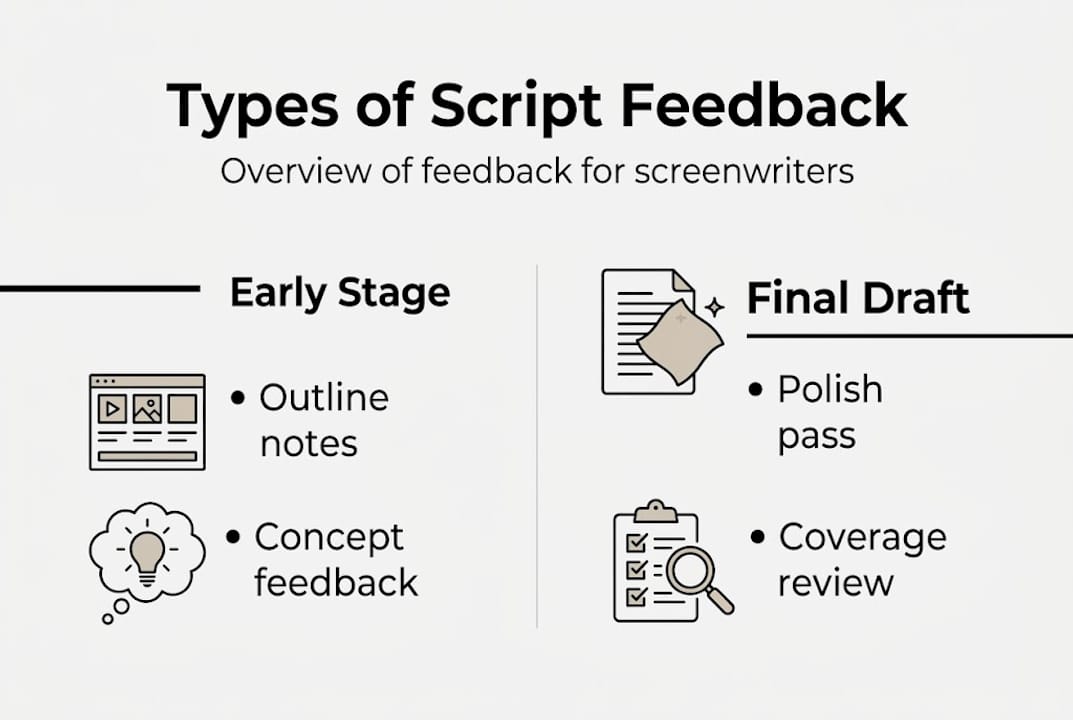
| Feedback type | Best for | Typical cost | Turnaround |
|---|---|---|---|
| Script coverage | Full structural evaluation | $60 to $400 | 1 to 2 weeks |
| Script notes | Targeted scene or act issues | $200 to $800 | 1 to 3 weeks |
| Peer review | Early drafts, general impressions | Free to low cost | Variable |
| AI-based analysis | Structural checks, quick iteration | $9 to $25 | 1-2 days by email |
Here's a step-by-step framework for applying feedback effectively:
- Read all notes before reacting. Resist the urge to defend your choices immediately. Let the feedback settle.
- Identify patterns. If three different readers flag the same issue, it's real. One reader's preference is debatable. Three readers' consensus is structural.
- Separate the actionable from the subjective. Some notes reflect personal taste. Focus on structural and clarity issues first.
- Prioritize by impact. Fix act-level problems before scene-level problems. Don't polish dialogue in a scene you might cut.
- Revise with intention. Each revision pass should have a specific goal. Don't rewrite everything at once.
Pro Tip: Use AI script analysis as your first filter before investing in expensive human coverage. It catches structural problems fast and cheaply, so you arrive at the human reader stage with a cleaner draft.
Established writers on the Scriptnotes podcast have noted that polish passes before submission are non-negotiable. Even experienced writers run multiple review cycles before anything goes to a producer. The habit of iteration isn't a sign of weakness. It's professional discipline.
For writers still developing their premise, our logline crafting tips can help you sharpen the concept before feedback even begins.
From feedback to industry success: How coverage predicts script outcomes
Having looked at feedback types, let's connect the dots: how does ongoing feedback relate to industry recognition and script success?
The relationship between feedback and industry outcomes is real but often misread. Writers sometimes expect a single round of strong coverage to open doors. That's not how it works. The pattern is more nuanced.
High coverage scores attract attention, but they're the result of consistent iteration, not luck. The Black List, which tracks industry interest in unproduced scripts, consistently surfaces scripts that have been through multiple rounds of feedback and revision. The scripts that land on that list didn't get there on a first draft.
Here's what the evidence actually shows:
- High coverage scores signal quality. Scripts scoring consistently well across multiple readers attract manager and producer interest.
- Feedback iteration builds pattern recognition. Writers who revise based on coverage learn to anticipate reader objections before submission.
- No direct link to guaranteed sales exists. Coverage predicts interest, not transactions. The market is still unpredictable.
- Perception of feedback shapes long-term outcomes. Writers who treat coverage as a tool rather than a verdict improve faster and submit stronger work over time.
"Consistent high coverage doesn't guarantee a sale, but it dramatically increases the probability that the right person reads your script at the right moment."
The writers who succeed aren't necessarily the most talented in the room. They're the most disciplined about the feedback loop. They submit, they receive notes, they revise, they resubmit. That cycle, repeated across multiple projects, is what builds a career.
Our screenwriting concepts resource covers the foundational ideas that coverage readers evaluate, giving you a framework to assess your own work before external feedback arrives.
Feedback: The truth most screenwriters miss
Here's a candid take on what most writers overlook, and it's something I've seen repeatedly in how writers respond to coverage.
The problem isn't that writers don't get feedback. It's that they don't know how to receive it. There's a meaningful difference between reading notes and actually processing them. Most writers skim for validation and resist anything that challenges their vision. That's human. It's also a career limiter.
Research confirms that feedback perception affects self-efficacy directly. Negative perception of feedback, even when the feedback is accurate and useful, reduces confidence and degrades performance. The implication is uncomfortable: your attitude toward notes matters as much as the notes themselves.
Here's what I tell screenwriters who want to use feedback effectively:
- Treat every note as information, not judgment.
- Ask for specific feedback, not general impressions.
- Build resilience by separating your identity from your draft.
Our screenplay structure mastery resource gives you the structural vocabulary to understand and apply notes with precision, rather than reacting emotionally to them.
The writers who thrive are the ones who stay curious about their own weaknesses. That's not a soft skill. It's a competitive advantage.
Take your screenwriting to the next level with affordable feedback
You now have a clear picture of how feedback works, what readers prioritize, and how to apply notes strategically. The next step is getting quality feedback without spending hundreds of dollars on coverage you're not ready for.

At Roast My Script, we built the platform specifically as the brutal first filter before you send your script anywhere. For $9 to $25, you get a professional structural analysis based on Hollywood methodology, delivered in 1-2 days by email. It's designed to catch the problems that would get your script passed on, before a real reader ever sees it. Explore our screenwriting course to strengthen your foundational skills alongside your feedback practice.
Frequently asked questions
How does feedback improve screenwriting skills?
Feedback perception predicts self-efficacy and activates self-regulated learning strategies, which directly improve writing ability over time. Writers who engage actively with notes build stronger structural instincts across every project.
What do script readers focus on when reviewing screenplays?
Professionals prioritize concept clarity, structure, formatting, and distinct voice, with particular attention to the first pages. A study of 12,309 screenplays confirms these are the consistent criteria separating strong scripts from weak ones.
Can feedback guarantee a screenplay sale or production?
Feedback doesn't guarantee sales, but consistent high coverage signals scripts worth investing in and significantly increases the likelihood of attracting industry attention.
What is the best way to receive and apply feedback?
Approach notes without defensiveness, identify recurring patterns across multiple readers, and revise iteratively with a specific goal for each pass. Polish passes before submission are standard practice among working professionals for good reason.
Recommended
- Script Development Process: Preparing for Hollywood Success | ROAST MY SCRIPT
- Script format impact: 90% boost production & pitch success | ROAST MY SCRIPT
- How to analyze a script for powerful screenplay improvement | ROAST MY SCRIPT
- Roast My Script | AI Script Coverage & Analysis from $9
- Step-by-step guide to writing gripping horror stories
- How to write a sci-fi novel: essential steps for success