
TL;DR:
- Effective script feedback requires structured preparation, including polishing, clarifying goals, and proper materials.
- Following a staged, iterative process with different reader levels ensures continuous improvement and stronger drafts.
- Analyzing and tracking patterns in feedback helps prioritize craft issues over individual opinions for better revisions.
Turning a good script into a great one rarely happens in isolation. Most screenwriters face the same wall: they finish a draft, send it out, and come back with a pile of notes that seem to contradict each other, miss the point entirely, or push the story in directions that feel wrong. The problem isn't that feedback is bad. The problem is that most writers don't have a structured system for seeking it, processing it, and acting on it effectively. This guide gives you that system, step by step, so every round of notes actually moves your script forward.
Table of Contents
- What you need to prepare: Setting your script up for feedback success
- Step-by-step script feedback process: Structured stages for actionable notes
- How to interpret and act on script notes: Distinguishing good feedback from noise
- Common feedback channels and navigating your options
- What most screenwriters miss about script feedback
- Ready to refine your script? Unlock affordable, expert feedback
- Frequently asked questions
Key Takeaways
| Point | Details |
|---|---|
| Prepare your script | Polish and format your script independently before seeking feedback. |
| Follow a feedback workflow | Use staged readers and process notes in order for clear, actionable improvements. |
| Track and analyze notes | Categorize feedback and focus on recurring patterns to guide revisions. |
| Choose feedback source wisely | Match feedback channels to your script’s stage and budget for best results. |
| Prioritize actionable patterns | Distinguish meaningful feedback from personal bias or isolated opinions. |
What you need to prepare: Setting your script up for feedback success
With your motivation set, begin by preparing your script and mindset before you even seek feedback. Rushing to get notes on an unpolished draft wastes everyone's time, including yours. The feedback you receive will focus on surface-level errors instead of the deeper structural and character issues that actually matter.
Start by polishing your script before reaching out to any reader. Fix typos, continuity errors, awkward dialog, and pacing issues you already know exist. A reader who stumbles over avoidable mistakes will lose trust in your storytelling ability before they even reach your story's core problems.
Before you send anything out, clarify your goals for feedback. Ask yourself what you actually need to know:
- Is your structure sound? Does the story hit its major turning points at the right moments?
- Are your characters dimensional and consistent?
- Is your dialog naturalistic and distinct for each voice?
- Does the concept have market viability for your target genre or festival circuit?
- Does the pacing hold attention across all three acts?
Being specific about your goals helps readers give you targeted, useful notes instead of general impressions.
Next, prepare your materials. Every feedback request should include:
- Your script file in industry-standard PDF format
- A one-page synopsis summarizing the story
- A logline (one to two sentences describing your protagonist, conflict, and stakes)
- A note-tracking spreadsheet to log all incoming feedback and patterns
Proper script formatting tips matter more than writers often assume. A script with incorrect margins, wrong font, or missing scene headings signals inexperience before a reader processes a single line of story. Similarly, following proper title page rules communicates professionalism and respects the reader's time.
Pro Tip: Run your script through a final formatting check the day before you submit it. Verify margins, font (Courier Prime or Courier Final Draft, 12pt), scene headings, and page count. A 90-to-120 page feature or a 30-to-60 page pilot signals you've done the foundational work.
Here's a quick comparison of common feedback avenues and what preparation each requires:
| Feedback channel | Preparation needed | Cost range |
|---|---|---|
| Script swap partner | Polished draft, synopsis | Free |
| Writing group | Polished draft, logline | Free or low cost |
| Online community | Basic polish, PDF format | Free |
| Professional coverage | Full polish, logline, synopsis | $60 to $400 |
| Script consultant | Full polish, all materials | $500 to $1,500 |
| AI-driven coverage | Full polish, PDF format | $9 to $25 |
The clearer your script and the sharper your materials, the better feedback you'll receive at every level of this table.
Step-by-step script feedback process: Structured stages for actionable notes
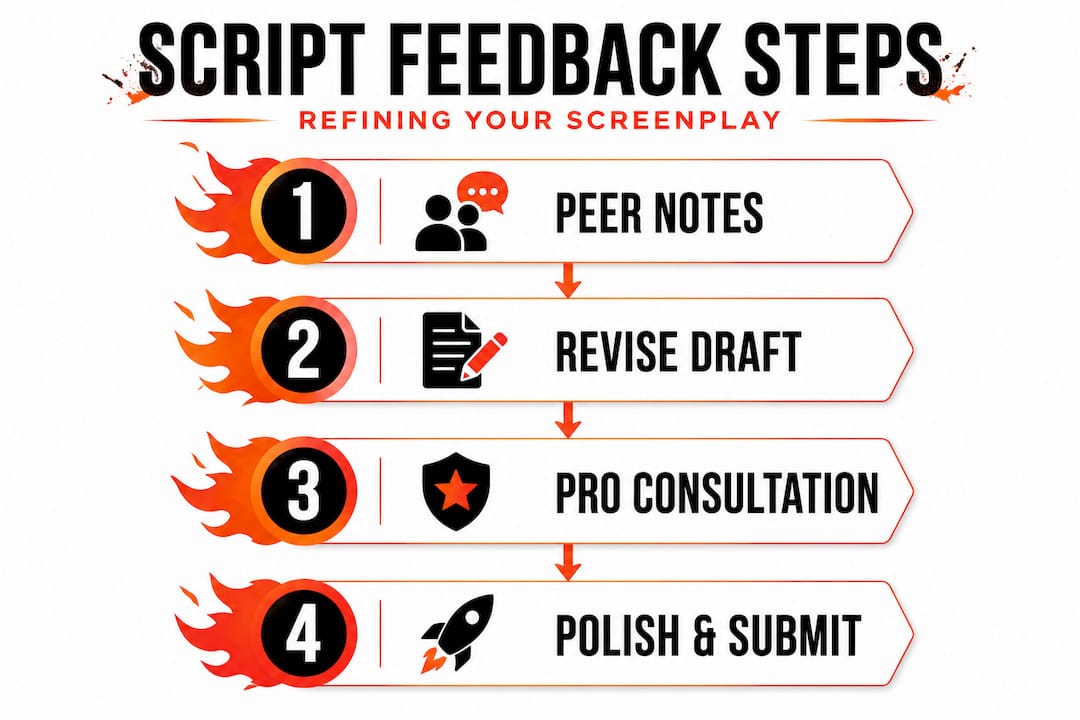
Once you've prepared your script, follow this structured, step-by-step process to maximize feedback effectiveness. The biggest mistake writers make is treating feedback as a single event rather than an iterative cycle. Here's the process that actually works:
The step-by-step process that professional development executives use:
- Polish your script independently. Handle every issue you already know exists. Don't rely on readers to catch problems you can fix yourself.
- Create a staged critique plan. Map out who will read your script and in what order, moving from trusted peers to professional readers as the draft improves.
- Send to one reader at a time. Receiving simultaneous notes from multiple readers creates contradictory noise that's difficult to parse.
- Process notes objectively. Take at least 48 to 72 hours between receiving notes and responding to them. Emotional distance improves your ability to evaluate feedback honestly.
- Implement note-backed changes. Revise based on patterns and actionable insights, not every single opinion. Not all notes deserve equal weight.
- Resend up the hierarchy. Once you've revised based on peer-level feedback, move to more experienced readers, then to professional coverage.
Following this sequence means each round of feedback is building on a stronger draft. You're not sending the same flawed version to everyone and hoping for the best.
Good script development steps mirror how professional development works in Hollywood. Studio scripts go through multiple layers of notes, each designed to strengthen the material incrementally. You can apply the same discipline to your independent process.
Here's how the staged reader hierarchy typically looks in practice:
| Stage | Reader type | Focus area | When to use |
|---|---|---|---|
| Stage 1 | Trusted peer or writing partner | Clarity, basic story logic | After first complete draft |
| Stage 2 | Writing group or script swap | Character, dialog, pacing | After second draft |
| Stage 3 | AI-driven coverage | Structure, marketability | Before investing in paid coverage |
| Stage 4 | Professional script coverage | Market readiness, industry analysis | Near-final draft |
| Stage 5 | Script consultant | Targeted deep revision | Before major pitch or submission |
Pro Tip: Build a simple spreadsheet with columns for reader name, date, feedback category (structure, character, dialog, pacing), specific note, and action taken. After three or more rounds of feedback, patterns become visible immediately. This is far more useful than re-reading stacks of notes without organization.
Analyzing your script systematically between each feedback stage also helps you see which issues you've actually solved and which ones are still present.

How to interpret and act on script notes: Distinguishing good feedback from noise
Receiving feedback is only valuable if you know how to prioritize and act on it effectively. The volume of notes you get means nothing. What matters is whether you can identify what the notes are actually telling you about your script.
Here's the core principle: categorize and track patterns rather than reacting to individual comments. When one reader says your protagonist feels passive, that's worth noting. When three out of four readers say the same thing in different words, that's a structural issue that demands revision.
Use these steps to interpret your notes effectively:
- Categorize each note by type: story logic, character motivation, dialog, pacing, structure, or marketability.
- Look for the note behind the note. A reader who says "I got bored in Act Two" is probably telling you that your midpoint isn't raising the stakes enough, or that your protagonist isn't making active choices. The surface note is boredom. The real note is a stakes problem.
- Separate taste from craft. A reader who dislikes your genre or finds your protagonist unlikable for personal reasons is giving you taste-based feedback. A reader who identifies that your protagonist has no clear goal in Act One is giving you craft-based feedback. Craft notes deserve serious attention. Taste notes deserve consideration but not automatic implementation.
- Avoid fixes that misdirect your story. Some notes are technically valid but point you away from your original vision. If implementing a note requires you to change the story's core premise or theme, evaluate it carefully before acting on it.
"Patterns matter more than single opinions. Track them for clarity and you'll see your script's real problems emerge naturally from the data."
How to analyze feedback effectively is a skill that takes practice. The writers who improve fastest aren't the ones who receive the most notes. They're the ones who know how to read patterns and translate them into surgical, confident revisions.
One practical technique: after each feedback round, write a one-paragraph summary of what the notes collectively say. Not what individual readers said, but what the overall pattern reveals. This forces you to synthesize rather than just react, and it produces a clearer action plan for your next draft.
Common feedback channels and navigating your options
Understanding the types of feedback available lets you strategically choose the best route for your script's current stage. The five core avenues for script feedback each serve a different purpose depending on where your draft is in the development process.
Free and low-cost options:
- Script swaps involve exchanging scripts with another writer for mutual notes. The quality depends entirely on the skill level of your partner. Ideal for early drafts where you need basic story clarity checks.
- Writing groups offer peer-level feedback from multiple voices. Useful for dialog, character, and pacing, but group dynamics can sometimes produce overly cautious or unfocused notes.
- Screenwriting classes and workshops provide structured feedback within an educational context. A good instructor adds genuine craft expertise to peer feedback.
Paid options:
- Professional script coverage delivers a formal written analysis covering concept, structure, characters, dialog, and market viability. Coverage from a working reader costs between $60 and $400 depending on the service and turnaround. This is best for near-final drafts.
- Script consultants provide deep, targeted revision guidance for a specific issue or the whole script. At $500 to $1,500 per session, consultants are most valuable when you're preparing for a major pitch or a competitive fellowship application.
Here's how to match your feedback source to your draft stage:
| Draft stage | Best feedback source | Primary goal |
|---|---|---|
| First draft | Script swap, writing group | Story clarity, basic structure |
| Second draft | Writing group, AI coverage | Character, pacing, dialog |
| Third draft | AI coverage, low-cost coverage | Structure validation, market sense |
| Near-final draft | Professional coverage | Industry-level analysis |
| Submission-ready | Script consultant | Targeted pitch preparation |
Understanding script coverage explained in its various forms helps you avoid overspending on coverage for a draft that isn't ready for it, and underinvesting in feedback when your script is ready for a professional read.
The strategic move is to use AI-driven coverage as the filter between peer feedback and expensive professional coverage. It costs a fraction of traditional coverage, delivers structured analysis grounded in industry methodology, and tells you whether your draft is actually ready for the next level of investment.
What most screenwriters miss about script feedback
Here's what I've observed working with scripts at every stage of development: most writers treat feedback as a volume problem. They think more notes from more readers automatically means more improvement. It doesn't.
Pattern recognition is the actual skill. Two precise, well-articulated notes from a single sharp reader are worth more than twenty scattered comments from five different people. The writers who improve fastest learn to extract signal from noise, not to chase volume.
The second blind spot is the belief that one solid round of notes is enough. Real script development is iterative. It's not linear. You revise, you seek feedback again, you revise again. Each cycle tightens the story. Skipping cycles to save time or money means your script arrives at pitch meetings or festival submissions with problems that a second or third round of notes would have caught.
The third issue is over-reliance on feedback itself. Too much input from too many voices can erode the clarity and specificity of your original vision. The staged approach protects against this. You stay in control of your story while still benefiting from external perspective.
Good script development insights always point back to the same truth: the writer who knows why a note was given is in a far stronger position than the writer who simply knows what the note says. Always ask the follow-up question. If a reader tells you a scene isn't working, push to understand whether the problem is logic, emotion, pacing, or character motivation. The answer changes your revision entirely.
Pro Tip: Before implementing any note, write one sentence explaining why a reader gave it. If you can't articulate a clear reason, the note may be based on taste rather than craft.
Ready to refine your script? Unlock affordable, expert feedback
If you're ready to implement this process, here's where to get affordable, professional feedback for your script.

At Roast My Script, we built our service specifically as the brutal first filter before you invest in expensive coverage or a script doctor. Upload your script, and within 1-2 days by email you receive a detailed PDF analysis grounded in Hollywood methodology: Syd Field, McKee, Save the Cat. It covers structure, character, dialog, concept, and market viability for $9 to $25. Explore our affordable script coverage to see exactly what the analysis includes. If character work is your current focus, our character development insights resource will strengthen the next draft before you submit anywhere.
Frequently asked questions
Should I send my script to multiple readers at once or one at a time?
Send your script to one reader at a time to avoid contradictory feedback that muddles your revision priorities. Sequential reads help you identify note patterns more clearly.
What's the best way to track script notes and identify patterns?
Track notes in a spreadsheet with categories for structure, character, dialog, and pacing; focus on recurring patterns across multiple readers rather than reacting to isolated opinions.
How do I choose between paid coverage and free feedback groups?
Free script swaps and groups work well for early drafts where you need story clarity and peer perspective; paid coverage is the right investment when your draft is near-final and needs market-level analysis.
What should I do if feedback contradicts my story's intent?
Evaluate whether each note reflects a genuine craft issue or stems from a reader's personal taste; prioritize notes that align with your story's structural goals and discard those that would misdirect your original vision.
Recommended
- How to analyze a script for powerful screenplay improvement | ROAST MY SCRIPT
- Role of dialogue in scripts: 42% tied to verbosity | ROAST MY SCRIPT
- Script format impact: 90% boost production & pitch success | ROAST MY SCRIPT
- Script Development Process: Preparing for Hollywood Success | ROAST MY SCRIPT