
TL;DR:
- In filmmaking, coverage refers to filming scenes from multiple angles to facilitate editing.
- Proper scene coverage reduces costs, delays, and reshoots by providing editing flexibility.
- Screenwriters should craft clear, spatially precise action lines to support efficient coverage and production.
Most screenwriters think of "coverage" as the written feedback they receive on a screenplay. But on an actual film set, coverage means something entirely different, and understanding that distinction can change how you write. Camera coverage, the practice of filming scenes from multiple angles and shot sizes, directly shapes how your script gets interpreted, shot, and edited. Scripts that account for this reality tend to generate cleaner feedback, fewer revision requests, and stronger responses from producers. If you want your screenplay to survive contact with a real production, you need to understand how coverage works from both sides of the camera.
Table of Contents
- What does coverage mean in filmmaking?
- Key coverage methodologies: From classic to contemporary
- Why coverage matters: Editor's toolbox and production insurance
- Coverage strategies: Minimalism, overshooting, and creative constraints
- How screenwriters can leverage coverage for better feedback and market results
- A new perspective on coverage: Why screenwriters should embrace the editor's mindset
- Take your script further with professional coverage insights
- Frequently asked questions
Key Takeaways
| Point | Details |
|---|---|
| Coverage empowers editors | Filming more angles and takes gives editors vital options to fix, pace, and enhance scenes during post-production. |
| Script clarity aids coverage | Clear action lines and scene breakdowns in your script make it easier for directors to plan effective camera coverage. |
| Balance coverage approach | Both overshooting and minimalism have pros and cons; smart writers anticipate which their story needs and format accordingly. |
| Coverage reduces costly fixes | Solid coverage planning prevents delays, reshoots, and helps scripts succeed with producers and festivals. |
What does coverage mean in filmmaking?
With misconceptions addressed, let's clarify what coverage really means on a film set.
"Coverage" is one of those words that means two very different things depending on who's using it. For screenwriters, coverage typically refers to the written analysis a script reader produces after evaluating your screenplay. But for directors, cinematographers, and editors, camera coverage is the strategic practice of filming scenes from multiple angles, shot sizes, and takes to give editors the raw material they need in post-production.
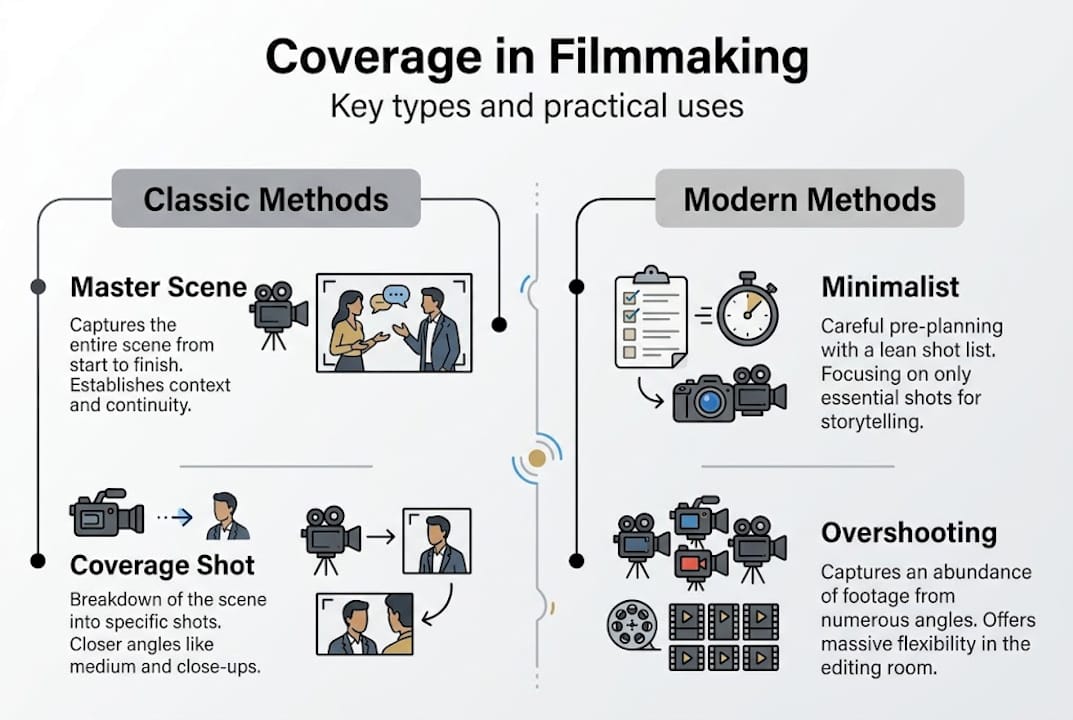
As StudioBinder explains, coverage in filmmaking primarily refers to camera coverage, the practice of shooting multiple angles, shot sizes, and takes of a scene to provide editors with options for post-production assembly, pacing control, and error correction.
Here's what camera coverage typically includes:
- Master shot: A wide shot capturing the entire scene from start to finish, establishing geography and relationships between characters
- Close-ups: Tight shots on faces, hands, or objects that carry emotional or narrative weight
- Over-the-shoulder (OTS): Two-shot angles that anchor dialogue scenes and create a sense of spatial connection between characters
- Cutaways and inserts: Reaction shots or detail shots that give editors flexibility to cut around problems
- Multiple takes: Different performances or line readings of the same shot
Think of coverage as insurance. If an actor flubs a line, if a continuity error slips through, or if the pacing feels wrong in the edit, coverage gives the editor options to fix it without calling everyone back to set. When you're analyzing your script for improvement, it's worth asking whether your scenes are written in a way that gives a director clear visual options.
"Coverage is the editor's safety net. Without it, you're locked into choices made on the day, and those choices may not survive the edit." — Common wisdom among professional editors and script supervisors.
For screenwriters, this matters because scenes that are geographically vague, action-heavy without clear blocking, or emotionally ambiguous are harder to cover effectively. They create problems on set before a single frame is cut.
Key coverage methodologies: From classic to contemporary
Understanding what coverage is sets the stage to explore the different strategies filmmakers use.
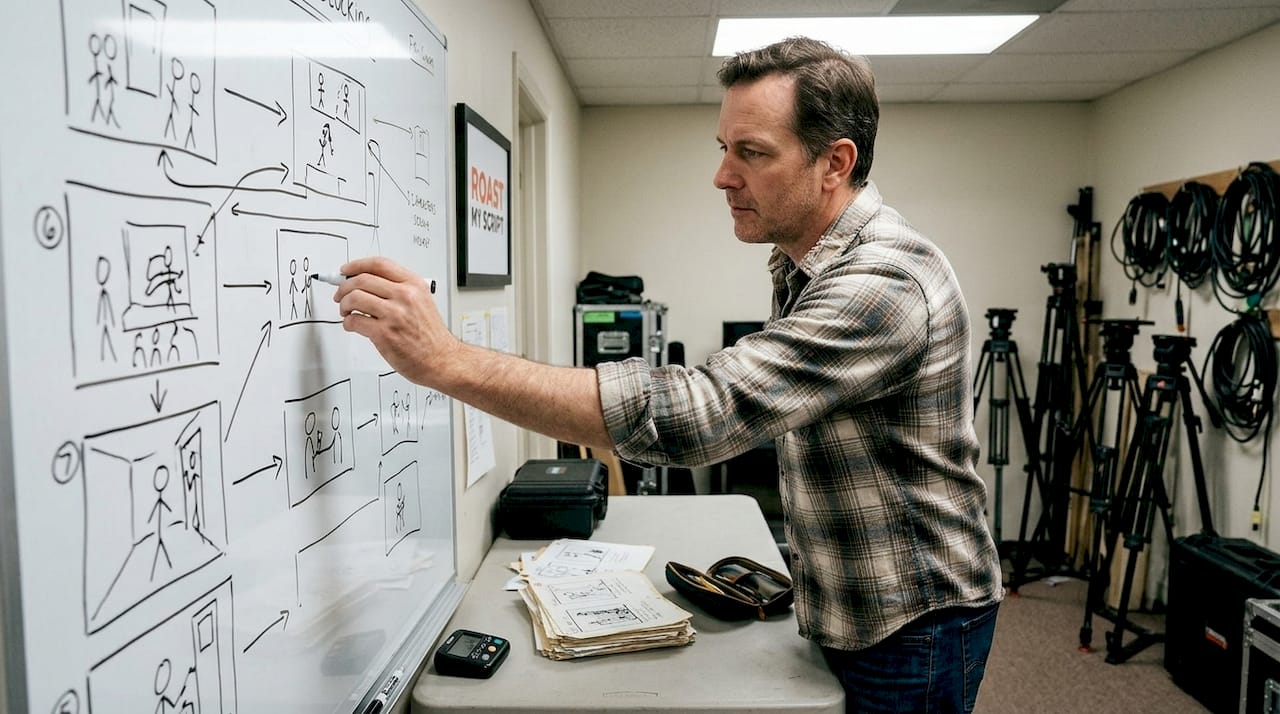
Not all coverage is created equal. Key methodologies range from the structured Hollywood System to free-form approaches used in independent cinema, and each has direct implications for how a script needs to be written.
| Methodology | Typical use case | Complexity | Production impact |
|---|---|---|---|
| Master Scene | Drama, dialogue scenes | Low to medium | Stable base; editor-friendly |
| V Coverage | Dialogue-heavy scenes | Medium | Efficient; classic Hollywood approach |
| Hollywood System | Studio productions | High | Maximum options; time-intensive |
| BBC System | TV drama, limited budgets | Medium | Structured; fast turnaround |
| Overlapping/Triple-Take | Action, stunts, complex scenes | High | Safety net for unpredictable moments |
| Oner (one-shot) | Stylized, intimate scenes | Low | High risk; requires precise scripting |
| Freeform | Indie, documentary-style | Variable | Creative flexibility; less predictable |
According to Wolfcrow's breakdown, these methodologies each serve a distinct production context. The Master Scene Technique, for example, starts with a wide establishing shot and then moves into tighter coverage. V Coverage moves from wide to close-up in a structured pattern, making it ideal for two-person dialogue scenes.
Here's when to use each approach:
- Stunts or action sequences: Overlapping/Triple-Take coverage is standard because you rarely get a second chance
- Dialogue-heavy scenes: V Coverage or BBC System keeps things efficient without sacrificing options
- Stylized or intimate scripts: Oners can work, but only if the script supports the precision required
- Low-budget productions: Master Scene Technique offers the best balance of coverage and efficiency
For a solid story structure breakdown, it helps to think about which coverage methodology your scenes naturally invite. A tense two-person confrontation in a kitchen calls for different coverage than a chase sequence through a crowded market.
Pro Tip: Write your action lines with enough spatial clarity that a director can visualize the master shot immediately. Phrases like "they move toward each other across the narrow hallway" give a DP a physical frame to work with. Vague blocking like "they argue" leaves coverage decisions entirely to chance.
Why coverage matters: Editor's toolbox and production insurance
After covering the "how," it's crucial to understand why coverage is seen as essential insurance in production.
Coverage is not just a creative tool. It's a financial and logistical safeguard. US film production spend runs around $40 billion per year, and a significant portion of budget overruns trace back to insufficient coverage requiring expensive reshoots.
Here's how insufficient coverage creates real production problems, step by step:
- Scene is shot with minimal angles. The director moves on, confident in the performance.
- Editor assembles the cut. A continuity error or a weak line reading surfaces that can't be cut around.
- Reshoot is requested. Actors, crew, and locations must be reassembled, often at premium rates.
- Budget overruns. The production loses days and money that could have been avoided with one additional angle on the day.
- Delivery delays. Festival submission windows close, or producer interest cools while the fix is sorted.
As FilmDaft notes, coverage acts as a safety net against reshoots, continuity errors, and performance issues, and the need for coverage increases significantly for stunts, explosions, and complex sequences.
| Coverage gap | Likely consequence | Average cost impact |
|---|---|---|
| Missing close-up on key emotional beat | Flat scene; editor has no option | Reshoot: $10K to $50K+ |
| No cutaway during dialogue | Locked into single performance | ADR or reshoots required |
| Unclear geography in action scene | Confusing edit; viewer disorientation | Reshoots or heavy VFX fixes |
| Missing reaction shots | Pacing problems in edit | Additional pickup days |
For screenwriters, the connection is direct. Scripts with clear, producible scenes reduce the likelihood of coverage gaps. When your action lines precisely describe what's happening and where, a director can plan shots efficiently. Understanding how AI transforms scriptwriting can also help you identify structural and clarity issues before they become production problems.
Scripts that anticipate coverage also tend to receive cleaner feedback from readers. When a scene is visually clear, a reader can evaluate it on its dramatic merits rather than getting lost in spatial confusion.
Coverage strategies: Minimalism, overshooting, and creative constraints
Understanding the stakes brings us to the creative philosophies shaping coverage today.
Not every director approaches coverage the same way. Two opposing philosophies have shaped modern filmmaking, and both carry lessons for screenwriters.
On one end, directors like Michael Bay are known for overshooting, capturing dozens of angles, multiple lenses, and countless takes. The edit suite becomes a place of abundance. But this approach burns time and budget, and it can actually create decision paralysis in the edit.
On the other end, directors like Luca Guadagnino and the late Orson Welles have favored minimal coverage, sometimes shooting scenes in a single take with a single angle. According to CineD's analysis, overshooting gives editors flexibility but wastes time and resources, while minimalism can build intensity and visual specificity but carries real risk if something goes wrong.
Digital filmmaking has shifted the balance. Because storage is cheap and cameras are smaller, many indie productions now shoot more coverage than their budgets would have allowed on film. But more footage doesn't automatically mean better coverage. Strategic coverage still beats random coverage every time.
Direct lessons for screenwriters:
- Minimalism suits scripts with precise, controlled visual storytelling. If your script depends on a single image holding emotional weight, write it with that specificity.
- More coverage is needed when scenes involve physical risk, complex blocking, or large casts. Write those scenes with enough detail that a director knows what's at stake.
- Producers favor scripts that feel producible. Vague or chaotic action lines signal a difficult shoot.
- Festival programmers respond to visual clarity. A script that reads cinematically is easier to champion.
Pro Tip: You can signal coverage intent without directing. Instead of writing "CLOSE ON her hands," write "Her hands shake as she reaches for the door." The detail is there. The director will find the close-up naturally.
For more on script formatting for coverage and analyzing for coverage gaps, both resources will help you apply these principles directly to your pages.
How screenwriters can leverage coverage for better feedback and market results
With the creative approaches in mind, it's time to make this actionable for your next script.
Understanding script clarity for coverage means that precise action lines and blocking descriptions help directors plan shots, reduce missing coverage risks, and improve both producibility and market readiness.
Here are three practical strategies to make your script more coverage-friendly:
Strategy 1: Anchor your scenes spatially
- Open each scene with a clear sense of geography. Where are the characters? How far apart are they?
- Track entrances and exits explicitly. If a character crosses the room, say so.
- Note any objects that carry narrative weight. A gun on the table, a letter in a drawer. These become natural cutaway targets.
Strategy 2: Write action that implies visual rhythm
- Break long action sequences into distinct beats, not one dense paragraph.
- Use short sentences for fast action. Longer sentences for slower, more deliberate moments.
- Let the pacing of your prose mirror the pacing of the scene. Editors and directors notice this.
Strategy 3: Anticipate the director's needs without over-directing
- Describe what the audience needs to see, not how the camera should move.
- Trust that a clear emotional beat will suggest its own coverage.
- Avoid camera directions like "PUSH IN" or "RACK FOCUS" unless they are absolutely essential to the story.
Pro Tip: Read your action lines out loud. If you can't picture the scene clearly from what you've written, a director won't be able to either. Clarity on the page translates directly to coverage efficiency on set.
For deeper work on analyzing screenplay clarity and applying Hollywood structure tips, both resources connect these principles to the broader craft of writing market-ready scripts. And for a technical reference on shot breakdown techniques, Wikipedia's camera coverage entry is a solid starting point.
A new perspective on coverage: Why screenwriters should embrace the editor's mindset
Most screenwriting advice focuses on dialogue, character arcs, and plot structure. Those things matter. But almost no one tells writers to think like an editor.
Here's the uncomfortable truth: a script that reads beautifully but shoots ambiguously will generate more revision requests, more on-set confusion, and more post-production problems than a script that's merely competent but visually precise. Producers and directors can feel the difference, even if they can't always articulate it.
When you write with coverage in mind, you're not constraining your creativity. You're signaling professionalism. You're telling every reader, every director, and every producer that you understand how films actually get made. That signal matters. It reduces feedback fatigue and increases the likelihood that your script moves forward rather than stalling in development.
The writers who consistently sell scripts and attract strong directors are rarely the ones with the most original ideas alone. They're the ones whose pages feel ready. Coverage-aware writing is a big part of what makes a script feel ready. Start applying screenplay improvement strategies with this mindset, and you'll notice the difference in how your work is received.
Take your script further with professional coverage insights
If the ideas in this article have you rethinking how you approach your pages, the next step is getting real feedback on what's actually on them.
At Roast My Script, we analyze your screenplay using Hollywood methodology (Syd Field, McKee, Save the Cat) and deliver a detailed PDF report in 1-2 days by email, starting at just $9. It's the brutal first filter before you invest in expensive coverage or script doctors. Beyond the analysis, our learning resources cover essential screenwriting concepts and character dimensionality strategies that directly support the kind of clear, producible writing this article describes. Your script deserves honest feedback before it goes anywhere.
Frequently asked questions
What is the difference between script coverage and camera coverage?
Script coverage is a written analysis of your screenplay evaluating structure, character, and marketability, while camera coverage is the process of filming scenes from multiple angles to give editors flexibility in post-production. Both use the same word but describe entirely different parts of the filmmaking process.
How does coverage help avoid costly reshoots?
By filming scenes from multiple angles on the day of shooting, coverage provides options to fix mistakes, cut around weak performances, or correct continuity errors in the edit, eliminating the need to reassemble cast and crew for expensive reshoots.
Should I indicate camera coverage in my script as a screenwriter?
Generally, no. Your job is to write clear action and visual storytelling. Precise action lines and specific blocking descriptions give directors what they need to plan coverage without you specifying camera angles directly on the page.
Can minimal coverage work for indie or low-budget films?
Minimal coverage, including single-take oners, can suit intimate or stylized scripts, but it carries real risk if scenes need fixing in post. Detailed scene breakdowns and precise scripting reduce that risk significantly for low-budget productions.
Recommended
- What is script coverage? Your 2026 guide to expert feedback | ROAST MY SCRIPT
- Roast My Script | AI Script Coverage & Analysis from $9
- Roast My Script | AI Script Coverage & Analysis from $9
- Roast My Script | AI Script Coverage & Analysis from $9
- Screenplay Coverage Example: How Coverage Works | Stonington Media LLC