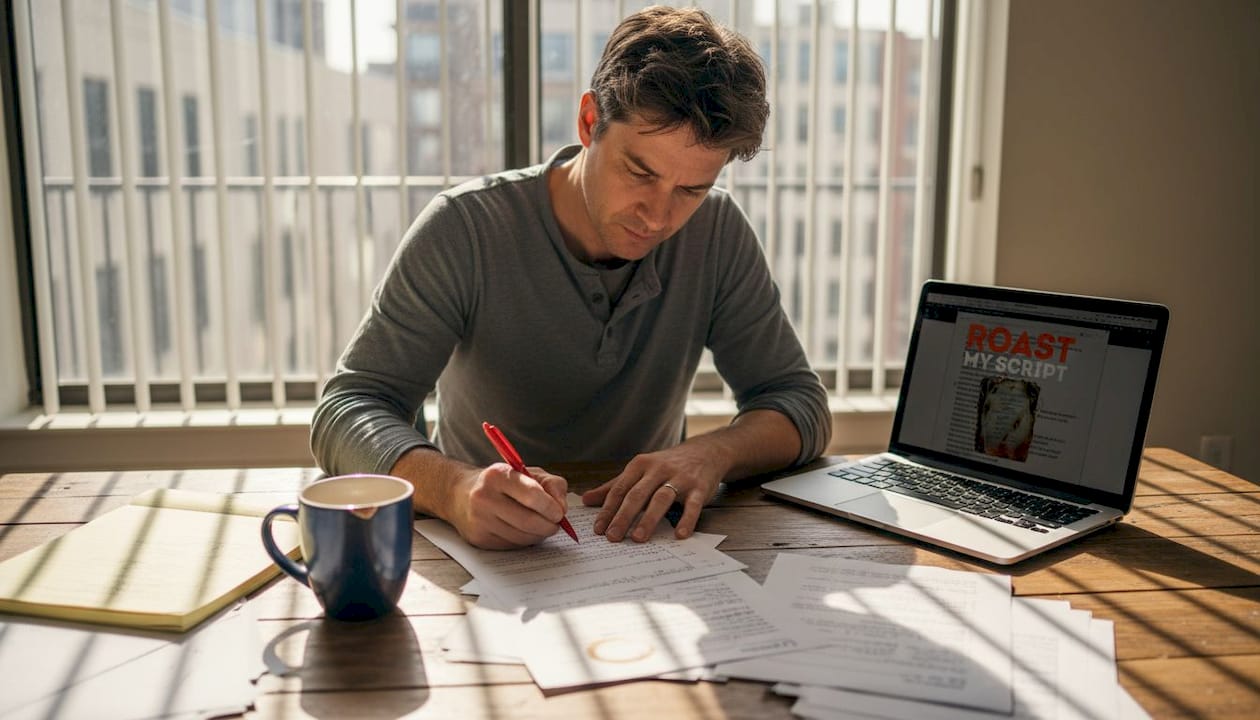
Choosing the right script critique can feel overwhelming when you're trying to polish your screenplay before submission. You know feedback matters, but how do you distinguish truly helpful analysis from surface-level notes? Professional script critique offers structured, actionable insights that sharpen your story's structure, characters, and dialogue. This article breaks down the essential benefits to look for in script critique services, helping you make informed decisions that elevate your screenplay's market readiness without breaking your budget.
Table of Contents
- Key takeaways
- Criteria to evaluate script critique benefits
- Top benefits of professional script critique services
- How to leverage multiple critiques to maximize benefits
- Emerging role of AI vs. human expert script critique
- Affordable professional script critique with Roast My Script
- Frequently asked questions
Key Takeaways
| Point | Details |
|---|---|
| Structured actionable feedback | Structured, actionable feedback targets root problems in plot, pacing, and dialogue. |
| Clear evaluation benchmarks | Evaluations that use defined benchmarks help separate craft weaknesses from personal preferences. |
| Consistency across reviewers | Multiple independent notes reveal real story gaps rather than individual taste, improving revision priority. |
| Distinguish craft from taste | Effective critiques separate structural issues from subjective opinions to protect your creative voice. |
Criteria to evaluate script critique benefits
Not all script feedback delivers equal value. Coverage by experienced readers using structured criteria provides more trustworthy analysis than generic comments from untrained sources. When evaluating critique services, prioritize readers who assess your screenplay against clear benchmarks for plot coherence, character development, pacing, and dialogue authenticity.
Actionable feedback addresses root story problems rather than symptoms. A note saying "Act Two drags" helps less than "Your protagonist lacks clear obstacles between pages 45-70, weakening dramatic tension." The second comment gives you a specific fix. Quality critique distinguishes between craft issues that undermine your story and taste preferences that reflect reader subjectivity. This distinction protects your creative voice while addressing genuine structural weaknesses.
Consistency across evaluations signals reliable critique. If multiple readers identify the same story gaps, you've found a real problem worth fixing. If feedback contradicts wildly, you're likely dealing with personal taste rather than craft flaws. Use structured frameworks to assess whether critique digs into story mechanics or stays superficial.
Pro Tip: Create a simple checklist before purchasing coverage. Does the service specify reader qualifications? Do they evaluate against recognized story models like three-act structure or Save the Cat beats? Clear methodology indicates useful feedback ahead.
When selecting script critique, examine sample coverage reports if available. Strong analysis balances praise with constructive criticism, offers scene-specific examples, and connects individual notes to broader story patterns. Weak critique stays vague, focuses on formatting trivia, or simply summarizes your plot without insight. Understanding these evaluation standards for script coverage helps you invest wisely in feedback that genuinely improves your screenplay.
Top benefits of professional script critique services
Professional script critique delivers five core advantages that directly improve your screenplay's quality and submission success rate. First, reliable feedback helps you polish plot structure, pacing, and character arcs effectively. Experienced readers trained in story fundamentals spot weaknesses you've become blind to after multiple drafts. They identify where your protagonist's motivation falters, where subplots distract from your main story, or where dialogue sounds artificial.
Second, consistent scoring by professional readers confirms balanced analysis. Research on Black List evaluations shows 73.8% agreement within one point across different readers, demonstrating high inter-reader reliability. This consistency means you're getting objective assessment of your script's strengths and weaknesses, not random opinions.
Third, multiple professional notes pinpoint widespread story issues versus subjective taste. When three readers independently flag your second act pacing, that's a craft problem demanding revision. When one reader dislikes your genre-blending approach while others praise it, that's taste. Using multiple coverages helps you distinguish signal from noise in feedback.
"Professional coverage identifies specific structural weaknesses early, allowing targeted revisions that save months of unfocused rewriting and dramatically improve your script's competitive position."
Fourth, early critique reduces costly late-stage rewrites and improves market readiness. Discovering your protagonist lacks a clear goal before you pitch to producers saves embarrassment and preserves relationships. Fixing dialogue problems before festival submission increases your acceptance odds. Understanding how to apply screenplay structure principles through professional feedback accelerates your revision process.
Fifth, informed feedback sharpens your logline, dialogue authenticity, and formatting for submission success. Professional readers help you distill your story's essence into a compelling logline, catch dialogue that reads as exposition rather than natural speech, and flag formatting errors that mark you as amateur. These refinements matter because readers at production companies and festivals judge your professionalism within the first ten pages. Quality critique ensures those pages showcase your best work.
How to leverage multiple critiques to maximize benefits
Obtaining feedback from multiple professional readers amplifies the value of script critique significantly. Multiple evaluations reveal recurring story flaws that demand attention while filtering out isolated opinions rooted in personal taste. When several readers independently identify the same structural weakness, you've discovered a genuine problem worth prioritizing in your rewrite.

| Single Critique | Multiple Critiques |
|---|---|
| One perspective on story strengths and weaknesses | Pattern recognition across multiple professional viewpoints |
| Difficult to distinguish craft issues from taste | Clear consensus on structural problems versus subjective preferences |
| Limited confidence in revision priorities | High confidence in which story elements need work |
| Risk of following misguided advice | Cross-validation reduces risk of unhelpful revisions |
Conflicting feedback between readers often signals subjective taste rather than objective craft problems. If Reader A loves your dark comedy tone while Reader B finds it off-putting, your tone likely works for your target audience. Focus revision energy on issues where readers agree. Multiple coverages help distinguish between craft fundamentals and personal preferences effectively.
To synthesize diverse notes into actionable rewrite plans, follow these steps. First, list every issue raised across all coverage reports. Second, mark which problems appear in multiple reports. Third, categorize feedback into structure, character, dialogue, and formatting buckets. Fourth, prioritize fixes that address recurring structural issues before tackling smaller character or dialogue notes. This systematic approach prevents you from getting overwhelmed by competing suggestions.
Pro Tip: Create a simple spreadsheet tracking feedback themes across readers. When three of four readers flag your protagonist's unclear motivation, that issue jumps to the top of your revision list. When only one reader suggests cutting a supporting character others praised, you can safely ignore that note.
Using multiple expert readers increases your confidence and script polish quality substantially. You gain certainty about which story elements work and which need revision. This confidence shows in pitch meetings and query letters because you've stress-tested your screenplay against professional standards. Exploring diverse script analysis techniques helps you understand how different coverage approaches complement each other for maximum insight.
Emerging role of AI vs. human expert script critique
Artificial intelligence tools now offer quick, affordable screenplay feedback, but screenwriters still prefer human analysis for nuanced script evaluation. AI-powered coverage excels at identifying formatting errors, calculating page counts per act, and flagging basic structural deviations from standard three-act templates. These tools provide value for early draft assessment and basic craft checks at minimal cost.
Human readers excel where AI currently falls short. Experienced script analysts interpret tonal subtleties, assess character psychological depth, evaluate dialogue authenticity for specific demographics, and judge whether your story's emotional beats land effectively. A human reader recognizes when your protagonist's seemingly irrational choice actually reveals deep character motivation. AI tools miss these nuances because they lack lived experience and cultural context.
Combining AI with human critique optimizes your cost and quality balance strategically. Use AI tools for initial structural assessment and formatting cleanup on early drafts. This catches obvious problems cheaply before you invest in human coverage. Then obtain professional human feedback on polished drafts when you need nuanced analysis of character depth, dialogue authenticity, and emotional resonance before submission.
"Human script readers bring irreplaceable contextual understanding and emotional intelligence to screenplay analysis, interpreting story choices through the lens of audience psychology and market trends that AI cannot yet replicate."
When should you rely primarily on human critique? For market-ready scripts you plan to pitch to producers, submit to competitions, or send to agents, human expertise proves essential. These high-stakes situations demand confident assessment of your screenplay's commercial viability, genre execution, and competitive positioning. Human readers provide this strategic insight based on industry knowledge AI lacks.
Pro Tip: Start with AI coverage to catch structural basics on your second or third draft, then get human feedback on your fourth or fifth draft when the story fundamentals are solid. This staged approach maximizes value from both feedback types.
Understanding how AI script coverage tools complement rather than replace human expertise helps you build an efficient feedback strategy. The future likely involves hybrid models where AI handles mechanical analysis while humans focus on creative and strategic evaluation. For now, budget-conscious screenwriters benefit most from using both tools appropriately at different revision stages.
Affordable professional script critique with Roast My Script
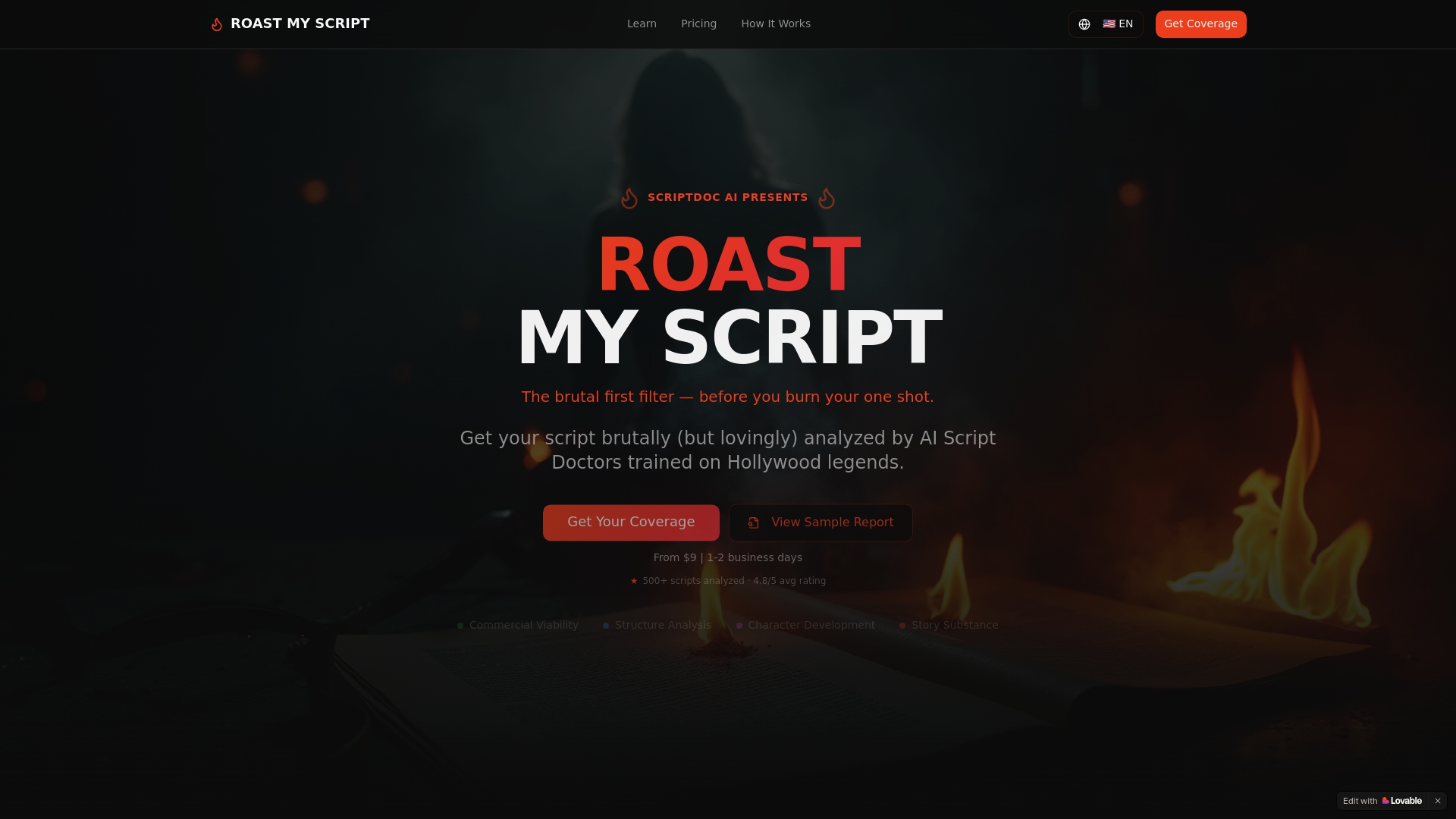
Finding professional screenplay feedback that fits your budget doesn't mean sacrificing quality analysis. Roast My Script delivers expert coverage starting at just $9, making professional polish accessible whether you're a film school student or working writer. The service combines AI-powered structural analysis with human expertise to identify specific plot weaknesses, character development gaps, and dialogue issues that undermine your script's market potential.
Coverage reports focus on actionable feedback you can implement immediately. Rather than vague comments about "improving character depth," you receive scene-specific notes explaining exactly where your protagonist's motivation becomes unclear or where supporting characters feel one-dimensional. This structured approach helps you prioritize revisions that deliver maximum impact on your screenplay's quality.
The platform offers comprehensive script analysis that evaluates your screenplay against proven Hollywood frameworks including three-act structure, Save the Cat beat sheets, and character arc models. You can deepen your craft knowledge through detailed resources on character spine development using Linda Seger's methodology and advanced techniques for building character dimensionality that elevate your storytelling.
Roast My Script serves screenwriters who need professional feedback before investing in expensive script consultants or submitting to competitions. The service acts as your brutal first filter, catching structural problems early when they're easiest to fix. With turnaround in 1-2 days by email, you get timely insights that keep your revision momentum strong without the weeks-long wait typical of traditional coverage services.
Frequently asked questions
What makes feedback from experienced readers more valuable?
Experienced readers apply proven story frameworks and recognize patterns across thousands of scripts they've evaluated. They distinguish between surface symptoms like "boring dialogue" and root causes like unclear character objectives driving that dialogue. This expertise helps you fix core problems rather than applying cosmetic changes that leave fundamental weaknesses intact.
How do multiple critiques improve script revision confidence?
Multiple professional evaluations reveal which feedback represents consensus on craft issues versus individual taste preferences. When several readers independently flag the same structural weakness, you gain confidence that fixing it will genuinely improve your screenplay. This pattern recognition prevents you from second-guessing yourself or chasing contradictory suggestions that don't address real problems.
Can AI replace human script critique effectively?
AI tools excel at mechanical analysis like structure, formatting, and pacing calculations but struggle with nuanced evaluation of tone, subtext, and emotional resonance. Human readers interpret character psychology, assess dialogue authenticity for specific demographics, and evaluate commercial viability based on market knowledge. The most effective approach combines AI for basic structural assessment with human expertise for strategic creative feedback.
What should I look for in affordable professional script coverage?
Prioritize services that specify reader qualifications, use structured evaluation criteria, and provide scene-specific actionable notes rather than generic comments. Quality affordable coverage identifies root story problems with clear examples, distinguishes craft issues from taste preferences, and offers revision guidance that improves your screenplay's competitive position. Turnaround time and report format matter less than feedback substance and applicability.
How does script critique help market readiness?
Professional critique identifies weaknesses that cause producers and festival readers to pass on your screenplay. Coverage catches unclear protagonist goals, weak second-act conflict, underdeveloped character relationships, and dialogue that reads as exposition. Fixing these issues before submission dramatically improves your script's chances because you're competing against thousands of screenplays. Polish separates scripts that get read from those that get rejected after ten pages.
Recommended
- Role of dialogue in scripts: 42% tied to verbosity | ROAST MY SCRIPT
- Script format impact: 90% boost production & pitch success | ROAST MY SCRIPT
- Roast My Script | AI Script Coverage & Analysis from $9
- Roast My Script | AI Script Coverage & Analysis from $9
- Chuck Forsman and cinematic pacing – The Mansion Press