
TL;DR:
- A script report offers structured, actionable feedback to improve storytelling before submitting.
- Unlike coverage, it is designed for the writer's growth, focusing on story, structure, and characters.
- Using script reports early helps avoid costly rewrites and strengthens your script's foundation.
You finish your script. You've lived inside it for months. Then comes the paralyzing question: is it ready? Most writers skip straight to submitting for competitions or expensive professional coverage, only to get vague rejections that teach them nothing. There's a smarter, more affordable step between finishing a draft and seeking industry attention. A script report gives you structured, actionable feedback on your story's core elements before you spend hundreds on formal coverage. This guide breaks down exactly what a script report is, how it differs from coverage, what's inside one, and how to use it to write a stronger script faster.
Table of Contents
- Defining a script report: What it is and why it matters
- Script report vs. script coverage: Key differences
- What's inside a typical script report?
- How script reports accelerate your path to a better script
- How to get the most out of your script report
- Why early script analysis beats expensive rewrites
- Transform your script with expert, affordable analysis
- Frequently asked questions
Key Takeaways
| Point | Details |
|---|---|
| Script reports explained | Script reports offer structured, actionable feedback to help writers quickly improve their screenplay. |
| Script reports vs. coverage | A script report helps writers polish a draft, while coverage is for industry decision-makers. |
| Affordable actionable insights | Script reports deliver clear, prioritized notes for a fraction of the cost of professional coverage. |
| Boost revision efficiency | Using script reports iteratively accelerates script improvement and increases submission readiness. |
Defining a script report: What it is and why it matters
A script report is a written document that evaluates your screenplay across its most critical storytelling dimensions: story concept, structure, character development, dialog, and formatting. It's not a casual read from a friend or a vague "I liked it" from a writing group peer. It's a structured analysis built around the same fundamentals that professional readers assess when scripts land on their desks.
Think of it as a diagnostic tool. A mechanic doesn't guess what's wrong with your engine. They run diagnostics first, then tell you exactly what needs fixing. A script report does the same thing for your screenplay.
Standard components of a script report include:
- Logline evaluation: Does your one-sentence pitch clearly communicate concept, character, and conflict?
- Synopsis: A brief breakdown of the story as written, to confirm the reader understood your narrative arc.
- Strengths section: Specific elements that are working well, including voice, premise, or compelling characters.
- Improvement areas: Concrete notes on structural problems, pacing issues, underdeveloped characters, or unclear motivations.
- Formatting notes: Observations on slug lines, action lines, or other technical elements that affect readability.
- Summary score or rating: Some reports include a numerical or letter-grade assessment across categories.
Who uses script reports? Writers at every level. First-draft writers need them to identify fundamental problems before wasting time on surface polish. Intermediate writers use them to stress-test structure before investing in a script doctor. Even experienced screenwriters use them as a reality check, because analyzing your script with fresh eyes consistently surfaces issues the writer can no longer see.
"Script reports help writers catch fundamental issues before submitting to coverage or competitions, saving time, money, and professional credibility."
The key distinction from peer feedback is objectivity and structure. A friend might hesitate to tell you your third act collapses. A script report won't.
Pro Tip: Read your script report twice before opening your script to revise. First pass: absorb the big picture. Second pass: take notes on specific action items. This prevents reactive, scattered editing.
Script report vs. script coverage: Key differences
These two terms get used interchangeably, but they serve very different purposes and very different audiences. Confusing them leads writers to use the wrong tool at the wrong stage, which wastes money and misses the point.
The difference between reports and coverage comes down to who the feedback is written for. Script coverage is a professional evaluation document prepared for studios, production companies, or agents. The reader assesses whether the script is worth the decision-maker's time. Coverage often includes a "recommend," "consider," or "pass" rating, which functions as a gatekeeping signal, not a teaching tool.
A script report, by contrast, is written for the writer. Its goal is to help you improve your work, not to judge whether it's market-ready.

| Feature | Script report | Script coverage |
|---|---|---|
| Primary audience | The writer | Producers, agents, studios |
| Purpose | Story improvement | Project evaluation |
| Marketability rating | Rarely included | Almost always included |
| Average cost | $9 to $50 | $60 to $400+ |
| Turnaround | 1-2 days by email | 3 to 10 days |
| Best used | Early drafts, revision stages | Pre-pitch, pre-submission |
| Tone | Educational, constructive | Evaluative, decisive |
When to use each:
- Use a script report when you've finished a draft and need to identify structural or character problems before refining further.
- Use script coverage when you believe your script is polished and you want to know if it's ready for industry submission.
- Consider checking your script format feedback before either, since poor formatting can undermine an otherwise strong script.
Pro Tip: Don't pay for professional coverage on an unrevised first draft. Get a script report first, fix the major issues, then invest in coverage. You'll get a dramatically better result.
What's inside a typical script report?
Knowing that a script report exists is one thing. Understanding what you're actually getting and how to read it is what makes the feedback useful.
Script reports most often evaluate story, structure, character development, and formatting, though the depth and format vary by provider. Here's what each section typically contains and how to interpret it.
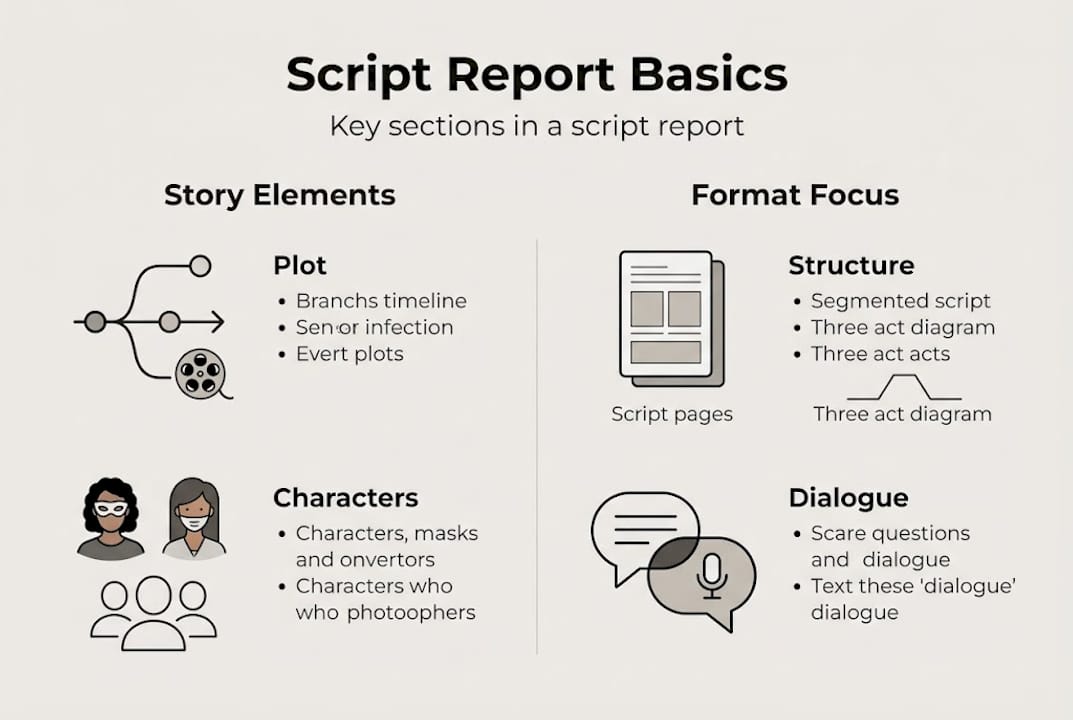
| Report section | What it covers | How to use it |
|---|---|---|
| Logline | Clarity of premise and hook | Rewrite until it's specific and compelling |
| Synopsis | Story as the reader understood it | Note gaps between intent and reception |
| Story strengths | What's genuinely working | Protect these elements during revision |
| Structure notes | Act breaks, pacing, plot logic | Address these first; they affect everything |
| Character development | Arcs, motivation, consistency | Focus on your protagonist's internal journey |
| Dialog notes | Voice, subtext, on-the-nose issues | Read problem scenes aloud after revising |
| Formatting issues | Technical compliance and readability | Fix before any professional submission |
| Score or rating | Categorical assessment | Use as a benchmark across drafts |
The structure notes section deserves special attention. Most script problems trace back to structural issues, and understanding structure in storytelling is foundational to acting on these notes effectively.
Reading scores strategically:
- A low score in "concept" suggests the premise needs rethinking before anything else.
- A low score in "character" but a high score in "structure" means your plot engine works but your people don't feel real.
- Consistent low scores across categories signal that this draft needs significant work before another round of feedback.
One thing new writers often miss: pay as much attention to the strengths section as to the weaknesses. Knowing what's working tells you what not to accidentally remove during revision.
How script reports accelerate your path to a better script
Affordable, fast feedback changes how you approach the revision process. Instead of guessing what's wrong, you have a specific list of issues to address. Instead of waiting weeks and spending hundreds, you get actionable notes within 48 hours for under $25.
Writers who use cost-effective analysis techniques iteratively, meaning they apply feedback, revise, and get another round of notes, consistently produce stronger scripts before seeking expensive submissions.
Here's a practical process for applying script report feedback:
- Read the full report without opening your script. Absorb the overall picture before reacting.
- Categorize notes by impact. Separate structural issues (high impact) from surface-level formatting notes (lower impact).
- Address structure first. Act break problems, plot logic gaps, and pacing issues affect every subsequent scene.
- Work through character notes next. Motivation, arc, and consistency issues usually require scene-level rewrites.
- Handle dialog and formatting last. Polish is the final layer, not the first.
- Mark what you disagree with. Not every note will be right for your vision. But if two reports flag the same issue, take it seriously.
- Get a second report after major revisions. One round of feedback rarely catches everything.
"Writers who treat script reports as revision checkpoints rather than one-time assessments consistently outperform those who seek expensive professional coverage on unrevised drafts."
Common pitfalls writers discover through script reports:
- A protagonist with no clear internal goal, only external obstacles.
- An Act 2 midpoint that doesn't meaningfully shift the story's direction.
- Dialog that tells the audience what they can already see from action.
- A climax that doesn't connect emotionally to the character's setup.
Pro Tip: After applying report feedback, do a one-page outline of your revised script. If the structure still feels muddy on paper, it will feel muddy on screen.
How to get the most out of your script report
Receiving a script report is only half the equation. How you respond to it determines whether your script actually improves.
Understanding and applying feedback from reports drives substantial script improvements when writers treat the notes as a starting point for analysis, not a verdict to accept or reject wholesale.
Best practices for working with script report feedback:
- Separate your ego from your draft. The notes are about the script, not your worth as a writer.
- Ask "why" for every note. If a note says your character is unsympathetic, ask why before changing anything.
- Prioritize notes that appear more than once. Repeated issues across sections signal deep problems.
- Don't fix everything at once. Work through one category of notes per revision pass.
- Track changes between drafts. Keep a simple log of what you addressed and how, so you can measure progress.
Questions to ask after reading your report:
- Does the reader's synopsis match the story I intended to tell?
- Which structural note will have the biggest ripple effect if I address it first?
- What in the strengths section am I at risk of changing unnecessarily?
Pro Tip: After revising, read mastering script structure to pressure-test your act breaks before your next round of analysis.
How to know when your script is ready for professional coverage:
- Your structure notes are clean across two consecutive reports.
- Your character arcs feel clear and emotionally resonant.
- Peers who read it understand the story without needing explanations.
- You've addressed every formatting issue flagged in prior reports.
The revision routine that works: apply report feedback, revise, seek a trusted peer read, then get a new report. Repeat until the major structural and character issues are resolved. Only then is the script ready for professional coverage or pitching.
Why early script analysis beats expensive rewrites
Here's the perspective most writing advice glosses over: the problem isn't that writers lack talent. It's that writers spend money in the wrong order. They finish a draft, skip straight to a $300 coverage, get a "pass" with minimal notes, and have no idea what to fix. Then they guess at a rewrite and repeat the cycle.
The smarter sequence starts with a script report. Not because it replaces professional coverage, but because it identifies the deep structural and character problems that expensive rewrites consistently miss. I've seen writers spend $1,500 on a script doctor and still submit a script with a broken second act, because neither the writer nor the doctor had objective distance from the material.
Even veteran writers get too close to their work. The script reader's perspective matters precisely because it's outside the writer's head. An early, affordable report surfaces what you can't see anymore. The writers who consistently move forward are the ones who treat feedback as a process, not a one-time event. They iterate cheaply and fix expensively only when the foundation is solid.
Transform your script with expert, affordable analysis
You now have a clear picture of what a script report is, how it differs from coverage, and how to use it to drive real improvement. The next step is putting that knowledge to work.
At Roast My Script, you can get a professional AI-driven script analysis starting at just $9, delivered within 1-2 days by email as a structured PDF. Before you spend hundreds on coverage or pitch to anyone, let us be the brutal first filter. If you want to go deeper on the craft side, master essential screenwriting concepts to strengthen your foundation. Ready to stop guessing and start improving? Get your affordable script analysis today and know exactly what your script needs.
Frequently asked questions
What's the main purpose of a script report?
A script report provides objective feedback on your screenplay's strengths and weaknesses so you can revise before submitting for professional analysis or production, catching fundamental issues early in the process.
How is a script report different from script coverage?
A script report is written for the writer and focuses on improvement, while script coverage is a professional evaluation prepared for studios or agents to decide whether a script should move forward.
How do I use a script report to improve my script?
Review the notes section by section, prioritize structural issues first, address them in your next draft, and repeat the process until your storytelling is clear and compelling, following the principles of mastering story flow.
How much does a script report cost?
Script reports are often available for under $20, making them an affordable tool for writers at any stage, especially compared to professional coverage which typically starts at $60 and can exceed $400.
Recommended
- Script format impact: 90% boost production & pitch success | ROAST MY SCRIPT
- How to analyze a script for powerful screenplay improvement | ROAST MY SCRIPT
- Roast My Script | AI Script Coverage & Analysis from $9
- What is a script reader? A 2026 guide for screenwriters | ROAST MY SCRIPT
- What is professional screenplay coverage, really? | Stonington Media LLC