
TL;DR:
- Submission-ready scripts meet strict formatting, structure, and technical standards to impress industry professionals.
- Strong narrative and character arcs, along with critical feedback, are essential for story impact and polish.
- Continuous learning and use of professional feedback help writers adapt to evolving industry expectations.
Finishing your screenplay feels like crossing a finish line. But in reality, a completed draft and a submission-ready script are two very different things. Many writers send out work that is technically done but structurally flawed, poorly formatted, or narratively underdeveloped — and they never find out why it got passed on. The formatting and technical precision required to get a script seriously considered goes well beyond spell-checking and page count. This guide breaks down exactly what industry professionals look for, where most scripts fall short, and what you can do right now to close that gap before your next submission.
Table of Contents
- Understanding industry expectations for scripts
- Essential formatting and technical accuracy
- Narrative strength and structure: Beyond the basics
- The role of expert feedback and final script polish
- The uncomfortable truth: Submission ready is a moving target
- Get actionable feedback and maximize your script's potential
- Frequently asked questions
Key Takeaways
| Point | Details |
|---|---|
| Submission ready is not finished | A script must meet technical, structural, and professional standards—not just be complete. |
| Formatting matters | Proper format, title page, and logline are non-negotiable for serious consideration. |
| Story structure counts | Clear acts, strong characters, and narrative cohesion are critical for advancing in the industry. |
| Critical feedback is essential | Objective, expert input dramatically increases your script’s market viability. |
Understanding industry expectations for scripts
When a producer, agent, or contest reader says they want a "submission-ready" script, they are not just asking for something that is finished. They are asking for something that meets a specific professional standard — one that signals the writer knows how the industry works.
Here is the misconception most writers carry: they believe completing the story is the hardest part. It is not. The hardest part is making the script feel effortless to read while meeting every technical and structural checkpoint that professional readers use to filter submissions. Scripts must often clear technical and structural checkpoints before anyone even evaluates the story itself.
Baseline requirements for a submission-ready script include:
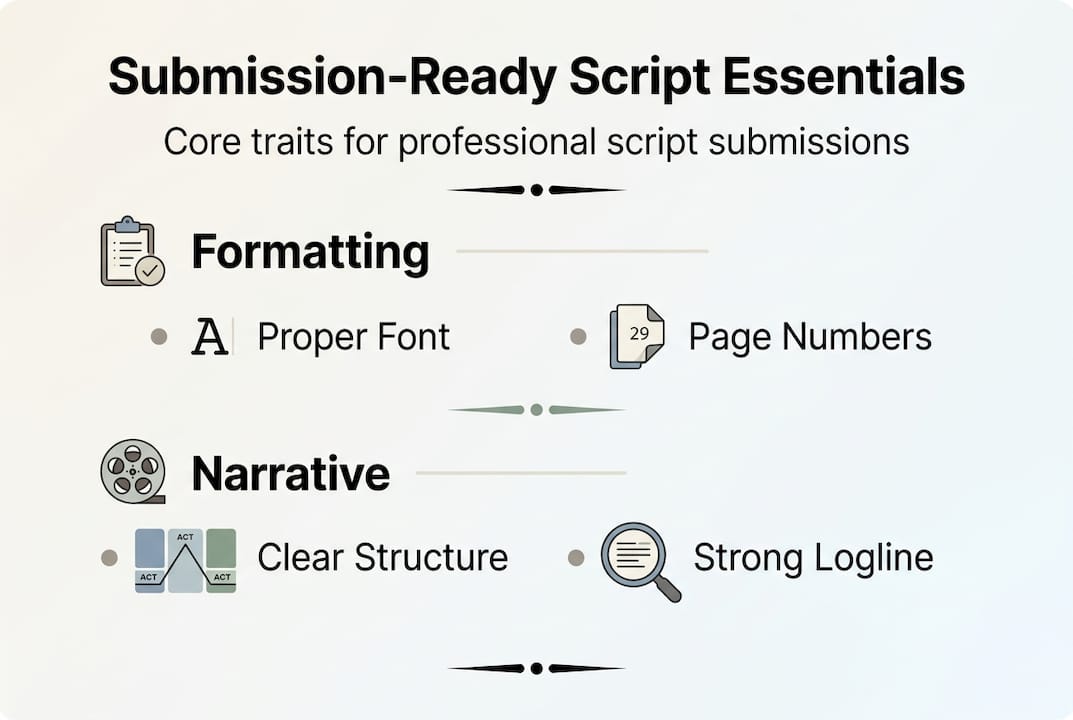
- Proper formatting: Courier 12pt font, correct margins, standard scene headers
- Appropriate length: Feature scripts typically run 90 to 120 pages
- Clear structure: A recognizable three-act or genre-appropriate framework
- Unique concept: A logline that is specific, marketable, and original
- Polished dialogue: No on-the-nose exchanges or expository dumps
- Consistent tone: Genre signals maintained throughout
Understanding what script coverage checks can also help you see your script through a reader's eyes before it ever lands on a desk.
| Submission-ready | Not ready |
|---|---|
| Correct format and font | Inconsistent formatting |
| Strong logline on title page | Missing or vague logline |
| Clear three-act structure | Meandering or unresolved plot |
| Distinct character voices | Flat or interchangeable dialogue |
| Genre-consistent tone | Tonal whiplash between scenes |
| 90 to 120 pages | Significantly over or under page count |
Pro Tip: Read your script as if you are a tired reader with 30 scripts to get through by Friday. If anything slows you down or confuses you, it is a problem. The typical errors writers make are often invisible to the writer but immediately obvious to a professional.
With these expectations set, let's examine the technical and formatting essentials that form the foundation of a submission-ready script.
Essential formatting and technical accuracy
Formatting is not about aesthetics. It is a professional signal. When a reader opens your script and sees incorrect margins, missing scene numbers, or a cluttered title page, they make an immediate judgment about your experience level. Improper formatting can lead to scripts being instantly dismissed — and that happens before anyone reads a single line of your story.

Here are the most common technical mistakes and what they cost you:
| Error | Consequence |
|---|---|
| Wrong font or size | Flags amateur status immediately |
| Missing page numbers | Unusable in production meetings |
| Incorrect slug lines | Breaks scene readability |
| No contact info on title page | Submission cannot be followed up |
| Vague or missing logline | Reader has no story anchor |
| Parentheticals overused | Dialogue feels directed, not written |
Title page and logline errors are among the most common credibility hazards, and they are entirely preventable.
Here is a step-by-step checklist to confirm your script's technical accuracy before submission:
- Title page: Confirm it includes title, format (feature, pilot), writer name, contact info, and WGA registration or copyright notice if applicable
- Font and margins: Courier New or Final Draft default, 12pt, standard 1.5-inch left margin and 1-inch right margin
- Page count: Verify your script falls within the acceptable range for its format
- Scene headers: Every INT./EXT. slug line must be formatted correctly and consistently
- Logline: A single sentence that captures protagonist, goal, obstacle, and stakes — check logline essentials if yours needs work
- Dialogue blocks: No character names in action lines, no directing on the page unless absolutely necessary
- Transitions: Use FADE IN, FADE OUT, and CUT TO sparingly and only where they serve the story
Pro Tip: Use a detailed formatting guide as a cross-reference before you submit anywhere. Even experienced writers catch small errors this way. And if you are unsure whether your proper script format is holding up, a quick technical review is always worth it.
Once the technical foundation is set, it is time to focus on narrative and story structure, which ultimately determine script impact and longevity.
Narrative strength and structure: Beyond the basics
You can have a perfectly formatted script that still fails to get past page 10. That is because formatting is the floor, not the ceiling. Narrative strength is what separates a technically competent script from one that actually gets read, remembered, and recommended.
The hallmarks of professional story structure include:
- A protagonist with a clear, specific goal and a measurable internal wound
- An inciting incident that occurs within the first 10 to 15 pages
- A midpoint that genuinely shifts the story's direction or raises the stakes
- An act two low point that forces the protagonist to make a defining choice
- A resolution that pays off every major setup from act one
The most common narrative flaws that block submission readiness are passive protagonists, subplots that never connect to the main story, and endings that feel unearned. These are not minor polish issues. They are structural failures that signal a script is not ready.
Ask yourself these questions when evaluating your script's narrative depth:
- Does my protagonist want something specific in every scene?
- Is the conflict external and internal?
- Does every scene either advance plot or reveal character — ideally both?
- Is my theme expressed through action and consequence, not dialogue?
- Would a reader understand the genre and tone from page one?
"A clear structure and strong character arcs increase the likelihood of a script advancing in the industry." — Analyzing screenplay structure is the fastest way to identify where your narrative is losing momentum.
Scripts with obvious structural issues are filtered out early, often before the second act. That is a hard reality, but it is also useful information. It means fixing your structure before submission is the single highest-leverage move you can make.
If you want to go deeper on master story structure, the principles behind effective narrative apply across formats and genres. Studying storytelling best practices from multiple angles also sharpens your instincts for what keeps an audience engaged.
With your script's format and structure solid, there is one final hurdle: subjecting your work to critical feedback and honest revision.
The role of expert feedback and final script polish
No writer can fully evaluate their own script. You are too close to it. You know what you meant to write, which makes it nearly impossible to see what is actually on the page. This is why outside feedback is not optional — it is a structural part of the process.
Professional feedback can highlight fixable flaws and industry red flags that even experienced writers miss after multiple drafts. A fresh set of eyes, whether human or AI-powered, catches the things familiarity hides.
Here is how to use feedback effectively for final polish:
- Get coverage before you submit anywhere. Even one round of structural notes will surface issues you cannot unsee once they are pointed out.
- Separate line-level notes from structural notes. Fix structural problems first. Polishing dialogue on a broken structure is wasted effort.
- Track recurring feedback. If two or more readers flag the same issue, it is real. Do not dismiss it.
- Revise with intention, not defensiveness. Your job is to make the script work, not to protect your original vision.
- Do a final self-pass after revisions. Read the whole script aloud. Awkward dialogue becomes obvious when spoken.
- Check against essential screenplay concepts one more time. Market readiness is about craft mastery, not just completion.
Late-stage writers often miss errors in scene transitions, tonal inconsistencies in the third act, and character motivation gaps that appear when earlier scenes are revised. These are the details that separate a "pretty good" draft from a script that reads as genuinely professional.
Pro Tip: Before submitting, do a targeted read where you track only one element per pass — first pass for structure, second for character consistency, third for dialogue. This focused approach catches more than a general read-through. AI script analysis tools can also run this kind of targeted structural check quickly and affordably.
The uncomfortable truth: Submission ready is a moving target
Here is something most screenwriting guides will not tell you directly: there is no universal, fixed definition of submission ready. The standard shifts depending on who is reading, what the market wants right now, and which genre is trending this quarter.
I have seen technically flawless scripts get passed on because the concept felt dated. I have also seen rough drafts with genuine voice move forward because the idea was exactly what a producer needed that week. That is not a reason to stop caring about craft. It is a reason to stop chasing perfection and start chasing clarity.
The writers who succeed are not the ones who wait until their script is "perfect." They are the ones who understand script development challenges well enough to know when a script is genuinely ready versus when they are just scared to submit. Ongoing learning, flexibility, and a willingness to take notes without ego are what keep a career moving forward. Submission ready is a high bar. But it is also a moving one — and that means you can always get closer.
Get actionable feedback and maximize your script's potential
You now have a clear framework for what submission ready actually means. The next step is applying it to your own work with honest, structured analysis.

At Roast My Script, we built our service specifically to be the brutal first filter before you spend money on expensive coverage or pitch to anyone important. For as little as $9, you get a professional-grade structural analysis in 1-2 days by email, based on Hollywood methodology from Syd Field, McKee, and Save the Cat. Start by deepening your craft with our master screenwriting concepts resources, then get your script analyzed with affordable script coverage that tells you exactly what needs to change before it goes anywhere.
Frequently asked questions
What are the most common mistakes preventing a script from being submission ready?
Incorrect formatting, weak structure, and lack of professional feedback are the top reasons scripts are not ready for submission. Formatting and structure issues derail most scripts before a reader even engages with the story.
Does having a logline matter for script submissions?
Yes, a compelling logline is critical — it captures attention and summarizes your story for readers and executives. Title page and logline errors are among the most common credibility hazards on any submission.
How important is it to get feedback before submitting my script?
Professional feedback identifies red flags before they block your submission and surfaces issues you will almost certainly miss on your own. It is one of the highest-return investments you can make before submitting anywhere.
Can I make my script submission ready without using coverage services?
It is possible with self-education and peer reviews, but coverage accelerates improvement and highlights unseen flaws much faster. Script coverage is an expert tool for pinpointing fixable issues that self-review consistently misses.
Recommended
- How to analyze a script for powerful screenplay improvement | ROAST MY SCRIPT
- Roast My Script | AI Script Coverage & Analysis from $9
- Roast My Script | AI Script Coverage & Analysis from $9
- Script Development Process: Preparing for Hollywood Success | ROAST MY SCRIPT
- How to write a sci-fi novel: essential steps for success