
TL;DR:
- Most scripts are rejected due to structural flaws, pacing issues, and character inconsistencies that writers overlook from inside the work. Combining affordable AI feedback with human analysis significantly enhances script quality, addressing both mechanical and emotional elements. Iterative revision, incorporating multiple feedback cycles, is essential for refining a screenplay to industry standards and increasing submission success.
Most scripts aren't rejected because the idea is bad. They're rejected because of structural flaws, pacing problems, and character inconsistencies that the writer simply cannot see from inside the work. Even experienced screenwriters fall into this trap. Empirical research shows that AI-driven feedback tools can improve scripts by over 53% at the script level and 66% at the scene level compared to originals. That's not a minor polish. That's the difference between a pass and a request. In this article, you'll learn exactly how to leverage both affordable AI feedback and human coverage to fix what's broken before it lands on the wrong desk.
Table of Contents
- Why script feedback is essential for every writer
- AI vs. human feedback: What each offers for your script
- Iterative feedback: How to maximize script revisions
- Preparing your script for submission: Key takeaways from feedback
- A screenwriter's perspective: What most people miss about script feedback
- Next steps: Affordable script feedback solutions
- Frequently asked questions
Key Takeaways
| Point | Details |
|---|---|
| Feedback uncovers flaws | Outside feedback, especially from AI and humans, reveals structural and pacing issues that writers typically miss. |
| AI saves time | AI-powered tools give affordable, fast insights for early script drafts but lack emotional nuance. |
| Human judgment adds depth | Human readers are crucial for dialogue, humor, and market-readiness, adding subjective insights AI can’t match. |
| Iterative revision works best | Combining multiple rounds of feedback leads to significant improvements before submission to industry gatekeepers. |
| Blend both approaches | Pairing AI diagnostics with human coverage results in the strongest scripts for festival or producer success. |
Why script feedback is essential for every writer
Every writer has blind spots. You've lived inside your script for months, maybe years. You know what you meant to write. The problem is, a reader only sees what's actually on the page. Feedback bridges that gap.
Script analysis for improvement works because it forces an outside perspective onto work that feels finished but often isn't. The structural issues a professional reader flags in 24 hours are issues you might rationalize away indefinitely on your own.
Here's what feedback consistently uncovers:
- Act breaks that don't land: Your second act turn arrives too late or too early, killing momentum
- Passive protagonists: Your lead reacts instead of drives the story forward
- Muddy loglines: The central dramatic question isn't clear by page 10
- Dialogue that explains instead of reveals: Characters say what they mean instead of showing who they are
- Scene-level pacing problems: Too many scenes that neither advance plot nor deepen character
- Tonal inconsistencies: The script can't decide if it's a dark thriller or a dark comedy
These aren't abstract concerns. They're the exact reasons coverage readers pass scripts without a second read.
The script coverage process becomes most powerful when it's structured. Professional feedback methodologies involve targeted asks, such as asking for notes on your logline specifically or on a particular act, then categorizing feedback by structure first before moving to dialogue and character details. You prioritize patterns across multiple notes rather than chasing isolated comments. Then you revise and get fresh coverage on the next draft.
"The most valuable feedback isn't praise. It's a prioritized, honest breakdown of what's structurally broken and why. That's the feedback that actually moves a script forward."
Both aspiring and experienced writers benefit from this. Veterans need it because habits calcify over time. Beginners need it because they don't yet know what they don't know. The common ground is this: nobody improves in isolation.
AI vs. human feedback: What each offers for your script
The question isn't whether AI feedback is legitimate. It is. The real question is knowing exactly what each type of feedback does well and where it falls short.

AI-driven feedback tools like ScriptCheck.ai and ScriptReader.ai offer fast, affordable analysis of structure, pacing, and tone. For an early draft, that's exactly what you need. You get objective data on whether your three-act structure holds, whether scenes run too long, and whether your protagonist's arc follows a recognizable pattern. That analysis arrives in hours, not weeks, and costs a fraction of traditional coverage.
But AI tools improve scripts measurably while still falling short in areas that matter enormously to readers, contest judges, and producers. Emotional resonance, humor timing, cultural subtext, and market expectations require human judgment. A comedy scene that lands perfectly for one demographic might fall flat for another. No algorithm fully accounts for that.
Here's a direct comparison:
| Feature | AI feedback | Human feedback |
|---|---|---|
| Turnaround time | 1-2 days by email | 1 to 3 weeks |
| Cost | $9 to $50 | $60 to $400+ |
| Structure analysis | Excellent | Good |
| Pacing assessment | Excellent | Good |
| Dialogue nuance | Limited | Excellent |
| Emotional resonance | Limited | Excellent |
| Market viability | Moderate | Excellent |
| Bias | Low | Variable |
| Humor assessment | Poor | Excellent |
| Best use case | Early drafts, diagnostics | Pre-submission polish |
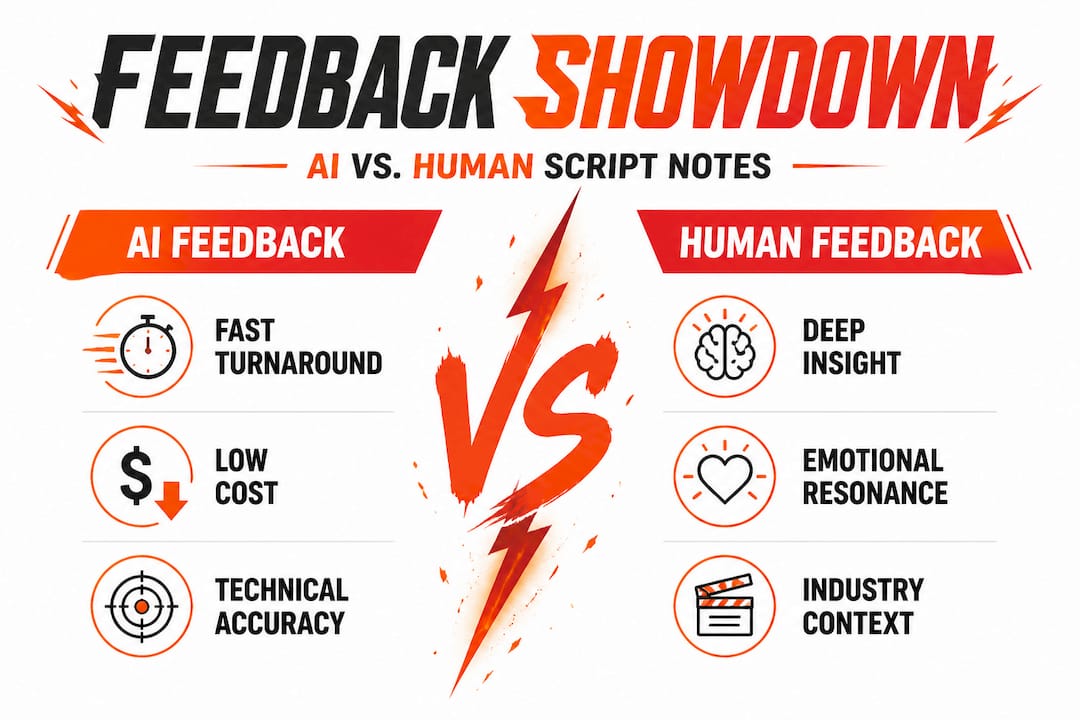
The savings from AI script analysis are significant, but the smartest writers use them strategically. They don't choose one or the other. They sequence both.
Pro Tip: Run your script through AI feedback before sending it to any human reader. Fix the structural and mechanical issues first. That way, when you pay for human coverage, the reader spends their time on the deeper creative and emotional layers, not on pointing out that your second act is 40 pages too long.
Understanding what a script reader actually evaluates helps you interpret notes more accurately, whether they come from a person or an algorithm. Coverage readers are trained to assess concept, structure, character, dialogue, and marketability. Knowing their framework lets you address each category deliberately.
Iterative feedback: How to maximize script revisions
One round of feedback will not get your script to the finish line. It just won't. The writers who succeed in festivals and pitch rooms are the ones who treat revision as a process, not an event.
Here's a practical framework for iterative revision:
- Write your first complete draft. Don't seek feedback mid-draft. Finish it. Even if it's rough, a complete draft is the raw material you need to work with.
- Run an AI diagnostic. Upload to an AI feedback tool and get structural notes. Flag every issue related to act structure, scene function, and protagonist agency. These are your priority repairs.
- Categorize and prioritize notes. Sort feedback into structure, character, dialogue, and formatting categories. Professional feedback methodology starts with structure because fixing structural problems often resolves character and dialogue issues downstream.
- Revise based on structural notes only. Don't touch dialogue yet. Fix the foundation first. A great line of dialogue in the wrong scene still doesn't work.
- Get a second AI pass. Confirm the structural repairs held. Check pacing again. Sometimes fixing one act problem creates a new one elsewhere.
- Send to a human reader. Now your script is structurally sound. The human reader focuses on emotional resonance, dialogue, humor, and market positioning. That's where their time is best spent.
- Revise again. Integrate human notes using the same prioritization method. Patterns across notes get addressed first. One-off comments get weighed carefully.
- Optional fresh coverage. For festival or producer submissions, consider one final round of AI or human feedback on the polished draft to confirm the changes landed.
This mirrors how Hollywood screenplay structure is actually developed in writers rooms and on studio development slates. The process isn't linear. It spirals: draft, feedback, revise, repeat.
The data supports this approach. Below is an illustration of how script quality improves across feedback cycles, drawing from published empirical results:
| Revision stage | Structural quality | Scene-level quality | Dialogue strength |
|---|---|---|---|
| First draft (no feedback) | Baseline | Baseline | Baseline |
| After AI feedback (round 1) | +35% | +40% | +10% |
| After human feedback (round 1) | +48% | +55% | +38% |
| After AI + human (round 2) | +53% | +67% | +52% |
The gains from a second combined cycle are substantial. Structured revision approaches used in other narrative forms confirm the same pattern: layered editorial processes consistently outperform single-pass reviews.
Understanding how screenplay structure drives story flow gives you a mental model for evaluating your own work between feedback rounds. The more fluent you become in structural principles, the more you'll anticipate problems before they show up in coverage.
Preparing your script for submission: Key takeaways from feedback
You've done the rounds. You've revised. Now you're thinking about submissions. Before you click send, here's what the preparation phase actually looks like.
Affordable AI tools handle initial mechanics checks fast and without bias. Use them in the final stage for one specific purpose: formatting and consistency. Check that your scene headings are consistent, your page count is appropriate for the genre (features typically run 90 to 115 pages), and your act transitions hit at roughly the right marks.
Here's a pre-submission checklist based on feedback patterns we see repeatedly:
- Logline clarity: Can you state your script's premise in one sentence that includes the protagonist, their goal, and the central conflict? Review your logline and screenplay pitch before anything else.
- Formatting compliance: Industry-standard formatting isn't optional for serious submissions. Review a current script formatting guide and compare your draft against it.
- Character arcs confirmed: Each major character should begin in one emotional state and end in a meaningfully different one. If they don't, that's a rewrite, not a polish.
- Dialogue pass: Read every scene aloud. If you stumble, the reader will stumble. Cut what doesn't serve the scene.
- Page count and pacing audit: Run a final AI pass specifically checking scene length distribution and act timing.
- Market context: Know where your script fits. Understand comparable films, the target audience, and the distribution landscape before writing your pitch materials.
Pro Tip: Avoid submitting immediately after your first complete round of feedback. The temptation is real, especially after a strong revision session. Resist it. Let the draft rest for at least a week after major revisions, then read it fresh before submission. You'll catch issues you were too close to see.
A screenwriter's perspective: What most people miss about script feedback
Here's the honest take after watching how writers engage with coverage, both AI and human.
Most writers think speed is the primary advantage of AI feedback. They're half right. Speed matters, but the real advantage is objectivity. An AI doesn't care that you worked on a scene for three weeks. It doesn't soften the note because it met you at a conference. It tells you the scene doesn't work. That bluntness is valuable.
But here's what most writers miss: the combination of AI objectivity and human subjectivity isn't a compromise. It's the most effective editorial process available to independent writers today. Think of it as two different instruments measuring different things. The AI gives you the blueprint assessment. The human gives you the emotional truth.
AI excels in speed and objectivity for structural elements but consistently falls short on tone, humor, and the "soul" of a story. Those are the elements industry readers actually greenlight. A script can be structurally perfect and still get passed because nothing in it makes a reader feel something.
This connects to a harder truth about dialogue and script rejection. Scripts rarely get rejected for typos or minor formatting errors. They get overlooked because the emotional engine isn't firing.
"Scripts aren't rejected for technical errors. They're overlooked for not connecting emotionally. That's where human feedback shines."
The writers who get the most out of feedback are the ones who treat it like data, not judgment. They don't get defensive about notes. They look for patterns across multiple readers. They ask specific questions. And they go back for more coverage after revisions, not just once before submission.
Next steps: Affordable script feedback solutions
If this article made one thing clear, it's that feedback isn't optional. It's the mechanism that moves a script from a draft to a competitive submission. The question is how to access that feedback affordably and effectively.

Frequently asked questions
Why should I get feedback before submitting to producers or festivals?
Feedback identifies fixable structural and pacing flaws that lead to rejections, giving your script a measurable improvement in both mechanics and market readiness before it reaches decision-makers. Targeted feedback methodologies that categorize notes by structure first and prioritize recurring patterns are the most efficient path to a competitive draft.
Is AI feedback enough or should I also use human readers?
AI feedback is fast, affordable, and highly accurate for structural and mechanical analysis, but AI tools lack nuance in emotional resonance, humor, and tone, making human readers essential before any serious submission.
How much can feedback improve my script?
Studies show structured feedback cycles improve scripts by 53% at the overall script level and by nearly 67% at the scene level compared to unreviewed originals, with humans still preferred for dialogue and pacing in competitive contexts.
How many rounds of feedback should I do?
Multiple passes catch substantially more issues than a single review. The most effective approach combines at least two AI passes with at least one human coverage round, with revisions between each cycle.
What's the biggest mistake writers make in getting feedback?
Submitting a script immediately after the first round of notes is the most common error. The best scripts improve through layered, iterative revisions where patterns across multiple rounds of feedback are addressed systematically rather than in a single pass.
Recommended
- Script format impact: 90% boost production & pitch success | ROAST MY SCRIPT
- Role of dialogue in scripts: 42% tied to verbosity | ROAST MY SCRIPT
- How to analyze a script for powerful screenplay improvement | ROAST MY SCRIPT
- Roast My Script | AI Script Coverage & Analysis from $9
- Feedback fuels growth: 0.73 effect size proven