
TL;DR:
- Script analysis proactively identifies structural issues to improve screenplay quality early.
- Using industry frameworks enhances storytelling clarity and audience engagement.
- Affordable AI tools and feedback before costly rewrites optimize success chances.
Most screenwriters think script analysis is something that happens to their work after they submit it to a production company or contest. That's backwards. The writers who consistently advance past the first round, land meetings, and build real careers treat analysis as something they initiate, not something they wait for. AI-driven analysis on 25,000+ TV scripts now predicts 41 to 50% of viewership variance, which tells you how much structural patterns matter to audiences. Script analysis isn't gatekeeping. It's one of the most practical tools available to any writer who wants honest feedback before the stakes get expensive.
Table of Contents
- What is script analysis and why does it matter?
- How professional analysis pinpoints script weaknesses
- Script analysis frameworks: What do professionals look for?
- When, why, and how to get your script analyzed
- A contrarian perspective: Why script analysis is a creative advantage, not a crutch
- Find affordable, actionable script analysis for your next draft
- Frequently asked questions
Key Takeaways
| Point | Details |
|---|---|
| Early feedback advantage | Getting script analysis before big edits or pitching can boost success and save time. |
| Proven industry frameworks | Applying frameworks like three-act structure or Hero’s Journey spotlights what works and what doesn't. |
| Cost-effective improvement | Affordable script analysis reveals fixable weaknesses before investing in costly coverage. |
| Creative empowerment | Analysis doesn’t stifle creativity—it unlocks new possibilities for bold storytelling. |
What is script analysis and why does it matter?
Script analysis is a structured process for identifying what's working and what isn't in your screenplay. It goes beyond a gut reaction or general notes. A proper analysis evaluates your script against proven industry criteria: structure, pacing, character arcs, dialogue, theme, and marketability. The goal is to surface specific, actionable problems before anyone else sees them.
Here's a misconception worth addressing directly: script analysis is not just for industry professionals reviewing submissions. It's a tool writers use on their own work, at every stage of development. The role of script readers in Hollywood is built entirely around systematic analysis, but that same methodology is available to you right now.
The script analysis methods professionals use most often include:
- Three-act structure breakdown: Evaluates setup, confrontation, and resolution against page-count benchmarks
- Scene-by-scene analysis: Checks that every scene advances plot or character, not just fills space
- Hero's Journey mapping: Identifies whether your protagonist follows a recognizable transformation arc
- Save the Cat beat sheet: Pinpoints the 15 structural beats that define commercially successful scripts
- Character arc mapping: Tracks whether characters change in meaningful, believable ways
- Theme mapping: Confirms your story's central argument is consistent throughout
- Script coverage criteria: Applies the same pass/consider/recommend framework used by production companies
"The difference between a script that gets a 'pass' and one that gets a 'consider' often comes down to structural clarity, not raw talent."
Starting analyzing your script early saves you from the most expensive mistake in screenwriting: polishing a script that has a fundamental structural problem. Rewriting act two after you've already paid for coverage is painful. Catching it yourself first is just smart.
How professional analysis pinpoints script weaknesses
Understanding the essence of script analysis sets the stage for seeing how it actually impacts your script's quality. The difference between a vague reader note and a professional analysis is specificity. Vague notes tell you something feels off. Professional analysis tells you why it feels off and where the problem lives on the page.
Here's what that looks like in practice. Consider a thriller script that opens with a strong premise but loses momentum around page 55. A professional analysis would flag that the midpoint beat is missing, the antagonist's motivation shifts without justification on page 48, and three scenes in act two repeat the same emotional beat. That's not a feeling. That's a diagnosis.

Before and after analysis: a real-world comparison
| Element | Before analysis | After analysis |
|---|---|---|
| Reader engagement score | 6/10 | 8/10 |
| Page count | 118 pages | 110 pages |
| Structural clarity | Weak midpoint | Clear midpoint and escalation |
| Contest result | No placement | Semifinalist |
| Dialogue notes | Flagged as clunky | Tightened, character-specific |
This kind of improvement is documented. Empirical studies on 12,000+ screenplays identify clear patterns in what readers respond to, and scripts that address those patterns consistently score higher. The data isn't speculative. It reflects what actually happens when writers act on structured feedback.
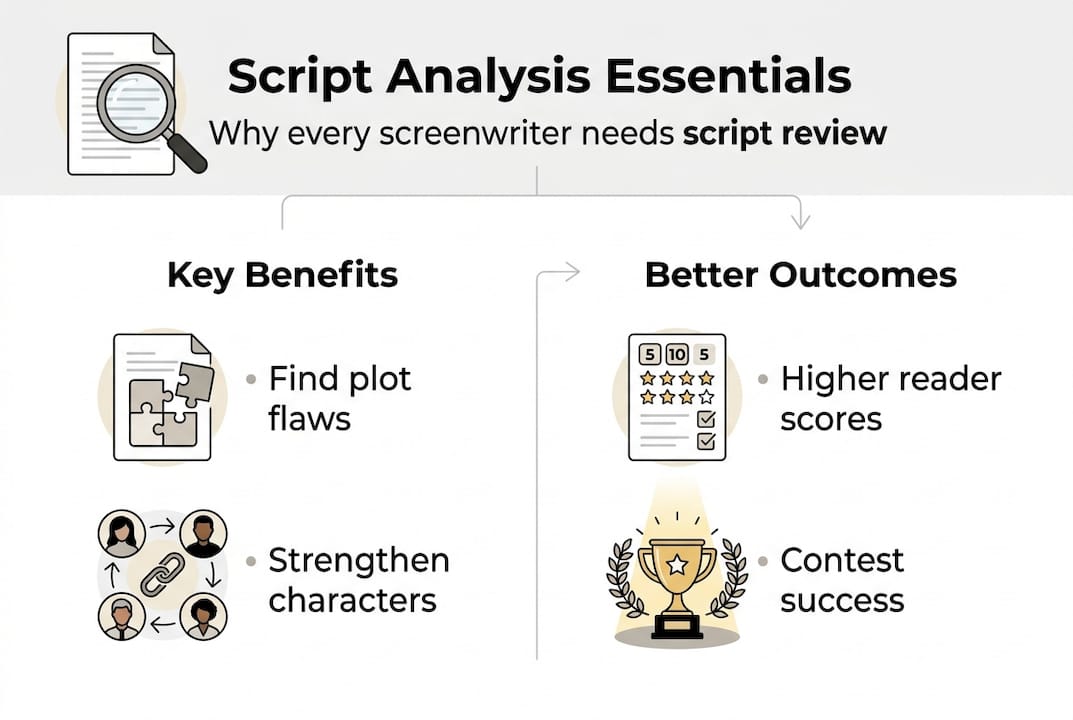
You can explore modern script analysis techniques that use AI to surface these issues faster and cheaper than traditional coverage. The case studies of script improvements show the same pattern repeatedly: targeted analysis leads to measurable gains.
Also worth noting: script analysis and viewership data from recent research confirms that structural variables in scripts correlate with audience engagement at a statistically significant level. This isn't just craft theory. It's backed by numbers.
Pro Tip: Get your script analyzed before you pay for rewrites or professional consultations. A $25 analysis that identifies a broken act two saves you from a $500 script doctor session spent fixing the wrong things.
Script analysis frameworks: What do professionals look for?
Knowing script analysis works is half the battle. The other half is understanding what professionals are actually evaluating. When a script reader or analyst sits down with your screenplay, they're not reading it the way an audience watches a movie. They're applying a framework, consciously or not.
Here's a quick reference for the core frameworks used in professional analysis:
| Framework | What it evaluates | Best used for |
|---|---|---|
| Three-act structure | Setup, confrontation, resolution timing | Feature films, pilots |
| Hero's Journey | Protagonist transformation arc | Character-driven stories |
| Save the Cat beat sheet | 15 structural beats and pacing | Commercial features |
| Character arc mapping | Internal and external change | Drama, character studies |
| Theme mapping | Consistency of central argument | Any genre |
| Scene-by-scene breakdown | Scene function and necessity | Pacing and fat-trimming |
These script analysis methods aren't arbitrary. They reflect decades of study into what makes stories work for audiences. Understanding them gives you a shared vocabulary with analysts, readers, and producers.
Here's how to start applying these frameworks yourself:
- Map your acts first. Identify your inciting incident, midpoint, and climax by page number. If they don't land near industry benchmarks, that's your first flag.
- Check every scene for function. Each scene should either advance the plot or reveal character. If it does neither, cut it or rewrite it.
- Track your protagonist's arc. Write one sentence describing who they are on page 1 and one sentence describing who they are on the last page. If those sentences are identical, there's no arc.
- Test your theme. Ask: what is this story actually about? Then check whether every major scene reinforces or complicates that idea.
- Apply the Save the Cat beat sheet. Map your script's key moments against the 15 beats. Missing beats reveal structural gaps immediately.
Knowing these screenplay structure frameworks also helps you interpret feedback more accurately. When an analyst references script coverage criteria, you'll understand exactly what they're measuring instead of feeling like you're decoding a foreign language.
When, why, and how to get your script analyzed
You know the frameworks and the benefits. Now let's focus on applying this in your writing process without breaking the bank. Timing matters. Getting analysis too early (before you've finished a complete draft) means you're analyzing an incomplete idea. Getting it too late (after you've already submitted to your top contests) means you've missed your window to improve.
Here are the key moments when script analysis delivers the most value:
- After your first complete draft: This is the most important moment. You've finished something. Now find out if it works before you fall in love with it.
- Before entering competitions: Contest readers are ruthless and fast. Analysis helps you fix the issues they'd use to eliminate you.
- Before sending to reps or producers: A script that goes out with structural problems rarely gets a second chance with the same contact.
- After a significant rewrite: Confirm that your changes actually solved the problem and didn't create new ones.
- When you feel stuck: Sometimes analysis clarifies what's wrong when you can't see it yourself anymore.
Pro Tip: Don't skip the affordable options. Peer feedback, writing groups, and AI-powered tools are legitimate first passes. Use them before spending $60 to $400 on traditional coverage. AI script analysis solutions have become precise enough to catch structural issues that used to require a human reader.
When you receive analysis, resist the urge to defend your choices. Read the feedback once for emotional reaction, then set it aside for 24 hours. Read it again looking only for patterns. If three different notes all point to the same scene, that scene is the problem. Script format and success are more connected than most writers realize, and analysis often surfaces formatting habits that undermine an otherwise strong story.
The long-term math is simple. Writers who invest in iterative analysis spend less on rewrites, advance further in competitions, and build stronger relationships with industry contacts. Scripts that go through analysis show measurable improvements in reader scores and contest placement. That's not a coincidence.
A contrarian perspective: Why script analysis is a creative advantage, not a crutch
Here's the pushback I hear most often: "If I analyze my script too much, I'll lose the spontaneity. The structure will feel forced." I understand the instinct, but I think it's wrong.
Analysis doesn't constrain creativity. It redirects it. When you know your act two is structurally sound, you stop worrying about whether the story works and start focusing on making it yours. The value of structure in creativity is that it frees you from second-guessing the foundation so you can take risks on character, tone, and voice.
The writers who resist analysis often produce scripts that feel original but don't land emotionally. The writers who use analysis proactively, not just reactively, tend to find their unique voice within proven structures rather than fighting against them. That's where the real creative leverage lives. Analysis isn't the enemy of originality. Structural confusion is.
Find affordable, actionable script analysis for your next draft
If you're ready to put these insights into action, the next logical step is getting your script in front of a system built to give you honest, structured feedback at a price that doesn't require you to gamble your writing budget.
At Roast My Script, you can get professional-grade script coverage starting at $9, with a full PDF analysis delivered in 1-2 days by email. The analysis is built on the same Hollywood methodology covered in this article: Syd Field, McKee, Save the Cat. It's designed to be the brutal first filter before you spend real money on traditional coverage or script doctors. You can also master key screenwriting concepts through our educational resources to sharpen your craft between drafts.
Frequently asked questions
What is script analysis in screenwriting?
Script analysis is a systematic review using industry frameworks to uncover structural and storytelling strengths or flaws in your screenplay. Common methodologies include three-act structure breakdown, Hero's Journey, Save the Cat beat sheet, character arc mapping, and script coverage criteria.
Is script analysis only for new writers?
No. Both aspiring and seasoned writers use script analysis to catch issues and strengthen their work before costly rewrites or professional feedback. Documented case studies show scripts at all development stages benefit from structured analysis, with measurable gains in reader scores and contest placement.
How does script analysis impact contest or production outcomes?
Research shows scripts that go through analysis earn higher reader scores, advance further in competitions, and better predict audience engagement. NLP analysis on 25,000 TV scripts found structural variables predict 41 to 50% of viewership variance.
When should I get script analysis on my project?
The best times are after your first complete draft, before entering competitions, or before sending your script to producers or agents. Acting at these moments gives you the most room to improve before the stakes are high.