
Many screenwriters confuse loglines with taglines or treat them as simple summaries, which can doom their pitches before they start. A logline is actually your script's most powerful marketing tool, capturing your story's essence in 25-50 words. This guide breaks down what loglines are, why they matter for pitching success, and exactly how to write ones that grab attention from producers and festival readers.
Table of Contents
- Definition And Purpose Of A Logline
- Importance Of Loglines In Pitching
- Key Components Of Effective Loglines
- Common Misconceptions About Loglines
- Comparison: Loglines Vs Synopses Vs Taglines
- Practical Frameworks For Writing Loglines
- Examples Of Effective Loglines
- Enhance Your Scripts With Roast My Script
- FAQ
Key takeaways
| Point | Details |
|---|---|
| Loglines focus on core narrative | They capture protagonist, goal, conflict, and stakes in one concise sentence. |
| Clear loglines boost consideration | Scripts with strong loglines are 40% more likely to be read by industry professionals. |
| Avoid common mistakes | Vague language, excessive length, or cliché descriptions lead to immediate rejection. |
| Loglines differ from synopses | Loglines are brief story summaries while synopses provide detailed plot breakdowns. |
| Frameworks improve results | Using proven structural templates enhances logline clarity and pitch effectiveness. |
Definition and purpose of a logline
A logline is a one or two sentence summary that distills your screenplay into its essential narrative elements. It serves as the foundation for pitching your story to producers, agents, and festival programmers who need to grasp your concept instantly.
The core components typically include your protagonist, their primary goal, the main conflict standing in their way, and what's at stake if they fail. This compact format forces you to identify what truly drives your story forward. Unlike a detailed synopsis that walks through plot points or a catchy tagline designed for posters, the logline balances brevity with narrative substance.
Industry professionals use loglines as filtering tools to decide which scripts deserve their limited reading time. Your logline functions as both a storytelling summary and a marketing hook. When crafted well, it communicates genre, tone, and uniqueness while sparking curiosity about how the story unfolds.
Key functions of loglines:
- Communicate your script's premise quickly to busy industry readers
- Serve as the opening hook in query letters and pitch meetings
- Help you clarify your own story's core conflict and stakes
- Differentiate your screenplay from competing submissions
- Provide the foundation for elevator pitches and festival applications
Importance of loglines in pitching
Your logline determines whether industry professionals even open your script file. Producers and agents typically review hundreds of submissions monthly, spending less than 30 seconds on initial screening. A compelling logline can mean the difference between serious consideration and immediate rejection.
Research shows that scripts with strong loglines are 40% more likely to receive full reads from decision makers. This single sentence serves as your first and sometimes only opportunity to demonstrate your storytelling abilities. Film festivals face similar submission volumes, with programmers relying heavily on loglines during initial rounds. Studies indicate that festival submissions with clear stakes and conflict have 25% higher acceptance rates compared to vaguely pitched entries.
The logline also functions as an early marketing prototype for your project. If industry professionals can't quickly grasp and repeat your concept, they won't champion it to their colleagues or financiers. Your ability to condense complex narratives into tight, engaging summaries signals professional polish.
How loglines impact your success:
- Determine which scripts get priority reading slots
- Influence whether your query email gets responses
- Shape first impressions during networking and pitch events
- Help producers visualize marketing angles for your story
- Separate amateur submissions from professional quality work
Neglecting your logline means wasting the effort you put into writing 90-120 pages. Even brilliant screenplays get overlooked when their loglines fail to communicate their value clearly and compellingly.
Key components of effective loglines
Every compelling logline contains four essential narrative elements working together. Your protagonist must be specific enough to visualize, not generic labels like "a man" or "a woman." Their goal needs to be concrete and urgent, giving readers a clear sense of what success looks like.

The conflict or antagonistic force creates the story's central tension. This obstacle must feel substantial enough to justify a feature length screenplay. Stakes answer the critical question of why this goal matters, what happens if your protagonist fails, and why audiences should care about the outcome.
Language choice dramatically affects logline impact. Using unique emotional stakes and character dilemmas is 25% more effective at attracting interest than focusing solely on plot mechanics. Active verbs drive momentum while specific details prevent vague, forgettable descriptions.
Essential logline components:
- Protagonist specificity: Define who they are beyond basic demographics
- Clear objective: State exactly what they're trying to achieve
- Compelling conflict: Show the primary obstacle or antagonist
- Meaningful stakes: Reveal consequences of failure or success
- Unique angle: Highlight what makes your story different from similar concepts
Avoid tired phrases like "must choose between" or "finds themselves in" that signal formulaic thinking. Your story structure should shine through naturally without relying on cliché constructions.
Pro Tip: Test your logline by removing all adjectives and adverbs. If the core sentence still communicates your story clearly, you've built a solid foundation. Then add back only the most essential descriptive words that enhance clarity or uniqueness.
Focus on the element that makes your conflict distinctive. Two loglines about revenge stories can feel completely different when you emphasize what makes each character's spine unique.
Common misconceptions about loglines
Many screenwriters treat loglines as afterthoughts or confuse them with taglines, damaging their pitch effectiveness. A tagline like "In space, no one can hear you scream" creates atmosphere but doesn't summarize the story. Your logline must convey actual narrative information about who wants what and why it matters.
Excessive length kills impact just as quickly as being too vague. Writers often try cramming subplots, twists, and character backstory into loglines, creating confusing run on sentences. Others swing to the opposite extreme with generic phrases like "a journey of self discovery" that could apply to thousands of different stories.
Research reveals that 40% of script rejections stem from unclear or poorly written loglines, with many writers confusing formats or writing descriptions that are too vague or excessively detailed. Some screenwriters submit without any logline at all, assuming their query letter or script title alone will suffice.
Frequent logline mistakes:
- Confusing loglines with taglines or promotional copy
- Writing multiple sentences that ramble beyond 75 words
- Using vague language that could describe any genre film
- Including character names instead of descriptive identifiers
- Revealing major plot twists or ending details
- Relying on cliché phrases that signal amateur work
"Your logline is your script's audition. If it can't perform in 25-50 words, why should anyone invest two hours reading 120 pages?"
The killer logline guide emphasizes specificity over cleverness. Industry readers want to understand your story instantly, not decode cryptic descriptions or wade through unnecessary details. Clear communication always trumps trying to sound sophisticated.
Comparison: loglines vs synopses vs taglines
Screenwriters often confuse these three marketing tools because they all describe your screenplay, but each serves distinct purposes. Understanding when to use each format prevents miscommunication during pitching and submission processes.
A logline provides a narrative snapshot in extreme brevity, focusing on core story mechanics. Synopses expand to cover major plot points, character arcs, and story resolution across several paragraphs or pages. Taglines abandon narrative detail entirely in favor of evoking mood or creating intrigue.
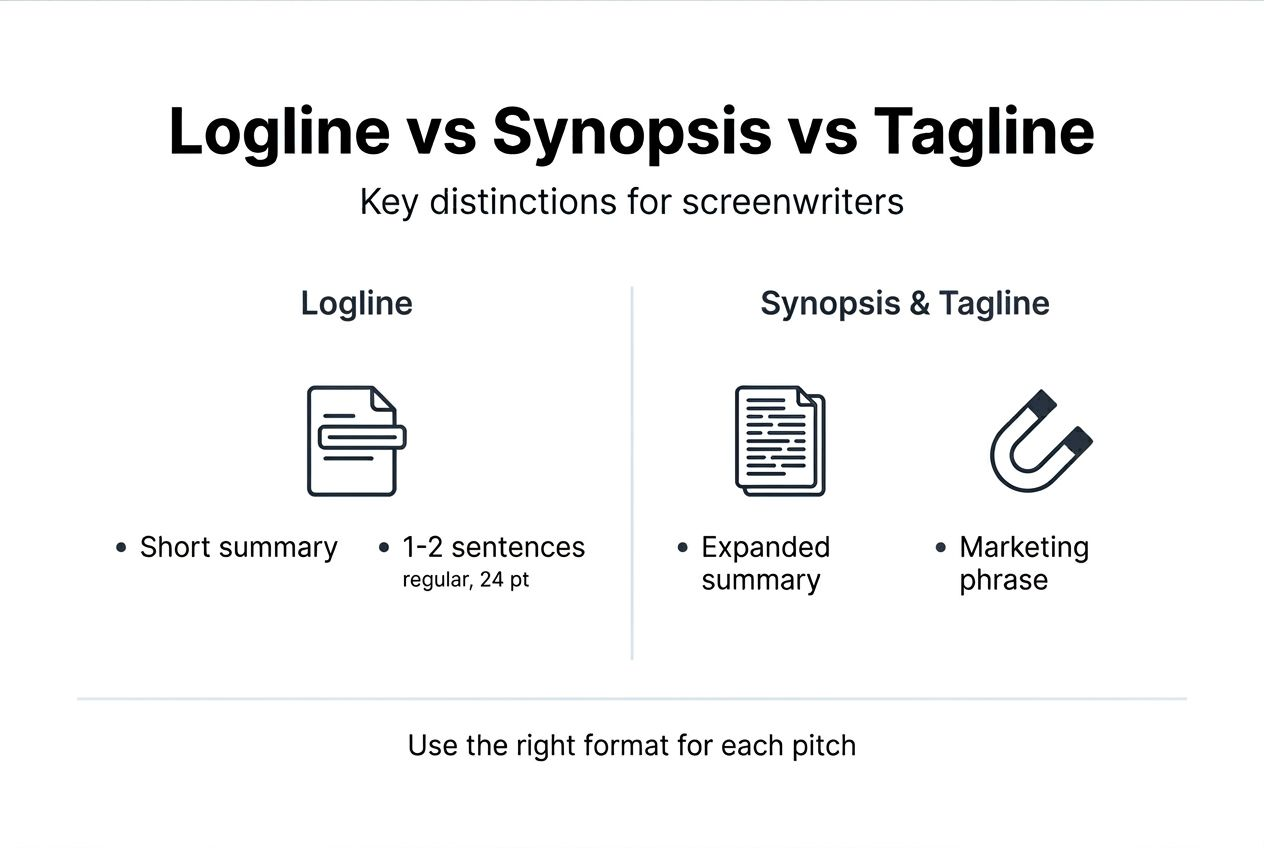
| Element | Logline | Synopsis | Tagline |
|---|---|---|---|
| Length | 25-50 words (1-2 sentences) | 300-500 words (detailed) | 3-10 words (ultra brief) |
| Purpose | Summarize core narrative | Detail full plot progression | Create marketing hook |
| Focus | Protagonist, goal, conflict, stakes | Complete story arc and themes | Emotional impact or concept |
| Usage | Query letters, pitch meetings, festival submissions | Requested by producers, script databases | Movie posters, trailers, advertising |
| Reveals ending | No | Yes | No |
Industry professionals expect you to have all three prepared but will request them at different stages. Initial queries require loglines. Interested parties request synopses before committing to full reads. Taglines only become relevant once a project moves toward production and marketing.
Using the wrong format signals inexperience and creates confusion. Sending a synopsis when asked for a logline suggests you can't distill your story effectively. Offering only a tagline without narrative substance leaves readers with no concrete information about your actual screenplay.
Practical frameworks for writing loglines
Following proven structural templates removes guesswork from logline creation. The most reliable framework follows this pattern: When [inciting incident occurs], [specific protagonist] must [concrete goal], but [compelling obstacle] threatens [meaningful consequences].
Start by identifying your screenplay's inciting incident, the event that launches your protagonist into the main story. Then specify exactly who your protagonist is using descriptive identifiers rather than proper names. Define their goal in action oriented terms that readers can visualize.
Step by step logline construction:
- Identify core elements: Write down protagonist, goal, main obstacle, and stakes separately
- Draft first version: Combine elements into one sentence between 25-50 words
- Remove weak words: Cut adjectives, adverbs, and passive voice constructions
- Add specific details: Replace generic terms with concrete, visual language
- Test for clarity: Read aloud to someone unfamiliar with your script
- Refine based on feedback: Adjust confusing phrases or unclear elements
- Verify essentials: Confirm protagonist, goal, conflict, and stakes are all present
Your first draft will likely exceed 50 words or feel awkward. That's normal. Revision tightens language and sharpens focus. Read successful loglines from produced films to internalize what works.
Pro Tip: Apply copywriting principles for concise summaries to your logline. Every word must earn its place by adding clarity, specificity, or emotional weight. If removing a word doesn't diminish understanding, cut it.
Test your logline with multiple readers from your target audience. Ask them to describe the story back to you. If they misunderstand key elements or can't remember the core concept, your logline needs more work.
Examples of effective loglines
Studying successful film loglines reveals how professionals balance all essential elements within strict word limits. These examples demonstrate clarity, specificity, and compelling conflict without wasting words.
"Alien" (1979): After a space merchant vessel responds to a distress signal, the crew must survive when a hostile alien creature hunts them one by one in deep space.
This logline specifies the protagonist group, their situation, clear threat, and confined setting that raises stakes. Notice how it avoids character names while providing concrete details.
"The Martian" (2015): When a NASA astronaut is presumed dead and left behind on Mars, he must use his ingenuity to survive and signal Earth for rescue before his supplies run out.
Here we see a lone protagonist with a specific obstacle, clear goal, and ticking clock stakes. The unique setting and survival angle differentiate it from generic space stories.
Strong logline characteristics:
- Immediately establish genre and tone through word choice
- Include specific obstacles that create compelling conflict
- Highlight emotional or physical stakes that raise tension
- Use active voice and concrete action verbs throughout
- Avoid revealing plot twists or ending resolution
Weak example: A man goes on a journey and discovers who he really is.
This fails because it's too vague. What kind of man? What journey? What discovery? Readers can't visualize anything specific or understand what makes this story unique.
Improved version: When a disillusioned corporate lawyer inherits his estranged father's failing vineyard, he must choose between his lucrative career and saving the family legacy before foreclosure.
The revision adds specificity, clear stakes, a ticking clock, and meaningful conflict. Readers immediately understand the protagonist's dilemma and what's at risk.
Enhance your scripts with Roast My Script
Crafting killer loglines is just the beginning of professional screenplay development. Roast My Script offers affordable AI powered script coverage that analyzes your logline alongside your full screenplay's structure, characters, and marketability. Get expert level feedback for a fraction of traditional coverage costs, helping you identify weaknesses before pitching to industry professionals.
Our analysis examines how well your script delivers on your logline's promise, highlighting where narrative focus drifts or stakes weaken. Access detailed resources like our comprehensive guide on crafting killer loglines and character development frameworks to strengthen every element of your screenplay.
Whether you're preparing for film festival submissions or producer meetings, professional feedback increases your script's chances dramatically. Leverage technology and expertise to refine your pitch and boost your screenplay's marketability.
FAQ
What is a logline in screenwriting?
A logline is a concise one or two sentence summary capturing your screenplay's essential story elements. It identifies your protagonist, their primary goal, the main conflict they face, and what's at stake if they fail. This format differs from a synopsis, which provides detailed plot coverage, and from a tagline, which serves as a brief marketing phrase.
How long should a logline be?
Ideal loglines range between 25 and 50 words to maintain conciseness and readability. This length forces you to focus on only the most essential narrative elements. Keeping loglines brief helps busy industry decision makers quickly grasp your core story concept without wading through unnecessary details.
What makes a logline effective?
Effective loglines feature a clear protagonist, compelling goal, substantial conflict, and meaningful stakes. Using specific, action driven language rather than vague descriptions increases impact significantly. Highlighting unique elements that differentiate your story from similar concepts also enhances reader interest while avoiding cliché phrases signals professional quality.
How is a logline different from a tagline or synopsis?
Loglines are brief narrative summaries of 25-50 words focusing on protagonist, goal, conflict, and stakes. Synopses are detailed plot summaries spanning several hundred words that cover full story arcs and character development. Taglines are ultra short marketing slogans of 3-10 words designed to evoke emotion or create intrigue rather than convey narrative information.
Recommended
- How to Write a Killer Logline | ROAST MY SCRIPT
- Role of dialogue in scripts: 42% tied to verbosity | ROAST MY SCRIPT
- Script Development Process: Preparing for Hollywood Success | ROAST MY SCRIPT
- Master Story Structure Breakdown for Screenwriters | ROAST MY SCRIPT
- Copywriting for Amazon Listings: Tips & Best Practices
- What is narrative-driven photography: telling your Iceland story