
TL;DR:
- Most script rejections are due to avoidable formatting, structural, or eligibility errors.
- Strengthening the script's overall structure and story takes priority over line-by-line editing.
- Professional, targeted feedback helps identify hidden issues that checklists alone might miss.
Most scripts don't get rejected because the writing is bad. They get rejected because the writer skipped steps that had nothing to do with creativity. Missed eligibility rules, weak structure, verbose dialogue, and sloppy formatting are avoidable mistakes that eliminate scripts before a reader even gets invested. A checklist gives you a systematic way to work through every submission requirement and catch those problems before they cost you. In this guide, you'll find each essential step broken down clearly, from protecting your script legally to polishing your final page, so you can submit with confidence instead of crossing your fingers.
Table of Contents
- Understand eligibility and rights registration
- Structure and story: Big-picture polishing passes
- Dialogue and character: Final layer of refinement
- Formatting, presentation, and typo check
- What most screenwriters miss: The power of strategic feedback
- Get expert feedback and boost your script submission
- Frequently asked questions
Key Takeaways
| Point | Details |
|---|---|
| Check eligibility first | Always confirm contest rules, page count, and registration requirements before submitting your script. |
| Polish structure and story | Big-picture revision passes can dramatically improve your script’s impact and success rate. |
| Refine dialogue and characters | Authentic dialogue and multidimensional characters are key to engaging readers and judges. |
| Fix formatting and typos | Proper formatting ensures your script passes industry standards and avoids early rejection. |
| Seek affordable feedback | Professional coverage can pinpoint issues and increase your script’s market readiness. |
Understand eligibility and rights registration
Once you understand the stakes, the first step is confirming you qualify and your script is protected.
Every contest and production company has its own submission rules. Ignoring them is the fastest way to waste an entry fee. Before you submit anywhere, read the eligibility section carefully. Some contests cap lifetime earnings. Others restrict by genre, nationality, or professional status. The Nicholl rules for 2026, for example, require that applicants have earned less than $25,000 writing for film or TV and that scripts fall between 80 and 125 pages. That's a hard cutoff, not a suggestion.
On the legal side, WGA and US Copyright registration is optional but strongly recommended before submitting your work anywhere. Registration doesn't affect your eligibility, but it establishes a timestamped record of your authorship. That matters if a dispute ever comes up. WGA registration is quick and costs around $20 for non-members. US Copyright registration is more formal and offers stronger legal protection.
Research consistently shows that up to 62% of scripts are disqualified for not meeting eligibility or formatting rules before a reader ever evaluates the story. That's a preventable loss.
Before submitting, confirm the following:
- Page count falls within the contest's required range
- You meet any earnings or professional status limits
- Genre matches what the contest accepts
- Script is registered with WGA or US Copyright if you want that protection
- Submission format matches requirements (PDF, Final Draft, etc.)
- Entry fee and deadline have been verified
| Contest | Page range | Earnings limit | Genre restrictions |
|---|---|---|---|
| Nicholl Fellowship | 80-125 pages | Under $25k lifetime | Feature films only |
| Austin Film Festival | 90-120 pages | None specified | Multiple categories |
| PAGE International | 80-120 pages | None specified | Multiple genres |
| Sundance Labs | Varies by lab | None specified | Varies by program |
Understanding the script development process from early draft to submission helps you see eligibility as part of a larger system, not a bureaucratic afterthought.
Structure and story: Big-picture polishing passes
Once eligibility and rights are clear, focus shifts to strengthening the script's core story.
Most writers revise scene by scene. That's a mistake at this stage. Before you fix a single line of dialogue, step back and evaluate the script as a whole. Does the structure hold? Is your protagonist's arc visible and earned? Does the theme land with consistency across all three acts? These are the questions that separate a script that places in competitions from one that doesn't make the first cut.
According to professional revision methodology, a disciplined polish moves through distinct passes: big-picture structure and themes first, then character arcs, then dialogue, and finally a typo and format check. Skipping ahead costs you clarity.
Consider a real scenario: a writer submits a thriller with a strong premise but a muddy second act. The protagonist disappears emotionally for 30 pages. Readers lose investment. After a structural rewrite that built a clear midpoint reversal and raised personal stakes for the protagonist, the same script advanced to the semifinals of a major contest. The story didn't change. The architecture did.
Most overlooked big-picture edits:
- Act breaks don't land at the right page markers
- The midpoint shift is missing or underpowered
- Subplots don't connect thematically to the main story
- Character arc has no measurable internal change by the end
- Theme is stated in dialogue instead of shown through behavior
- The climax doesn't reflect what the protagonist has learned
"A script that survives structure notes will survive most other notes. Fix the foundation first, then the walls."
Pro Tip: Before revising, write a one-sentence logline and map your three act breaks on paper. If your logline doesn't match what's actually on the page, you've found your first structural problem.
Strong story structure breakdown resources can help you identify where your script's architecture is holding firm and where it's collapsing. Also look closely at character dimensionality during this pass, because flat supporting characters often signal weak thematic execution. Knowing how to analyze script improvement systematically makes each revision pass more productive.
Dialogue and character: Final layer of refinement
After big-picture edits, focus on the script's surface: what characters say and how they interact.
Dialogue is where a script either feels alive or feels written. The difference is usually audible before it's readable. That's why the read-aloud test exists. When you read your dialogue out loud, clunky phrasing becomes obvious immediately. Lines that look fine on the page often feel forced, over-explained, or unnatural when spoken. This pass takes time, but it catches problems no amount of silent rereading will reveal.
Verbose dialogue is one of the top reasons readers flag scripts for rejection. Characters who explain their feelings instead of expressing them. Monologues that substitute for dramatic action. On-the-nose lines that tell you exactly what a scene means. Each of these signals to a professional reader that the writer hasn't fully internalized how film dialogue works.
Professional revision guidance emphasizes that the dialogue read-aloud pass is non-negotiable because it trains you to hear the rhythm of your characters' speech patterns, not just read them.
Key questions for your character and dialogue passes:
- Does each character have a distinct voice, or do they all sound the same?
- Are characters reacting differently to the same situation based on who they are?
- Is any information delivered in dialogue that should be shown visually?
- Do characters ever speak in complete, formal sentences when informal would be natural?
- Are subtext and tension present in scenes, or does every character say exactly what they mean?
- Is any single speech longer than half a page without a strong dramatic reason?
Pro Tip: Record a table read with friends, even informally. Flat line delivery from readers who are unfamiliar with the story is the clearest signal that something isn't working on the page.
Pairing this with an understanding of character dimensionality ensures you're not just fixing words but also verifying that each character is earning their place in your story.
Formatting, presentation, and typo check
With story and character locked, the final step is technical presentation: how your script looks and reads to gatekeepers.
Formatting isn't a formality. It's a signal. A script with correct margins, proper slug lines, and consistent scene headings tells a reader you're a professional before they've read a single line of story. A script with obvious formatting errors tells them the opposite. Research suggests that proper script formatting can boost a script's chance of serious consideration by up to 90% simply by removing the friction that makes readers disengage.
Industry-standard revision practice includes a dedicated final pass for typos and formatting, separate from all creative revision. Treat it as a technical audit.
| Common formatting mistake | Industry standard |
|---|---|
| Double-spacing between action lines | Single space between action blocks |
| Character names in lowercase | Character names in ALL CAPS |
| Scene headings without INT./EXT. | Always include INT. or EXT. + location + time |
| Parentheticals used excessively | Reserve for essential performance direction only |
| Font other than Courier 12pt | Courier 12pt is the only acceptable font |
| Page count outside contest range | Always verify and trim or expand as needed |
Final formatting and typo checklist:
- Confirm script is in Courier 12pt with correct margins
- Check all slug lines for INT./EXT. and time of day
- Verify character names are consistent and in ALL CAPS on first appearance
- Review all parentheticals and cut any that over-direct the actor
- Read every page for typos, especially character name inconsistencies
- Confirm total page count meets contest requirements
- Export as PDF and review the final file before uploading
Understanding how AI transforms scriptwriting in 2026 can also help you use automated tools to catch formatting issues faster. And if your script still needs a logline for submission materials, crafting a strong logline is a skill worth developing before any submission deadline.
What most screenwriters miss: The power of strategic feedback
Here's something I see constantly: writers follow every step on a checklist and still submit a script with a fixable structural flaw they simply couldn't see themselves. It's not laziness. It's proximity. When you've written something, you stop reading what's on the page and start reading what you intended to write.
Most writers rely on feedback from friends or writing groups. That input has value, but it rarely produces the structured, honest assessment that identifies whether your script is market-ready. A friend might love your characters and miss the fact that your second act loses dramatic momentum for 25 pages. A professional, targeted coverage report finds that.
Affordable script analysis, grounded in frameworks like those you'll find in essential screenwriting concepts, catches structural, formatting, and market-fit issues before you spend money on expensive coverage or submit to a contest you're not ready for. Even experienced writers benefit from that outside perspective. The checklist gets you close. Structured feedback gets you there.
Get expert feedback and boost your script submission
Following a submission checklist is the right move. But if you want to be certain your script is ready, getting targeted, professional feedback is the step that separates the writers who place from the ones who keep wondering why they didn't.
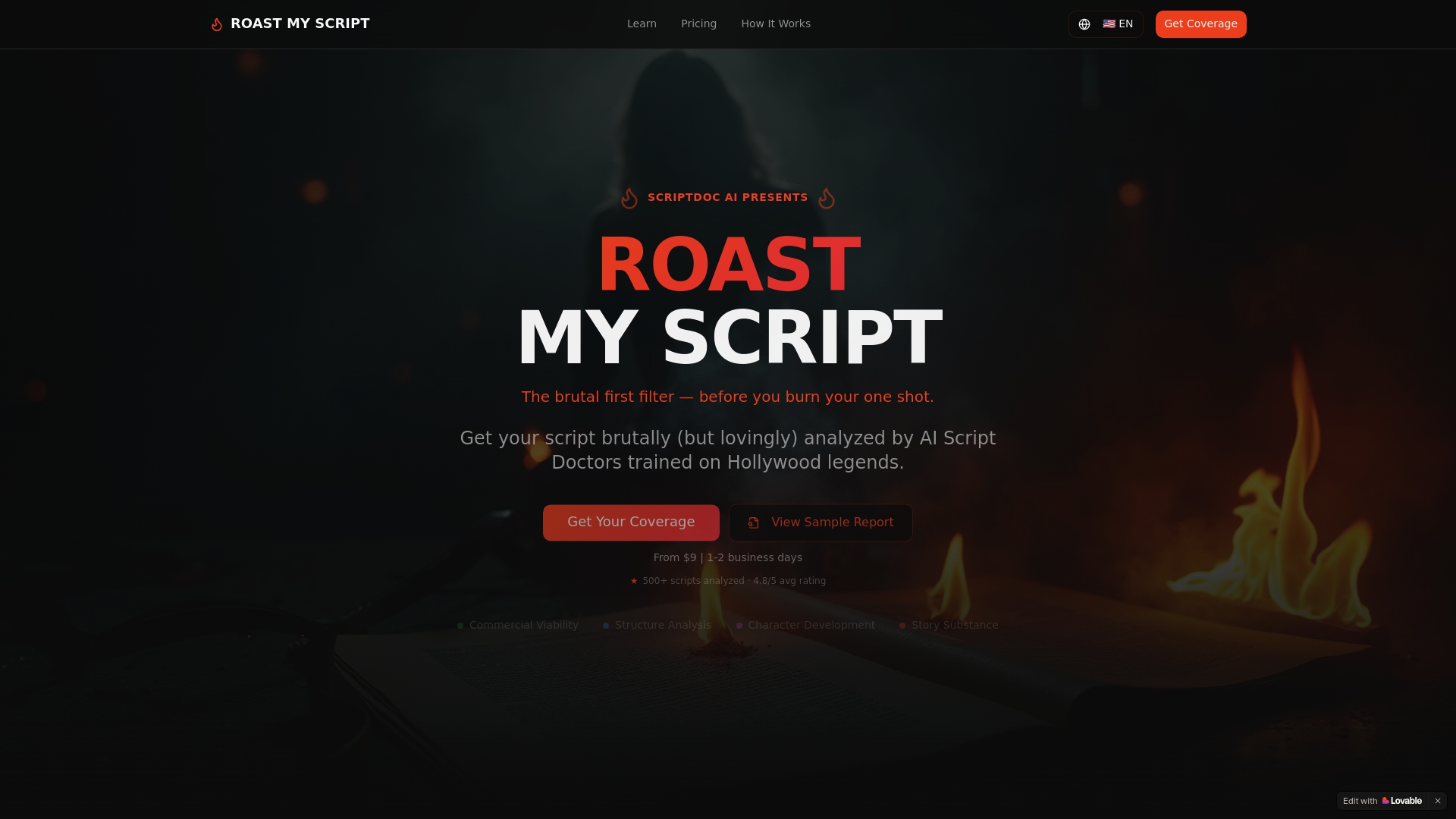
At Roast My Script, we offer affordable script coverage starting at $9, with a turnaround of 1-2 days by email. Our AI-driven analysis, built on Hollywood methodology including Syd Field, McKee, and Save the Cat, delivers a detailed PDF covering structure, dialogue, character, and market viability. It's the brutal first filter before you send your script anywhere. Use the checklist to prepare. Use Roast My Script to confirm you're ready.
Frequently asked questions
Do I need to register my script before submitting to a contest?
Registration with WGA or US Copyright is optional but recommended; always check each contest's specific eligibility rules before submitting.
What is the ideal page count for a feature screenplay contest submission?
Most major contests require scripts between 80 and 125 pages; always verify the specific requirements before you submit.
How do I spot and fix common formatting errors before submitting?
Use an industry-standard checklist and dedicated script software to catch typos and verify correct formatting practices before exporting your final PDF.
Should I get feedback before submitting my screenplay?
Yes. Professional feedback identifies structural and formatting issues you're too close to your own work to see clearly.
Recommended
- Script Development Process: Preparing for Hollywood Success | ROAST MY SCRIPT
- How to analyze a script for powerful screenplay improvement | ROAST MY SCRIPT
- Script format impact: 90% boost production & pitch success | ROAST MY SCRIPT
- Master Story Structure Breakdown for Screenwriters | ROAST MY SCRIPT
- Screenplay coverage workflow guide for writers in 2026