
You've spent months on your screenplay. You believe in the story. But the moment you consider submitting it to a producer, a competition, or a script reader, a familiar anxiety kicks in: Is the structure actually working? Most writers can't answer that question with confidence, and that uncertainty is expensive. Submitting a structurally broken script to industry professionals wastes your time, your money, and your credibility. A focused script structure checklist gives you a clear, professional-grade diagnostic tool to catch problems before anyone else sees them. This guide walks you through exactly how to use one.
Table of Contents
- Why script structure matters: The checklist mindset
- The essential script structure checklist: Step-by-step
- Frameworks compared: Three-act vs. Save the Cat beat sheet
- Script analysis in action: Applying your checklist
- Beyond the checklist: Flexibility and experimental structure
- Take your script further: Professional diagnostics and resources
- Frequently asked questions
Key Takeaways
| Point | Details |
|---|---|
| Checklist catches flaws | A structure checklist spots issues before costly submissions. |
| Frameworks are tools | Three-Act and Save the Cat both guide—but don’t constrain—strong scripts. |
| Beat mapping reveals gaps | Overlay your script to find missed beats or structural weak spots. |
| Flexibility is possible | You can innovate on structure when your story logic remains clear. |
| Professional analysis helps | Combining checklists with expert coverage increases your script’s industry readiness. |
Why script structure matters: The checklist mindset
Structure isn't just a set of rules imposed on your creativity. It's a diagnostic lens. When you read your own script, you're too close to it. You know what you meant to write, so your brain fills in gaps that aren't actually on the page. A checklist forces you to look at what's there, not what you intended.
Think of it this way: professional script readers use screenplay structures as a baseline to evaluate whether a story functions. They're not checking boxes for fun. They're identifying whether the narrative engine is running or stalling.
As the Save the Cat beat sheet methodology makes clear, structure is diagnostic, not prescriptive. Use beat sheets to identify gaps rather than force-fit your story into a mold. Blend models for nuance.
Here's what a checklist mindset actually helps you catch:
- A protagonist who reacts instead of drives the story forward
- A second act that meanders without escalating stakes
- A climax that doesn't pay off the setup from Act 1
- Tonal inconsistencies that confuse the genre promise
- Missing emotional beats that leave the audience cold
You can do scene-by-scene script checks manually, or use affordable script analysis tools to speed up the process. Either way, the checklist is your starting point.
The essential script structure checklist: Step-by-step
Professional feature scripts follow a three-act breakdown with clear page targets. According to industry standards, feature scripts run 90-120 pages with act proportions roughly split 25/50/25. That means Act 1 covers pages 1-25, Act 2 spans pages 25-85, and Act 3 closes out pages 85-110 or beyond.

Here's the master checklist, broken by act:
Act 1: Setup (pages 1-25)
- Is your protagonist introduced within the first 10 pages?
- Is the ordinary world established clearly before disruption?
- Does the inciting incident land by page 15-20?
- Is the central dramatic question posed before page 25?
- Does your protagonist make an active choice that launches Act 2?
Act 2: Confrontation (pages 25-85)
- Are obstacles escalating in stakes and complexity?
- Does a midpoint shift occur around pages 55-60, changing the protagonist's approach?
- Is there a clear "all is lost" moment near page 75-85?
- Does the protagonist's internal arc develop alongside the external plot?
- Are subplots connected to the main theme?
Act 3: Resolution (pages 85-end)
- Does the climax force the protagonist to use what they've learned?
- Is the central dramatic question answered?
- Does the ending feel earned, not convenient?
Statistic: Professional scripts that pass 80-90% of these checklist items consistently score higher in coverage evaluations. Scripts that fail more than 30% of items are typically passed on without notes.
Consult our Hollywood structure guide for deeper context on each beat and why it matters to readers.
Pro Tip: During your first reread, mark each beat directly in the margins with a simple label ("II" for inciting incident, "MP" for midpoint). This gives you a visual map of where your structure is strong and where it's thin.
Frameworks compared: Three-act vs. Save the Cat beat sheet
Two frameworks dominate professional script development. Understanding both helps you use the checklist more intelligently.
Standard screenplay structure follows the Three-Act model, which divides your story into Setup, Confrontation, and Resolution. It's broad and flexible. Blake Snyder's Save the Cat goes further, breaking the story into 15 precise beats with specific page targets.
| Element | Three-Act structure | Save the Cat beat sheet |
|---|---|---|
| Total beats | 3 broad acts | 15 specific beats |
| Inciting incident | Pages 15-25 | "Catalyst" at page 12 |
| Midpoint | Pages 55-60 | "Midpoint" at page 55 |
| All is lost | Pages 75-85 | "All is Lost" at page 75 |
| Climax | Final act | "Finale" pages 85-110 |
| Best for | Flexible, genre-varied scripts | Commercial, high-concept films |
Neither framework is superior. They serve different purposes.
- Use Three-Act when you want structural freedom with clear guardrails
- Use Save the Cat when writing commercial genre films or pitching to studios
- Mix both when your story has a strong emotional core but needs tighter pacing
The Save the Cat summary is worth reading in full if you're writing anything with a clear genre hook. It's not a formula. It's a map.
For a deeper look at how these models interact, the detailed structure breakdown on our blog covers both frameworks with annotated examples.
Script analysis in action: Applying your checklist
Knowing the checklist is one thing. Using it on your own script is another. Here's a practical process.
Start with a scene-by-scene breakdown to map each scene to a checklist item. List every scene, its page number, and its function. Then ask: does this scene advance plot, develop character, or do both? If it does neither, it's a candidate for cutting.
Common red flags and quick fixes:
- Late inciting incident (after page 25): Move it earlier or restructure the opening to compress setup
- Sagging second act: Add a complication at the midpoint that forces a new strategy
- Passive protagonist: Give them a clear want and make them pursue it actively in every scene
- Missing stakes: Clarify what the protagonist loses if they fail, and make it personal
- Unearned climax: Trace back from the ending and plant the solution earlier in Act 1
According to common screenplay mistakes research, a weak second act and a late inciting incident are the two most frequent reasons scripts get passed on. These are fixable problems, but only if you catch them.
| Scene | Page | Checklist beat | Status |
|---|---|---|---|
| Opening image | 1 | Establishes tone/world | ✓ Pass |
| Protagonist intro | 8 | Character established | ✓ Pass |
| Inciting incident | 22 | Catalyst for story | ⚠ Late |
| Midpoint shift | 58 | Stakes escalate | ✓ Pass |
| All is lost | 80 | Darkest moment | ✓ Pass |
| Climax | 95 | Resolution of conflict | ✓ Pass |
Also watch for reader errors that stem from structural confusion, not just prose quality. A reader who can't track your protagonist's goal by page 10 will disengage fast.
Pro Tip: Use color-coded index cards or a digital equivalent. Assign one color per act, and a different color for scenes that don't clearly serve a structural function. The visual pattern tells you immediately where your script is losing momentum.
For a full walkthrough, visit our guide on how to improve your script analysis and our breakdown of AI script analysis tools that can accelerate this process.
Beyond the checklist: Flexibility and experimental structure
Not every great film follows the checklist perfectly. Memento runs backward. Pulp Fiction fragments its timeline. Eternal Sunshine of the Spotless Mind dissolves chronology entirely. These films work because their experimental structures succeed when grounded in emotional logic, not because they ignored structure.
Here's the honest truth: breaking structural rules is a high-risk move. It works when the deviation serves the story's emotional core. It fails when it's used to disguise weak plotting.
Before you decide to ignore a checklist item, ask yourself these three questions:
- Does my deviation create a stronger emotional experience for the audience, or does it just feel original to me?
- Can a first-time reader track the protagonist's goal and stakes without a traditional setup?
- Would a script reader recognize the structural choice as intentional, or would they flag it as a mistake?
A Citizen Kane analysis shows how nonlinear structure can deepen theme without abandoning emotional clarity. The checklist still applies. It just gets applied differently.
For genre-specific guidance, our genre and structure tips article covers how different genres flex structural expectations. And if you're working on an arthouse or experimental script, the structure breakdown advice on our blog addresses how to apply these frameworks without flattening your vision.
Take your script further: Professional diagnostics and resources
Running your script through this checklist is a strong first step. But there's a limit to how clearly you can see your own blind spots. That's where professional coverage earns its value.
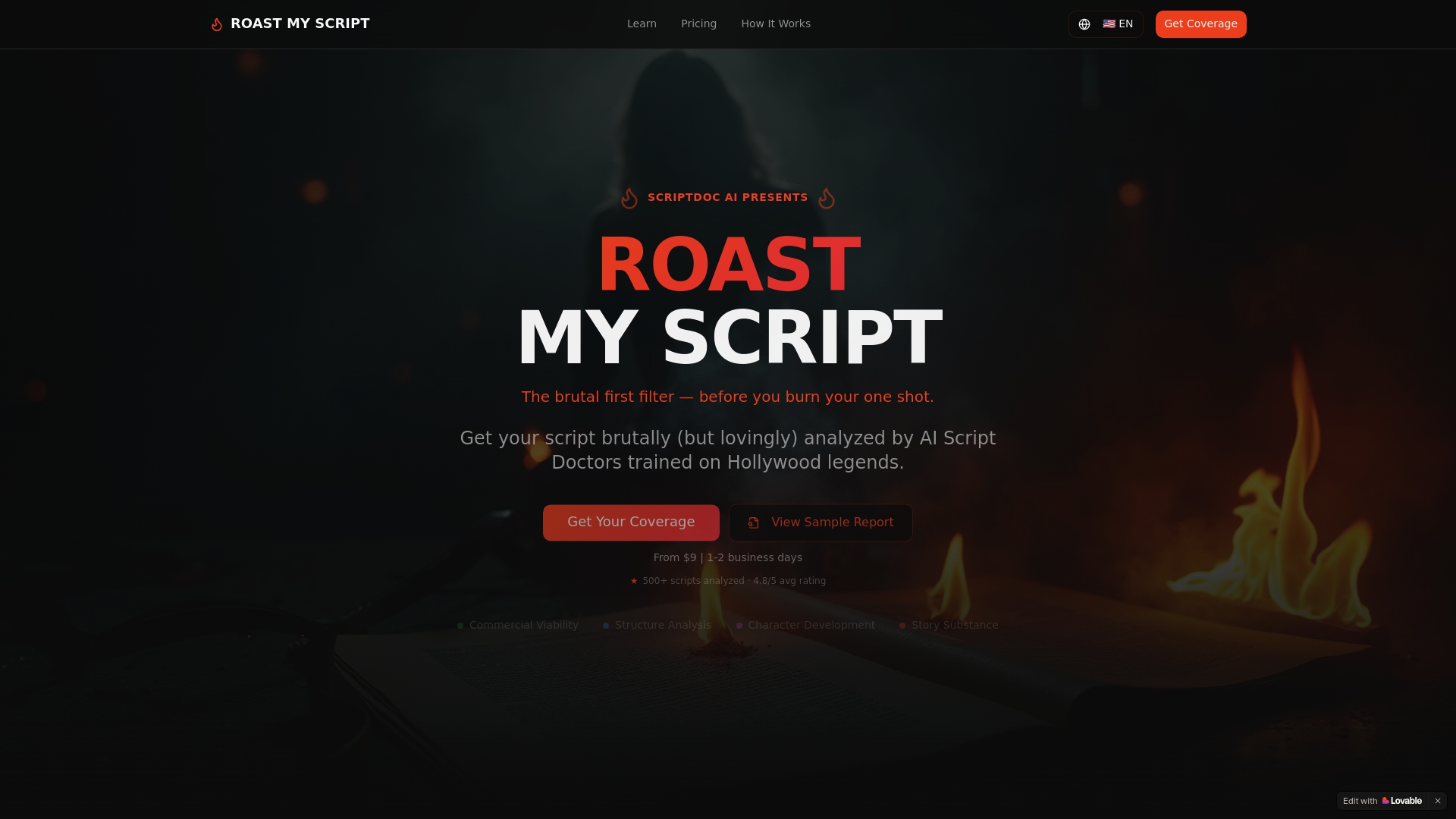
At Roast My Script, we built our analysis service specifically as the brutal first filter before you spend money on expensive coverage ($60-$400) or script doctors ($500-$1,500). For $9-$25, you get a structured PDF report based on Hollywood methodology (Syd Field, McKee, Save the Cat), delivered in 1-2 days by email. The report maps your script against the same checklist items covered in this article, flags structural gaps, and gives you actionable notes before your script reaches a human reader. Start by exploring how to master essential screenwriting concepts and strengthen your character dimensionality before your next draft.
Frequently asked questions
What is the most important item on a script structure checklist?
A clear inciting incident by page 15-20 anchors your story and sets up your protagonist's journey. Without it, readers disengage before Act 2 begins.
How long should my screenplay be for industry standards?
A professional feature screenplay is typically 90-120 pages, matching roughly one page per screen minute. Act proportions follow an approximate 25/50/25 split.
What's the difference between Three-Act structure and Save the Cat?
Three-Act divides the story into setup, confrontation, and resolution. Save the Cat uses 15 beats for more precise milestones with specific page targets, making it especially useful for commercial genre scripts.
Can a script succeed if it breaks structure rules?
Yes. Experimental structures work when their emotional logic is strong and the deviation is intentional. But checklists help you confirm that any rule-breaking is a choice, not an oversight.
What are common red flags on a script structure checklist?
The most frequent issues include late inciting incidents, sagging second acts, passive protagonists, and missing or unclear stakes. All of these are fixable once you identify them.
Recommended
- Master Story Structure Breakdown for Screenwriters | ROAST MY SCRIPT
- How to analyze a script for powerful screenplay improvement | ROAST MY SCRIPT
- Script format impact: 90% boost production & pitch success | ROAST MY SCRIPT
- Script Development Process: Preparing for Hollywood Success | ROAST MY SCRIPT
- Master your screenplay with the 2026 structure checklist