
TL;DR:
- Address common script flaws like pacing, structure, and dialogue through systematic analysis and targeted fixes.
- Use timing, formatting, and industry benchmarks to ensure your screenplay meets market standards before submitting.
- Embrace honest feedback and structural revisions to improve script quality and increase chances of success.
Fix script flaws with proven techniques: a screenwriter's guide
Your script stalls. A producer passes. A festival ignores your submission. The brutal truth is that most scripts fail not because the idea is weak, but because fixable flaws go unaddressed before anyone important reads them. Pacing issues, a sagging second act, verbose dialogue, inconsistent character arcs — these are not death sentences for your story. They are problems with known solutions. This guide gives you a clear, step-by-step workflow for spotting, fixing, and verifying every major type of script flaw so your screenplay meets industry standards and earns a genuine read.
Table of Contents
- Spot script flaws before they cost you
- Gather your script-fixing toolkit
- Step-by-step: Fix the flaws holding back your script
- Review, iterate, and verify your fixes
- Why most script advice skips the hardest part
- Ready to get expert eyes on your script?
- Frequently asked questions
Key Takeaways
| Point | Details |
|---|---|
| Spot mistakes early | Quick identification of script flaws saves time and makes revision more effective. |
| Use the right tools | Combining feedback, structure guides, and professional analysis ensures thorough fixes. |
| Follow expert steps | Address each flaw with proven techniques tailored to script structure and character depth. |
| Verify with benchmarks | Compare your script to industry standards to catch hidden problems before submission. |
| Embrace real feedback | Meaningful progress comes from honest critique and multiple revision cycles. |
Spot script flaws before they cost you
Having set the stage for what's at stake, let's zero in on the practical ways you can actually spot where your script needs work. Catching problems early is far cheaper — in time, money, and reputation — than submitting a flawed script and waiting for rejection to tell you something was wrong.
The most common red flags
Before you can fix anything, you need to know what to look for. Most script weaknesses fall into a predictable set of categories:
- Pacing slips: Scenes that feel slow, overstay their welcome, or repeat information already established.
- Saggy second act: The middle of your script loses momentum because there is no escalating pressure or clear structural spine.
- Inconsistent character arcs: Your protagonist behaves differently from scene to scene without any earned transformation.
- Verbose dialogue: Characters explain what the audience can already see or feel, killing subtext and pace.
- Formatting errors: Incorrect scene headings, overlong action blocks, or unconventional slug lines that signal amateur work to professional readers.
Analyzing your script systematically is the most reliable way to catch these issues before submission. The key is to look at each element in isolation, not just as part of the overall read.
Why timing matters: the page-per-minute rule
One of the most measurable indicators of script health is runtime. Industry readers operate on a clear expectation: one page equals roughly one minute of screen time. But the reality is more nuanced. Research shows that scripts average 1.1 pages per minute, meaning most scripts run about 9% longer than intended, with only 18% hitting a true 1:1 ratio.
This matters practically. A 115-page script might read like a 126-minute film, which is already long for a spec. If you're writing a thriller that should clock in at 95 minutes, submitting 110 pages signals to a reader that you haven't done the work of tightening your story.
| Script length | Expected runtime | Common actual runtime | Overage |
|---|---|---|---|
| 90 pages | 90 minutes | ~99 minutes | +9 minutes |
| 105 pages | 105 minutes | ~115 minutes | +10 minutes |
| 120 pages | 120 minutes | ~132 minutes | +12 minutes |
Pro Tip: Even minor formatting impact can distort your perceived page count. A single incorrect margin setting or an overlong action block can add three to five pages to a script that reads correctly in every other way. Fix your format before you fix anything else.
Gather your script-fixing toolkit
Once you know what needs fixing, it's time to choose the right tools and strategies for the job. Different flaws demand different solutions, and throwing generic advice at a structural problem rarely works.
Structure repair strategies
The second act is where most scripts collapse. A strong story structure breakdown will show you that the Act 2 sag almost always comes from one of three pattern failures: a weak midpoint, a missing thematic B-Story, or a crisis that lacks real stakes. The industry-tested fixes are specific:
- Midpoint false victory or defeat: Give your protagonist a major shift at the midpoint, either a false sense of winning or a devastating setback. This forces a strategy change that re-energizes the second half of Act 2.
- B-Story as thematic anchor: Your subplot should not just be a romance or a buddy relationship. It should directly reflect and challenge the main theme, keeping the audience emotionally invested when the A-Story plot mechanics get complicated.
- Pinch 2 flaw test and whiff of death: Around page 75, your protagonist's core flaw should be tested at its most extreme. There should be a real sense that failure is possible, what some writers call the Fix Saggy Second Act approach of using a "whiff of death" to raise the existential stakes just before the climax.
Choosing the right feedback
Different stages of revision call for different types of feedback. Here is a practical comparison:
| Feedback type | Best for | Cost range | Turnaround |
|---|---|---|---|
| Peer review | Early drafts, basic story logic | Free | Variable |
| AI script coverage | Structure, pacing, formatting | $9 to $25 | 1-2 days by email |
| Professional coverage | Market-ready polish | $60 to $400 | 1 to 2 weeks |
| Script doctor | Deep structural overhaul | $500 to $1,500 | Weeks |
For building dimensional characters, external feedback is especially valuable. Writers tend to see their characters through the lens of intention, meaning they know what a character is supposed to feel. Readers only see what's on the page. That gap is where inconsistency hides.
Pro Tip: The best feedback is feedback you didn't ask for. Ask your reviewer to flag moments where they felt bored, confused, or disconnected rather than asking them to evaluate craft elements. Honest emotional responses reveal structural problems more reliably than craft checklists alone.
Step-by-step: Fix the flaws holding back your script
With your toolkit in hand, let's move into the actionable sequence for resolving common and advanced script flaws. A structured approach works better than patching problems as you notice them.
Step 1: Diagnose before you rewrite
The single biggest mistake writers make is rewriting scenes before they understand what's causing the problem. A slow scene might feel like a dialogue problem when it's actually a structural problem. Fix the wrong thing and you waste weeks.
Start by categorizing each identified flaw into one of four buckets:
- Story structure: Issues with act breaks, turning points, midpoint, or climax placement.
- Character: Arcs that don't pay off, motivations that shift without justification, or protagonists who don't actively drive the story.
- Dialogue: Lines that are too long, too on-the-nose, or that repeat information already established visually.
- Formatting and pacing: Physical presentation issues, overlong scenes, or scenes that don't advance plot or character.
Step 2: Address structure first, then character, then dialogue
This sequence matters. If your structure is broken, fixing your dialogue is pointless because scenes may be cut entirely. If your character arcs aren't working, polishing individual lines won't help readers connect emotionally.
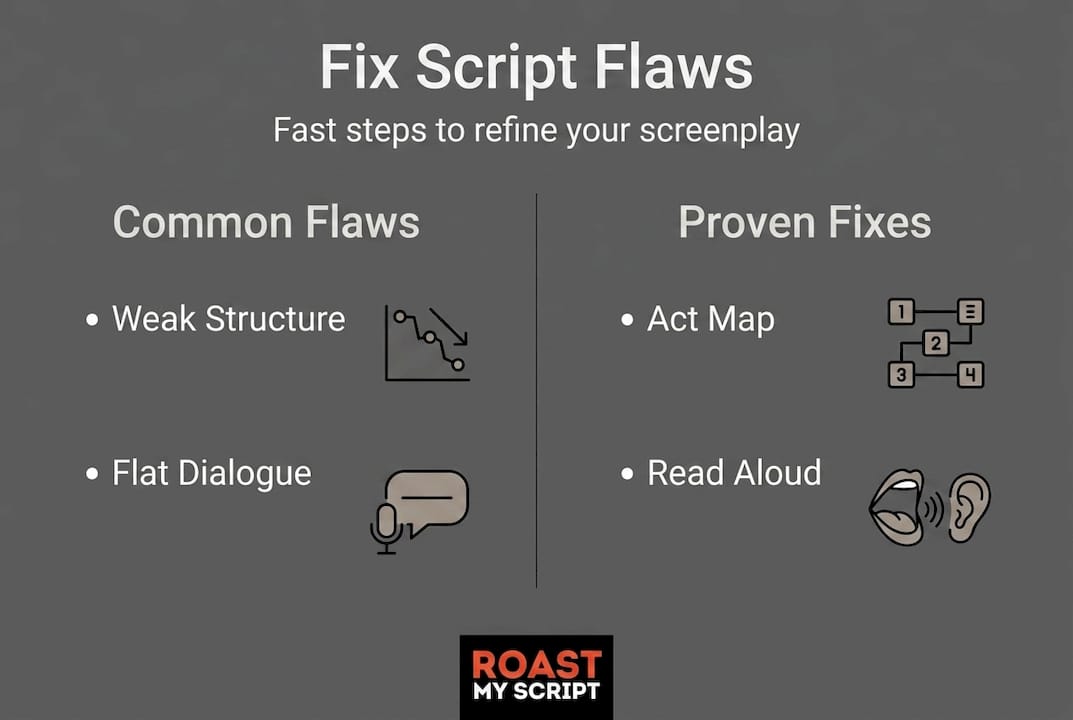
For structure fixes, work from the outside in. Map your act breaks first. Confirm your midpoint is actually at the midpoint. Then check your turning points. Only once the macro structure is sound should you move into scene-level work.
For dialogue, one of the most effective fixes is reading every line aloud. If you stumble, the line is probably too long or too formal. Research consistently shows that concise dialogue is directly linked to lower rejection rates, and verbal over-explanation is one of the most common reader complaints.
Step 3: Handle edge cases with nuance
Not every second act sags for the same reason. The pattern failure determines the fix. Research on the saggy second act identifies that different writers struggle with different structural weak points: some lose the midpoint, others skip the thematic layer entirely, and others simply fail to escalate stakes toward the crisis.
"The debate in the industry is not about whether your protagonist needs to be likable. It's about whether they need to be relatable. A flawed character who makes understandable choices can carry a story further than a likable one who simply reacts to events."
This distinction matters for how you approach character fixes at the Act 2 level. A passive protagonist is a structural flaw as much as a character flaw. Understanding the script development stages helps you know which version of the problem you're dealing with and which type of intervention is appropriate.
Review, iterate, and verify your fixes
Once you've enacted your fixes, the final step is ensuring they're effective and your script is ready for real-world scrutiny. Revision without verification is incomplete.
The assessment sequence
Use this three-stage review process after every major revision pass:
- Read aloud: This catches dialogue problems, pacing issues, and scenes that feel longer than they read silently. If you find yourself mentally skipping ahead, that is a scene that needs cutting.
- Peer review with fresh eyes: Send the script to someone who has not read a previous draft. Ask them to note every moment they lose interest, not just where they think you made a craft mistake.
- Break and return: Leave the script alone for at least a week after revisions. Coming back cold gives you the closest thing to a first-read experience, which is what every producer and festival reader brings to your script.
Data benchmarks and verification checklists
Verification is not just subjective. Use measurable benchmarks to confirm your script is within industry norms before submission.
| Check | Industry standard | How to verify |
|---|---|---|
| Script length | 90 to 115 pages for features | Page count in Final Draft or Fade In |
| Page-per-minute ratio | Target 1:1, expect ~1.1 | Divide estimated runtime by page count |
| Scene count | Typically 40 to 60 scenes for features | Scene breakdown in your writing software |
| Dialogue-to-action ratio | No universal rule, but flag heavy dialogue scenes | Highlight all dialogue blocks, assess visually |
| Act break placement | Act 1 ends ~pp. 25-30; Act 2 ends ~pp. 85-90 | Map on index cards or script outline |
Here is a critical data point worth repeating: scripts average 1.1 pages per minute, meaning a 9% overshoot is the industry norm. If your script is already tight, you have a real competitive edge over the majority of submissions. Most writers submit bloated scripts because they never run this check.
Once you've confirmed your structural fixes hold and your timing is within range, master story flow by running a full continuity pass. Check that every scene connects causally to the next, that each character's decisions follow logically from their established motivations, and that theme is consistent without being repetitive.
Verification checklist before submission:
- Act breaks land at correct page ranges
- Midpoint is clear and causes a strategy shift
- All character arcs have an identifiable start, midpoint test, and resolution
- No scene runs longer than three pages without a strong justification
- Dialogue has been read aloud and tightened
- Formatting has been checked against industry standard margins and sluglines
- Page count is within target range for the genre
Why most script advice skips the hardest part
Now that you know the workflow, let's talk openly about why meaningful improvement often doesn't come from shortcuts.
Most script advice focuses on technique: fix your midpoint, tighten your dialogue, cut your adverbs. That advice is correct, but it misses the harder truth. Applying a technique requires you to first admit that the current version of your script isn't working. That admission is harder than any rewrite.
I've seen writers apply every structural fix correctly and still resist the one change that would actually make the script work, because that change means abandoning a scene, a character, or an idea they love. Real improvement is not about knowing the techniques. It's about having the courage to use them on your own work without flinching.
AI coverage and peer feedback are useful tools, but they only work if you're genuinely open to what they reveal. The writers who improve fastest are not the ones with the most talent. They're the ones who treat every note as useful information rather than a personal verdict. You can read about how AI transforms scriptwriting and integrate every tool available, but adaptability and honesty about your own weaknesses are still the real differentiators. Industry expectations shift. Genres fall in and out of favor. What stays constant is the ability to look at your own work clearly and revise without ego.
Ready to get expert eyes on your script?
Armed with strategies and honest perspective, it's time to take real action on your own script.
At Roast My Script, we built our service specifically for writers at this stage: you know your script has potential, you've done the work, and now you need a structured, affordable analysis before you invest in expensive coverage or send it somewhere that matters. For as little as $9, you get a professional-grade PDF report in 1-2 days by email, built on proven Hollywood methodology including Syd Field, McKee, and Save the Cat.

Our analysis covers structure, character, pacing, dialogue, and market viability. It's designed to be the brutal first filter, the one that tells you exactly what needs fixing before the industry gets to weigh in. Start with our essential screenwriting concepts library to strengthen your foundation, then submit your script and get the honest feedback your story deserves.
Frequently asked questions
What is the fastest way to identify script flaws?
A script coverage service or structured peer review can quickly uncover pacing, formatting, and character issues before submission. Both approaches give you an outside perspective that self-editing cannot replicate.
How do professionals fix a saggy second act?
They use specific structural techniques such as midpoint reversals, strategy changes, and strong B-Story anchors to maintain engagement and pace through Act 2. The fix depends on which structural pattern failed first.
Does script length really matter for market success?
Yes. Producers expect scripts to match the page-per-minute timing industry standard, so a bloated script signals lack of self-editing and can hurt your read before the story even gets evaluated on its merits.
What's one overlooked source of script rejection?
Overly verbose dialogue is a leading but fixable cause of rejection. Research shows 42% of rejections are tied to verbosity, making dialogue tightening one of the highest-impact revisions you can make before submission.
Recommended
- Script Development Process: Preparing for Hollywood Success | ROAST MY SCRIPT
- Script format impact: 90% boost production & pitch success | ROAST MY SCRIPT
- How to analyze a script for powerful screenplay improvement | ROAST MY SCRIPT
- What is a script reader? A 2026 guide for screenwriters | ROAST MY SCRIPT