
Every screenwriter reaches that stage where refining structure becomes just as important as crafting dialogue. Whether you dream of selling your script to a major Hollywood studio or simply want to sharpen your story's impact, understanding the art of structural analysis is your first real step toward a script that stands out. By organizing your screenplay materials and breaking down key moments, you set the foundation for a story that flows, captivates, and meets industry standards.
Table of Contents
- Step 1: Gather Screenplay Materials for Analysis
- Step 2: Identify Key Structural Plot Points
- Step 3: Apply Hollywood Story Structure Frameworks
- Step 4: Test Script Flow for Narrative Cohesion
- Step 5: Verify Script Readiness Against Industry Standards
Quick Summary
| Key Point | Explanation |
|---|---|
| 1. Organize Materials for Analysis | Gather your screenplay, research notes, and previous feedback into a single folder for easy reference during script analysis. |
| 2. Identify Critical Plot Points | Pinpoint the inciting incident, midpoint, climax, and resolution to ensure your screenplay has a clear narrative structure. |
| 3. Apply Proven Story Frameworks | Employ established frameworks like the three-act structure to align your plot points to recognized industry standards and audience expectations. |
| 4. Test Script for Narrative Cohesion | Read your script aloud to catch pacing issues and ensure flow, marking any scenes that disrupt the story coherence. |
| 5. Verify Against Industry Standards | Ensure your script meets formatting, originality, character depth, and dialogue standards to enhance its readiness for submission. |
Step 1: Gather Screenplay Materials for Analysis
Before you can assess your script's structural strengths and weaknesses, you need to compile the raw materials that will inform your analysis. This step involves collecting reference materials, organizing your own screenplay draft, and ensuring you have everything ready for a thorough breakdown.
Start by gathering your current screenplay draft in its final or near-final form. Export it as a PDF or Word document so you can reference it easily throughout the analysis process. Make sure the formatting is clean and readable, as this affects how well you can track scene-by-scene progression and character arcs. You'll want to have page numbers visible, which helps when documenting specific structural issues.
Next, collect reference materials that informed your story. This includes research notes, character bios, story outlines, and thematic explorations you developed during the writing process. Screenplays are detailed blueprints that include scene settings, character actions, and dialogue, so having your foundational research organized helps you verify that these elements serve your story's core premise.
Gather any existing feedback you've received on earlier drafts. Include notes from writing groups, beta readers, or previous coverage if applicable. This context helps you identify patterns in what works and what doesn't.
Here's a quick comparison of screenplay feedback sources and their typical insights:
| Feedback Source | Typical Insights Provided | Strengths | Limitations |
|---|---|---|---|
| Peer Writing Groups | Story pacing, character arcs | Diverse perspectives, informal | May lack industry experience |
| Beta Readers | Emotional impact, engagement | Real audience reactions | Feedback can be subjective |
| Professional Coverage | Structure, market viability | Industry-aligned notes, detailed | Costly, requires industry access |
| Personal Notes | Story intent, thematic clarity | Direct from creator, context-rich | May miss objectivity or blind spots |
Organize these materials in a single folder or document for easy reference:
- Your screenplay draft (most recent version)
- Character development notes and backstories
- Story outline or beat sheet
- Reference materials used for research
- Any previous feedback or notes
- Logline and synopsis (if completed)
Having materials organized and accessible ensures you won't waste time hunting for context during analysis. You'll be able to cross-reference scenes, verify character consistency, and spot structural gaps more efficiently.
Organized materials speed up structural analysis and help you identify patterns that might otherwise get overlooked during the review process.
Pro tip: Create a simple one-page summary of your script's core conflict and character goals before analysis starts. This reference point keeps you focused on whether every scene moves the story forward toward resolving that central tension.
Step 2: Identify Key Structural Plot Points
Now that you have your materials organized, it's time to identify the critical turning points that shape your story. These plot points are the spine of your screenplay, the moments that propel the narrative forward and keep audiences invested in what happens next.
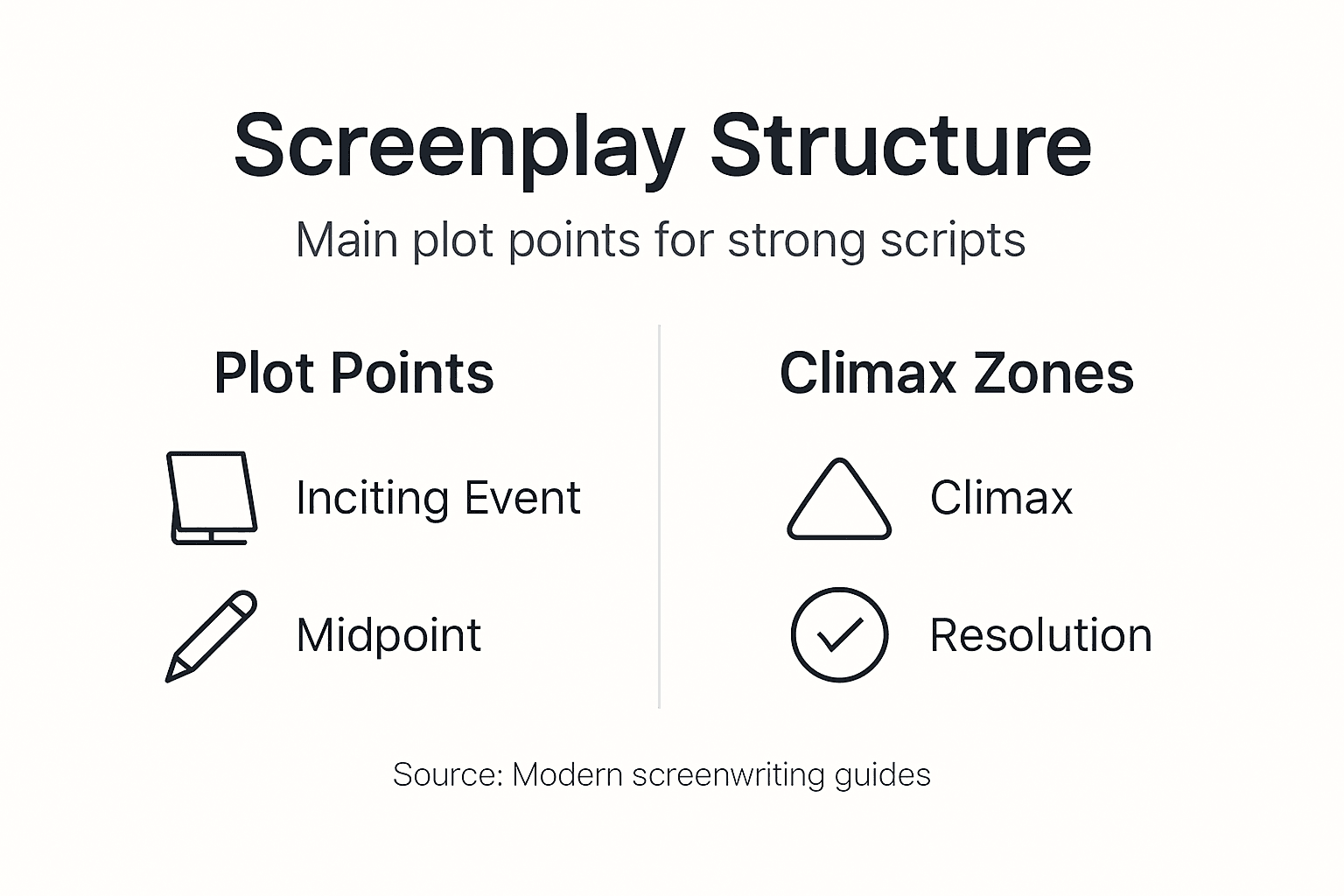
Start by pinpointing your inciting incident. This is the event that disrupts your protagonist's ordinary world and forces them into the central conflict. It typically occurs around page 10 to 15 in a feature screenplay. Without a clear inciting incident, your story lacks the catalyst that drives everything that follows.

Next, locate your midpoint. This is roughly the halfway point of your screenplay where the stakes intensify or the protagonist's understanding of the conflict deepens. The midpoint often raises the question: can the protagonist actually win? It shifts the energy and momentum of your story.
Then identify your climax, the moment where the protagonist faces their greatest challenge and the central conflict reaches its peak. This is where key beats and turning points converge, creating maximum tension and forcing a resolution.
Finally, mark your resolution or denouement, where the consequences of the climax play out and your story finds closure. This wraps up loose threads and shows how your protagonist has changed.
As you identify these points, ask yourself these questions:
- Does each plot point follow logically from the previous one?
- Are the transitions between major beats clear and motivated?
- Does the pacing between plot points feel appropriate to your story's genre?
- Do these moments reveal character change and thematic growth?
Map these four cornerstone moments on a simple timeline or beat sheet. Write one sentence describing each plot point and what it accomplishes in the story. This visual reference becomes invaluable when you assess whether your screenplay's structure actually works.
Strong plot points don't just happen by accident. They're deliberate story choices that control pacing, tension, and audience engagement throughout your screenplay.
Pro tip: Write down what your protagonist wants (external goal) and what they need (internal transformation) at the beginning of your screenplay. Then verify that your climax directly addresses both desires, forcing the character to choose between them.
Step 3: Apply Hollywood Story Structure Frameworks
With your plot points identified, it's time to map them onto proven structural frameworks that producers and studios recognize. These frameworks give your screenplay the architecture that audiences expect, even if they don't realize it.
The three-act structure remains the foundation of most commercial screenwriting. Act one introduces your world and inciting incident. Act two develops conflict and complications, building toward the midpoint where stakes escalate. Act three moves toward climax and resolution. This framework works across genres because it mirrors how audiences psychologically process stories.
Understand that Hollywood story frameworks aren't creative constraints. They're blueprints built from thousands of successful films. When you apply them strategically, they provide scaffolding for your unique story.
Below is a summary of major Hollywood story frameworks and their structural focus:
| Story Framework | Key Structure Elements | Typical Genre Usage |
|---|---|---|
| Three-Act Structure | Setup, confrontation, resolution | Most commercial features |
| Save the Cat | Beats, turning points, catalysts | Comedy, mainstream drama |
| Hero's Journey | Call, trials, transformation | Action, fantasy, adventure |
| McKee's Framework | Scene purpose, narrative flow | Drama, complex character studies |
Consider your screenplay's genre conventions. A thriller needs escalating tension and plot twists. A character-driven drama emphasizes internal transformation over external action. A romantic comedy follows different pacing rules than a horror film. Genre shapes how you deploy your plot points within the three-act structure.
Now overlay your identified plot points onto your chosen framework:
- Act One (0-30 pages): Establish character, world, and inciting incident
- Act Two A (30-60 pages): Complications rise, protagonist pursues goal
- Midpoint (around page 60): Major revelation or reversal increases stakes
- Act Two B (60-90 pages): Darker complications, protagonist struggles
- Act Three (90+ pages): Climax and resolution reveal character change
Check whether your plot points land approximately where the framework suggests. If your inciting incident occurs on page 25 instead of page 10 to 15, your act one may feel slow or under-developed. If your climax begins on page 95 in a 110-page script, you lack adequate resolution space.
This doesn't mean rigid adherence to page counts. Rather, it means understanding why pacing matters and whether your structure serves your story's emotional journey.
Frameworks guide structure without dictating story. The best screenplays bend rules deliberately, not accidentally.
Pro tip: Download or print a beat sheet template aligned with your chosen framework (three-act, Save the Cat, or McKee) and physically place your scenes on it. Visual mapping reveals gaps, redundancy, and pacing problems faster than any written analysis.
Step 4: Test Script Flow for Narrative Cohesion
Now it's time to verify that your screenplay actually flows as a cohesive whole. This step catches disconnects between scenes, reveals pacing problems, and ensures your thematic threads weave consistently throughout.
Start by reading your script aloud from beginning to end without stopping. This forces you to experience the actual rhythm and momentum your audience will feel. When you read, you notice awkward transitions, dialogue that sounds unnatural, and scenes that drag.
As you read, track scene-by-scene progression on a simple document. Write down what each scene accomplishes in one sentence. Does scene five advance the story, or does it repeat information from scene three? Are you introducing too many secondary characters in act two? Does the protagonist's behavior stay consistent with their established personality?
Analyzing scripts through reading and deconstructing screenplays reveals how effective narrative flow works in practice. Study how your favorite films transition between scenes, build tension, and deliver information.
Check for these specific flow problems:
- Repetitive exposition: Are you explaining the same plot point multiple times?
- Orphaned scenes: Do any scenes exist that don't serve the central conflict?
- Tonal whiplash: Do genre shifts feel earned or jarring?
- Character consistency: Would your protagonist actually make this choice in this moment?
- Thematic clarity: Do subplots reinforce or undermine your main story's message?
Mark problem areas directly on your script. Don't fix anything yet. Just identify where the flow breaks, where clarity fails, and where pacing stutters. This diagnostic pass is invaluable.
Once you've completed your analysis, step away for at least 48 hours. Fresh eyes reveal problems you missed during the initial read. Then return to address the gaps you identified.
Narrative cohesion isn't about having clever ideas. It's about every scene earning its place and moving the story forward.
Pro tip: Have someone unfamiliar with your script read it aloud while you listen without following along. Hearing your words spoken by another voice reveals dialogue problems and pacing issues you've become blind to.
Step 5: Verify Script Readiness Against Industry Standards
Before you submit your screenplay anywhere, you need to verify it meets professional industry benchmarks. This final verification step separates scripts that are ready from those that aren't yet polished enough for serious consideration.
Start with formatting compliance. Industry readers expect standard screenplay format: 12-point Courier font, one-inch margins, specific heading styles, and proper action line capitalization. A formatting error signals amateurism, even if your story is compelling. Check against the Academy's official formatting guidelines or use screenwriting software that enforces standards automatically.
Next, evaluate originality and concept strength. Does your premise feel fresh, or does it closely echo existing films? Producers receive dozens of pitches monthly. Your logline should immediately convey what makes your story different. If you struggle to articulate why your script stands apart, producers will too.
Assess character depth and motivation. Characters in professional scripts have clear desires, credible obstacles, and meaningful change. Assess whether format adherence, originality, character depth, and commercial viability reflect industry standards. Each main character should feel essential to the plot, not interchangeable.
Evaluate market positioning. Understand your screenplay's budget range, target audience, and comparable films. A period drama set in 1920s Vienna with fifty speaking roles won't appeal to streamers seeking low-budget content. Match your script to realistic markets based on scope and genre.
Use this checklist before submission:
- Professional screenplay formatting without errors
- Strong logline that emphasizes unique hook
- Character arcs with clear transformation
- Consistent tone appropriate to genre
- Pacing that respects audience attention
- Thematic depth beyond surface plot
- Dialogue that sounds authentic to each character
- Runtime appropriate to genre (100-120 pages typically)
If you identify gaps against these standards, your screenplay needs more development. Consider hiring a professional script analyst or submitting to a coverage service to catch issues before industry gatekeepers do.
A script that checks every technical and creative box doesn't guarantee success, but one that ignores industry standards guarantees rejection.
Pro tip: Print your final script and read it on paper with a pen in hand, marking every line that feels forced or unclear. Professional readers do exactly this, and physical reading catches problems digital screens miss.
Elevate Your Screenplay With Professional Structural Insights
Mastering story structure is crucial to crafting a screenplay that captivates and moves through Hollywood standards with confidence. This article highlights the challenge screenwriters face identifying clear plot points, pacing problems, and cohesive narrative flow using frameworks like the three-act structure and Save the Cat. If you find yourself struggling to test your script's flow, verify character arcs, or pinpoint key turning points before submission, you are not alone.
ROAST MY SCRIPT offers an affordable, fast solution to these exact pain points. Our AI-powered script analysis uses proven Hollywood methodologies from Syd Field, McKee, and Save the Cat to deliver a thorough structural breakdown in 1-2 days by email. With prices starting at just $9, you get professional reader-quality insights that help you identify structural weaknesses and pacing gaps before spending big on coverage or script doctors.
Get a detailed breakdown of your screenplay today and transform your draft into a market-ready script. Don't wait until you send your script out to producers or festivals to discover critical issues. Verify your story's foundation, strengthen your plot points, and polish your narrative flow now with professional structural analysis.
Take control of your script's success by submitting your screenplay to ROAST MY SCRIPT and receive actionable, professional feedback. This is the brutal filter every writer needs before going professional. Start improving your story structure today.
Frequently Asked Questions
How do I gather screenplay materials for my analysis?
To gather screenplay materials, start by compiling your current screenplay draft in a clean format, like a PDF or Word document. Then, collect reference materials, character bios, feedback notes, and any research you conducted to inform your story. Organize these into a single folder for easy access during your analysis.
What are the key structural plot points I should identify in my screenplay?
The four key structural plot points to identify are the inciting incident, midpoint, climax, and resolution. Each of these moments shapes the narrative and keeps audiences engaged. Map these points on a timeline or beat sheet to visualize their placement and ensure they support your story's flow.
How can I apply Hollywood story structure frameworks to my screenplay?
To apply Hollywood story structure frameworks, choose one that suits your screenplay, such as the three-act structure or Save the Cat. Then, overlay your identified plot points onto the chosen framework, ensuring each key moment aligns with its appropriate place in the structure, like establishing the inciting incident in Act One.
What steps can I take to test my script's flow for narrative cohesion?
Read your script aloud from start to finish to experience its rhythm and flow. Track what each scene accomplishes in one sentence, marking any areas where scenes feel repetitive or disconnected. This practice can reveal pacing issues and help ensure that every scene serves the story.
How do I verify my script meets industry standards before submission?
Start by checking the formatting of your screenplay to ensure it aligns with industry expectations. Then, assess your logline, character depth, and theme clarity, confirming that they resonate with your target audience and reflect originality. Use a checklist to ensure all aspects, like pacing and dialogue authenticity, meet professional benchmarks.