
TL;DR:
- Choosing the right screenwriting methodology depends on genre, story complexity, and writer experience.
- Syd Field’s three-act structure is ideal for mainstream, genre, or action scripts.
- McKee’s principles focus on story truth and character transformation, suitable for character-driven dramas.
Choosing a screenwriting methodology is one of the most consequential decisions you'll make before typing page one. The framework you pick shapes your story's pacing, character depth, and ultimately, how market-ready your script feels when a reader opens it. With options ranging from Syd Field's structural blueprint to Dramatica's analytic model, it's easy to get stuck comparing theories instead of writing. This guide cuts through the noise. We'll walk through the most influential frameworks, show you how they differ in practice, and help you identify which one (or which combination) gives your specific script its best shot at the industry.
Table of Contents
- How to evaluate screenwriting methodologies for your script
- Syd Field's Paradigm: The classic three-act structure
- Robert McKee's Story: Principles over formula
- Dramatica Theory: Mapping stories as problem-solving minds
- Choosing the right methodology for your next script
- What most writers miss when choosing a screenwriting framework
- Upgrade your script: Get actionable AI-driven coverage
- Frequently asked questions
Key Takeaways
| Point | Details |
|---|---|
| Framework choice matters | The right screenwriting methodology shapes story clarity, pacing, and market readiness. |
| Classic structures work | Paradigm and McKee’s story principles remain industry standards for a reason. |
| Analytical frameworks suit complexity | Dramatica’s model excels for scripts with intertwined themes or multiple protagonists. |
| Hybrid approaches are powerful | Blending methodologies—plus AI feedback—helps surface script weaknesses and amplify impact. |
How to evaluate screenwriting methodologies for your script
Before choosing a methodology, you need to know what you're optimizing for. Not every framework serves every story equally well. Picking the wrong one can lead to a script that feels forced, paced incorrectly, or structurally inconsistent in ways that are hard to pinpoint without outside feedback.
Screenwriting frameworks help writers address structure, pacing, and emotional impact. But how you apply them depends on several factors specific to your project.
Here's what to assess before committing to a methodology:
- Genre and tone: High-concept action thrillers respond well to tight three-act structures. Character-driven dramas may benefit from McKee's organic approach. Genre heavily influences which framework feels natural.
- Story complexity: A single-protagonist story with a linear timeline is easier to manage using Field's Paradigm. Multi-threaded ensemble stories often need a more analytic system.
- Character focus: If revealing character psychology is your central goal, prioritize frameworks that emphasize arc and inner conflict over page-count milestones.
- Commercial vs. personal goals: Scripts aimed at mainstream studio pitches benefit from conventional structural clarity. Festival-oriented or prestige projects can afford more experimentation.
- Your experience level: Beginning writers often benefit from concrete structural rules before breaking them intentionally.
AI-driven tools are also changing how writers test and refine these choices. You can now run a draft through an story structure breakdown tool and get real structural feedback before investing months in rewrites.
Pro Tip: If you're early to mid-career, start with a classic structure to build instinct. Advanced writers who already understand the rules can experiment more effectively with analytical frameworks like Dramatica.
Syd Field's Paradigm: The classic three-act structure
Now that you know the criteria, let's see how classic structures work in practice.
Field's Paradigm is the most widely taught screenwriting framework in the world, and for good reason. It gives you a clear, repeatable blueprint that translates directly to what script readers and development executives expect to see. Field's Paradigm divides a feature script into Setup, Confrontation, and Resolution, with precise page breakdowns and structural milestones.
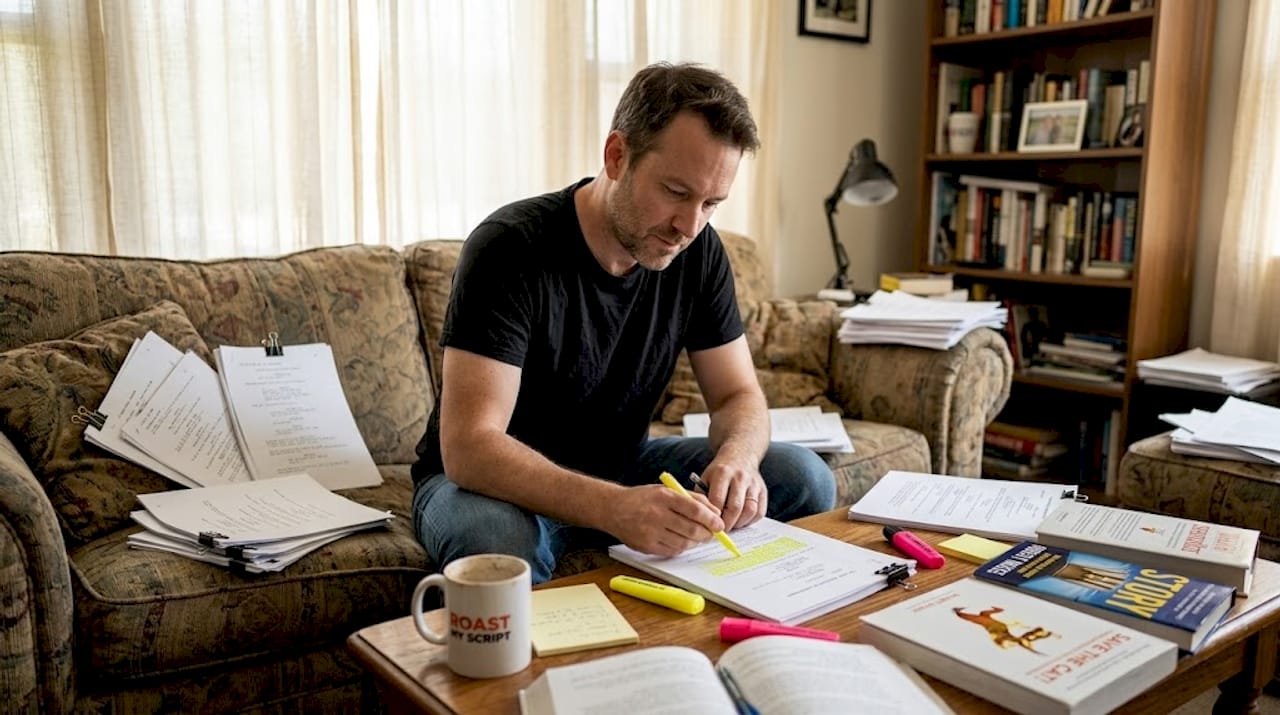
For a standard 110-page script, here's how it breaks down:
| Act | Pages | Function |
|---|---|---|
| Act 1: Setup | Pages 1-25 | Establish world, character, and stakes |
| Act 2: Confrontation | Pages 25-85 | Escalating conflict and character pressure |
| Act 3: Resolution | Pages 85-110 | Climax and emotional payoff |
Key structural milestones within this model include:
- Inciting Incident: Near page 10-12, the event that disrupts the protagonist's world
- Plot Point 1: Around page 25, spins the story into Act 2
- Midpoint: Page 55, a major shift that raises the stakes significantly
- Plot Point 2: Around page 85, pushes the protagonist into the final act
Roughly 80% of professional spec scripts still follow a three-act structure in some form. That number reflects the framework's staying power in Hollywood's development culture.
Pro Tip: If you're submitting to agents or production companies, using Field's Paradigm makes your script easier to evaluate. Readers can quickly locate turning points and assess pacing, which means faster, cleaner feedback from our structure breakdown guide.
Robert McKee's Story: Principles over formula
While Field's approach is structural, McKee offers a philosophy rooted in story integrity.
McKee's Story is not a template. It's a deep examination of what makes a story function at the level of truth. Where Field gives you page counts, McKee gives you principles. McKee emphasizes timeless story principles and deep character revelation over purely structural beats.
His central argument: story is about change. A character must be transformed by the events of the narrative, and that transformation must feel earned through genuine conflict. McKee uses films like Casablanca to illustrate how structure emerges organically from story needs, not from a blueprint imposed on top.
Core McKee concepts every screenwriter should know:
- Turning Points: Moments that shift the story's direction by reversing the value charge of a scene (from positive to negative or vice versa)
- Scene Design: Every scene must turn, or it shouldn't be there
- Character Revelation: Pressure, not exposition, reveals who a person truly is
- Gap: The distance between expectation and result, which drives audience engagement
"What happens is fact, not truth. Truth is what we think about what happens." — Robert McKee
For screenwriters, this philosophy is clarifying. It pushes you beyond "does this hit the right page?" to "does this scene actually mean something?" You can explore this approach further through script analysis techniques that apply McKee's logic to real draft problems. Interestingly, the same principles of story structure basics apply even across mediums, including how storytelling in music uses tension and release to connect with audiences.
Dramatica Theory: Mapping stories as problem-solving minds
Theories evolve. Dramatica brings analytical depth for nontraditional stories.
Dramatica is unlike any other framework on this list. It doesn't think of a story as a sequence of events. It thinks of a story as a mind solving a problem. Dramatica models a story as four throughlines, specifically Overall, Main Character, Impact Character, and Relationship, to address dramatic argument in depth.
Here's how to begin applying Dramatica to your script:
- Identify the four throughlines for your story: the overall story problem, your protagonist's personal struggle, the influence character's perspective, and the relationship dynamic between them
- Assign characters to dramatic functions rather than archetypes (e.g., the Protagonist pursues, the Antagonist avoids)
- Map the dramatic argument your story is making, which theme or question it is exploring through all four lenses simultaneously
- Balance all four throughlines across your acts so each gets development
Here's a comparison of the three frameworks at a glance:
| Framework | Focus | Flexibility | Learning Curve |
|---|---|---|---|
| Syd Field | Structure and page timing | Low to moderate | Low |
| Robert McKee | Story principles and character | Moderate to high | Moderate |
| Dramatica | Analytic, thematic depth | Very high | High |
For analyzing scripts with Dramatica, the payoff is substantial for complex stories, but the learning investment is real. Pair it with AI script analysis to quickly identify where your throughlines break down before spending weeks on rewrites. A solid script development overview can help you contextualize where Dramatica fits in your overall workflow.
Pro Tip: If you're writing an ensemble film, a nonlinear story, or a script where multiple characters share equal narrative weight, Dramatica gives you a system to track complexity that Field and McKee simply weren't designed for.
Choosing the right methodology for your next script
You've seen the frameworks. Here's how to find your perfect fit.
Different frameworks suit different genres, goals, and writing styles. The good news is you don't have to pick just one.
Here's a quick guide to matching framework to story type:
- Use Field's Paradigm for genre films, action, thriller, comedy, and anything aimed at a mainstream studio audience. It gives readers what they expect and makes your pacing easy to assess.
- Use McKee's approach for character-driven dramas, prestige TV pilots, and any story where emotional truth matters more than plot mechanics.
- Use Dramatica for ensemble casts, nonlinear narratives, or stories built around complex thematic arguments.
- Hybridize when your story doesn't fit neatly. Many successful scripts use Field's structure as the skeleton and McKee's principles to build the scenes within it.
| Story Type | Recommended Framework |
|---|---|
| Action or thriller | Syd Field's Paradigm |
| Character drama | McKee's Story principles |
| Ensemble or nonlinear | Dramatica |
| Hybrid or experimental | Combination approach |
AI tools can be a practical shortcut here. Rather than guessing whether your structure is working, you can get direct feedback that maps your draft against these methodologies. Pay attention to your script genre selection early, since genre expectations heavily influence which structural signals readers are looking for. Strong dialogue tips also vary by framework, since McKee-influenced scripts prioritize subtext while Field-aligned scripts often benefit from more direct, propulsive exchanges.
What most writers miss when choosing a screenwriting framework
Here's something I've noticed working with scripts across genres: most writers who resist frameworks aren't protecting their creativity. They're avoiding the discomfort of honest structural self-assessment.
Frameworks don't limit creative vision. When understood well, they give you the freedom to break rules intentionally, which is very different from breaking them by accident. A script with structural problems doesn't feel "free." It feels off, and readers notice even when they can't articulate why.
The real breakthrough comes when you stop treating frameworks as a checklist and start using them as diagnostic tools. Hybridizing elements from Field, McKee, and Dramatica lets you pressure-test your story from multiple angles. And pairing that with AI in scriptwriting means you can surface hidden weaknesses before spending money on professional coverage. The writers who improve fastest are the ones who get honest feedback early, apply a framework deliberately, and treat the first draft as a structural experiment worth analyzing.
Upgrade your script: Get actionable AI-driven coverage
Ready to apply what you've learned? Here's the next step.
You upload your script, and within 1-2 days by email, you get a detailed PDF covering structure, pacing, character arcs, and market readiness, all mapped against the same Hollywood methodologies we've covered here. It's the brutal filter before you send your script anywhere expensive. If you want to go deeper, master essential screenwriting concepts through our learning resources, or work through character dimensionality before your next draft. Get your AI script coverage today.
Frequently asked questions
How do I know which screenwriting methodology is best for my story?
Consider your genre, story complexity, and writing experience. Different frameworks suit different genres, so classic structures like Field's Paradigm fit most commercial scripts, while analytic frameworks like Dramatica suit layered or experimental narratives.
Do professional screenwriters always use these frameworks?
Most professionals rely on these methodologies as foundations but adapt or blend them based on the material and their personal workflow. Field's Paradigm and McKee's principles are considered foundational across the industry.
What is the main advantage of Dramatica Theory?
Dramatica offers a detailed model to track story themes and character relationships simultaneously, making it especially powerful for ensemble or multi-threaded scripts. Dramatica models a story as four throughlines that each address a distinct dramatic perspective.
Can AI tools help me apply these screenwriting methodologies?
Yes. Modern AI script analysis highlights structural weak spots and flags where your draft may not align with your chosen framework. AI tools offer affordable, actionable script coverage that makes professional-level feedback accessible at a fraction of the cost of traditional coverage.
Recommended
- Master Story Structure Breakdown for Screenwriters | ROAST MY SCRIPT
- How to analyze a script for powerful screenplay improvement | ROAST MY SCRIPT
- Script Development Process: Preparing for Hollywood Success | ROAST MY SCRIPT
- Explain screenplay genres to elevate your scripts in 2026 | ROAST MY SCRIPT
- How to revise a screenplay for stronger storytelling