TL;DR:
- Script doctors are expert screenwriters hired to diagnose and fix specific problems in existing scripts quickly under tight deadlines. They focus on scenes, structure, and character consistency, often working during production to salvage or improve films at risk of failure. Their high rates reflect the urgency and specialized skill involved, highlighting the value of outside perspective in refining screenplays.
Most people assume a screenplay has one author. That assumption is wrong. Behind some of the most celebrated blockbusters in Hollywood history, a small group of highly skilled writers worked quietly in the background, rewriting scenes, fixing structure, and salvaging projects that were weeks away from catastrophe. These are script doctors, and their influence on the films you love is far greater than the credits suggest. This article breaks down exactly what they do, how much they earn, and what their methods mean for your own screenplay.
Table of Contents
- Defining the script doctor: What do they actually do?
- Script doctor in action: Famous cases and real-world examples
- Production timelines and last-minute fixes: Why script doctors are indispensable
- How script doctors are compensated: The economics behind the role
- The uncomfortable truth about script doctoring: Why most screenwriters need outside help
- Ready to level up your screenplay? Affordable script analysis for every writer
- Frequently asked questions
Key Takeaways
| Point | Details |
|---|---|
| Script doctors fix crucial story issues | Studios bring in script doctors to solve problems with dialogue, structure, and pacing under tight deadlines. |
| Top writers often go uncredited | Many script doctors remain behind the scenes, only credited for major rewrites per WGA rules. |
| Compensation is lucrative and project-based | Established script doctors can earn tens of thousands per week, with pay driven by urgency and complexity. |
| Rapid fixes impact production outcomes | Script doctors step in during development and filming, helping studios save time and improve quality. |
| Affordable analysis options exist for all writers | Professional script feedback is now accessible, helping every screenwriter prepare for industry success. |
Defining the script doctor: What do they actually do?
Script doctors are experienced screenwriters hired specifically to fix problems in existing scripts. They are not brought in to write from scratch. Their job is to diagnose what is broken and repair it fast, often under serious time pressure.
The term itself is a good description of the function. Like a surgeon called into an emergency room, a script doctor assesses the patient, identifies the damage, and performs targeted interventions. The goal is not a complete replacement but a focused fix that saves the overall project.
Core responsibilities
Script doctors are typically called in to handle one or more of the following:
- Dialogue rewrites. Flat, unnatural, or on-the-nose lines get replaced with sharper, more character-driven exchanges. Understanding dialogue's impact on scripts is a core competency every script doctor brings to the table.
- Structural overhauls. Act breaks that don't land, midpoints that have no weight, and third acts that collapse are common targets.
- Pacing corrections. Scenes that run too long or sequences that feel inert get trimmed or restructured.
- Character consistency. Motivations that shift without logic, arcs that stall, and relationships that contradict themselves all need surgical attention.
- Punching up scenes. Adding tension, humor, or emotional resonance to scenes that technically work but don't engage.
How they differ from standard writers and editors
Script doctors are not editors in the literary sense. They do not track grammar or style. They work at the story and scene level, asking whether a sequence achieves its dramatic purpose. They also differ from the original screenwriter in that they have no emotional ownership of the material, which is exactly why they are effective.
| Role | Primary focus | Credit? | Rewrites from scratch? |
|---|---|---|---|
| Original screenwriter | Full story creation | Yes | Yes |
| Script doctor | Targeted problem-solving | Rarely | No |
| Story editor | Story development notes | No | No |
| Copy editor | Grammar, formatting | No | No |
Pro Tip: If you want to understand what a script doctor actually looks for, study script analysis techniques before you submit your work to anyone. The vocabulary alone will sharpen how you see your own structural problems.
The credit question
This is one of the most misunderstood aspects of the profession. Script doctors are often uncredited because WGA rules require a writer to have contributed more than 33% of an adaptation to receive credit. Most script doctor engagements are deliberately scoped to stay under that threshold, which is how studios get the improvements they need while managing credit arbitrations. The writers doing this work are some of the most sought-after names in the industry. They simply do not appear on the poster.
Script doctor in action: Famous cases and real-world examples
The abstract definition only tells part of the story. The real picture comes from looking at specific projects where script doctor interventions changed the final film.
Iconic interventions
Consider these well-documented script doctoring examples from Hollywood:
| Film | Script doctor | Key contribution |
|---|---|---|
| Jurassic Park | David Koepp | Added human drama and emotional stakes to the creature concept |
| Rogue One | Tony Gilroy | Rewrote and reshot the entire third act |
| Speed | Joss Whedon | Rewrote most of the dialogue |
| Hook | Carrie Fisher | Punch-up and tonal adjustments |
| Sister Act | Carrie Fisher | Character and dialogue revisions |
| Lethal Weapon 3 | Carrie Fisher | Script fixes and dialogue polish |
What stands out about these cases is the specificity of each intervention. Tony Gilroy was not rethinking the entire mythology of Rogue One. He was solving a structural problem: the third act did not deliver on the promise of the story. That kind of targeted clarity is what separates script doctors from general rewrites.
What the data says about story impact
Studios invest heavily in script doctors precisely because script problems are expensive to discover late. A weak third act identified during production costs infinitely more to fix than one caught in development. Consider how Joss Whedon's dialogue work on Speed helped create some of the most quotable exchanges in action film history, none of which were in the original draft.
"The difference between a good movie and a great one is often a single rewrite by the right person at the right time." This is the reality studios have accepted, even if audiences never see the seams.
The lessons from these examples apply directly to your own work. If seasoned professionals with decades of credits needed outside voices to fix structural and tonal problems, the idea that your script is ready after a single pass is worth questioning honestly.
What script doctors look for first
When a script doctor opens a screenplay, they typically run through a fast triage process:
- Read the logline and first ten pages. Does the premise work? Is the protagonist established clearly? Is there a compelling problem?
- Identify act breaks. Does the story turn at the right moments? Are those turns driven by character choice or plot convenience?
- Assess dialogue economy. Are characters saying what they mean too directly? Is subtext doing its job? Does each character have a distinct voice?
- Flag pacing dead zones. Where does the reader disengage? Which scenes carry no consequence?
- Check character motivation consistency. Does every major decision feel earned based on what we know about the character?
Understanding how your script format impacts a reader's first impression is relevant here too. Script doctors work faster when the material is professionally formatted, because formatting signals craft and respect for the reader's time.
Production timelines and last-minute fixes: Why script doctors are indispensable
Here is where the role becomes genuinely dramatic. Script doctors are not always hired during comfortable pre-production planning. Sometimes they are called in when cameras are already rolling.

Emergency rewrites during production
Rewrites during production and post-production under tight deadlines, including cases where entire new acts are written in days, are a real and recurring part of the script doctor's world. John Sayles, one of the most respected writer-directors in independent film, stepped in to overhaul the script for Mimic while the film was actively shooting. That is not a hypothetical. That happened.
The economics of production make this make sense. A major studio film costs anywhere from $50 million to $300 million to produce. If a script problem is identified three weeks into a six-week shoot, the cost of bringing in a script doctor for two weeks is trivial compared to the cost of completing a film that does not work. A $200,000 fix on a $150 million film is essentially free insurance.
How script doctors perform under pressure
Speed and objectivity are the two qualities studios pay for above everything else. A script doctor who needs six months to deliver a rewrite is useless in production. The skill set that makes script doctors valuable is the ability to rapidly identify the single change that will fix the most problems with the least disruption to what is already working.
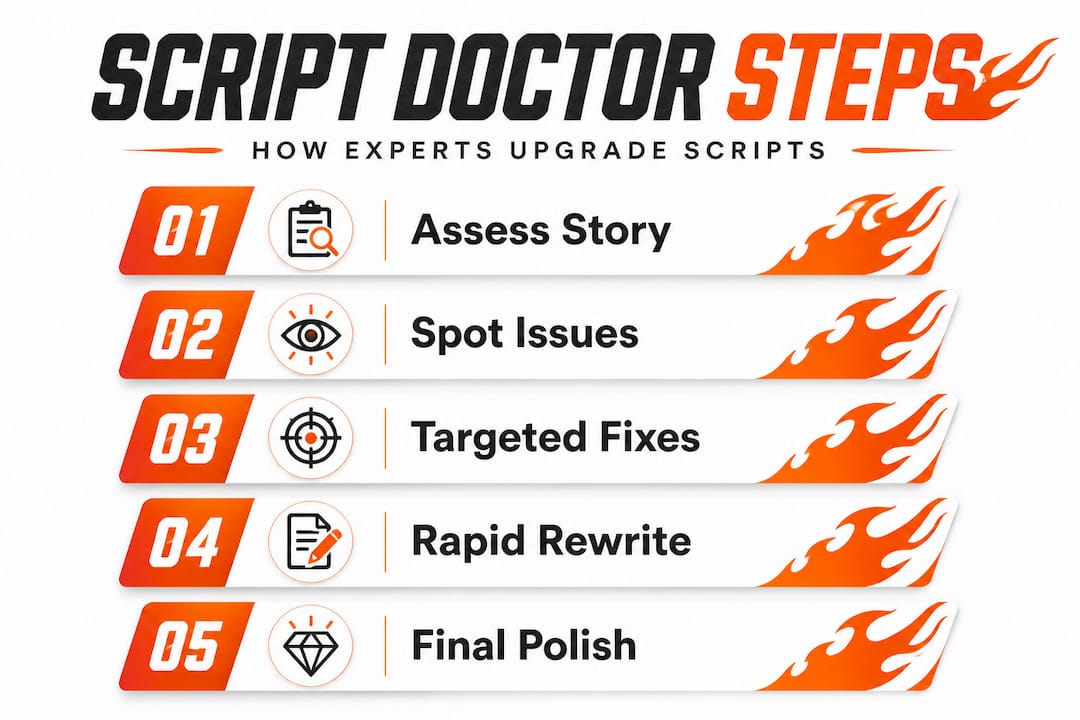
Here is a simplified version of how rapid production rewrites typically work:
- Briefing. The script doctor is given the current script, a breakdown of what is already shot, and a clear statement of the problem.
- Fast diagnosis. Within 1-2 days by email, the script doctor delivers an assessment of the core issue and a plan.
- Targeted rewrite. New pages are written for specific scenes, not the whole script.
- Director and producer review. Pages are refined through quick feedback rounds.
- On-set delivery. Final pages reach the cast and crew in time for shooting.
Pro Tip: This five-step triage process is actually a useful model for your own revision practice. Force yourself to identify the single biggest structural problem before you try to fix everything at once. Understand the script development process end to end, and you will spot your own problems faster.
How script doctors are compensated: The economics behind the role
The pay structure for script doctors is one of the most striking aspects of the profession. These are not salaried employees. They are hired for specific engagements, and the rates reflect the urgency and specialized skill involved.
What top script doctors earn
The numbers are significant. Top script doctors command $100,000 per week, with no fixed salary since work is entirely project-based. For established screenwriters, this makes script doctoring one of the most lucrative applications of their craft.
Why so high? Several factors drive the premium:
- Speed. Delivering quality rewrites in days instead of months is a rare skill.
- Objectivity. The ability to enter a project without emotional investment and make clear-eyed decisions is genuinely difficult.
- Reputation. Studios need to know the doctor's previous work. A proven track record justifies the rate.
- Confidentiality. Script doctors often sign non-disclosure agreements and work without public recognition, which commands additional compensation.
- Problem-solving under pressure. Emergency rewrites during production carry a premium similar to any other on-call professional service.
For context, talent agencies that work with top writers often negotiate these engagements as flat deals rather than weekly rates, especially when the scope is unclear at the start.
"The best script doctors are paid well because they solve problems that cheaper alternatives cannot. You are not paying for words on a page. You are paying for the diagnosis."
This economic reality matters for working screenwriters because it frames the value of professional feedback at every level. If studios willingly spend $100,000 a week on outside perspective, the argument for paying nothing for feedback on your own script does not hold up.
The uncomfortable truth about script doctoring: Why most screenwriters need outside help
Here is the honest reality, and it is one that most screenwriting advice avoids saying clearly: you cannot objectively evaluate your own screenplay. This is not a criticism. It is a structural problem with how human creativity works.
When you write something, you fill in the gaps with your intentions. You know what you meant by a scene, so you cannot see when the scene fails to communicate that meaning on the page. You know your character's internal logic, so you do not notice when the script fails to externalize it. Your proximity to the material is, by definition, a blind spot.
This is exactly why studios do not rely on original screenwriters to fix their own work. Not because those writers lack talent, but because fresh eyes see things the original author simply cannot. Carrie Fisher was a brilliant writer. David Koepp is one of the most commercially successful screenwriters in history. Joss Whedon built entire television universes. They were still brought in to fix other people's work because outside perspective has a different kind of clarity.
Here is the practical application: if you are waiting until your script is perfect before showing it to anyone, you are waiting for something that will never arrive. The script does not become perfect in isolation. It becomes better through structured external feedback applied at the right moments in the revision process.
For most screenwriters, affordable script analysis is the accessible version of that outside perspective. You may not have a $150 million production budget justifying a $100,000-a-week script doctor. But the underlying need is identical: you need someone who is not you to tell you what is actually on the page.
The writers who resist feedback are the ones who stay stuck. The ones who actively seek it, before pitching, before festivals, before submitting anywhere, are the ones who improve fastest.
Ready to level up your screenplay? Affordable script analysis for every writer
Script doctors exist because even the best scripts need outside eyes. That principle applies at every level of the industry, not just for studio tentpoles.

At Roast My Script, we built our service around exactly that principle. For $9 to $25, you get a professional-grade structural analysis of your screenplay delivered within 1-2 days by email, based on the same Hollywood methodology that script doctors use: Syd Field, McKee, Save the Cat. Think of it as the brutal first filter before you pay for expensive coverage or pitch to a producer. Before you invest more time revising in isolation, start with screenwriting essentials and let objective analysis tell you exactly where your script stands. Your next draft will be stronger for it.
Frequently asked questions
Does a script doctor receive screen credit?
Script doctors are usually uncredited unless they rewrite over 33% of an adaptation, per WGA rules. Most engagements are deliberately scoped to stay below that threshold.
Are script doctors only hired for big studio films?
While famous cases involve major movies, script doctors also help indie films and TV series when scripts need urgent improvement. The budget scale differs, but the structural problems are often identical.
Can script doctors rewrite scripts during production?
Yes, rewrites during production and even while shooting are common. The job specifically exists to handle situations where problems surface too late for standard development timelines.
How much do script doctors earn?
Top script doctors earn up to $100,000 per week, with compensation varying based on project scope, urgency, and the writer's track record. Pay is always project-based, never salaried.
Should I hire a script doctor or get professional analysis instead?
Most screenwriters benefit most from affordable script analysis services first, which provide fast, expert structural feedback at a fraction of Hollywood prices. Script doctors make sense once a project is already in production with significant budget at stake.