
Many screenwriters treat script coverage and script doctoring as interchangeable services. They are not. Choosing the wrong one at the wrong stage can cost you hundreds of dollars and weeks of wasted effort. Coverage provides hands-off notes and analysis, while script doctoring involves direct, hands-on rewriting. That single distinction changes everything about when, why, and how you should use each service. This guide breaks down both options clearly so you can make a smart, budget-conscious decision for your script right now.
Table of Contents
- Script coverage explained
- What does a script doctor do?
- Script doctor vs coverage: Key differences
- When to choose coverage, when to choose a script doctor
- Maximizing value: Combining coverage and script doctoring
- Get expert guidance for every draft
- Frequently asked questions
Key Takeaways
| Point | Details |
|---|---|
| Coverage is hands-off | Expect professional notes and analysis, not actual rewriting. |
| Script doctors collaborate | They rewrite and elevate your script, especially after strong coverage. |
| Choose based on script stage | Early drafts benefit from coverage, while polished scripts may need doctoring. |
| Use both for best results | A smart sequence—coverage then doctoring—saves money and improves results. |
Script coverage explained
With the misconception addressed, let's clarify what script coverage truly involves.
Script coverage is a professional reader's written report on your screenplay. It does not change your script. Instead, it gives you an outside perspective on what is working and what is not, delivered as a structured document you can act on yourself.
Understanding what script coverage means is the first step to using it effectively. A standard coverage report typically includes:
- Logline: A one or two sentence summary of your story's core premise
- Synopsis: A condensed retelling of your script's plot, usually one to two pages
- Strengths and weaknesses: Specific notes on concept, structure, character, dialog, and pacing
- Rating: A pass, consider, or recommend verdict that signals market readiness
- Recommendations: Actionable suggestions the writer can use to revise independently
Coverage is the go-to tool for early drafts, film competition submissions, and production company submissions. It is fast, relatively affordable, and gives you a clear diagnosis before you invest more time or money. AI-powered coverage has made this even more accessible, with turnaround times of 1-2 days by email at a fraction of traditional costs.
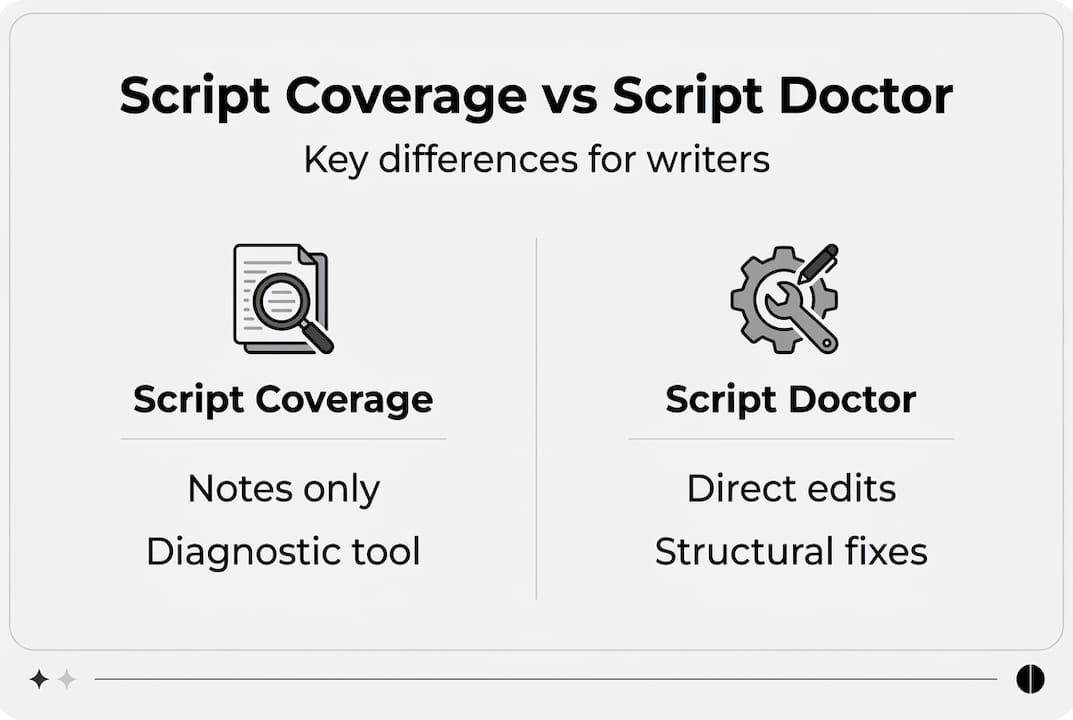
The key thing to remember: coverage is hands-off. The reader offers notes, but you do the rewriting. That is by design. It preserves your voice while giving you the information you need to improve your script toward a market-ready structure.
What does a script doctor do?
Now, let's look at the more involved alternative: the script doctor.
A script doctor is a hired expert who works directly on your screenplay. Script doctoring involves hands-on rewriting, which means they may restructure acts, rewrite dialog, sharpen character arcs, or fix pacing issues by actually editing the pages themselves.
Here is what a script doctor typically does:
- Structural overhaul: Rebuilds weak act breaks, midpoints, or climaxes that are not landing
- Dialog polish: Rewrites flat or on-the-nose lines to sound natural and character-specific
- Character work: Strengthens motivations, arcs, and relationships across the script
- Narrative tightening: Cuts scenes, combines characters, or reorders sequences for better flow
- Collaboration: Works with you to preserve your vision while elevating the execution
Script doctors are often brought in after coverage has already identified deep structural problems. They are also used when a script is close to production and needs a final polish to meet industry standards. The cost reflects the labor involved. Rates typically range from $500 to $1,500 or more depending on the scope of work.

Pro Tip: Before hiring a script doctor, ask for a sample edit or a brief consultation call. A good doctor will want to understand your vision before touching a single page. If they skip that step, that is a red flag.
For writers who want to explore AI tools for script improvement before committing to a script doctor, there are now affordable options that can simulate some of the diagnostic work at a much lower cost.
Script doctor vs coverage: Key differences
Understanding both roles, let's break down where each shines.
The key difference is simple: coverage tells you what is wrong, and a script doctor helps fix it. But the practical implications of that difference are significant when it comes to cost, timeline, and what stage your script should be at.
| Feature | Script coverage | Script doctor |
|---|---|---|
| Approach | Hands-off (notes only) | Hands-on (direct edits) |
| Cost range | $9 to $200 | $500 to $1,500+ |
| Turnaround | 1-2 days by email (ROAST MY SCRIPT); up to 5 days for other services | 1 to 4 weeks |
| Best stage | Early to mid draft | Mid to late draft |
| Writer involvement | Writer revises independently | Collaborative process |
| Output | Written report with notes | Revised or polished pages |
| Risk level | Low (affordable to repeat) | Higher (significant investment) |
The guide to script feedback makes it clear: coverage is a diagnostic tool, while script doctoring is a treatment. You would not skip the diagnosis and go straight to surgery. The same logic applies here.
Coverage is also repeatable. You can run multiple drafts through coverage at low cost to track your progress. Script doctoring is a one-time, targeted investment that makes the most sense when your script already has a solid foundation.
When to choose coverage, when to choose a script doctor
So, how do you know which fits your needs right now?
The answer depends on where your script is in its development and what you are trying to achieve. Here is a practical framework:
- You are on draft one or two: Get coverage. You need a diagnosis, not surgery. Coverage will surface the biggest structural and conceptual issues at a cost you can afford to repeat.
- Your coverage rating is 'Pass': Revise on your own first. Coverage for early drafts is specifically designed for this stage. A script doctor cannot save a script that has not been through basic revision.
- Your coverage rating is 'Consider': This is the signal. Your script has real potential. Now a script doctor can take it from good to great without wasting effort on foundational problems.
- You have a production deadline or pitch meeting: A script doctor makes sense here. Time pressure and high stakes justify the investment when your script is already in solid shape.
- You are entering competitions: Coverage is your best tool. It mirrors the evaluation process judges use and helps you improve your logline and premise before submission.
Pro Tip: Never hire a script doctor for a first draft. It is the most common and costly mistake writers make. Coverage first, always.
Script doctoring preserves writer vision but is a larger budget item. Reserve it for scripts that have already shown promise through coverage feedback.
The logic is straightforward. Coverage is your filter. It tells you whether your script is ready for the next level of investment. Skipping it means paying premium rates to fix problems you could have identified for a fraction of the cost.
Maximizing value: Combining coverage and script doctoring
To wrap up, here is how to get the most out of both services without wasting resources.
The most effective path is sequential. Use coverage first, revise based on the notes, then consider a script doctor only when your script has earned a stronger rating. Script doctoring is best post-coverage because the doctor can focus on elevation rather than triage.
Here is the step-by-step process that works:
- Submit for coverage: Get your first objective read. Note every issue flagged in the report.
- Revise independently: Address the structural, character, and dialog notes on your own. This is where you grow as a writer.
- Get a second round of coverage (optional): If you made major changes, a second coverage pass confirms whether the revisions landed. This is affordable and worth it.
- Hire a script doctor: Once your coverage rating reaches 'Consider' or higher, bring in a doctor for targeted polish. Focus their work on the specific areas the coverage identified as remaining weaknesses.
- Final proofread and format check: Before any submission, review script formatting tips to make sure your pages meet industry standards.
A real scenario: A writer submits a thriller on draft three and receives a 'Pass' with notes on a weak second act and unclear protagonist motivation. They revise, tighten the midpoint, and rewrite the protagonist's backstory. On the second coverage pass, the script earns a 'Consider.' They then hire a script doctor for two weeks to polish the dialog and sharpen the climax. The result is a script that is genuinely competitive.
This process maximizes both affordability and outcomes. You are not throwing money at a broken script. You are investing strategically at each stage.
Get expert guidance for every draft
Ready to take your script further? Whether you are diagnosing a first draft or preparing for a serious pitch, having the right feedback at the right stage makes all the difference.
Roast My Script provides affordable, AI-powered coverage starting at $9, with professional structural analysis delivered in 1-2 days by email. It is built to be the brutal first filter before you spend money on expensive coverage or a script doctor. If you want to go deeper, the platform also offers educational resources including a screenwriting concept toolkit and a detailed guide to master character development that can help you address the most common issues flagged in coverage before you even submit. Smart writers use every tool available. Start with the most affordable one.
Frequently asked questions
Is script coverage worth it for new writers?
Yes. Coverage provides hands-off notes that give new writers objective, structured feedback at an affordable price point, making it ideal for early drafts and building revision skills without a large financial commitment.
Can I skip script coverage and go straight to a script doctor?
It is not recommended. Script doctoring is best post-coverage because doctors work most efficiently when foundational issues have already been identified and addressed, so your investment goes toward polish rather than basic fixes.
How much does script coverage cost compared to hiring a script doctor?
Script coverage typically ranges from $9 to $200 depending on the service, while script doctors generally charge $500 to $1,500 or more for significant rewrites, making coverage the far more accessible starting point for most writers.
What if my coverage recommends 'Pass'?
A 'Pass' rating means your script needs more revision before any further investment. Coverage for early drafts is designed to surface exactly these issues so you can fix them yourself before spending money on a script doctor.
Recommended
- What is script coverage? Your 2026 guide to expert feedback | ROAST MY SCRIPT
- Roast My Script | AI Script Coverage & Analysis from $9
- Roast My Script | AI Script Coverage & Analysis from $9
- Roast My Script | AI Script Coverage & Analysis from $9
- Why use sample coverage: get pro script feedback in 2026