
Many screenwriters struggle to transform their initial ideas into well-structured, market-ready scripts. Without a clear roadmap, even talented writers find themselves stuck in endless rewrites or submitting scripts with fundamental structural flaws. This guide walks you through a proven, step-by-step approach to story development that will help you craft compelling screenplays with confidence. By following these actionable steps, you'll build a solid foundation, execute your vision effectively, and refine your work to professional standards that capture attention in Hollywood and festival circuits.
Table of Contents
- Key takeaways
- Preparing your story development foundation
- Step-by-step execution of story development
- Common pitfalls and how to avoid them
- Verifying and refining your script before submission
- Streamline your story development with expert script coverage
- Frequently asked questions
Key Takeaways
| Point | Details |
|---|---|
| Structured preparation | Successful screenplay development relies on organized upfront work including clear concept, well defined characters, and a solid story architecture. |
| Clear concept and stakes | Distill your idea into a single sentence that captures the core conflict and what matters to the audience. |
| Dimensional characters | Build protagonist and supporting characters with clear desires, believable flaws, backstory, and meaningful growth that drive the plot. |
| Verification and polish | Assess your script with critical analysis, using traditional methods and emerging AI tools to identify weaknesses before submission. |
Preparing your story development foundation
Before you type a single scene, you need a rock-solid foundation. This preparation phase determines whether your screenplay will resonate with audiences or collapse under its own weight. Start by clarifying your story concept with laser focus on what makes it original and why your target audience will care. A vague concept leads to unfocused writing, so distill your idea into a single sentence that captures the essence of your story's conflict and stakes.
Next, develop dimensional characters who feel like real people rather than plot devices. Use frameworks like Linda Seger's character spine approach to build depth through backstory, psychology, and transformation arcs. Your protagonist needs clear desires, believable flaws, and meaningful obstacles that force growth. Supporting characters should each serve specific functions in advancing plot or theme while maintaining their own authentic voices and motivations.
Understanding story structure basics is non-negotiable. Familiarize yourself with acts, sequences, and turning points that create narrative momentum. Whether you follow three-act structure, Save the Cat beat sheets, or alternative frameworks, you need a roadmap for pacing revelations and escalating tension. Mastering essential screenwriting concepts is critical for market success, giving you the vocabulary and tools to communicate with industry professionals.
Gather your development tools before diving in. Consider these essential resources:
- Outline software or index cards for organizing scenes and story beats
- Character worksheets to track arcs, relationships, and motivations
- Reference scripts in your genre to study formatting and pacing conventions
- Trusted peer readers or writing groups for early feedback
- Script analysis resources to evaluate your work objectively
This preparation work might feel tedious, but it prevents the frustration of realizing halfway through your draft that your premise doesn't support a full screenplay. Invest time upfront to clarify your vision, and the actual writing becomes significantly easier.
Step-by-step execution of story development
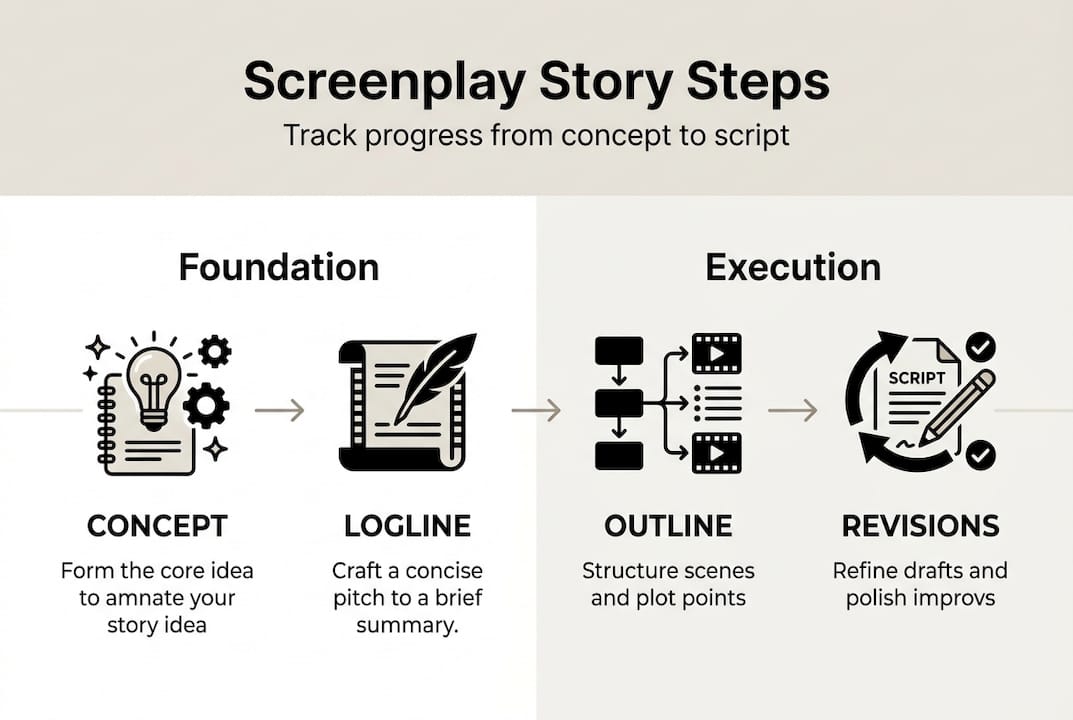
With your foundation in place, you're ready to execute the actual story development process. Begin with logline and premise refinement to anchor your story focus. Your logline should identify your protagonist, their goal, the central conflict, and what's at stake in 25 words or less. Test it on friends who aren't writers. If they can't immediately grasp what your story is about, keep refining until the core concept shines through clearly.
Create a step outline listing major scenes and story beats in chronological order. This isn't a detailed treatment yet, just a skeleton showing how your story moves from opening image to final resolution. Number each beat and write one or two sentences describing what happens and why it matters to character development or plot progression. This outline becomes your compass when you're deep in drafting and lose perspective on where the story needs to go next.
Develop character arcs aligned with plot progression so internal and external journeys reinforce each other. Map how your protagonist changes from beginning to end, identifying specific scenes where transformation occurs. Pinpoint the moment they commit to their goal, face their deepest fear, and emerge changed. Supporting characters should have mini-arcs that intersect meaningfully with the main storyline, creating a rich tapestry of human experience rather than a single thread.

Draft detailed scenes integrating dialogue and action with equal attention. Write in master scene format, focusing on what we see and hear rather than internal thoughts or camera directions. Let dialogue reveal character through subtext and conflict rather than exposition dumps. Action lines should be crisp and visual, painting pictures that directors and actors can translate to screen. Resist the urge to over-explain or direct the reader's interpretation.
Revise iteratively to address pacing, conflict, and thematic clarity. Your first draft exists to be rewritten. Read through looking specifically for sagging middle sections where momentum stalls, scenes that don't advance story or character, and dialogue that feels on-the-nose. Understanding story structure breakdown improves screenplay coherence and production readiness, helping you identify exactly where adjustments are needed.
Follow this execution sequence:
- Draft your logline and test it with multiple readers for clarity
- Build a beat sheet with 40 to 60 major story moments
- Expand beats into a detailed scene-by-scene outline
- Write a vomit draft focusing on completing the story without self-editing
- Revise for structure, ensuring proper setup, confrontation, and resolution
- Polish dialogue for authenticity, subtext, and character voice
- Tighten action lines to be visual, specific, and economical
- Read aloud to catch awkward phrasing and pacing issues
Pro Tip: Schedule your writing sessions consistently rather than waiting for inspiration. Treat story development like a job with regular hours, even if you can only commit to 30 minutes daily. Consistency builds momentum and keeps your story world vivid in your mind, reducing the time spent reorienting yourself each session.
The script development process is inherently iterative. Don't expect perfection in early drafts. Focus on getting your story down, then systematically improve it through targeted revisions that address specific craft elements one at a time.
Common pitfalls and how to avoid them
Even experienced screenwriters fall into predictable traps during story development. Recognizing these pitfalls helps you sidestep them and maintain forward momentum. Overloading scripts with verbose or redundant dialogue dilutes impact and slows pacing to a crawl. Excessive dialogue verbosity causes nearly half of screenplay rejections, underscoring the importance of precise writing. Every line should reveal character, advance plot, or both. If dialogue merely restates what action already showed, cut it ruthlessly.
Neglecting character consistency harms emotional engagement and makes your story feel amateurish. Track character voices, motivations, and knowledge carefully throughout your script. A character shouldn't suddenly possess skills or information they couldn't logically have, and their speech patterns should remain recognizable. Create character sheets noting specific phrases, verbal tics, and communication styles to maintain consistency across 100+ pages.
Ignoring script format reduces production and pitch success because it signals unprofessionalism before anyone reads a word of your story. Master industry-standard formatting for scene headings, action lines, character names, dialogue, parentheticals, and transitions. Use proper screenplay software like Final Draft, WriterDuet, or Highland to automate formatting so you can focus on storytelling rather than margins and fonts.
Rushing through revisions misses critical story flaws that undermine your screenplay's potential. Many writers finish their first draft and immediately start querying, but professional scripts typically go through five to ten revisions before they're truly ready. Build in cooling-off periods between drafts so you can approach your work with fresh eyes and greater objectivity about what's working and what needs rethinking.
Overcomplicating plot causes audience confusion and dilutes thematic focus. While intricate storylines can be compelling, every subplot and twist must serve the central narrative. Ask whether each plot thread meaningfully connects to your protagonist's journey or core theme. If a storyline exists merely because it's clever or cool, consider cutting it to strengthen your main narrative spine.
Watch for these warning signs:
- Characters explaining things to each other they both already know
- Scenes that don't change the status quo or reveal new information
- Backstory dumps interrupting present action and momentum
- Coincidences resolving major conflicts rather than character choices
- Thematic messages stated explicitly instead of dramatized through action
Pro Tip: Create a reverse outline after completing your first draft by summarizing what each scene accomplishes in one sentence. This reveals whether every scene earns its place in your screenplay or if some are redundant, off-theme, or dramatically inert. Scenes that don't advance story or character should be cut or combined with others.
As legendary screenwriter William Goldman observed:
"Nobody knows anything. Not one person in the entire motion picture field knows for a certainty what's going to work. Every time out it's a guess and, if you're lucky, an educated one."
This humility should guide your revision process. Stay open to feedback, trust your instincts about what serves your story, and remember that even experienced professionals constantly learn and adapt their craft.
Verifying and refining your script before submission
Once you've completed multiple revision passes, it's time to verify your screenplay meets professional standards before sending it into the world. Use manual script analysis to spot structural and character weaknesses that you've become blind to through familiarity. Read your script as if you're a producer deciding whether to invest millions in production. Does the opening grab attention immediately? Do character arcs pay off satisfyingly? Is every scene essential?
Incorporate AI-based tools for fast, objective coverage feedback that reduces costs dramatically. AI-assisted script analysis reduces costs by 75% while improving coverage quality, making professional-grade feedback accessible to writers at all budget levels. These tools identify structural issues, pacing problems, and character inconsistencies with speed and consistency that complement human insight.
Compare traditional and AI methods to optimize your revision cycles. Traditional script coverage from industry readers costs $60 to $400 per screenplay and takes one to three weeks, but provides nuanced understanding of market positioning and subjective reader response. AI analysis delivers results in 1-2 days by email for $9 to $25, offering objective structural assessment based on proven screenplay principles. The smart approach combines both: use AI for quick identification of technical issues, then invest in human coverage for market-readiness evaluation.
| Analysis Method | Cost Range | Turnaround Time | Best For |
|---|---|---|---|
| Traditional Coverage | $60-$400 | 1-3 weeks | Market positioning, subjective appeal |
| AI Analysis | $9-$25 | 1-2 days by email | Structure, pacing, format issues |
| Script Consultant | $500-$1,500 | 2-4 weeks | Deep story problems, career guidance |
| Peer Feedback | Free | Variable | Fresh perspectives, blind spots |
Iterate based on feedback focusing on clarity, pacing, and emotional impact. Not all feedback deserves implementation, so evaluate suggestions against your story's core vision. If multiple readers identify the same issue, take it seriously even if you initially disagree. Look for patterns in feedback rather than reacting to every individual comment. Prioritize changes that strengthen your protagonist's journey, sharpen conflict, and clarify stakes.
Prepare your final draft adhering strictly to industry script formatting standards. Double-check that scene headings are properly formatted with INT./EXT., location, and time of day. Verify character names are consistently capitalized in dialogue blocks and action lines on first appearance. Ensure page count aligns with genre expectations: 90 to 110 pages for features, with one page roughly equaling one minute of screen time. Proofread meticulously for typos, as errors undermine your professionalism.
Before submitting anywhere, conduct these final verification steps:
- Run spell-check and grammar tools, then read aloud to catch errors software misses
- Verify all character names are spelled consistently throughout
- Check that scene numbers are removed unless specifically requested for production
- Confirm your title page includes only title, author name, and contact information
- Export to PDF to preserve formatting across different systems
- Test that your PDF opens correctly and displays properly on multiple devices
Leverage script analysis techniques to systematically evaluate your work against industry benchmarks. Professional readers assess scripts on concept originality, structural soundness, character development, dialogue quality, pacing, and market viability. Score yourself honestly in each category, then focus revision energy on your weakest areas.
The verification phase separates amateur submissions from professional ones. Investing time in thorough analysis and refinement exponentially increases your chances of getting past the first page and securing genuine consideration from agents, managers, producers, and festivals.
Streamline your story development with expert script coverage
Developing a compelling screenplay requires dedication, craft knowledge, and objective feedback at critical stages. While this guide provides a roadmap, getting expert eyes on your work accelerates improvement and helps you avoid common pitfalls that lead to rejection. That's where professional script coverage becomes invaluable for writers serious about market success.

Roast My Script offers AI-driven script coverage starting from $9, delivering professional-grade analysis in 1-2 days by email. You'll receive detailed feedback on structure, character development, dialogue, pacing, and market viability based on proven Hollywood methodologies from Syd Field, Robert McKee, and Save the Cat. This objective assessment identifies exactly where your screenplay needs strengthening before you invest in expensive traditional coverage or pitch to industry gatekeepers.
Access comprehensive learning resources to master essential screenwriting concepts that give you competitive advantage in crowded markets. Understanding craft fundamentals transforms your writing from intuitive to intentional, helping you make informed creative choices that serve your story. Save time and costs with technology-enhanced analysis that sharpens your screenplay's market readiness without breaking your budget. Think of it as the brutal filter before sending your script anywhere that matters, catching structural problems early when they're easiest to fix.
Frequently asked questions
What is the first step in story development?
The first step is refining your story concept into a clear, compelling logline that defines the story's core conflict, protagonist, and stakes in one sentence. This foundation guides all subsequent development decisions. Focus on originality and audience appeal to ensure your concept can sustain a full screenplay and differentiate itself in competitive markets.
How can AI tools improve script development?
AI tools provide objective feedback to identify plot holes, pacing issues, and character inconsistencies early in development. This technology significantly reduces analysis costs by 75% compared to traditional coverage while streamlining revision cycles. AI excels at structural assessment based on proven screenplay principles, though human readers still offer superior insight into subjective market positioning and emotional resonance.
What common mistakes should I avoid during story development?
Avoid verbose dialogue that restates what action already shows, inconsistent character voices and motivations, and neglecting industry-standard script formatting. Ensure thorough revision through multiple drafts rather than submitting your first pass. Maintain plot clarity by cutting subplots that don't serve your central narrative, and resist resolving conflicts through coincidence rather than character choice.
How many revisions does a professional screenplay typically require?
Professional screenplays typically undergo five to ten substantial revisions before reaching market-ready quality. Each revision pass should target specific craft elements like structure, character arcs, dialogue, pacing, or format rather than trying to fix everything simultaneously. Build cooling-off periods between drafts to approach your work with fresh perspective and greater objectivity about what needs improvement.
Should I use three-act structure or alternative frameworks?
Three-act structure remains the industry standard because it mirrors natural story progression and audience expectations, but alternative frameworks like Save the Cat, sequence approach, or five-act structure can work equally well. Choose the framework that best serves your specific story and helps you organize narrative momentum effectively. Understanding multiple approaches gives you flexibility to apply the right tool for each project rather than forcing every story into identical templates.
Recommended
- Master Story Structure Breakdown for Screenwriters | ROAST MY SCRIPT
- Script Development Process: Preparing for Hollywood Success | ROAST MY SCRIPT
- How to analyze a script for powerful screenplay improvement | ROAST MY SCRIPT
- Script format impact: 90% boost production & pitch success | ROAST MY SCRIPT
- What is story development? Expert guide for screenwriters