
Staring at a blank page or a rough draft can feel overwhelming for aspiring screenwriters aiming for Hollywood or top festivals. The real challenge is not just writing, but understanding core screenwriting principles that separate professional scripts from amateur attempts. With affordable AI-driven coverage now available, you can pinpoint structural flaws and formatting issues before your script faces industry readers. This guide helps you master script development fundamentals while avoiding common pitfalls that sabotage submissions.
Table of Contents
- Script Development Fundamentals and Misconceptions
- Key Stages in Crafting a Screenplay
- Hollywood Methodologies and Industry Standards
- Affordable AI Coverage Versus Traditional Options
- Mistakes to Avoid Before Pitching or Submission
Key Takeaways
| Point | Details |
|---|---|
| Screenwriting is a Learnable Craft | Success in screenwriting is achieved through understanding story structure and disciplined practice, rather than innate talent. |
| Revision is Essential | Multiple drafts and revisions are necessary to refine your script, addressing structural, character, and dialogue issues. |
| Professional Format Matters | Proper formatting is crucial in Hollywood, as it demonstrates professionalism and ensures your script is taken seriously. |
| Identify and Fix Key Issues Early | Use AI feedback for early drafts to catch structural problems, and consider professional insights for final revisions before submission. |
Script Development Fundamentals and Misconceptions
Screenwriting isn't magic. It's a craft built on learnable principles, and that changes everything about how you approach your script.
Most aspiring writers believe one of two myths: either screenwriting requires innate talent you're born with, or learning the "rules" will kill creativity. Both are false.
Writing is a skill developed through discipline, not inherited talent. The professionals who break into Hollywood didn't wake up knowing story structure—they studied it, applied it, and rewrote their scripts repeatedly until they worked.
What Actually Matters in Script Development
Three foundational concepts separate scripts that get read from scripts that get rejected.
Story structure gives your screenplay a backbone. This doesn't mean following a formula blindly. It means understanding how audiences engage with narrative—where tension builds, where characters transform, where emotional payoffs land.
Character development creates people audiences care about. Your protagonist needs wants, obstacles, and reasons to change. Without this, dialogue falls flat and plot feels mechanical.
Audience engagement is the third pillar. Every scene serves the story forward. Every piece of dialogue reveals character or moves plot. Filler distracts from your message.
Common Misconceptions Holding You Back
Here's what screenwriters get wrong most often:
"My script is good—it just needs one more pass." One pass never fixes structural problems. You need feedback and multiple revisions targeting different layers (plot, character, dialogue).
"Good dialogue means realistic dialogue." Real conversation is boring. Effective screenplay dialogue is filtered reality that reveals character while advancing story.
"If I follow the three-act structure, I'm being formulaic." Structure is not formula. It's architecture. You can build wildly different stories using the same framework.
"Rewrites mean my first draft was bad." Rewrites mean you're a professional. Every produced screenplay went through dozens of drafts.
Professional screenwriters rewrite. Repeatedly. The writers who skip revision are the ones whose scripts stay in drawers.
The Real Work Begins After Draft One
Your first draft is discovery. You're learning who your characters are, how your plot works, what your story actually says.
That draft isn't your screenplay—it's your foundation. The real screenplay emerges through revision cycles where you fix structure, deepen character arcs, and sharpen dialogue.
This is where tools like core screenwriting principles become invaluable. Understanding story structure, character development, and audience engagement before rewriting saves you months of guessing.
Think of it this way: a carpenter doesn't measure once. They measure, cut, test, adjust, and refine. Your script needs the same precision.
Pro tip: Identify one structural problem in your script (weak midpoint, unclear character goal, sagging second act), fix only that in your next revision, then get feedback. Fixing everything at once creates more problems than it solves.
Key Stages in Crafting a Screenplay
Screenwriting follows a predictable path from idea to finished script. Understanding each stage prevents wasted effort and keeps you moving forward.
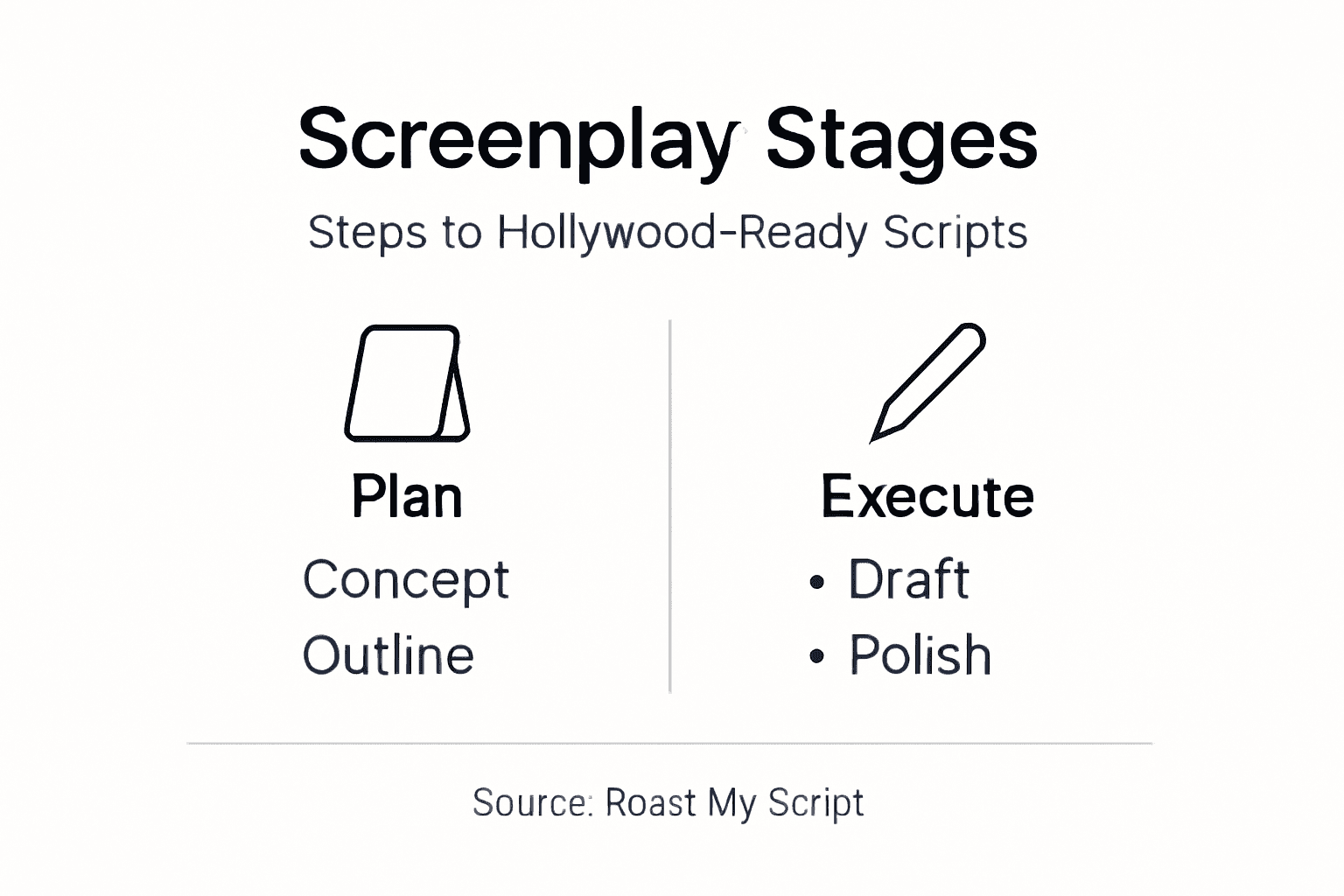
Most writers jump straight to writing dialogue without building a foundation. That's why their scripts feel scattered. The stages aren't optional—they're the scaffolding that holds your story together.
Stage 1: Concept Development
Your concept is the DNA of your screenplay. It answers one question: what is this story about in one sentence?
This isn't your logline yet. It's simpler. It's the core idea—a detective who solves crimes using his dead partner's memories, a single mother training for the Olympics, a tech startup that turns dark.
Spend time here. A strong concept can survive weak execution. A weak concept can't survive anything.
During this stage, you define your genre, identify your audience, and clarify why this story matters. You're testing whether your idea can support 90+ pages.
Stage 2: Story Structure and Outline
Now you map your story. This is where screenplay development and structure become essential frameworks for organizing your narrative.
You don't need a 40-page outline. A solid one-page breakdown works: setup, inciting incident, midpoint, all-is-lost moment, climax, resolution.
Your outline should show:
- Act breaks and turning points
- Major plot events in sequence
- Character arc progression
- Emotional beats that matter
The outline prevents you from writing 60 pages into Act Two only to realize your plot doesn't work. It's protection.
Stage 3: First Draft
Write fast. Don't edit. Your job is getting the story on the page, not making it perfect.

Many writers slow down here, rewriting scenes obsessively. That kills momentum. Write the whole thing first, then fix it.
Stage 4: Structural Revision
Now you fix the skeleton. Does your midpoint land correctly? Is your climax satisfying? Do characters change meaningfully?
Don't touch dialogue yet. Don't polish sentences. Fix the foundation.
Stage 5: Polish and Refinement
With structure solid, refine character voice, dialogue, scene descriptions, and pacing.
Every screenplay goes through these stages in some form. Skipping any of them costs you weeks of rework later.
Pro tip: Finish your outline before writing Act One. A solid outline saves you from major rewrites and keeps your first draft focused on story, not structure.
Hollywood Methodologies and Industry Standards
Hollywood doesn't care about your creative vision if your script looks unprofessional. Format matters because readers scan scripts at speed, and formatting errors signal amateurism.
Industry standards exist for one reason: consistency. When every screenplay follows the same format, professionals can read 120 pages in 90 minutes without confusion.
Understanding Professional Screenplay Format
Standard screenplay formatting follows strict rules for scene headings, dialogue, action, and parentheticals. These aren't suggestions—they're requirements.
A properly formatted script uses Courier New, 12-point font, with one-inch margins. This creates roughly one page per minute of screen time.
Break these rules and your script gets rejected before anyone reads the actual story.
Critical Formatting Elements
Four elements separate professional scripts from amateur submissions:
- Scene headings establish location and time in all caps: INT. COFFEE SHOP - DAY
- Action lines describe what happens, written in present tense, active voice
- Dialogue appears below character names, centered and properly spaced
- Parentheticals modify how dialogue is delivered, kept brief and minimal
Each of these has specific spacing rules. A single extra line break can throw off your entire page count.
Structure Matters as Much as Format
Hollywood scripts follow predictable structure patterns. Feature films typically run 100-130 pages with three acts of roughly equal weight.
Television varies by format. A 30-minute sitcom runs 25-30 pages. A one-hour drama runs 50-60 pages. Cable drama stretches longer.
Act breaks land at specific points—usually 25 percent, 50 percent, and 75 percent through your story. Readers expect them there.
Why Standards Exist
Formatting standards allow producers, directors, and actors to read your script efficiently. They also create a level playing field.
When your script looks professional, readers focus on story. When formatting is sloppy, they assume the writing is too.
A perfectly formatted script with a weak story gets passed. An amazing story in bad format might never get read.
Common Formatting Mistakes to Avoid
Most aspiring writers make predictable errors:
- Using dialogue abbreviations (CONTINUED, MORE) that belong in shooting scripts
- Overusing parentheticals to direct actor performance
- Writing action paragraphs longer than three lines
- Inconsistent character name spelling or formatting
- Putting scene numbers on spec scripts (those go on shooting scripts)
These mistakes signal that you don't know industry standards. Publishers and producers notice immediately.
Pro tip: Use industry-standard screenwriting software like Final Draft, Screenply, or WriterDuet to handle formatting automatically. Spend your energy on story, not spacing and font sizes.
Affordable AI Coverage Versus Traditional Options
Script coverage used to mean one thing: pay $200-400 to a professional reader who spends two hours analyzing your script. That option still exists. But it's not your only path anymore.
AI-driven coverage has changed the game for writers on tight budgets. You need to understand what you're getting and what you're losing when you choose between them.
The Traditional Coverage Model
Professional script coverage comes from hired readers—usually working screenwriters or industry professionals. They read your script, write a two-to-three-page report covering concept, structure, characters, dialogue, and marketability, then deliver a single recommendation: Pass, Consider, or Recommend.
This costs $60-400 depending on the reader's experience and turnaround time.
The advantage is clear: a human reader brings industry experience, subjective judgment, and context about current market trends. They understand what sells.
The disadvantage is cost. Most writers can't afford multiple rounds of coverage from professional readers.
How AI Coverage Works Differently
AI-integrated screenwriting tools now analyze scripts using machine learning trained on thousands of produced screenplays and industry feedback patterns. You upload your script, pay $9-25, and receive automated structural analysis in 1-2 days by email.
AI coverage is faster and cheaper. It scales instantly. You can get feedback on your third draft without spending $300.
But here's what AI coverage cannot do: it cannot predict whether a specific producer will connect with your story. It cannot account for current market trends beyond its training data. It cannot make a business judgment about whether to recommend your script to colleagues.
Direct Comparison
Understand what you're trading off:
- Speed: AI wins. Hours versus days.
- Cost: AI wins. $9-25 versus $60-400.
- Market insight: Professional coverage wins.
- Subjective judgment: Professional coverage wins.
- Detailed structural feedback: Tied. Both provide it.
- Multiple revisions: AI wins. You can iterate affordably.
The Smart Approach
Use AI coverage as your first filter. Identify structural problems before they compound. Fix major issues in your outline and early drafts when changes are cheapest.
Then invest in professional coverage when your script is tight. By that point, you're paying for market insight and industry judgment, not basic structural feedback.
AI coverage finds problems in your script. Professional coverage tells you if the market wants your story.
This combination—affordable AI feedback early, professional coverage later—gives you the best of both worlds without breaking your budget.
Here's a comparison of AI-driven and traditional script coverage models to help you pick the right choice for your needs:
| Aspect | AI Coverage (Automated) | Traditional Coverage (Human) |
|---|---|---|
| Feedback Speed | 1-2 days by email | 2-7 days |
| Cost Range | $9–$25 per round | $60–$400 per round |
| Market Insight | Limited, historical data | Current, personalized advice |
| Subjectivity | Neutral, pattern-based | Highly subjective, nuanced |
| Feedback Detail | Focuses on structure | Covers story & marketability |
| Iteration Cost | Very low, repeat easily | Expensive for many rounds |
| Best Used For | Early drafts, revisions | Final draft, sales insights |
Pro tip: Use AI coverage on your second draft to catch structural issues, then implement fixes. Save professional coverage for when your story is locked and you need market validation before querying agents.
Mistakes to Avoid Before Pitching or Submission
One formatting error, one structural hole, one unclear character motivation—any of these can sink your script before an agent finishes page five. These aren't small mistakes. They're submission killers.
Most writers submit too early because they're afraid of missing opportunities. That fear costs them years. The script that gets rejected never gets a second read.
Formatting Mistakes That Kill Submissions
Overlooking proper script formatting signals unprofessionalism immediately. Industry readers notice formatting errors before they notice story problems.
Common disasters include inconsistent character name spelling, improper dialogue formatting, scene headings that don't follow conventions, and action paragraphs that stretch four lines or longer.
Your script should look like it came from a professional. That means correct margins, proper font, consistent spacing, and zero cosmetic errors.
Structural Problems That Get Rejected
Your script needs a clear three-act structure with identifiable turning points. If a reader can't find your inciting incident, midpoint, or climax, your story is broken.
Common structural failures:
- Act One drags. You spend 20 pages establishing setup when 10 pages work.
- Act Two sags. Your protagonist isn't actively pursuing their goal; they're reacting.
- Climax lacks stakes. Readers don't understand what the protagonist loses if they fail.
- Resolution feels tacked on. Your ending doesn't connect to the story's central question.
These problems need fixing before submission, not after rejection.
Character and Dialogue Mistakes
Unclear character motivations break scripts. Your protagonist needs a specific, understandable want that drives all their decisions.
Dialogue problems are equally destructive. Dialogue that sounds realistic often bores readers. Every line must reveal character or advance plot. Small talk has no place in screenplays.
Genre and Audience Mismatch
Submitting a dark indie drama to a studio focused on family comedies guarantees rejection. Research your targets. Understand what each agent, manager, and producer actually buys.
Your script should be positioned for a specific audience. Know your genre. Know your market. Know who wants this story.
To guide your screenplay revision process, here is a summary of common script-killing mistakes and their impact:
| Mistake Type | Typical Cause | Impact on Submission |
|---|---|---|
| Formatting Errors | Nonstandard font or layout | Immediate rejection |
| Weak Structure | Missing act breaks, unclear turning point | Reader confusion, poor pace |
| Bland Characters | Vague goals or lack of motivation | Audience disengagement |
| Ineffective Dialogue | Overly realistic or off-topic lines | Bored or distracted reader |
| Genre/Audience Mismatch | Not researching targets | Guaranteed misfit, rejection |
The Submission Checklist
Before you hit send, verify:
- Formatting is flawless—use screenwriting software to ensure it
- Structure is tight—you identify act breaks clearly
- Characters have consistent, understandable motivations
- Dialogue serves story, not realism
- Script matches target agent's submission guidelines exactly
- You've had the script read by at least three trusted readers
- You've revised based on feedback, not defended your original draft
Your script isn't ready when you think it's done. It's ready when you've fixed every problem readers identified.
Pro tip: Get professional or AI-driven feedback before querying agents. One rejection from a major agent is harder to overcome than ten rejections before your script was ready. Invest in feedback first, querying second.
Take Control of Your Script Development Journey Today
Mastering story structure, character development, and proper screenplay formatting are critical hurdles on the path to Hollywood success. The toughest part is knowing exactly where your script needs improvement before costly coverage or endless rewrites drain your time and budget. Common frustrations include unclear act breaks, weak character motivation, and structural holes that can doom submissions — problems highlighted in the article you just read.

ROAST MY SCRIPT offers an affordable, AI-powered solution tailored to help you identify these key issues early in your development process. For prices between $9 and $25, you receive a detailed professional-grade PDF report grounded in Hollywood methodology like Syd Field and Save the Cat. This brutal filter ensures your script's backbone is solid before investing in expensive traditional coverage. Start refining your concept and outline with targeted feedback on your structure, characters, and dialogue by visiting ROAST MY SCRIPT. Don't wait until submission mistakes cost you precious opportunities — get your script ready to impress with expert analysis today.
Frequently Asked Questions
What are the key stages in the screenplay development process?
The key stages include concept development, story structure and outlining, writing the first draft, structural revision, and polishing and refinement. Each stage builds upon the previous one to create a cohesive and engaging screenplay.
How important is script structure in screenwriting?
Script structure is crucial as it provides the foundation for your screenplay. Understanding the three-act structure and key turning points ensures that your story flows naturally and keeps the audience engaged throughout.
What are common misconceptions about writing a screenplay?
Many aspiring writers believe that good dialogue must be realistic, that structure limits creativity, or that a script should be perfect after one draft. However, effective screenwriting relies on understanding and applying structure, character development, and multiple revisions.
How can I ensure my screenplay is properly formatted before submission?
To ensure proper formatting, use standard screenplay formatting guidelines, such as using Courier New font in 12-point size and maintaining one-inch margins. Screenwriting software can help automate formatting, ensuring your script meets industry standards.