
TL;DR:
- Proper concept evaluation ensures a story is clear, engaging, and marketable before full drafting.
- Using logline and grab-indicator tests helps identify concept strengths and weaknesses early.
- Targeted, dimension-by-dimension feedback saves time and focuses revisions on core story issues.
A good idea is not enough. It never was. The screenwriters who struggle most aren't failing because their dialogue is flat or their second act drags. They're failing because their core concept was never properly stress-tested before they typed page one. Concept evaluation is the discipline of examining your script's foundational idea for clarity, narrative promise, and market potential. It's the step most writers skip entirely. This guide walks you through evidence-backed, practical methods for evaluating your concept before you invest months in a full draft or hundreds of dollars in professional coverage.
Table of Contents
- Why concept evaluation is critical for screenwriters
- How to pressure-test your screenplay concept
- Evaluating market readiness: The 'Hollywood ready' mindset
- Multi-dimensional evaluation: Diagnosing strengths and weaknesses
- The actionable workflow: Streamlining script evaluation for affordability
- Affordable feedback to level up your screenplay concept
- Frequently asked questions
Key Takeaways
| Point | Details |
|---|---|
| Concept clarity comes first | Evaluating your script's core idea before rewriting ensures market viability. |
| Logline exposes weaknesses | Building a logline reveals gaps in character, conflict, and stakes in your concept. |
| Targeted coverage saves resources | Dimension-by-dimension scoring lets you focus revisions, avoiding expensive broad rewrites. |
| 'Hollywood ready' means big idea and ride | Industry-minded evaluation prioritizes narrative momentum and sellability at pitch. |
| Affordable workflow is triage plus specific coverage | Use triage and targeted feedback to maximize impact and control revision costs. |
Why concept evaluation is critical for screenwriters
Let's define the term precisely. Concept evaluation in screenwriting means assessing your script's central idea: the "big idea" that would compel a producer to keep reading. It's not just the premise you'd describe at a dinner party. It's the complete package of clarity, narrative direction, character conflict, and emotional hook that makes a story idea viable as a feature or pilot.
Writers often confuse having a logline with having a strong concept. These are related but different things. A logline is a sentence-level compression of your story. A concept is the underlying engine that makes that story worth telling. Understanding logline basics will sharpen your concept thinking, but a polished logline can still mask a hollow idea.
Here's what concept evaluation actually examines:
- Clarity: Can someone immediately understand what your story is about?
- Grab: Does the central idea create immediate curiosity or emotional pull?
- Indicator: Does the concept signal the kind of narrative experience the audience will have?
- Sustained ride: Does the idea promise enough conflict and development to fill a full screenplay?
- Market fit: Does this story live in a recognizable genre space, or is it orphaned between categories?
"A practical way to evaluate a screenplay concept early is to pressure-test it against concrete viability questions, such as whether it has a 'grab' and whether it provides an indicator of narrative direction."
The "grab" and "indicator" framework, widely discussed in professional screenwriting circles, is one of the most useful tools for early-stage evaluation. The grab is what makes someone lean forward. The indicator tells them the shape of the story they're about to experience. Both must be present. A high-concept thriller that doesn't clearly signal its genre leaves producers confused. A heartwarming drama without an emotional grab leaves them uninterested.
Industry readers, the people who evaluate scripts for production companies and studios, are not primarily looking for clever scenes or memorable lines on page one. They're looking for evidence that the idea itself can sustain a feature-length narrative ride. A brilliant scene in act two does not save a concept that lacks direction. This is why concept evaluation matters more than scene-level polish, at least at this stage of development.
Learning how to write killer loglines is one concrete way to start this evaluation process, because the act of compressing your story forces clarity. If you can't write a clean logline, your concept may not be clear enough yet.
How to pressure-test your screenplay concept
Having set the context for why concept evaluation matters, we move into hands-on methods to test your own ideas before you commit to a full draft or a round of expensive coverage.
The most practical framework comes from the grab-and-indicator model combined with logline construction. Here's how to apply both in sequence:
Step 1: Write a raw logline using this formula:
- Identify your protagonist clearly (name, world, defining trait)
- State their specific want or need (external goal)
- Define the central obstacle (the antagonistic force, situation, or internal flaw)
- Add stakes or context that raise the cost of failure
The formula looks like this: When [inciting event], [protagonist] must [goal] before/or else [stakes], but [the Big But].
Step 2: Apply the "Big But" test. Logline construction is taught using "Protagonist + Want/Need + Obstacle + stakes/context" logic, with deliberate emphasis on conflict through "the Big But." The Big But is the complication that makes the story genuinely difficult. Without it, you have a premise. With it, you have a concept.
Step 3: Check your concept against the grab-and-indicator criteria.
Pro Tip: Read your logline to someone who knows nothing about your script. If their first question is "What happens next?" you have a grab. If their first question is "So what kind of movie is this?" your indicator is weak.

Here's a quick comparison to clarify what separates weak from strong concepts at the concept-evaluation stage:
| Element | Weak concept | Strong concept |
|---|---|---|
| Clarity | Vague premise, multiple possible interpretations | Single, clear story idea anyone can understand |
| Grab | Interesting but not urgent or emotionally engaging | Immediate curiosity or emotional pull |
| Indicator | Genre and tone are ambiguous | Signals clearly what kind of story experience it is |
| The Big But | Conflict is mild or underdeveloped | Central obstacle creates genuine, escalating difficulty |
| Sustained ride | Story could be resolved in 20 minutes | Conflict is substantial enough for a feature or pilot |
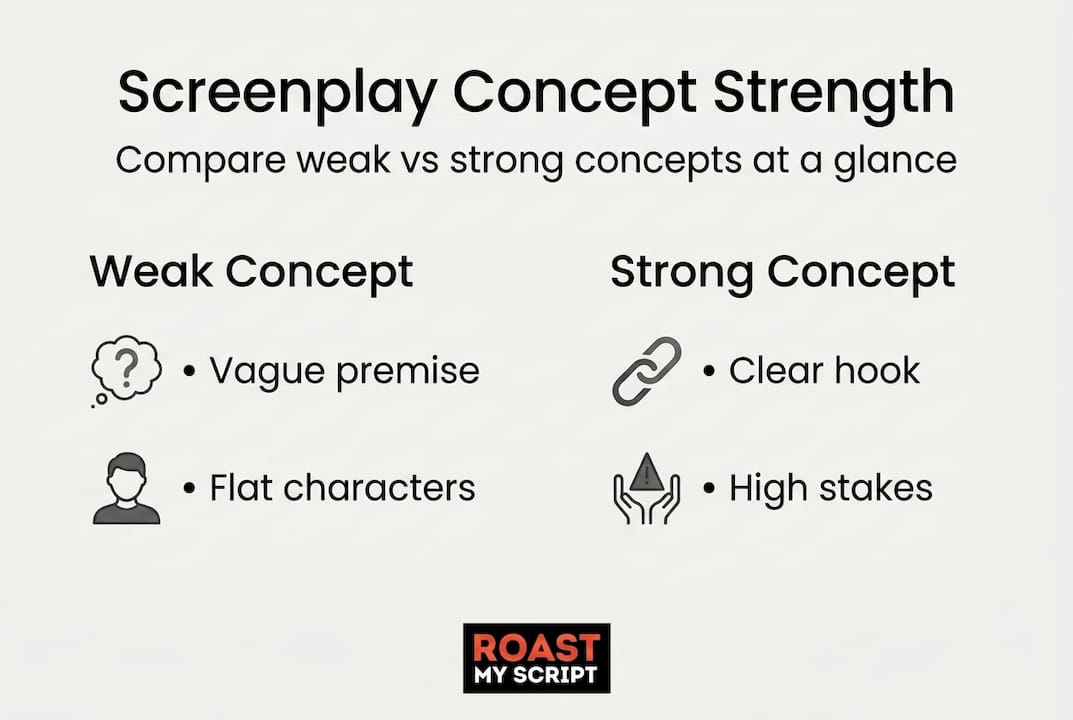
Applying mastering screenwriting concepts methods to each of these dimensions lets you isolate exactly where your concept breaks down, before you write 90 pages on a faulty foundation.
One more practical pressure-test: ask yourself whether your concept needs to be a movie. Could it be a short story? A news article? A podcast? If the answer is yes to any of those, the idea may not be inherently cinematic. Great screenplay concepts need visual storytelling, escalation, and character transformation that can only work on screen.
Evaluating market readiness: The 'Hollywood ready' mindset
Once your concept passes the viability tests, the next challenge is ensuring it meets industry expectations for pitching. This is where you shift from "Is this a good story?" to "Is this a story the industry can get behind?"
A pitch-readiness check means evaluating whether the script's big idea sells and whether the narrative creates a sustained "ride," rather than relying only on local scenes or surface authenticity. That distinction is important. A script with beautiful individual scenes but a concept that doesn't travel is hard to champion internally at a production company. Coverage readers, development executives, and producers all need to answer the same question to their bosses: Why this story, and why now?
Here's what industry readers are actually looking for when they evaluate a concept for market readiness:
- Clarity of the central conflict: Can they describe it in one sentence to a superior?
- Emotional build: Does the concept promise escalating stakes, not just a status quo?
- Genre clarity: Is there a clear audience and marketing hook?
- Originality within familiarity: Is this concept fresh enough to feel new but familiar enough to feel sellable?
- Promise of entertainment: Does the concept create a credible emotional or intellectual experience for an audience?
The data on why scripts fail at the pitch stage is revealing. Most rejections happen not because the writing is poor but because the concept doesn't survive scrutiny. Consider these common concept-level pitfalls:
| Concept weakness | Why it fails in pitching |
|---|---|
| Premise too familiar without a twist | No clear reason for this version to exist |
| Premise too niche without crossover | Limited commercial appeal signals risk to producers |
| Unclear protagonist goal | Readers cannot picture the story's shape or ending |
| No meaningful stakes | Low emotional investment from page one |
| Genre confusion | Hard to market, hard to greenlight |
The Hollywood structure guide outlines how structural frameworks underpin marketable stories. But structure alone doesn't rescue a concept that hasn't been validated first.
One underrated aspect of market readiness is character dimensionality at the concept level. You don't need a fully developed character arc in your logline, but your protagonist should feel specific. Generic characters attached to generic premises create doubly forgettable pitches. Checking character dimensionality principles early helps you attach a compelling character to your concept before you're deep into a draft.
Multi-dimensional evaluation: Diagnosing strengths and weaknesses
With pitching readiness clarified, let's look at ways to pinpoint specific elements that need work using structured evaluation across multiple script dimensions.
Most writers who get early feedback hear something like "the script doesn't work" without understanding why. That's expensive. It leads to wholesale rewrites that fix the wrong problem. A more effective approach is dimension-by-dimension evaluation, where you isolate the specific category that needs attention.
Research on evaluation pipelines shows that dimension-by-dimension scoring can reveal trade-offs that a single aggregate score hides. In other words, a script rated "average" overall might actually be excellent in structure but failing badly in character logic. That's a very different rewrite from a script that's weak across all dimensions.
Here are the six key dimensions to evaluate in any screenplay:
- Format: Is the script written to professional standards? Page count, slug lines, action lines, and dialog formatting all signal craft level.
- Emotional depth: Do characters react believably? Does the story create genuine emotional investment?
- Logic: Does the plot hold together? Are character motivations clear and consistent?
- Conflict: Is there meaningful, escalating conflict throughout all three acts?
- Structure: Does the story follow a coherent dramatic shape with clear turning points?
- Character: Are characters specific, dimensional, and consistent in their behavior?
Signs of strength vs. weakness in each dimension:
- Format strength: Clean, readable pages that move without friction. Format weakness: Dense action blocks, unclear scene headings, overwritten description.
- Emotional depth strength: You feel something at act breaks. Emotional depth weakness: Scenes that inform but don't affect.
- Logic strength: Every plot turn follows from what came before. Logic weakness: Characters make choices that serve the plot, not their established personalities.
- Conflict strength: Every scene has a micro-conflict. Conflict weakness: Scenes that advance plot without friction.
- Structure strength: Clear inciting incident, midpoint shift, and climax. Structure weakness: Meandering second act with no discernible midpoint.
- Character strength: Specific details that make characters memorable. Character weakness: Protagonists who are reactive rather than active.
Pro Tip: When coverage flags one specific dimension as the primary weakness, revise that dimension systematically across the entire script rather than rewriting the whole thing. Targeted revision saves weeks of work and keeps strong elements intact.
Learning how AI transforms scriptwriting and understanding story flow alongside script formatting tips equips you to address all six dimensions intelligently.
The actionable workflow: Streamlining script evaluation for affordability
Here's what I've seen repeatedly: writers spend months doing full rewrites when a single round of structured feedback would have told them the problem was the concept, not the execution. That's the most expensive mistake in independent screenwriting. You rewrite 90 pages when you should have revised your logline.
The efficient, affordable workflow looks like this:
- Step 1. Concept triage. Apply the grab-and-indicator check to your logline before anything else. If it fails here, rewrite the concept, not the script.
- Step 2. One round of structured coverage. Get coverage that evaluates your script by dimension. This tells you exactly which category needs work.
- Step 3. Targeted revision. Rewrite only the flagged dimension systemically across the script. If coverage flags premise weakness, rework the premise. If it flags character logic, address character decision-making throughout.
- Step 4. Verify with a second pass. A second round of concept-level feedback confirms whether the targeted revision landed.
This workflow saves you from throwing money at script doctors or broad rewrites before you understand what's actually broken. Learning Save the Cat methodology alongside your structured coverage helps you contextualize structural feedback in terms you can act on immediately.
Most writers resist this approach because they're emotionally attached to the draft, not the idea. The discipline of evaluating the concept first, before defending the pages, is what separates writers who develop fast from those who spin in place.
Affordable feedback to level up your screenplay concept
For those who want actionable feedback and structured support, here's how you can access professional-grade evaluation affordably.
At Roast My Script, we built the platform specifically for this moment in a screenwriter's process. You have a script. You're not sure if it's ready. You don't want to pay $300 for coverage on something that might have a concept-level problem. Our AI-driven coverage, starting at $9, evaluates your script across all key dimensions and delivers a structured PDF report in 1-2 days by email. Start with our screenwriting concepts course to sharpen your concept thinking, then submit your script for coverage that tells you exactly where to focus your revision energy.
Frequently asked questions
What is the most important question to ask when evaluating a screenplay concept?
The most critical question is whether the idea has a "grab." Ask yourself: does it spark immediate curiosity or emotional investment that carries through the narrative, not just at the opening scene?
How does logline creation help concept evaluation?
Writing a logline forces you to identify the protagonist, goal, obstacle, and stakes in a single sentence, which immediately exposes conceptual vagueness. Logline construction using the "Protagonist + Want/Need + Obstacle + stakes/context" structure with a "Big But" reveals whether your conflict is strong enough to carry the story.
Can AI coverage help diagnose concept weaknesses?
Yes. Dimension-by-dimension scoring reveals specific failure types that a single aggregate score would obscure, so you know exactly which area to rewrite rather than guessing.
What makes a script 'Hollywood ready'?
A script is Hollywood ready when the big idea is clear, promises an entertaining narrative ride, and compels readers from the pitch summary onward. Evaluating pitch readiness means checking whether your concept sells independently of the writing quality.
How can targeted coverage save time and money?
Structured coverage that identifies a specific weakness (premise, structure, character, or pace) lets you rewrite that dimension systemically rather than doing broad rewrites that may fix the wrong problem entirely.
Recommended
- Script Development Process: Preparing for Hollywood Success | ROAST MY SCRIPT
- Script format impact: 90% boost production & pitch success | ROAST MY SCRIPT
- How to analyze a script for powerful screenplay improvement | ROAST MY SCRIPT
- Explain screenplay genres to elevate your scripts in 2026 | ROAST MY SCRIPT