
Many screenwriters dismiss Save the Cat as a rigid formula that kills creativity, but this misunderstanding prevents them from using one of Hollywood's most effective diagnostic tools. The methodology isn't about following strict rules. It's a flexible framework designed to identify and fix structural weaknesses in your screenplay before you pitch it to producers or submit to festivals. This guide breaks down the core elements of Save the Cat, shows how to apply it without sacrificing originality, and reveals how modern AI-powered analysis can help you leverage its insights affordably.
Table of Contents
- Understanding The Save The Cat Methodology
- How Save The Cat Structures Your Screenplay For Success
- Balancing Structure And Creativity: Strengths And Criticisms
- Applying The Save The Cat Methodology With Ai-Driven Script Analysis
- Learn To Craft Winning Scripts With Roast My Script
- FAQ
Key takeaways
| Point | Details |
|---|---|
| Save the Cat uses a 15-beat structure to guide narratives. | This framework creates clear emotional momentum and commercial viability when applied as a diagnostic tool. |
| It emphasizes character empathy through a 'save the cat' moment. | An early selfless action endears the protagonist to audiences, building emotional investment. |
| The method supports pacing, emotional momentum, and commercial viability. | Industry professionals use the structure as a quick evaluation tool to assess screenplay readiness. |
| Over-reliance on it can risk formulaic storytelling. | Writers must balance structural guidance with original creative vision to avoid predictable outcomes. |
| It is a tool meant to be balanced with original creativity. | Use the beats flexibly as a diagnostic framework, not as strict rules that constrain your unique story. |
Understanding the Save the Cat methodology
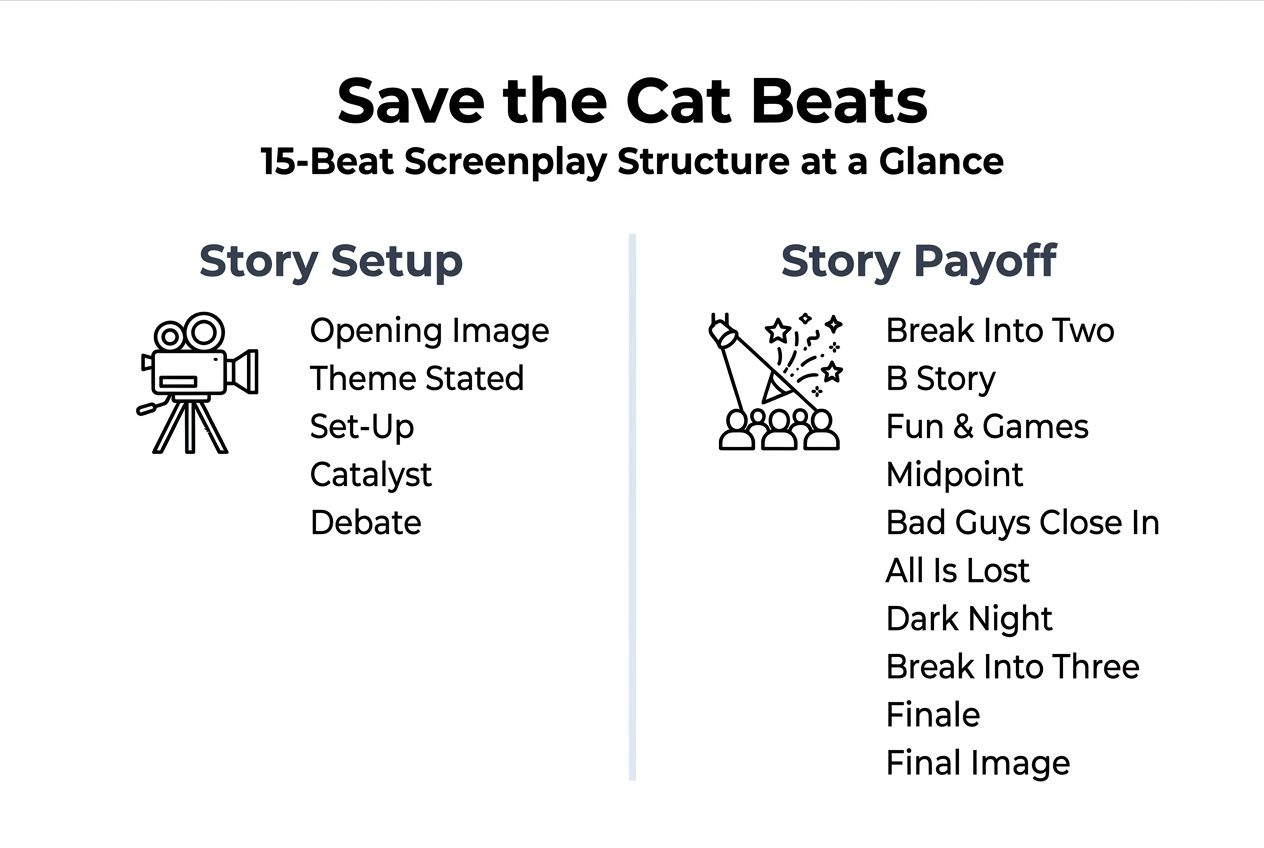
Blake Snyder created Save the Cat as a screenwriting guide that demystifies Hollywood story structure. The methodology centers on a 15-beat screenwriting model designed to create clear momentum, emotional investment, and commercial viability. Rather than prescribing a rigid formula, these beats function as diagnostic checkpoints to ensure your story hits essential emotional and narrative markers.
The framework helps you identify where your screenplay might lose momentum or fail to connect with audiences. Think of it as a structural health check for your script, not a paint-by-numbers template. When you understand the 15 beats, you gain a common language shared by producers, executives, and script readers across the industry.
Key beats include:
- Opening Image: Establishes your protagonist's world before change occurs
- Theme Stated: Introduces the story's central thematic question early
- Catalyst: The inciting incident that disrupts the protagonist's status quo
- Break into Two: The moment your hero commits to a new world or journey
- Midpoint: A false victory or defeat that raises the stakes dramatically
- All Is Lost: The lowest emotional point where everything seems hopeless
- Break into Three: The solution becomes clear and the final push begins
- Final Image: Shows how the protagonist's world has transformed
The story structure breakdown for screenwriters reveals how these beats work together to create satisfying narratives. The goal isn't to make every screenplay identical. It's to ensure your unique story unfolds with the emotional clarity and pacing that keeps audiences engaged from page one to FADE OUT.
How Save the Cat structures your screenplay for success
The 15-beat structure maps directly to screenplay page counts, giving you concrete timing benchmarks. A typical 110-page script places the Catalyst around page 12, Break into Two at page 25, Midpoint at page 55, and All Is Lost near page 75. These aren't arbitrary numbers. They reflect successful Hollywood movies reverse-engineered to reveal common patterns in audience engagement.

Producers and executives use this structure as a quick evaluation tool. When they open your script, they instinctively look for these beats at their expected locations. If your Catalyst hits at page 35 instead of page 12, readers notice the sluggish pacing immediately. The structure helps the story move visually and efficiently, which matters in an industry where readers evaluate dozens of scripts weekly.
The script development process overview shows how professionals integrate these timing principles. Key emotional peaks like the Midpoint and All Is Lost moments create the dramatic momentum that prevents your screenplay from feeling flat or episodic.
| Beat | Approximate Page | Emotional Impact |
|---|---|---|
| Opening Image | 1 | Establishes tone and protagonist's starting point |
| Catalyst | 10-12 | Disrupts status quo, launches the story |
| Break into Two | 22-25 | Commits hero to the journey |
| Midpoint | 50-55 | Raises stakes with false victory or defeat |
| All Is Lost | 70-75 | Creates emotional low point |
| Break into Three | 85-90 | Reveals solution and final push |
| Final Image | 108-110 | Shows transformation complete |
Here's how the structure flows through your screenplay:
- Act One establishes your protagonist's ordinary world and introduces the central conflict
- The Catalyst forces your hero to confront a problem they can't ignore
- Break into Two commits them to a new direction or environment
- Fun and Games delivers the promise of your premise with entertaining sequences
- Midpoint shifts everything with a revelation or reversal that raises stakes
- Bad Guys Close In tightens pressure from external and internal forces
- All Is Lost drops your protagonist to their lowest emotional point
- Dark Night of the Soul allows reflection before the solution emerges
- Break into Three launches the final confrontation armed with new understanding
- Act Three resolves conflicts and shows how your hero has transformed
Pro Tip: Use the beat timings flexibly, adjusting them to fit your story's unique pace and genre conventions rather than forcing your narrative into exact page counts.
Balancing structure and creativity: strengths and criticisms
Save the Cat offers clear advantages for screenwriters at every experience level. The structure provides character empathy through moments that make protagonists relatable, commercial appeal through proven pacing patterns, and a shared vocabulary that helps you communicate with industry professionals. When you pitch a script that hits these structural beats, executives recognize the professional polish immediately.
Yet the methodology faces legitimate criticism. Formulaic storytelling becomes a real risk when writers treat the beats as mandatory checkboxes rather than diagnostic guidelines. The structure can stifle creativity if you prioritize hitting beats over developing your unique voice and vision. Blindly following trends and over-reliance on Save the Cat can lead to unoriginal stories that feel like copies of copies.
The key is balance. Use Save the Cat as a guiding tool, not a straitjacket. Your story should drive the structure, not the other way around. The master Hollywood screenplay structure principles work best when combined with genuine creativity and fresh perspectives.
To avoid formulaic pitfalls:
- Let your characters and theme dictate when beats naturally occur rather than forcing them at specific page counts
- Focus on emotional truth over structural compliance when the two conflict
- Study the methodology but write from instinct in your first draft
- Use the beats during revision to diagnose pacing issues, not during initial creation
- Prioritize your original ideas and increase text originality naturally while maintaining structural integrity
Story is both craft and art. Master the craft of structure so you can focus your creative energy on the art of meaningful, original storytelling.
The strongest screenplays emerge when you understand Save the Cat well enough to know when and how to deviate from it intentionally. Rules exist to be broken, but you must understand them first to break them effectively.
Applying the Save the Cat methodology with AI-driven script analysis
Modern AI script analysis offers an affordable way to check how well your screenplay aligns with Save the Cat beats without spending hundreds on traditional coverage. AI-powered tools evaluate your script against the 15-beat structure designed to create clear momentum, emotional investment, and commercial viability, identifying exactly where your narrative might lose focus or fail to connect emotionally.
AI feedback highlights pacing issues by comparing your beat placement to proven patterns. It assesses character depth by analyzing whether your protagonist demonstrates growth across the narrative arc. The technology flags emotional beats that feel rushed or underdeveloped, giving you specific revision targets rather than vague impressions.
Combining human creativity with AI diagnostics creates a powerful workflow. You write from instinct and originality, then use AI analysis to identify structural weaknesses before investing in expensive professional coverage or script consulting. This approach maintains your creative vision while ensuring your screenplay meets industry standards for pacing and structure.
Ways to use AI tools effectively:
- Upload your screenplay for beat sheet analysis that maps your actual structure against Save the Cat expectations
- Request character arc feedback focusing on transformation and emotional authenticity
- Get pacing suggestions that identify where your story drags or rushes crucial moments
- Review dialogue patterns to ensure voices remain distinct and authentic
- Analyze theme consistency across your screenplay to strengthen thematic resonance
The character spine framework integrates seamlessly with Save the Cat analysis, helping you build protagonists whose inner journeys align with your external plot structure. When you combine structural methodology with deep character work, your screenplay gains both commercial viability and emotional authenticity.
Pro Tip: Use AI suggestions as guidance to identify problem areas, not as strict rules that override your creative instincts and storytelling vision.
Learn to craft winning scripts with Roast My Script
Ready to apply Save the Cat principles without spending hundreds on traditional coverage? Roast My Script delivers professional-grade AI script analysis starting at just $9, giving you detailed structural feedback in 1-2 days by email. Our platform evaluates your screenplay against proven Hollywood methodologies including Save the Cat, identifying exactly where your narrative loses momentum or emotional impact.
You'll receive actionable insights on character development using Linda Seger's character spine framework, plus detailed analysis of narrative character dimensionality that helps your protagonists feel authentic and compelling. Our AI-powered coverage identifies structural weaknesses before you pitch to producers or submit to festivals, saving you from costly rejections.
Key benefits of our service:
- Fast turnaround with comprehensive coverage delivered in 1 to 2 days
- Detailed structural notes highlighting beat placement and pacing issues
- Character analysis that goes beyond surface level to examine arc and transformation
- Affordable pricing that makes professional feedback accessible to every writer
- Objective analysis free from personal bias or industry politics
Get the brutal feedback you need to fix structural problems before anyone else sees your script. Our AI-driven analysis serves as your first filter, helping you refine your screenplay into a polished, industry-ready submission.
FAQ
What is the 'save the cat' moment in screenwriting?
The 'save the cat' moment shows your protagonist performing a selfless or relatable action early in the screenplay. This beat creates empathy by showing audiences that your hero deserves their emotional investment. The moment doesn't literally require saving a cat, it requires revealing character through action.
How does Save the Cat compare to the Hero's Journey?
The Hero's Journey emphasizes cyclical narrative with mythical stages like Departure and Return, while Save the Cat provides a linear 15-beat structure focused on commercial screenplays. Hero's Journey works across all storytelling mediums and cultures. Save the Cat specifically targets modern Hollywood film structure and pacing expectations.
Can Save the Cat stifle creativity?
Strict adherence to the structure risks predictable outcomes that make stories feel formulaic and derivative. The methodology works best as a flexible diagnostic guide used alongside your original creative vision. Prioritize your unique story and characters, then use the beats to identify structural weaknesses during revision.
How long should each act be in a Save the Cat screenplay?
Act One typically runs 25 pages, Act Two spans approximately 60 pages, and Act Three concludes in the final 25 pages of a 110-page script. These proportions create the pacing rhythm audiences expect. Adjust timing based on your genre and story needs rather than adhering rigidly to exact page counts.
Do all successful screenplays follow Save the Cat?
Many successful films deviate from the structure intentionally, proving that understanding the methodology matters more than strict compliance. Art house films, experimental narratives, and character studies often ignore conventional beats entirely. Commercial Hollywood productions tend to align more closely with Save the Cat expectations because the structure reflects proven audience engagement patterns.
Recommended
- Script Development Process: Preparing for Hollywood Success | ROAST MY SCRIPT
- Master Story Structure Breakdown for Screenwriters | ROAST MY SCRIPT
- Script format impact: 90% boost production & pitch success | ROAST MY SCRIPT
- Roast My Script | AI Script Coverage & Analysis from $9
- AI Proof Writing | Semihuman AI | Samwell AI
- Creating Cinematic Wedding Films: A Step-by-Step Guide | Cinevisualstudios Blog