
You've poured months into your screenplay, refining dialogue and perfecting character arcs. Then it lands on a producer's desk and gets tossed after page two. The culprit? Formatting. Scripts non-compliant with formatting standards may be discarded after page 1 or 2 by readers and agents who view sloppy presentation as a red flag for amateur work. Proper script format isn't about rigid rules killing creativity. It's the universal language that makes your story readable, producible, and marketable. This article breaks down why format matters, which elements are non-negotiable, and how mastering these conventions directly increases your odds of getting read, analyzed accurately, and green-lit.
Table of Contents
- Introduction To Script Format In Screenwriting
- Fundamental Screenplay Formatting Elements And Their Roles
- Common Mistakes And Misconceptions About Formatting
- Impact Of Format On Production Planning And Budgets
- Role Of Format In Ai-Based Script Analysis Services
- Practical Steps To Improve Script Format Before Seeking Coverage
- Get Professional-Format Script Analysis With Roast My Script
- Frequently Asked Questions About Script Formatting
Key takeaways
| Point | Details |
|---|---|
| Format impacts first impressions | Industry readers often reject improperly formatted scripts within the first two pages as unprofessional. |
| Production efficiency depends on format | Correct formatting enables accurate scheduling, budgeting, and resource allocation during pre-production. |
| AI analysis requires proper structure | Modern script analysis tools parse formatting conventions to deliver fast, affordable feedback on structure and pacing. |
| Standardization builds credibility | Following industry-standard screenplay format signals professionalism and increases read-through rates. |
Introduction to script format in screenwriting
Script format is the standard visualization and presentation protocol that transforms your story ideas into a blueprint readable by producers, directors, actors, and crew. Think of it as the architectural drawings for a building. Without clear plans, construction becomes guesswork.
Standardization improves professional readability and acceptance because every stakeholder speaks the same visual language. A director knows exactly where scene headings are. An actor can instantly spot their dialogue cues. Production managers estimate costs by glancing at scene density.
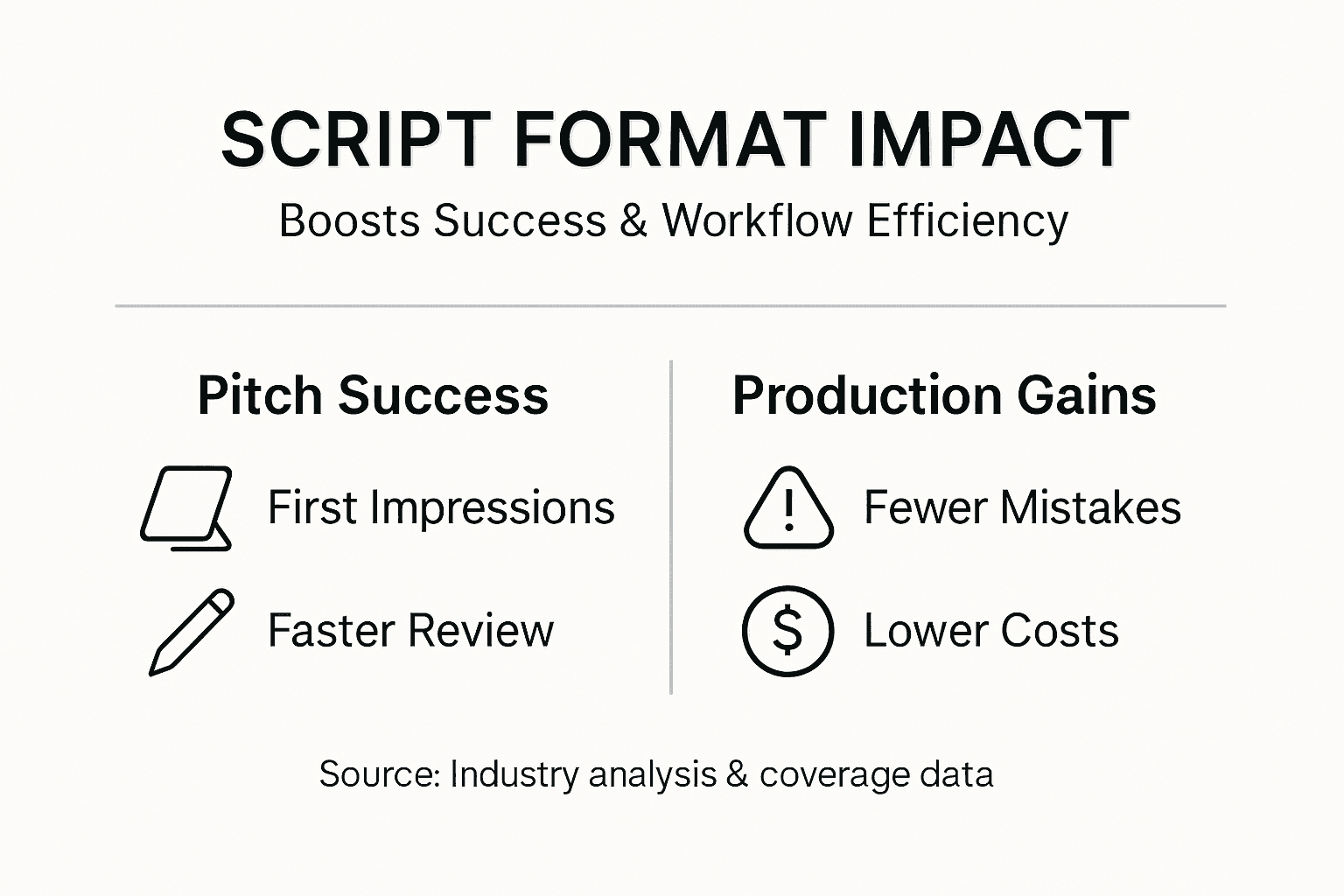
Screenplay structure and format importance extends beyond aesthetics. Format directly impacts production feasibility and pitch success by:
- Enabling rapid script assessment during coverage and pitch meetings
- Reducing miscommunication between departments during filming
- Signaling industry competence that earns respect from gatekeepers
- Facilitating accurate breakdowns for scheduling, budgeting, and crew planning
When you follow conventions, you're not limiting creativity. You're ensuring your creative vision gets understood and executed as intended. Scripts non-compliant with formatting standards may be discarded early by agents as unprofessional, regardless of story quality. That's why format functions as both communication tool and credibility marker.
Fundamental screenplay formatting elements and their roles
Every professional screenplay relies on specific formatting components that guide readers through your story while providing production teams with actionable information.
Sluglines (also called scene headings) appear in all caps and establish location and time. They follow the pattern INT. or EXT., followed by location, then time of day. Example: INT. COFFEE SHOP - MORNING. This simple convention tells the crew whether they're filming indoors or outdoors, where to set up, and what lighting conditions to expect.
Proper screenplay format uses Courier 12-point font to ensure page-to-screen time predictability. In Courier 12, one formatted page equals roughly one minute of screen time. This timing rule helps producers estimate runtime and budget before a single frame is shot.
Indentation, margins, and spacing follow strict standards:
- Scene headings: flush left, 1.5 inches from left edge
- Action lines: flush left, single-spaced between paragraphs
- Character names: centered at 3.7 inches from left, all caps
- Dialogue: centered at 2.5 inches, narrower than action
- Parentheticals: 3.1 inches from left, used sparingly for tone cues
Character name capitalization happens on first introduction in action lines and always in dialogue cues. Capitalizing SARAH when she first appears helps casting directors and actors identify key roles immediately. Understanding character name capitalization importance prevents confusion during table reads and production meetings.
Pro Tip: Use professional software to automate formatting. Manual spacing wastes time and introduces errors that undermine your professionalism.
| Formatting Element | Standard Use | Reader Benefit |
|---|---|---|
| Sluglines | INT./EXT. + Location + Time | Instant scene context |
| Courier 12pt Font | Body text throughout | Accurate timing estimates |
| Character Names (CAPS) | Dialogue cues and first mention | Clear role identification |
| Action Line Spacing | Single-spaced, double between paragraphs | Easy visual scanning |
| Dialogue Indentation | Centered, narrower than action | Distinguishes speech from description |
These elements work together as a system. Miss one, and you disrupt the reading experience. Master them, and your script flows effortlessly from page to production.
Common mistakes and misconceptions about formatting
Many aspiring screenwriters believe formatting stifles creativity. This myth causes more harm than any individual format error. Professional screenwriters use formatting to enhance storytelling clarity, not stifle creativity. Format is the delivery vehicle for your ideas, not a cage.
The serious risk of early script rejection due to format errors cannot be overstated. Scripts with poor formatting are often rejected early as amateurish, reducing chances of read-through. Readers handle hundreds of submissions monthly. Format errors signal inexperience before your story gets a fair shot.
Common format errors that lead to misinterpretation and increased costs include:
- Inconsistent sluglines that confuse location continuity
- Overwritten action paragraphs that slow pacing and inflate page count
- Missing or incorrect character cue formatting that disrupts dialogue flow
- Non-standard fonts or spacing that break timing calculations
- Camera directions and editing notes that belong in shooting scripts, not spec scripts
"Format isn't about following arbitrary rules. It's about respecting your reader's time and the production team's workflow. A well-formatted script shows you understand the business you're trying to break into." — Industry coverage professional
Another misconception: you can fix format later. By the time you're ready to submit, bad habits are ingrained. Learning correct format from day one saves you from expensive script doctoring fees and missed opportunities. Understanding formatting misconceptions debunked helps you avoid these pitfalls before they damage your reputation.
Impact of format on production planning and budgets
Correct formatting directly influences how production teams estimate costs, schedule shoots, and allocate resources. When your script follows conventions, line producers can quickly break down scenes and calculate expenses.
Formatted scene length and detail cue production complexity and scheduling needs. A three-page action sequence with multiple locations and stunts signals higher costs than a two-page dialogue scene in a single room. Production managers scan your sluglines and action descriptions to identify:
- Number of shooting days required per location
- Equipment and crew size needed for complex scenes
- Special effects, stunts, or animal wrangling that inflate budgets
- Day versus night shoots that affect crew rates and lighting costs
Properly formatted scripts improve production efficiency by enabling better cost and schedule estimation. Consistent formatting reduces surprises and delays on set because everyone from the director to the gaffer knows exactly what to expect.
Production benefits derived from proper formatting:
- Faster script breakdowns that save pre-production time and money
- Accurate budget forecasts that prevent cost overruns during filming
- Clear communication between departments that reduces on-set confusion
- Easier identification of problem scenes that need rewrites before production
- Streamlined scheduling that maximizes efficiency and minimizes crew overtime
Formatting errors increase the risk of production mistakes and add costly script doctoring fees. A scene mislabeled as INT. when it should be EXT. can cause location booking errors. Missing time-of-day indicators force crew to guess lighting setups. These mistakes cost thousands in wasted prep time and reshoot expenses.
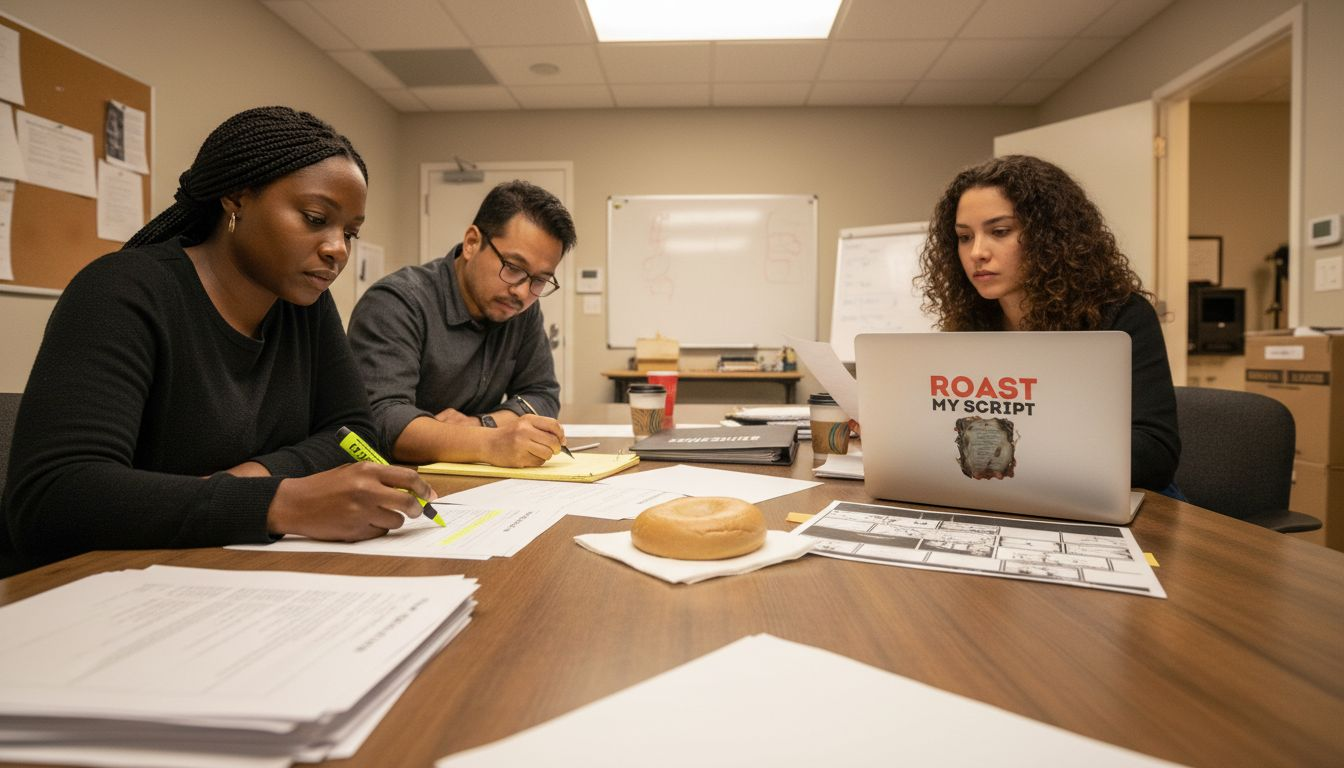
When you format correctly, you're not just impressing readers. You're building a roadmap that saves production teams money and headaches. Understanding format's effect on production logistics positions you as a writer who respects the collaborative filmmaking process.
Role of format in AI-based script analysis services
AI script analysis tools have transformed how screenwriters receive feedback, making professional-level coverage accessible at a fraction of traditional costs. These tools depend entirely on correct formatting to deliver accurate insights.
AI tools parse screenplay elements based on formatting conventions. When you upload a script to an affordable AI script analysis at ROAST MY SCRIPT, the system identifies sluglines, character introductions, dialogue blocks, and action descriptions by their formatting. Properly formatted elements allow the AI to:
- Track character appearances and dialogue distribution across acts
- Analyze pacing by measuring scene length and action-to-dialogue ratios
- Identify structural weaknesses like missing plot points or unbalanced act lengths
- Flag formatting inconsistencies that would confuse human readers
Benefits of AI feedback include faster turnaround, cost-effectiveness, and early structural insights. Traditional coverage costs $60 to $400 and takes one to two weeks. AI analysis delivers results in 1-2 days by email for $9 to $25, giving you rapid feedback before investing in expensive human coverage or script doctors charging $500 to $1,500.
Consistent formatting maximizes AI accuracy and usefulness. When your sluglines follow standard patterns, the AI correctly identifies scene transitions. When character names appear consistently in caps, the system tracks their arcs without confusion. Format errors cause parsing failures that reduce feedback quality.
Pro Tip: Use AI coverage services as a pre-coverage format checkpoint to catch errors before submitting to agents or competitions. Fix structural and formatting issues early, then invest in human coverage only when your script is polished and ready.
AI analysis doesn't replace human readers, but it serves as an affordable first filter that identifies problems you can fix yourself. This approach saves money and improves your script's chances when it finally reaches industry gatekeepers.
Practical steps to improve script format before seeking coverage
Mastering script format requires the right tools and a systematic approach to editing. Professional formatting software automates the heavy lifting, letting you focus on storytelling.
Recommended professional formatting software includes Final Draft and StudioBinder, both of which automate formatting and catch common errors. Industry-standard formatting software Final Draft handles sluglines, character cues, and dialogue indentation automatically. Dedicated software like Final Draft automates formatting, cuts errors, and saves time compared to manual formatting in word processors.
Follow these steps to ensure your script meets industry standards:
- Choose professional screenwriting software with built-in formatting templates that match industry conventions.
- Apply standard templates from the start rather than reformatting later, building good habits immediately.
- Run format checks using software tools that flag inconsistent sluglines, character names, and spacing errors.
- Review action paragraphs to ensure they're concise (three to four lines maximum) and avoid camera directions.
- Verify character name consistency by searching for variations or typos that confuse readers and AI tools.
- Check page count against runtime expectations, aiming for 90 to 120 pages for feature scripts.
- Export to industry-standard PDF format with embedded fonts to preserve formatting across devices.
- Submit your script to ROAST MY SCRIPT for AI analysis to catch remaining format and structural issues before human coverage.
Starting with proper format prevents the frustration of reformatting 110 pages after your first draft. Software does the work, but you need to understand the rules to apply them correctly.
Affordable AI feedback helps you catch issues early before human coverage. Spending $9 to $25 on AI analysis identifies format problems and structural weaknesses you can fix yourself, reserving expensive human coverage for scripts that are truly competition-ready. This two-step approach maximizes your budget while ensuring professional presentation.
Get professional-format script analysis with Roast My Script
You've learned why format matters and how to master it. Now it's time to put that knowledge into action with professional feedback.
ROAST MY SCRIPT AI coverage and analysis offers affordable, AI-powered script analysis that evaluates your screenplay's format, structure, character development, and market viability. For $9 to $25, you receive detailed feedback within 1-2 days by email, identifying formatting errors and structural weaknesses before you submit to agents, producers, or competitions.
Using the service helps you identify formatting and structural problems early, saving you from costly script doctoring fees and embarrassing rejections. The AI analyzes your script using proven Hollywood methodologies from Syd Field, Robert McKee, and Save the Cat, delivering professional-grade insights at a fraction of traditional coverage costs.
Improve your script with professional guidance before submitting to agents or producers. Get the brutal truth about what's working and what needs fixing, then revise with confidence knowing your format and structure meet industry standards. Submit your script today and take the first step toward market-ready screenwriting.
Frequently asked questions about script formatting
Does script formatting affect how quickly my script gets read?
Yes, dramatically. Readers and agents assess hundreds of scripts monthly and use format as an early filter. Proper formatting signals professionalism and makes your script easier to read, increasing the likelihood of a complete read-through rather than rejection after page two.
Can I submit a non-standard format script to agents or competitions?
You can, but you shouldn't. Non-standard formatting gets flagged as amateurish and often results in immediate rejection regardless of story quality. Competitions and agencies expect industry-standard format, and deviating from conventions hurts your chances before your story gets evaluated.
What is the most common formatting mistake to avoid?
Inconsistent or missing sluglines top the list. When scene headings don't follow the INT./EXT. + Location + Time pattern, readers lose track of where and when scenes occur. This confusion disrupts pacing analysis and signals inexperience, often leading to early rejection.
How does proper formatting save me money in production?
Correct formatting enables accurate budget estimates and scheduling before filming begins. Production teams break down scripts by scene, identifying equipment, crew, and location needs based on formatted information. Format errors cause miscalculations that lead to cost overruns, reshoots, and wasted prep time during production.
Should I include camera directions in my spec script format?
No. Spec scripts focus on story and character, leaving technical decisions to the director and cinematographer. Including camera angles and editing notes clutters your script and marks you as inexperienced. Save technical directions for shooting scripts created after your spec sells.
Can AI tools really analyze script format as well as human readers?
AI tools excel at identifying format inconsistencies, structural patterns, and pacing issues by parsing formatting conventions. They catch errors human readers might miss due to fatigue. However, AI complements rather than replaces human insight on nuanced story and character elements. Use AI for fast, affordable pre-coverage, then invest in human readers for final validation.