
You submit your screenplay to a contest or producer, convinced your script is ready. Then silence. What went wrong? Most writers believe script coverage is a rubber stamp for great work, but it's actually the diagnostic tool that reveals whether your script is truly submission-ready. This guide breaks down what coverage really is, how it works, and how to use it to strengthen your screenplay before you invest in expensive submissions.
Table of Contents
- What Is Script Coverage? Definition And Purpose
- Typical Components Of Script Coverage Reports
- Core Frameworks Behind Script Coverage
- Cost And Types Of Professional Script Coverage
- Common Misconceptions About Script Coverage
- How To Use Script Coverage Feedback Effectively
- AI-Powered Script Coverage Vs Traditional Human Coverage
- Discover Affordable AI And Hybrid Script Coverage Services
- Frequently Asked Questions
Key takeaways
| Point | Details |
|---|---|
| Script coverage analyzes story, structure, characters, and market fit | Professional reports evaluate your screenplay against industry standards to identify strengths and weaknesses |
| Coverage reports deliver actionable feedback for improvement | Writers receive 2-10 page analyses within 24-72 hours to refine scripts before costly submissions |
| AI and human coverage offer distinct advantages | Human coverage provides nuanced insight ($60-$400, 1-2 weeks), AI delivers fast structural analysis ($9-$25, 1-2 days by email) |
| Professional feedback increases script success rates by up to 40% | Implementing coverage recommendations significantly improves your chances with producers and festivals |
| Coverage is developmental, not a guarantee | It's a tool for identifying problems early, not a magic ticket to sales or acceptance |
What is script coverage? Definition and purpose
Script coverage is a professional evaluation report that analyzes your screenplay's core elements. Think of it as a health checkup for your script. Industry readers assess story concept, structure, character development, dialogue quality, and commercial viability.
Most coverage reports run 2 to 10 pages and arrive within 24 to 72 hours. They're designed to give you an honest, objective assessment before you send your script to agents, producers, or competitions. This early diagnostic saves you from wasting submission fees on scripts that aren't ready.
The primary value lies in identifying problems you can't see yourself. After months writing your screenplay, you lose objectivity. Coverage provides fresh eyes trained to spot structural weaknesses, unclear character motivations, or pacing issues that kill reader interest.
Key components coverage typically evaluates:
- Story concept and originality
- Three-act structure and pacing
- Character arcs and dimensionality
- Dialogue authenticity and efficiency
- Market positioning and commercial appeal
- Technical formatting and readability
Professional coverage helps writers save thousands of dollars. Instead of paying for multiple failed submissions or hiring expensive script consultants later, you get targeted feedback upfront. This lets you fix critical issues before they torpedo your chances with decision makers.
Typical components of script coverage reports
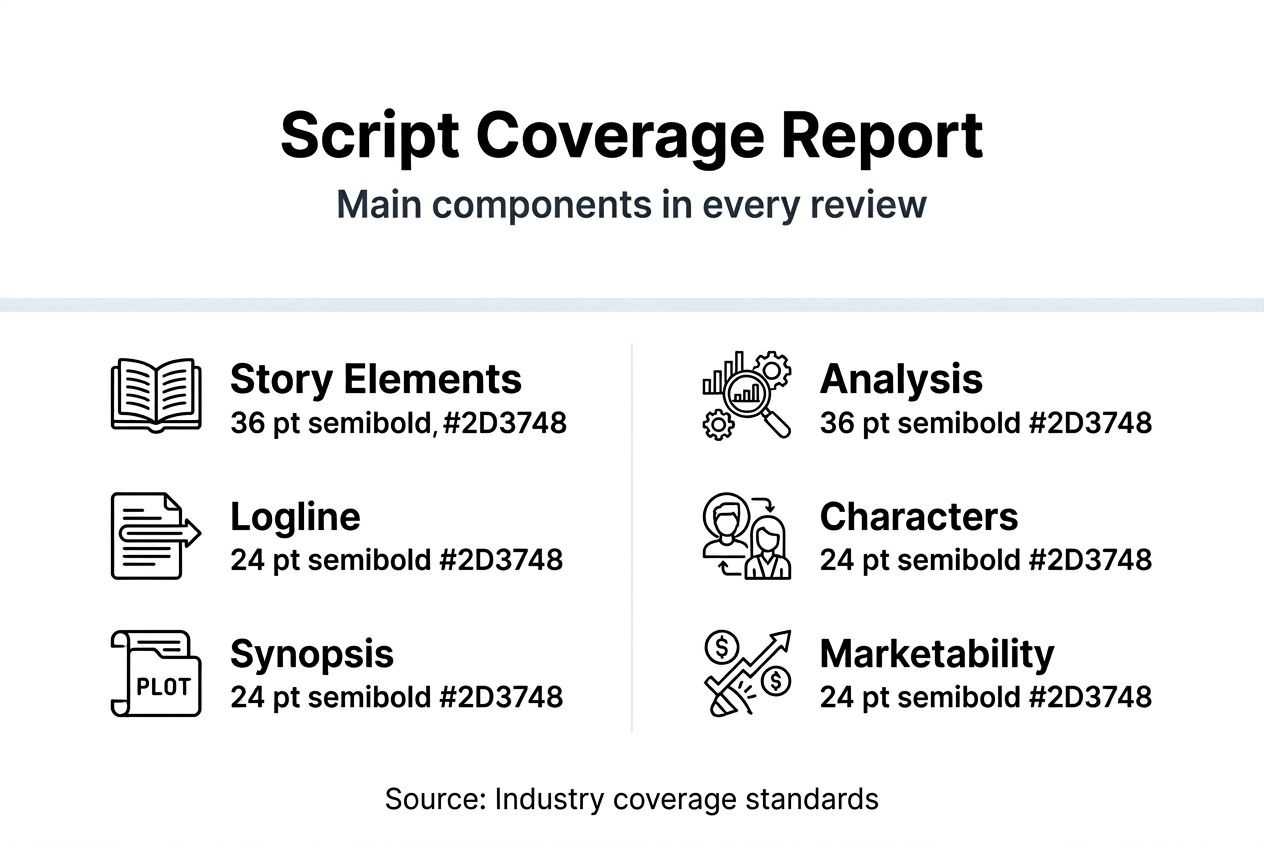
Every professional coverage report follows a standardized format that industry readers recognize. You'll receive a logline that distills your story into one compelling sentence, followed by a synopsis summarizing your plot in one to two paragraphs. These elements test whether your core concept communicates clearly.
The character analysis section examines your protagonist's arc, supporting characters' functions, and whether each character serves the story effectively. Readers assess motivation clarity, transformation believability, and whether characters feel three-dimensional or flat.
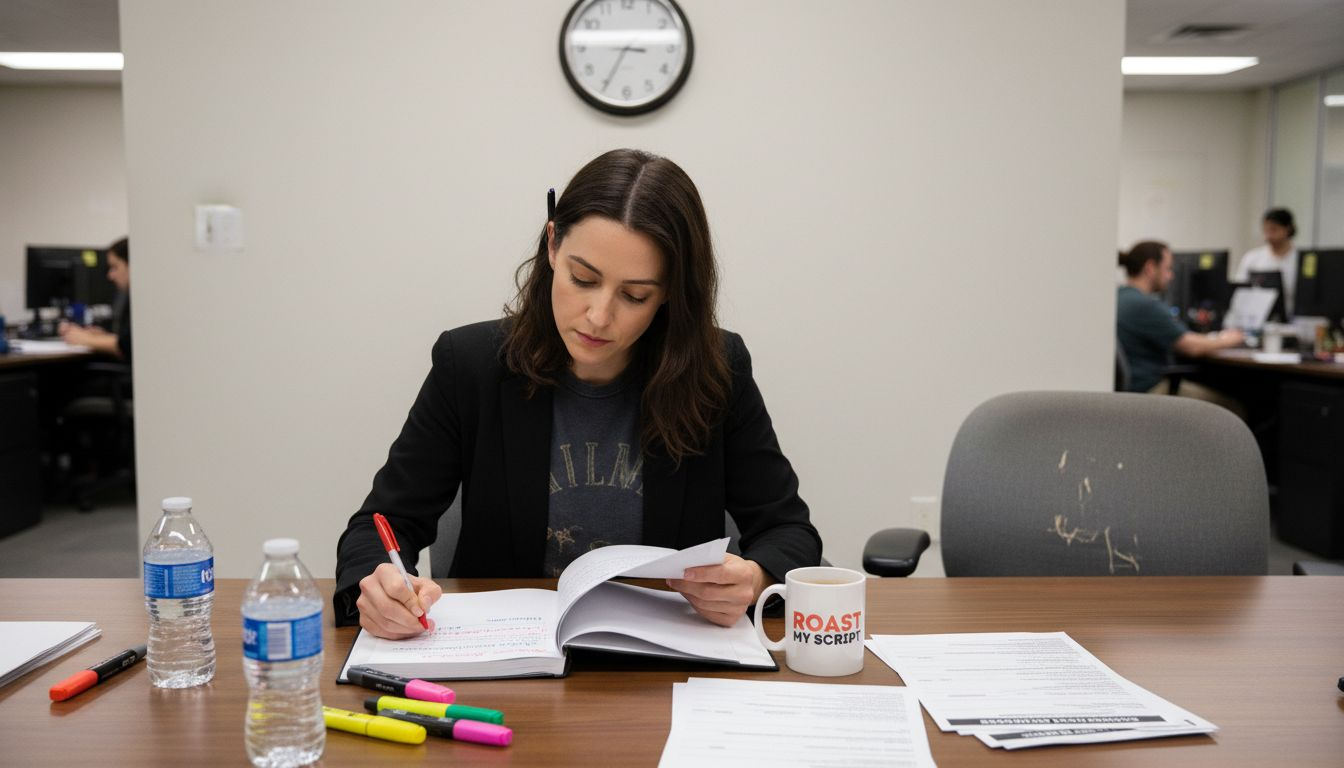
Strengths and weaknesses sections provide the diagnostic meat. Readers identify what works in your script and what needs revision. This isn't vague praise or criticism; it's specific feedback tied to story structure frameworks like three-act paradigm and Save the Cat beats.
Marketability evaluation addresses commercial viability. Readers consider genre positioning, target audience, comparable films, and whether your script could attract financing. This section tells you if your screenplay has realistic sales potential or needs repositioning.
Revision recommendations conclude most reports. You get a prioritized list of actionable fixes, from structural overhauls to dialogue tweaks. These recommendations guide your rewrite process, ensuring you focus energy where it matters most.
Standard coverage components:
- Logline and synopsis
- Premise evaluation
- Character breakdown and arc analysis
- Structural assessment against proven frameworks
- Dialogue quality review
- Pacing and tension analysis
- Marketability and positioning insights
- Specific revision priorities
Core frameworks behind script coverage
Professional readers evaluate your screenplay using established Hollywood story models. These frameworks aren't arbitrary; they're proven structures that audience psychology responds to. Understanding them helps you interpret coverage feedback accurately.
Syd Field's three-act paradigm remains the foundation. Readers check whether your script hits key structural beats: setup by page 30, midpoint around page 60, climax by page 90 in a feature. Deviations aren't automatically bad, but they must serve clear creative purposes.
Robert McKee's story principles emphasize meaningful change and escalating conflict. Coverage assesses whether your protagonist transforms through increasingly difficult choices. Readers look for active protagonists driving action, not passive characters reacting to events.
Save the Cat methodology provides detailed beat analysis. Readers verify you hit the opening image, catalyst, debate, break into two, midpoint, all is lost, and finale beats. This framework ensures proper pacing and emotional rhythm throughout your screenplay.
These frameworks help coverage identify why a script feels off even when individual scenes work. Structure problems manifest as pacing issues, unclear character motivation, or unsatisfying resolutions. The frameworks give readers objective criteria for diagnosis.
Key analytical approaches coverage employs:
- Three-act structure positioning
- Hero's journey archetype mapping
- Save the Cat beat sheet verification
- Character arc completion assessment
- Conflict escalation tracking
- Theme integration evaluation
Pro Tip: Before submitting for coverage, self-audit your script against Save the Cat beats. Mark where each beat occurs in your screenplay. If you can't identify them clearly, readers will flag structural issues.
Cost and types of professional script coverage
Human coverage from experienced industry readers costs $60 to $400 depending on script length and service level. You're paying for 10 to 20 years of reading experience, nuanced interpretation, and deep story intuition. Turnaround typically runs 1 to 2 weeks.
AI-powered coverage ranges from $9 to $25 and delivers reports within 1-2 days by email. These services analyze your script against structural frameworks, identify pattern problems, and provide objective diagnostics. Speed and affordability make AI ideal for early draft feedback.
Hybrid services combine both approaches. AI performs initial structural analysis, then human readers add interpretive depth and creative context. This balances cost, speed, and insight quality. Prices fall between pure AI and pure human coverage.
| Coverage Type | Cost Range | Turnaround | Best For |
|---|---|---|---|
| Human Professional | $60-$400 | 1-2 weeks | Final drafts needing nuanced feedback |
| AI-Powered | $9-$25 | 1-2 days by email | Early drafts requiring structural diagnostics |
| Hybrid AI-Human | $30-$150 | 3-5 days | Mid-stage scripts needing balanced analysis |
Each option serves different needs. Use AI coverage for multiple early drafts when you're still experimenting with structure. Switch to human coverage when you've addressed major issues and need subtle guidance. Hybrid works well when you want fast turnaround without sacrificing interpretive depth.
Budget constraints shouldn't stop you from getting feedback. Even a single AI coverage report at $9 provides more objective insight than writing in isolation. The investment pays for itself by preventing wasted submission fees on scripts that aren't ready.
Common misconceptions about script coverage
Many writers treat coverage like a pass/fail test for their screenplay. That's backwards. Coverage diagnoses problems so you can fix them. A critical report is more valuable than false praise because it identifies exactly what's blocking your script's success.
Script coverage doesn't guarantee sales or competition wins. It evaluates whether your screenplay meets professional standards and has market potential. Even a glowing coverage report doesn't force producers to buy your script. It simply confirms you're ready to compete.
Some writers confuse coverage with proofreading. Coverage barely touches grammar or typos. It focuses on story, character, structure, and marketability. If a reader mentions formatting issues, it's because they're severe enough to distract from your story.
The belief that AI can't provide useful feedback holds many writers back. Modern AI coverage excels at structural analysis, beat identification, and pattern recognition. What AI lacks is human intuition about tone, subtext, and cultural context. That's why hybrid approaches deliver optimal results.
"Coverage is a developmental tool, not a judgment of your worth as a writer. Use it to strengthen your craft, not as validation of your talent."
Common false assumptions:
- Coverage readers are looking for reasons to reject your script
- One negative coverage report means your screenplay is worthless
- AI coverage is just automated grammar checking
- Expensive coverage is always better than affordable options
- Coverage guarantees success if the report is positive
How to use script coverage feedback effectively
Receiving your coverage report is just the starting point. Read it twice: once for emotional reaction, once for analytical understanding. Set aside defensiveness. Even harsh feedback usually contains truth about how readers perceive your work.
Prioritize structural and character issues before polishing dialogue or description. If your midpoint doesn't create genuine reversal or your protagonist lacks clear motivation, fixing word choice won't matter. Address foundation problems first.
Implementing coverage recommendations can improve your script success rate by 40%. That's not hyperbole. Scripts that undergo professional analysis and revision consistently outperform unreviewed work in competitions and pitch meetings.
Step-by-step application process:
- Identify the top three weaknesses cited in your coverage report
- Research proven techniques for addressing each issue using resources on story structure and character development
- Revise systematically, focusing on one major issue per draft pass
- Study script format standards to ensure technical execution matches creative quality
- Review your script development process to integrate feedback into your workflow
- Pay special attention to dialogue efficiency if readers flag verbosity issues
- Refine your concept articulation by crafting a killer logline that captures your revised story
Pro Tip: Combine coverage insights with Linda Seger's character spine methodology. Coverage identifies where characters fall flat; Seger's framework shows you how to add the psychological depth readers want.
Use an iterative approach. Get coverage on your first complete draft, revise based on feedback, then get a second coverage round. This process catches both macro and micro issues systematically.
AI-powered script coverage vs traditional human coverage
Human readers bring 10 to 20 years of industry experience to their analysis. They catch subtle tone problems, recognize when genre conventions are subverted effectively, and understand current market trends. This nuanced interpretation costs more and takes longer but provides irreplaceable creative context.
AI coverage excels at objective structural analysis. It identifies missing story beats, tracks character appearance frequency, flags pacing irregularities, and compares your script against thousands of produced screenplays. AI doesn't get tired, biased, or distracted. It processes your entire script with consistent analytical rigor.
The data supports combining both approaches. Research shows 90% of professional readers recommend pairing AI coverage with human review for optimal results. Studies demonstrate that hybrid coverage improves revision quality by 35% while cutting turnaround time in half.
| Aspect | Human Coverage | AI Coverage | Hybrid Approach |
|---|---|---|---|
| Structural Analysis | Good | Excellent | Excellent |
| Emotional Nuance | Excellent | Limited | Very Good |
| Tone Interpretation | Excellent | Poor | Good |
| Market Context | Excellent | Good | Very Good |
| Consistency | Variable | Perfect | Very Good |
| Speed | Slow (1-2 weeks) | Fast (1-2 days by email) | Medium (3-5 days) |
| Cost | High ($60-$400) | Low ($9-$25) | Medium ($30-$150) |
Choosing the right coverage depends on your script's stage. Early drafts benefit most from AI's structural diagnostics. You can iterate quickly and affordably. Polished drafts ready for submission need human insight on subtleties AI misses.
Why hybrid delivers the best value:
- AI catches objective structural problems humans might overlook
- Human readers provide creative interpretation AI can't match
- Combined approach addresses both technical craft and artistic execution
- Faster than pure human coverage, deeper than pure AI analysis
- Cost-effective middle ground for serious writers on realistic budgets
Discover affordable AI and hybrid script coverage services
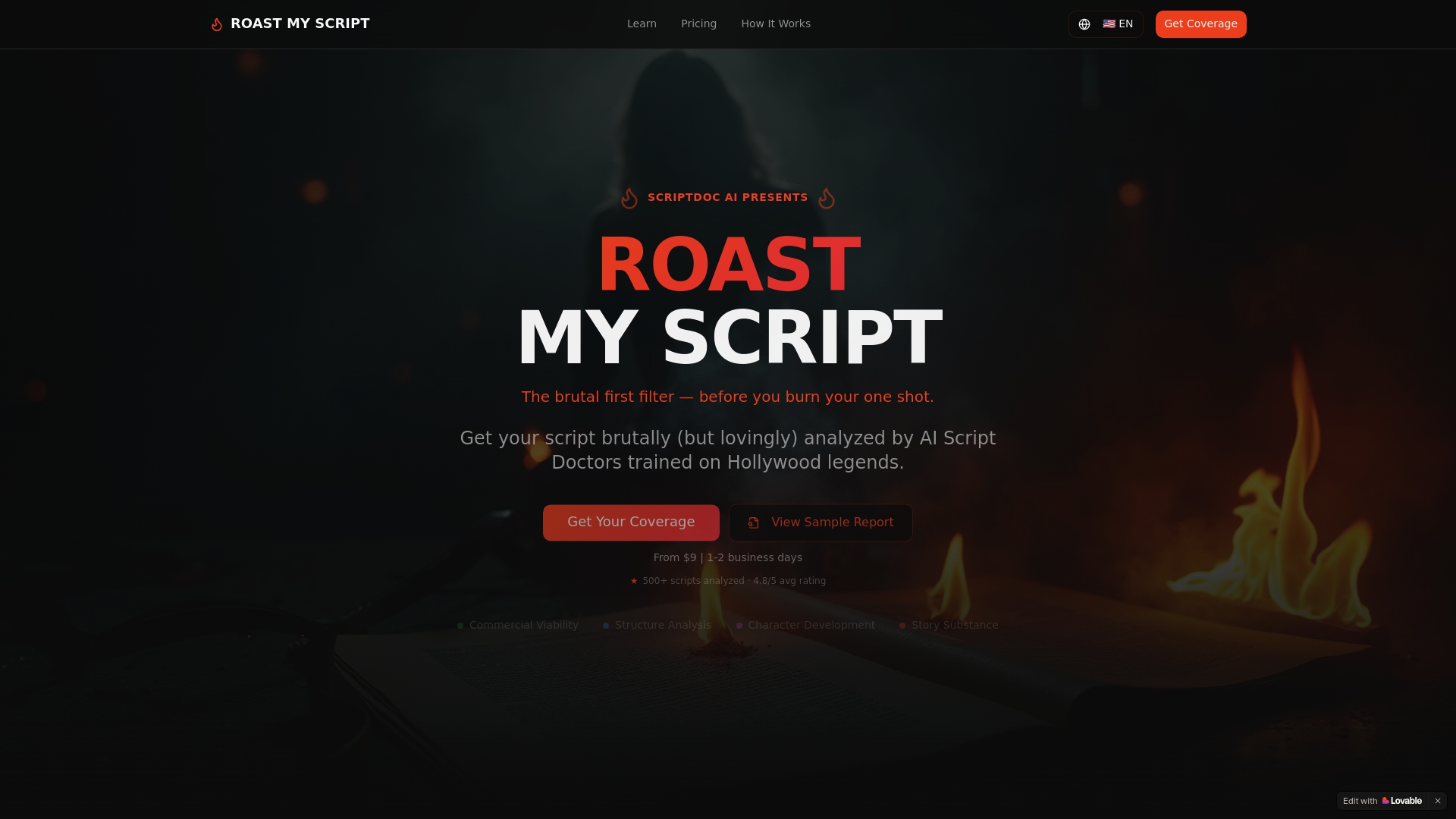
You've learned what coverage is and how to use it effectively. Now it's time to experience professional feedback on your own screenplay. Roast My Script offers AI-powered coverage starting at $9, delivering structural analysis within 48 hours. This affordable entry point lets you test coverage without financial risk.
For deeper analysis, explore hybrid services that combine AI diagnostics with human creative insight. These balanced reports help you address both technical craft issues and subtle storytelling challenges. Complement your coverage feedback with educational resources on character spine development and character dimensionality techniques. This combination of professional analysis and targeted learning accelerates your growth as a screenwriter. Stop guessing whether your script is ready. Get objective feedback that transforms your screenplay from promising to production-worthy.
Frequently asked questions
What is the turnaround time for professional script coverage?
Human coverage typically takes 1 to 2 weeks from submission to report delivery. Industry readers balance multiple projects and provide thoughtful analysis that requires time. AI coverage services deliver reports within 1-2 days by email since algorithms process scripts instantly. Hybrid services usually fall between these extremes, taking 3 to 5 days to complete both automated analysis and human review layers.
Can AI completely replace human script coverage?
AI excels at structural diagnostics, beat identification, and objective pattern analysis but cannot fully replicate human interpretive nuance. Expert readers note AI should serve as a preliminary diagnostic tool rather than a complete replacement for human feedback. AI misses subtleties in tone, subtext, cultural context, and creative rule-breaking that experienced readers recognize. Most professionals recommend combining AI's speed and consistency with human insight for comprehensive script evaluation.
How can I best apply script coverage feedback to improve my screenplay?
Start by prioritizing structural and character issues identified in your report before polishing surface-level elements. Address foundation problems like unclear protagonist motivation or missing story beats first. Use proven script analysis techniques to implement revisions systematically. Apply frameworks like Linda Seger's character spine to deepen character work when readers flag dimensional issues. Revise iteratively, tackling one major weakness per draft pass for measurable improvement.
Does positive script coverage guarantee my screenplay will sell?
No coverage report guarantees sales, acceptance, or success. Coverage evaluates whether your script meets professional standards and has commercial potential. Even glowing feedback doesn't force producers to buy your screenplay or festivals to accept your submission. Coverage serves as a developmental tool that increases your odds by ensuring your script competes at a professional level. It identifies strengths to leverage and weaknesses to fix before you invest in submissions or pitch meetings.