
You've finished your screenplay. But is it ready for producers, festivals, or even a paid script reader? Most screenwriters struggle to objectively assess their own work, unsure if their structure holds, characters resonate, or dialogue lands. Professional script analysis uncovers hidden strengths and glaring weaknesses before you invest in expensive coverage or risk rejection. This guide breaks down how to analyze a script efficiently, affordably, and with the precision Hollywood expects.
Table of Contents
- Preparing To Analyze Your Script: Gathering Tools And Understanding Context
- Step-By-Step Script Analysis: Scene Breakdowns And Identifying Key Story Elements
- Analyzing Narrative Structure And Thematic Elements To Strengthen Your Screenplay
- Critical Thinking And Refining: Identifying Opportunities To Improve Your Script
- Get Professional Script Analysis Before Your Next Submission
- Frequently Asked Questions About Script Analysis
Key takeaways
| Point | Details |
|---|---|
| Preparation is foundational | Gather clean scripts, research context, and understand writer intentions before analysis begins. |
| Scene-by-scene breakdown reveals structure | Dissecting beats, objectives, and obstacles clarifies narrative flow and character development. |
| Thematic and structural analysis elevates impact | Identifying motifs and structural pillars strengthens emotional resonance and audience engagement. |
| Critical thinking identifies opportunities | Questioning purpose, pacing, and biases pinpoints actionable improvements aligned with market expectations. |
| Professional tools enhance accuracy | Data-driven methods and AI analysis complement human insight for comprehensive script evaluation. |
Preparing to analyze your script: gathering tools and understanding context
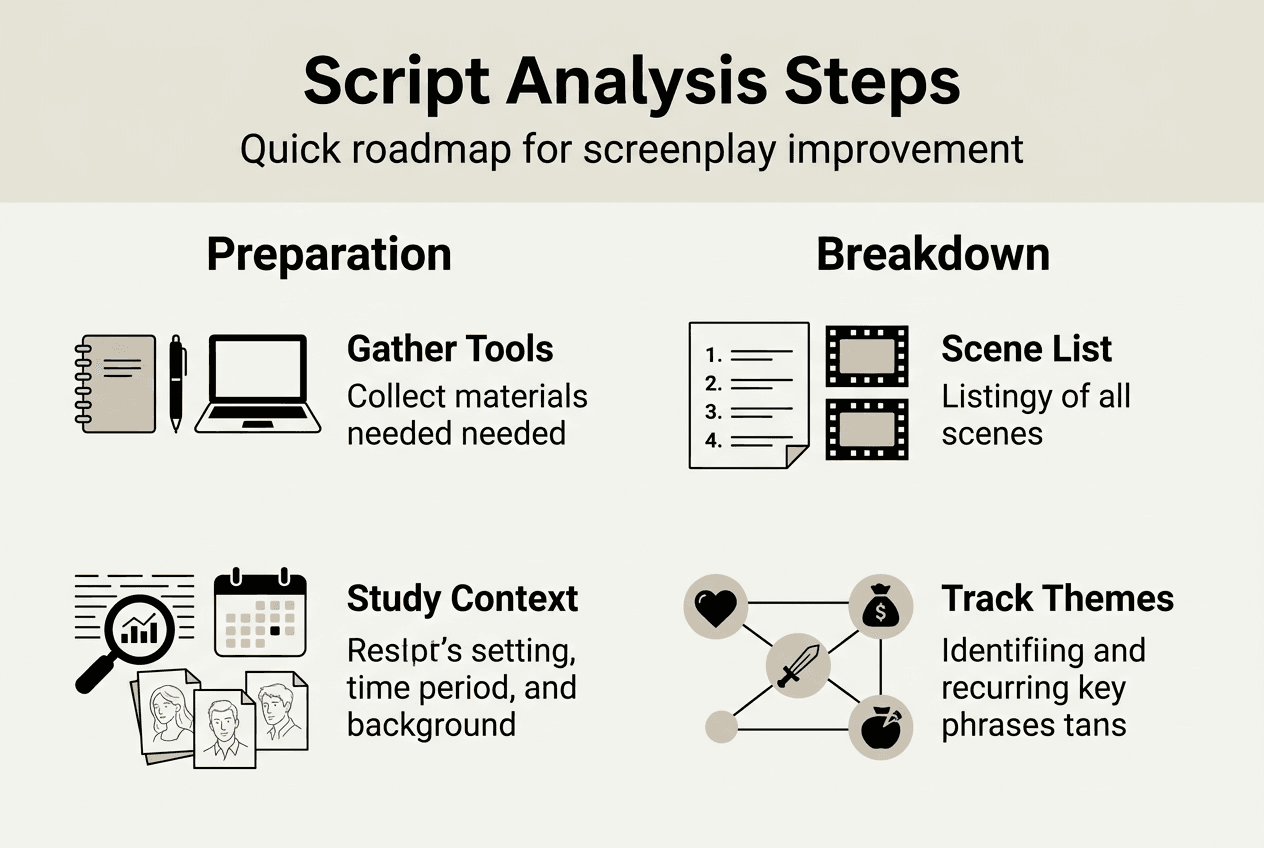
Before you dissect a single scene, you need the right materials and mindset. Start with a clean, professionally formatted copy of the script. Formatting errors distract from content and signal amateur work. Understanding script format impact on production and pitch success is crucial.
Research the script's cultural and socio-economic context. Analyzing a script professionally involves understanding context, including the character's socio-economic background and cultural backdrop. A period drama set in 1920s Chicago demands different analysis lenses than a contemporary sci-fi thriller. Context shapes character motivations, dialogue authenticity, and thematic depth.
Understand the writer's intentions and target audience beforehand. Is this a festival darling aiming for Sundance, or a commercial spec script targeting Netflix? Genre conventions and audience expectations vary wildly. A horror script needs different pacing and tension beats than a romantic comedy.
Gather note-taking tools and arrange a distraction-free space to analyze. Digital tools like Final Draft or Celtx offer scene navigation features. Physical notebooks work too. The key is consistency in how you track observations across scenes.
Familiarize yourself with key screenwriting terms and structure concepts:
- Beat: The smallest unit of action or emotional shift within a scene
- Inciting incident: The event that kicks the story into motion
- Midpoint: The structural pivot that raises stakes or reveals new information
- Climax: The story's highest tension point where the protagonist faces their ultimate challenge
- Resolution: How the story settles after the climax
Pro Tip: Create a one-page reference sheet with your script's logline, protagonist goal, and central conflict. Refer back to this sheet during analysis to ensure every scene serves the core story.
Step-by-step script analysis: scene breakdowns and identifying key story elements
Now you're ready to dissect the script. Scene-by-scene breakdown creates a foundation for deeper analysis of the story and helps pare it down to constituent parts. This granular approach reveals patterns invisible during casual reading.
-
Divide the script into individual scenes for detailed examination. Number each scene and note its page count. This creates a structural map you'll reference throughout analysis.
-
Within scenes, identify beats, objectives, tactics, and obstacles. Every scene should have a clear objective for the protagonist or viewpoint character. What do they want? What stands in their way? How do they attempt to overcome it? These elements drive dramatic tension.
-
Chart character goals and conflicts in each scene to trace development. Create a tracking document that logs each major character's objective, action, and outcome per scene. You'll spot inconsistent motivations or underdeveloped arcs immediately.
-
Analyze subtext in dialogue to add nuance. What characters say rarely matches what they mean. Strong dialogue operates on multiple levels. Look for moments where action contradicts words, revealing deeper emotional truths.
-
Use a structured table to organize scene details for clarity. Here's a sample framework:
| Scene # | Location | Characters | Objective | Conflict | Outcome | Story Function |
|---|---|---|---|---|---|---|
| 1 | Coffee shop | Sarah, Mark | Sarah wants to break up | Mark refuses to accept it | Unresolved tension | Establishes relationship stakes |
| 2 | Sarah's apartment | Sarah, Mom | Sarah seeks validation | Mom dismisses her feelings | Sarah feels isolated | Deepens emotional wound |
This table format lets you scan the entire script's structure at a glance. You'll notice if too many scenes share the same location, if a character disappears for thirty pages, or if objectives become repetitive.
Pro Tip: Track emotional beats separately from plot beats. A character can achieve their scene objective while emotionally regressing. These contradictions create complexity.
Analyzing narrative structure and thematic elements to strengthen your screenplay
With scene-level details mapped, zoom out to examine big-picture structure and themes. Spider-Man: Into the Spider-Verse uses structural parallelism and a narrative fugue to deconstruct genre conventions and accelerate dramatic pace. Your script needs similar structural intentionality.

Identify key structural pillars like acts, climaxes, and turning points. Traditional three-act structure places the first turning point around page 25-30, midpoint at page 55-60, and second turning point at page 85-90 in a 110-page script. Does your script hit these markers? If not, is the deviation intentional and effective?
Compare different structural approaches:
| Structure Type | Characteristics | Best For | Potential Pitfalls |
|---|---|---|---|
| Linear | Chronological progression | Clear cause-and-effect stories | Can feel predictable |
| Parallel | Multiple storylines converge | Ensemble casts, thematic exploration | Requires tight pacing to maintain interest |
| Non-linear | Time jumps, flashbacks | Mystery, psychological drama | Confusing if not clearly signposted |
Analyze thematic motifs such as identity, legacy, and responsibility. Themes emerge through repeated imagery, dialogue patterns, and character choices. A script about identity might feature mirrors, disguises, or characters questioning who they really are. Count how often these motifs appear and whether they build toward thematic resolution.
Evaluate how the script's tone and style reinforce its themes. A dark comedy about death should balance gallows humor with genuine emotion. Tonal inconsistency confuses audiences. Mark scenes that feel tonally off and ask why.
Understand how structure influences audience engagement. Structure isn't arbitrary. It manages information flow, controls pacing, and creates emotional peaks and valleys. A thriller needs escalating tension. A romance needs push-pull dynamics. Does your structure serve your genre's emotional contract with the audience?
Critical thinking and refining: identifying opportunities to improve your script
Objective analysis only takes you halfway. Now apply critical thinking to transform observations into actionable improvements. Critical script analysis involves questioning the script's purpose, target audience, biases, and tone to enhance accuracy.
Ask why the story is told and who it's for before making changes. Every revision choice should serve your target audience and market positioning. A script aimed at A24 needs different sensibilities than one targeting Marvel Studios. Define your ideal viewer and filter changes through their expectations.
Look for pacing inconsistencies and structural gaps. Does Act Two sag? Do scenes repeat information? Is the climax rushed? Use your scene breakdown table to identify where pacing drags or accelerates unnaturally. Common issues include:
- Too many setup scenes before the inciting incident
- Repetitive confrontations that don't escalate stakes
- Subplots that don't intersect with the main story
- Climaxes that resolve too easily without earned struggle
Beware of common biases and assumptions in your writing. You know your characters intimately, but readers don't. Information that feels obvious to you might be unclear on the page. Have you assumed readers will infer character backstory without adequate setup? Do you rely on cliches because they feel efficient?
Note dialogue verbosity and redundancies. Read dialogue aloud. If it sounds like a speech rather than conversation, cut it. Characters should communicate through subtext and action, not exposition dumps. Mark any dialogue exchange longer than half a page for potential trimming.
Prioritize improvements that align with target audience and market expectations. Not every note deserves implementation. Focus on changes that strengthen your script's commercial viability or artistic vision. A character's quirky hobby might be charming but irrelevant if it doesn't serve plot or theme.
Pro Tip: Create a revision priority matrix. Label issues as high, medium, or low impact based on how much they affect story clarity, character development, and marketability. Tackle high-impact issues first.
Modern script analysis techniques in 2026 combine traditional craft knowledge with data-driven tools. AI can flag pacing issues, dialogue patterns, and structural deviations faster than manual analysis. But human judgment remains essential for evaluating emotional resonance, originality, and marketability.
Get professional script analysis before your next submission
You've learned how to analyze your script systematically. But even experienced screenwriters benefit from outside perspectives. Self-analysis has limits because you're too close to the material. Fresh eyes catch blind spots you've rationalized away.

Roast My Script delivers professional AI-powered script analysis in 1-2 days by email for $9-$25, a fraction of traditional coverage costs. Our system applies Hollywood methodology from Syd Field, Robert McKee, and Save the Cat to identify structural weaknesses, pacing issues, and character inconsistencies before you pitch to producers or festivals. Think of it as your brutal filter, the reality check that saves you from expensive script doctors or embarrassing rejections. Upload your script, receive detailed PDF analysis, and revise with confidence knowing exactly what needs fixing.
Frequently asked questions about script analysis
How detailed should a scene breakdown be?
Your breakdown should capture objective, conflict, and outcome for each scene at minimum. Add emotional beats, subtext notes, and thematic connections for deeper analysis. The level of detail depends on your goals: quick structural audit versus comprehensive revision prep.
What is the best way to identify a script's theme?
Look for patterns in character choices, repeated imagery, and dialogue motifs. Theme emerges from what characters struggle with and how the story resolves. Ask what universal human experience your protagonist's journey represents. Understanding story structure breakdown helps reveal thematic architecture.
Can AI tools replace human script analysts?
AI tools for script analysis excel at identifying structural patterns, pacing issues, and formatting problems. They can't evaluate originality, emotional authenticity, or market positioning as effectively as experienced human readers. Best results come from combining AI efficiency with human insight for final evaluation.
How often should I analyze and revise my script before submission?
Analyze thoroughly after completing your first draft, then again after major revisions. Most professional scripts go through 3-5 substantial rewrites before submission. Set the script aside for two weeks between analysis sessions to gain fresh perspective. Stop revising when changes become cosmetic rather than structural.
What's the difference between script analysis and script coverage?
Analysis focuses on understanding how the script works structurally and thematically. Coverage adds a commercial evaluation, including marketability assessment, comparable films, and a pass/consider/recommend rating. Analysis is diagnostic, coverage is evaluative. Both are valuable at different stages of development.
Recommended
- Script format impact: 90% boost production & pitch success | ROAST MY SCRIPT
- Roast My Script | AI Script Coverage & Analysis from $9
- Role of dialogue in scripts: 42% tied to verbosity | ROAST MY SCRIPT
- Master Story Structure Breakdown for Screenwriters | ROAST MY SCRIPT
- The essential parts of a screenplay pros use to get noticed