
Many screenwriters treat genre as an afterthought, a simple checkbox on a contest submission form. This misconception can sabotage your script before it even reaches the right readers. Genre is not just a marketing label but a foundational framework that shapes audience expectations, guides your storytelling choices, and determines whether your screenplay finds its audience. Understanding screenplay genres deeply transforms how you write, pitch, and position your work in an increasingly competitive market. This guide demystifies genre conventions, explains strategic genre-bending, and shows you how to leverage genre knowledge to boost your screenplay's success in 2026.
Table of Contents
- Understanding Screenplay Genres And Their Importance
- Genre-Bending Screenplays: Balancing Conventions And Originality
- Comparing Screenplay Genre Conventions And Market Realities In 2026
- Applying Genre Knowledge To Improve Your Screenplay's Market Readiness
- Boost Your Screenplay's Character Depth With Expert Frameworks
Key takeaways
| Point | Details |
|---|---|
| Genre guides expectations | Clear genre identification helps meet audience expectations and simplifies marketing to industry professionals. |
| Dominant tone determines classification | Genre-bending requires emphasizing dominant tones and tropes for accurate classification. |
| Originality through blending | Successful genre-bending can increase a screenplay's originality and appeal when executed strategically. |
| Pitching advantage | Understanding genre conventions aids in pitching and contest submissions by communicating script identity quickly. |
| Market realities matter | Original films face market challenges; leveraging genre and source familiarity boosts success. |
Understanding screenplay genres and their importance
Screenplay genres are narrative categories distinguished by specific conventions and audience expectations. Each genre carries recurring tropes, tone, character types, and story structures that signal what kind of experience viewers should anticipate. When you write a thriller, audiences expect tension, suspense, and high stakes. A romantic comedy promises humor, relationship obstacles, and an emotionally satisfying resolution. These aren't arbitrary rules but shared languages between storyteller and audience.
Understanding genre conventions is crucial for screenwriters to meet audience expectations and market their scripts effectively. Industry professionals like producers, agents, and contest readers are genre-savvy gatekeepers who use genre as a filtering mechanism. They need to quickly assess whether your script fits their slate, their audience, or their personal reading preferences. A clearly defined genre makes your screenplay instantly comprehensible and marketable.
Genre conventions include:
- Recurring tropes that define the category (detective investigating crimes in noir, meet-cute in romance)
- Tone and mood that set emotional expectations (dark and cynical versus light and hopeful)
- Character archetypes typical to the genre (the reluctant hero, the femme fatale, the mentor)
- Story structure patterns specific to each genre (mystery reveals, romantic obstacles, action set pieces)
Scripts adhering to genre expectations are more easily understood and appreciated, increasing chances for success. Consider 'Cocaine Bear,' which clearly identifies as comedy horror, or 'Everything Everywhere All At Once,' which blends sci-fi, action, and family drama but maintains coherent emotional throughlines. Both films succeeded because they understood their genre foundations even while pushing boundaries. Mastering your script development process starts with recognizing how genre shapes every creative decision from concept to final draft.
Genre-bending screenplays: balancing conventions and originality
Genre-bending involves mixing elements from multiple genres within a single screenplay to create fresh, surprising narratives. This approach can elevate your script from formulaic to memorable, but it requires careful execution. The key challenge is maintaining clarity and marketability while experimenting with genre fusion. Audiences and industry professionals still need a primary genre anchor to understand what they're watching.

Determining the dominant genre requires assessing the overall mood, tone, and the most prevalent tropes present in your script. Ask yourself which genre elements drive the main character's journey and shape the viewer's primary emotional experience. If your script features horror elements but the core narrative follows a romantic relationship overcoming supernatural obstacles, you're writing a horror romance with romance as the dominant genre. If the horror creates the main tension and the romance serves as subplot, flip that classification.
Successful genre-bending often involves balancing tropes from different genres without diluting either. Quentin Tarantino masterfully blends crime, comedy, and drama by grounding outlandish scenarios in character-driven dialogue and emotional stakes. 'Cocaine Bear' and 'Everything Everywhere All at Once' achieved significant success by embracing genre-bending while maintaining strong narrative focus. 'Cocaine Bear' never loses sight of its comedic horror identity, and 'Everything Everywhere' anchors its multiverse chaos in a mother-daughter relationship.
The importance of focusing narrative and character arcs cannot be overstated when blending genres. Without a clear emotional throughline, genre-bending becomes genre confusion. Your protagonist's journey should remain coherent even as the world around them shifts between genre conventions. Effective story structure provides the skeleton that holds diverse genre elements together.
Key strategies for effective genre-bending:
- Identify one dominant genre and use others as flavoring rather than equal partners
- Ensure tonal consistency even when mixing disparate elements
- Ground experimental choices in strong character development and clear stakes
- Study successful genre-benders to understand how they manage audience expectations
Pro Tip: Focus on your main character's emotional journey to ground the story amid diverse genre elements. When genre conventions pull in different directions, the protagonist's arc provides the compass that keeps your screenplay coherent and emotionally resonant.
Comparing screenplay genre conventions and market realities in 2026
Each major screenplay genre carries distinct conventions that shape audience expectations and market positioning. Understanding these differences helps you make strategic choices about which genre best serves your story and career goals.
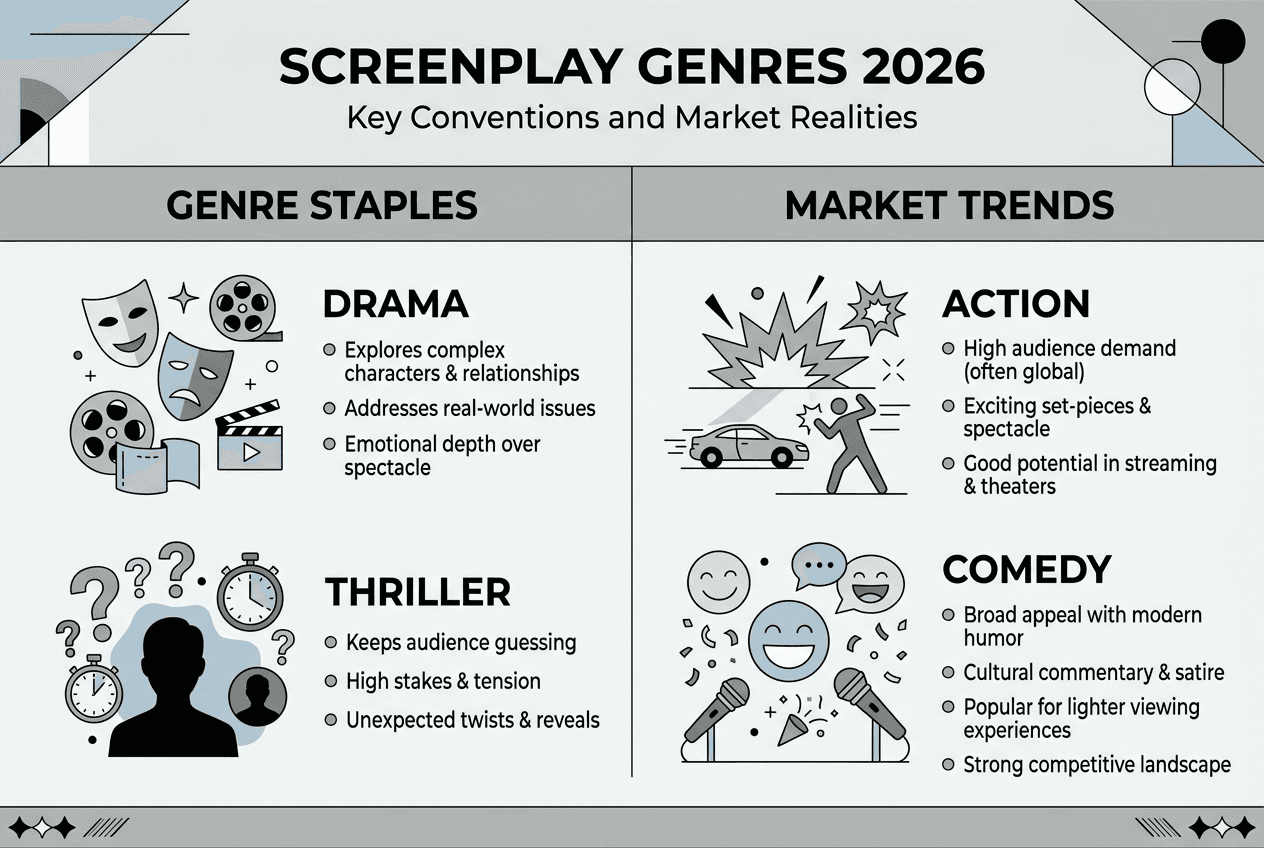
| Genre | Key Tropes | Tone | Audience Expectations |
|---|---|---|---|
| Thriller | High stakes, ticking clocks, conspiracy | Tense, suspenseful | Edge-of-seat tension, plot twists |
| Comedy | Misunderstandings, physical gags, witty dialogue | Light, humorous | Laughter, feel-good resolution |
| Drama | Character conflicts, moral dilemmas, relationships | Serious, emotional | Emotional depth, character growth |
| Sci-Fi | Advanced technology, future worlds, speculation | Wonder, cautionary | Thought-provoking concepts, world-building |
| Horror | Threats, jump scares, survival | Dark, frightening | Fear, adrenaline, catharsis |
Genre conventions appeal differently to various audience segments, which directly impacts marketability. Thrillers attract viewers seeking intellectual engagement and adrenaline. Comedies promise escape and stress relief. Dramas offer emotional catharsis and human connection. Sci-fi appeals to imaginative minds interested in ideas and possibilities. Horror provides controlled fear experiences and boundary-pushing content.
The 2026 market presents specific challenges for original screenplays. Original and new-to-screen films struggle at the box office compared to established intellectual property. Franchises, sequels, and adaptations dominate because they come with built-in audiences and reduced marketing risk. This reality doesn't mean original screenplays can't succeed, but it does require strategic thinking about how you position your work.
Source material, real-world subjects, and cultural familiarity can help launch fresh theatrical ideas. If you're writing an original screenplay, consider grounding it in recognizable genre conventions, true stories, or culturally resonant themes. A sci-fi thriller based on current AI concerns carries more immediate market appeal than a completely abstract futuristic concept. A horror film exploring contemporary social anxieties connects with audiences more readily than generic scares.
Understanding script format impact on production and pitch success complements genre knowledge. Professional formatting signals you understand industry standards, while clear genre identification signals you understand your audience.
Pro Tip: Align genre choices with market realities without sacrificing creative originality. Study what's selling in your target genre, identify underserved niches or fresh angles, and position your screenplay as both familiar enough to market and original enough to stand out.
Applying genre knowledge to improve your screenplay's market readiness
Transforming genre understanding into practical action requires systematic application throughout your writing and marketing process. Here's how to leverage genre knowledge at every stage:
-
Select your screenplay's genre by identifying the dominant tropes, tone, and emotional experience in your story. List the genre elements present, then rank them by prominence and impact on the narrative.
-
Confirm your genre choice by testing it against audience expectations. Does your thriller actually create sustained tension? Does your comedy deliver consistent laughs? If the answer is no, either revise the script or reconsider the genre label.
-
Use genre strategically when writing loglines and query letters. Crafting compelling screenplay pitches requires immediately communicating what kind of story you're telling. A clear genre reference helps busy readers instantly grasp your script's identity.
-
Apply genre knowledge when pitching to better communicate script identity quickly. Knowing your script's genre helps when pitching and explaining what kind of script it is to producers, agents, or financiers who think in genre categories.
-
Label your screenplay correctly for contest submissions. Contest readers prefer scripts in genres they enjoy, increasing the chance of a favorable read. Misidentifying your genre means your script lands with readers predisposed to dislike it.
-
Maintain genre consistency while allowing creative flexibility throughout your script development process. Genre provides guardrails, not a prison. You can innovate within genre boundaries by subverting specific tropes while honoring overall conventions.
-
Study successful films in your target genre to understand current market expectations. What worked five years ago may feel dated now. Genre conventions evolve with cultural shifts and audience sophistication.
-
Align your screenplay with proven Hollywood screenplay structure patterns appropriate to your genre. Thrillers typically accelerate pacing in act three, while dramas may slow down for emotional resolution.
Pro Tip: Regularly reassess your screenplay's genre as drafts evolve to keep marketing aligned. The genre that fit your initial concept may shift as characters deepen and themes emerge. Staying flexible about genre classification ensures your marketing accurately represents your finished script.
Boost your screenplay's character depth with expert frameworks
Deep character development enhances any genre screenplay's emotional impact and market appeal. Whether you're writing a high-concept thriller or an intimate drama, compelling characters transform good scripts into great ones that readers and audiences remember. Genre provides the framework, but characters provide the heart.
Roast My Script offers expert frameworks inspired by Linda Seger and Sánchez-Escalonilla to build character spine, dimensionality, and architecture. These proven methodologies help you create multi-layered protagonists and antagonists who drive your story forward while satisfying genre expectations. Understanding your character's spine clarifies their core motivation and ensures consistency across your screenplay.
Exploring character dimensionality adds complexity and unpredictability that elevates your screenplay beyond genre formulas. Meanwhile, mastering character architecture through archetypes and temperaments gives you tools to create memorable supporting casts. Using these character tools complements genre understanding to elevate storytelling quality and audience engagement, strengthening your screenplay from concept to pitch.
Frequently asked questions
What are the main screenplay genres and how do I choose the right one?
Main genres include drama, comedy, thriller, horror, romance, sci-fi, fantasy, and action, each with distinct conventions and audience expectations. Choose based on the dominant tone, story style, and recurring tropes in your script. Consider where your screenplay fits most naturally and what audience expectations you want to meet or subvert. Reassess genre choices as your story and characters evolve through the script development process, since early drafts may shift in unexpected directions.
How do I identify the dominant genre in a genre-bending screenplay?
Assess the overall tone and the most frequently used genre tropes throughout your screenplay. Prioritize the genre that shapes the viewer's main emotional experience and drives your protagonist's journey. If horror elements create the primary tension and emotional stakes, you're writing horror with other genre flavoring. If romance drives the narrative and horror provides obstacles, you're writing romance with horror elements.
Why is knowing my screenplay's genre important for pitching and contests?
It helps you succinctly describe your script and target the right readers or producers who specialize in or prefer that genre. Contests let readers filter scripts by preferred genres, increasing chances your script lands with fans of that genre who will appreciate your work. Misidentifying genre means your screenplay gets evaluated by readers predisposed to dislike it, regardless of quality. Clear genre communication is professional courtesy that respects everyone's time.
What market challenges do original screenplay genres face in 2026?
Original films tend to struggle more at box office compared to adaptations or franchises with built-in audiences and recognition. Leveraging familiar genre conventions and real-world or cultural references can improve market acceptance by reducing perceived risk. Studios and financiers view original screenplays as higher risk investments, so demonstrating strong genre credentials and marketability becomes even more critical for breaking through.
Recommended
- Script format impact: 90% boost production & pitch success | ROAST MY SCRIPT
- Master Story Structure Breakdown for Screenwriters | ROAST MY SCRIPT
- Roast My Script | AI Script Coverage & Analysis from $9
- Roast My Script | AI Script Coverage & Analysis from $9
- The essential parts of a screenplay pros use to get noticed