
You've probably heard the claim that AI will replace screenwriters entirely. That's not what's happening. In 2026, AI serves as an assistive tool through iterative refinement using collaborative language models, not as a creative replacement. This guide explains AI's real role in scriptwriting today, how it improves story development and script analysis, and what you need to know to integrate these tools into your workflow while maintaining your unique voice and vision.
Table of Contents
- Understanding AI's Capabilities And Mechanics In Scriptwriting
- What AI Excels At Versus Its Limitations In Storytelling
- How Screenwriters Are Integrating AI Into Their Creative Process Today
- Choosing The Right AI Tools To Enhance Your Script's Market Readiness
- Get AI-Driven Script Coverage With Roast My Script
- Frequently Asked Questions
Key takeaways
| Point | Details |
|---|---|
| AI improves quality through refinement | Iterative frameworks enhance scene detail by 66.7% and overall script quality by 53.4% compared to baseline methods. |
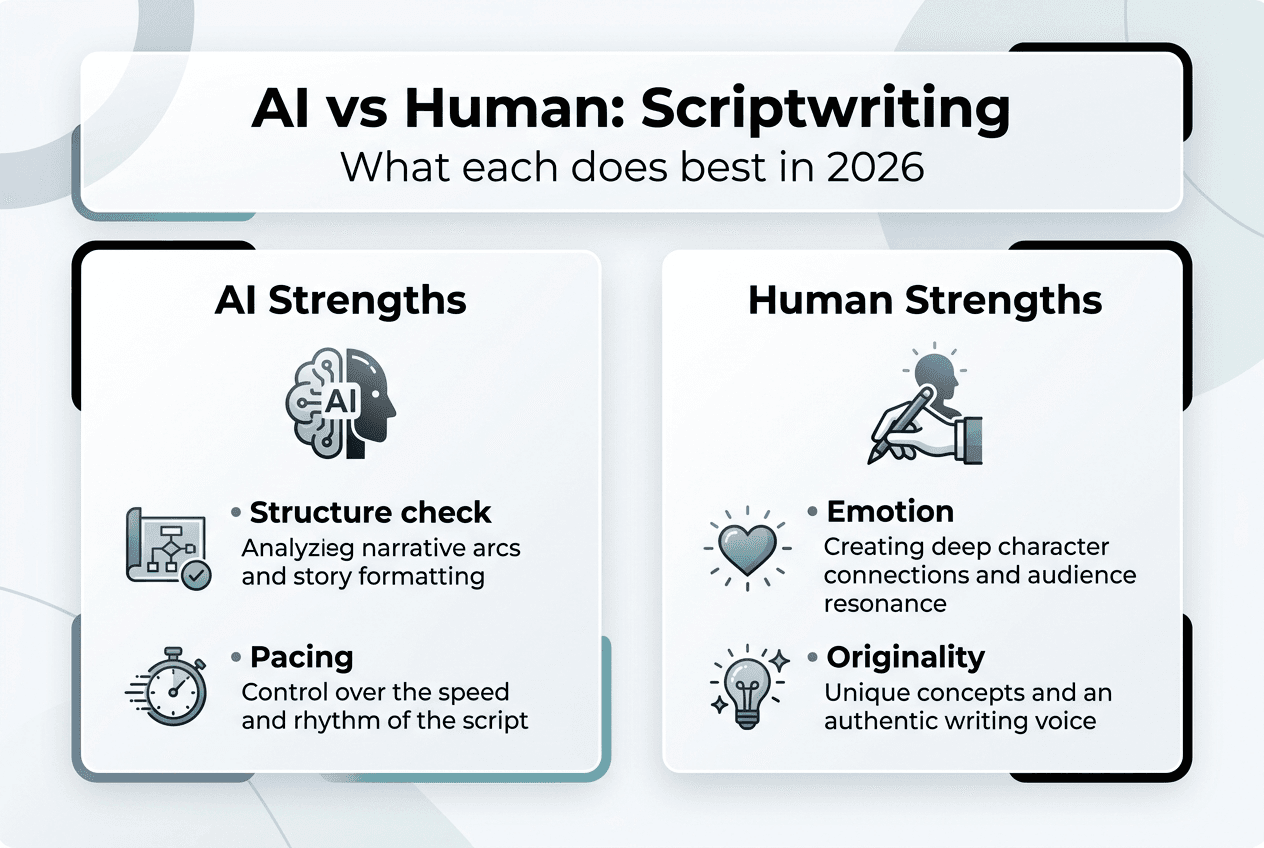
| Strengths in structure, gaps in emotion | AI excels at pacing and predictive metrics but struggles with subtext, originality, and emotional nuance. |
| Widespread adoption for ideation | 78% of screenwriters use AI primarily for plot development, dialogue assistance, and idea generation. |
| Specialized tools outperform generic models | Domain-specific platforms deliver superior accuracy in script analysis compared to general language models. |
| Best results come from collaboration | AI enhances human creativity rather than replacing it, serving as a structural partner in the writing process. |
Understanding AI's capabilities and mechanics in scriptwriting
AI scriptwriting tools rely on natural language processing to analyze sentiment, structure, and pacing within your screenplay. These systems use multi-agent large language models that collaborate in stages, each agent focusing on specific aspects like dialog flow, character consistency, or scene transitions. One agent might identify pacing issues while another suggests improvements to character arcs, creating a divide and conquer approach that mirrors how human script consultants work together.
The technology works through iterative cycles. You submit a draft, the AI analyzes it across multiple dimensions, provides feedback, and you revise. This process repeats until the script reaches a target quality threshold. Research shows this method improves script quality by 53.4% overall and delivers even stronger results at the scene level, where improvements reach 66.7%.
Challenges persist with very long scripts where context windows limit the AI's ability to track complex narrative threads across 120 pages. Emotional nuance remains difficult for algorithms to evaluate accurately. A scene might be technically well structured but lack the subtle tension that makes audiences lean forward in their seats. AI can flag structural problems but often misses these deeper layers.
The iterative workflow mimics human revision cycles. Professional screenwriters rarely nail a scene on the first pass. They write, review, rewrite, and polish. AI accelerates this process by providing instant structural feedback that would traditionally require weeks of notes from script consultants or coverage services. You can run through multiple revision cycles in days rather than months.
Pro Tip: Use AI driven iterative tools early in your development process to establish structural clarity, then shift focus to emotional depth and character authenticity in later drafts where human insight matters most.
What AI excels at versus its limitations in storytelling
AI demonstrates measurable strength in analyzing screenplay structure and predicting commercial performance. Systems trained on thousands of scripts can predict box office success with approximately 86% accuracy by identifying patterns in pacing, character introduction timing, and plot point placement. These predictive capabilities help you understand whether your script aligns with market expectations before you invest in expensive professional coverage.
Scene level improvements show the most dramatic results. The data reveals AI improves scene details by 66.7%, outperforming baseline methods by 8.3%. This means AI excels at micro level analysis, catching inconsistencies in character behavior within individual scenes, identifying dialog that doesn't match established voice patterns, and flagging pacing issues where scenes drag or rush.
However, emotional depth and originality remain distinctly human territories. AI can recognize that a scene needs more conflict but cannot generate the specific subtext that makes that conflict resonate emotionally. It identifies structural problems in your three act structure but struggles to evaluate whether your protagonist's internal journey feels authentic or derivative.
| Aspect | AI Strengths | AI Limitations |
|---|---|---|
| Structure | Identifies act breaks, pacing issues, plot holes | Cannot evaluate artistic structure choices |
| Dialog | Flags inconsistent voice patterns, exposition dumps | Misses subtext, irony, cultural nuance |
| Characters | Tracks consistency, arc completion | Cannot judge authenticity or depth |
| Originality | Compares to existing patterns | Cannot create or recognize true innovation |
| Market fit | Predicts commercial viability with 86% accuracy | Ignores breakthrough potential of unconventional scripts |
The technology works best on screenplay structure fundamentals where objective standards exist. Three act structure either functions or it doesn't. Inciting incidents either occur at the right page count or they don't. But evaluating whether your script's emotional core will move audiences requires human judgment that AI cannot replicate.
Pro Tip: Combine AI structural feedback with human emotional insight by using AI for your first two revision passes to fix technical problems, then bringing in human readers for feedback on character depth, thematic resonance, and originality.
How screenwriters are integrating AI into their creative process today
Research involving 23 professional screenwriters reveals that 78% use AI primarily for plot development, dialog generation, and idea brainstorming. These writers don't view AI as a replacement but as a creative partner that accelerates specific workflow stages. One writer might use AI to generate ten different approaches to a problematic second act, then select and refine the most promising option. Another uses AI to test dialog variations and identify which version sounds most natural.

Screenwriters assign AI different collaborative roles depending on their needs. Some treat AI as a simulated actor, feeding it character backstories and testing how that character might respond in various situations. Others use AI as a virtual audience, getting instant feedback on whether a joke lands or a twist feels earned. A third group employs AI as an expert consultant, asking questions about genre conventions, story structure, or formatting standards.
Attitudes toward AI remain mixed. Some writers embrace the technology enthusiastically, viewing it as a productivity multiplier that frees them to focus on creative decisions rather than technical execution. Others worry about authenticity, concerned that AI generated suggestions might homogenize their voice or push scripts toward formulaic patterns. Job security concerns persist, though most recognize AI as a tool rather than a competitor.
Effective integration strategies include:
- Define specific AI roles before each session to avoid aimless prompting
- Use AI for rapid iteration on problem scenes rather than generating entire drafts
- Treat AI suggestions as starting points requiring human refinement
- Maintain your authentic voice by filtering AI output through your creative vision
- Combine AI dialog analysis with human feedback on subtext and character voice
- Document your script development process to identify where AI adds most value
The most successful implementations treat AI as a collaborative tool within a larger creative process. You remain the creative director making final decisions about story, character, and theme. AI serves as a tireless assistant that generates options, identifies problems, and accelerates revision cycles.
Pro Tip: Define clear AI roles upfront by writing a brief creative brief for each AI session, specifying whether you need the AI to function as actor, audience, expert, or executor, which maximizes the relevance and usefulness of its suggestions.
Choosing the right AI tools to enhance your script's market readiness
Specialized AI platforms designed specifically for screenwriting deliver superior results compared to generic language models. These tools incorporate domain knowledge about screenplay formatting, industry standards, and genre conventions that general purpose AI lacks. A specialized platform understands that excessive dialog verbosity signals amateur writing, while a generic model might miss this industry specific issue.
Predictive analytics demonstrate the power of specialized training. Research on 25,000+ TV scripts shows machine learning models can explain up to 50% of viewership variance at the genre level by analyzing script features like pacing, character introduction patterns, and plot structure. This predictive capability helps you understand whether your script aligns with audience expectations before submission.
However, empirical benchmarks reveal humans remain superior at evaluating nuance, subtext, and originality. The data supports using specialized tools over generic language models for technical screenplay analysis while maintaining human oversight for creative judgment.
| Platform Type | Analysis Accuracy | Key Features | Typical Cost |
|---|---|---|---|
| Specialized AI script tools | 85-90% on structure | Dialog, pacing, formatting, predictive metrics | $9-50 per analysis |
| Generic LLMs | 60-70% on structure | General feedback, brainstorming, ideation | $20-200/month subscription |
| Human coverage services | 95%+ on nuance | Emotional depth, originality, market insight | $60-400 per script |
| Hybrid AI plus human | 90-95% comprehensive | Combined technical and creative analysis | $50-150 per script |
When selecting AI tools for market readiness, consider:
- Specialization in screenplay format versus general writing assistance
- Training data scope covering your target genre and format
- Integration with industry standard software like Final Draft or Celtx
- Transparency about AI limitations and when human feedback matters more
- Pricing structure matching your budget and revision frequency
- Turnaround time fitting your submission deadlines
The best approach combines AI script analysis tools for technical fundamentals with human readers for creative evaluation. Use AI to ensure your script formatting meets industry standards, your structure follows proven patterns, and your pacing maintains audience engagement. Then invest in human coverage to evaluate whether your story resonates emotionally and stands out in a crowded market.
Pro Tip: Validate AI feedback with human script readers by running your revised draft past at least one experienced screenwriter or script consultant to ensure the AI improvements haven't inadvertently flattened your unique voice or pushed your script toward generic patterns.
Get AI-driven script coverage with Roast My Script
Now that you understand how AI enhances scriptwriting without replacing human creativity, it's time to apply these insights to your own work. Roast My Script delivers affordable AI powered script analysis starting at $9, combining the structural precision of specialized AI with practical feedback designed for both aspiring and established screenwriters. The platform applies cutting edge AI script analysis techniques to identify structural issues, pacing problems, and formatting errors before you invest in expensive professional coverage.
Think of it as your first line of defense, the brutal filter that catches problems before you submit to producers, festivals, or script competitions. The service integrates seamlessly into your script development process, providing fast turnaround that keeps your revision momentum going. You get detailed feedback on structure, character arcs, dialog, and market readiness, all delivered through an easy to use platform that respects your creative vision while improving your script's commercial viability.
Frequently asked questions
Does AI replace human screenwriters?
No, AI serves as an assistive tool that enhances the writing process through structural analysis and iterative refinement. The technology excels at identifying technical problems like pacing issues, formatting errors, and structural inconsistencies, but it cannot replicate the emotional depth, originality, and creative vision that define compelling screenwriting. Human writers remain essential for authentic storytelling, character development, and thematic resonance.
What are the most common uses of AI in scriptwriting?
Screenwriters primarily use AI for plot development, dialog generation, idea brainstorming, and structural analysis. Research shows 78% of professional screenwriters employ AI tools to accelerate revision cycles, test different story approaches, and receive instant feedback on technical aspects. Writers also use AI to simulate character responses, predict audience reactions, and ensure their scripts align with genre conventions and industry formatting standards.
What are AI's biggest limitations in screenplay analysis?
AI struggles with emotional nuance, subtext, originality, and cultural context that human readers evaluate instinctively. While AI can identify that a scene lacks conflict or that dialog feels inconsistent, it cannot judge whether your protagonist's journey feels authentic or whether your script offers a fresh perspective on familiar themes. Creative breakthrough moments, ironic subtext, and authentic character voice remain distinctly human territories where AI provides limited value.
How should I integrate AI with human creativity in my writing process?
Use AI for early revision passes focusing on structure, pacing, and technical fundamentals, then bring in human readers for feedback on emotional resonance and originality. Define specific roles for AI in each session, treating it as a collaborative partner rather than a replacement for your creative judgment. Filter all AI suggestions through your unique voice and vision, accepting technical improvements while maintaining creative control over story, character, and theme.
Are AI scriptwriting tools affordable for independent writers?
Yes, specialized AI script analysis tools now start at $9 per analysis, making professional grade feedback accessible to writers at any budget level. This represents a 75-85% cost reduction compared to traditional human coverage services that typically charge $60-400 per script. The affordability allows you to run multiple revision cycles and receive consistent feedback throughout your development process without financial strain, though human coverage remains valuable for final polish before major submissions.
Recommended
- What is a script reader? A 2026 guide for screenwriters | ROAST MY SCRIPT
- What is script coverage? Your 2026 guide to expert feedback | ROAST MY SCRIPT
- Script Development Process: Preparing for Hollywood Success | ROAST MY SCRIPT
- Roast My Script | AI Script Coverage & Analysis from $9
- 2026 Trends in Public Speaking: AI’s Transformative Role | Pavone Academy